
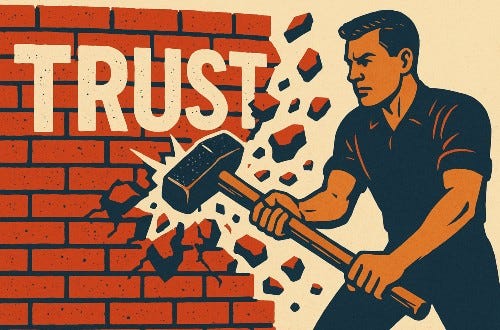
Trust is slow to build and easy to break. Few things destroy credibility faster than public contradictions between what a Leader says and how they act. In the world of Thought Leadership, your personal brand is your promise. When that promise is violated—through dishonesty or hypocrisy—the consequences are usually negative and permanent.
Elizabeth Holmes cultivated the image of a revolutionary healthcare entrepreneur. With her trademark black turtleneck and impassioned vision, she claimed her company Theranos would make diagnostic blood testing faster, cheaper, and more humane. But behind the scenes, she knowingly promoted a technology that didn’t work. Despite internal warnings and whistleblower reports, Holmes continued to mislead investors, partners, and the media.
In 2015, The Wall Street Journal exposed the truth: the company’s blood-testing technology was unreliable. Holmes was charged with fraud, convicted in 2022, and became a symbol of deception. Her public persona of transparency and innovation collapsed, proving that trust, once broken, rarely recovers.
Adam Neumann painted WeWork as more than a company. It was a consciousness movement. He spoke about community, purpose, and reshaping the future of work. But internally, his leadership was characterized by financial recklessness, self-dealing, and a lack of transparency. He purchased buildings and leased them back to his own company for personal gain, while presenting himself as a mission-first visionary.
When WeWork filed to go public in 2019, its IPO filing revealed serious governance issues and ballooning losses. Investor trust plummeted. The IPO was pulled, the company’s valuation tanked, and Neumann was forced out. The contradiction between his spiritual rhetoric and his opportunistic behavior destroyed his credibility. His story serves as a reminder: when personal enrichment overrides public purpose, trust runs dry.
Lance Armstrong was an implausible story of triumph. After surviving testicular cancer that had spread to his brain and lungs, he returned to competitive cycling and won seven consecutive Tour de France titles. His comeback wasn’t just athletic; it was spiritual, inspiring millions facing their own health battles.
Armstrong leveraged his story into a Thought Leadership platform that extended far beyond sports. Through his Livestrong Foundation, he became the voice of cancer survivorship, raising over $500 million and creating a global community of hope. Corporate sponsors lined up to associate with his message of perseverance. He authored bestselling books, commanded six-figure speaking fees, and influenced healthcare policy.
But Armstrong’s entire platform was built on a lie. He had used performance-enhancing drugs throughout his cycling career and orchestrated one of the most sophisticated doping programs in sports history. Worse, he aggressively destroyed anyone who threatened to expose the truth—suing journalists, intimidating teammates, and ruining the careers of those who spoke out.
The betrayal cut deepest among cancer survivors who had drawn strength from his story. They had believed that human determination could overcome impossible odds. When the truth emerged, Lance Armstrong lost the trust of millions who had believed that their own struggles mattered because his had been real. The revelation that his greatest triumph was fabricated left supporters feeling manipulated and questioning the very possibility of authentic heroism.
In each of these cases, trust wasn’t lost because of a business failure. It was lost because of disconnection—between words and actions, values and behavior, promise and performance. For Thought Leaders, the takeaway is that you don’t just build trust through what you say. You also need to preserve it through how you live.
Comments
Nothing yet. Say the first thing.
Sign in to join the conversation.