
When the government demands of its citizens, “Let me see your papers,” most of us instinctively recoil. Yet we are accustomed to showing documentation to the government—driver’s licenses, tax forms, permits, voter registrations, passports. One of the defining features of government transparency is a simple reversal of that power. In a healthy democracy, citizens can turn the question around and reply, “Now let’s see yours.”
The Massachusetts Public Records Law makes that reversal possible, allowing the public to examine how government spends tax dollars and conducts the people’s business. It gives residents the right to request emails, contracts, invoices, meeting minutes, financial records, reports, photographs, and countless other government documents. Those records are generally presumed to be public unless a specific exemption applies. The law exists for a simple reason: government is accountable to the people it serves. Transparency allows citizens to verify how that power is being exercised and to participate more meaningfully in public life.
Most people will never submit a public records request. Those who do assume they will find a straightforward process—submit a request, receive a response, and obtain the records unless the law clearly says otherwise.
But how does that process work in practice?
To answer that question, I reached out to people with firsthand experience using the Public Records Law, including Quincy residents, journalists, attorneys, and City Council members. Rather than focusing on any single request, I wanted to understand how people experienced the public records process and whether common patterns emerged.
The responses revealed no single, universal experience.
Some described receiving records within days. Others reported waiting weeks or months, appealing denials to the Massachusetts Supervisor of Records, or abandoning requests altogether after lengthy delays. Several emphasized that the process often depended on the complexity of the request, while others questioned whether similar requests consistently received similar treatment.
What Is a Public Record?
Massachusetts defines a public record broadly. In general, documentary material made or received by a government agency or public employee is presumed to be public unless a specific exemption applies.
A resident does not need to be a journalist, lawyer, or elected official to request records. Anyone may submit a request.
What Happens After You Submit a Public Records Request?
Submitting a public records request does not always mean you’ll receive the records within a few days. Under Massachusetts law, the government generally has 10 business days to provide an initial response. That response may include the requested records, but it can also:
confirm that the request was received;
explain that additional time is needed because of the size or complexity of the request;
identify records that will be withheld and cite the legal exemption relied upon;
ask you to narrow or clarify your request to make it easier to fulfill; or
provide a good-faith estimate of any fees that may be charged to produce the records.
For municipalities, if additional time is needed, the initial response must identify a reasonable production schedule. In most cases, that schedule cannot exceed 25 business days from the original request, unless the requester agrees to more time or the municipality successfully petitions the Supervisor of Records for an extension.
The law also limits when fees may be charged. A municipality generally cannot assess a fee unless it has provided the required initial response within the 10-business-day deadline. If it intends to charge for significant staff time—or in some circumstances seeks permission to exceed the normal limits—it must timely invoke those rights and, where required, petition the Supervisor of Records.
If you’re dissatisfied with the response—or receive no response at all—you may appeal to the Massachusetts Supervisor of Records within 90 days. The Supervisor reviews the request and the government’s response and generally issues a written determination within 10 business days. If a public body fails to comply with that determination, the Supervisor may refer the matter to the Attorney General for enforcement. Requesters also have the option of filing an action in Superior Court.
What We Heard
The experiences shared with AJQ ranged from routine to contentious.
One ward councilor reported that the only public records requests they had submitted involved registered voter lists. Those requests, they said, were generally fulfilled within a few days.
One journalist for a regional newspaper similarly described receiving a same-day response to one request, although he ultimately found the records unhelpful for his reporting.
Another South Shore reporter, who regularly files requests with municipalities across the region, described the process outside Quincy as largely uneventful. Straightforward requests are often fulfilled within a day or two, while broader email searches typically receive a response within the statutory timeframe or after a brief extension. He said municipal lawyers generally do not become involved in his requests and that legal disputes are uncommon.
Several respondents also reported that their requests were handled promptly and without controversy.
AJQ also reviewed examples of requests that produced large collections of emails, including constituent correspondence sent to elected officials regarding matters of public business. Those productions illustrate that email communications with public officials may themselves become public records subject to disclosure, depending on the circumstances and any applicable exemptions.
Not everyone described the process so favorably.
One city councilor said their experiences requesting records from Quincy have generally been frustrating, citing delayed responses and inconsistency. While stopping short of speculating about the reasons, the councilor said differences in treatment between requesters raise legitimate questions about consistency.
One resident shared multiple appeals to the Massachusetts Supervisor of Records after concluding that the City’s responses failed to comply with the Public Records Law. In several determinations, the Supervisor directed the City to provide additional responses or better explain its handling of the requests.
Other residents described partial productions, missing records they believed should have been included, or requests that turned into lengthy back-and-forth exchanges before reaching a resolution.
Taken together, the responses suggest that while many routine requests are handled without incident, more complex or disputed requests can produce markedly different experiences. The interviews alone do not establish why those differences occur.
On Geese, Ganders, and Government
Every public records request is different, but whatever process a request requires should be met with the same diligence and alacrity.
A request for a voter list is not the same as a request for years of internal emails. Some requests can be fulfilled almost immediately, while others require extensive searches or legal review. The Public Records Law recognizes those differences by allowing additional time in certain circumstances and by exempting specific categories of records from disclosure.
Another recurring theme involved the City’s Legal Department. Several respondents described receiving substantive responses from the City Solicitor’s Office rather than from the department maintaining the requested records. AJQ observed the same pattern in several requests reviewed during this reporting.
Whether those differences reflect the varying complexity of requests, differences in the records sought, or inconsistent administration of the Public Records Law is difficult to determine from individual experiences alone.
In addition to the interviews, AJQ reviewed a detailed log maintained by one frequent requester, covering nearly two years of requests to Quincy departments. The log showed widely varying outcomes even for the same person. Some requests were completed immediately or within a few business days, while others resulted in extended delays, repeated follow-up, fee disputes, appeals, or involvement by the City Solicitor’s Office.
The longest and most disputed exchanges tended to involve subjects at the center of public controversy, including the mayoral and council raises and payments for consulting work that had become the subject of public scrutiny. Other requests—some of them broad—were handled much more quickly. The log does not establish why the paths differed, but it suggests that the volume of records sought may not be the only factor shaping how a request moves through City Hall.
One request reviewed by AJQ demonstrates how quickly at least some records can be produced. Emails exchanged on May 19 were released through a public records request and publicly posted by May 28, showing they were produced no later than nine days after they were created—and likely sooner.
The observations described above do not establish why requests followed different paths. The differences may reflect the complexity of the requests, the nature of the records sought, routine administrative practices, or other factors not visible to requesters. Individual experiences alone cannot answer that question.

What is clear is that Quincy’s public records process does not feel the same to everyone who uses it. Some requests are fulfilled quickly with little difficulty. Others become prolonged exchanges involving legal review, appeals, or disputes over what records should be produced. Understanding those differences—and how the process works in practice—is the purpose of this series.
Before You Hit Send
Since its inception, AJQ has encouraged, cajoled, and occasionally begged residents to email their city councilors. We’ve published email lists, suggested talking points, and encouraged people to participate in local government.
It’s only fair that we also point out something many people may not realize: if you email a city councilor or other municipal official about public business, your email may be a public record under Massachusetts law.
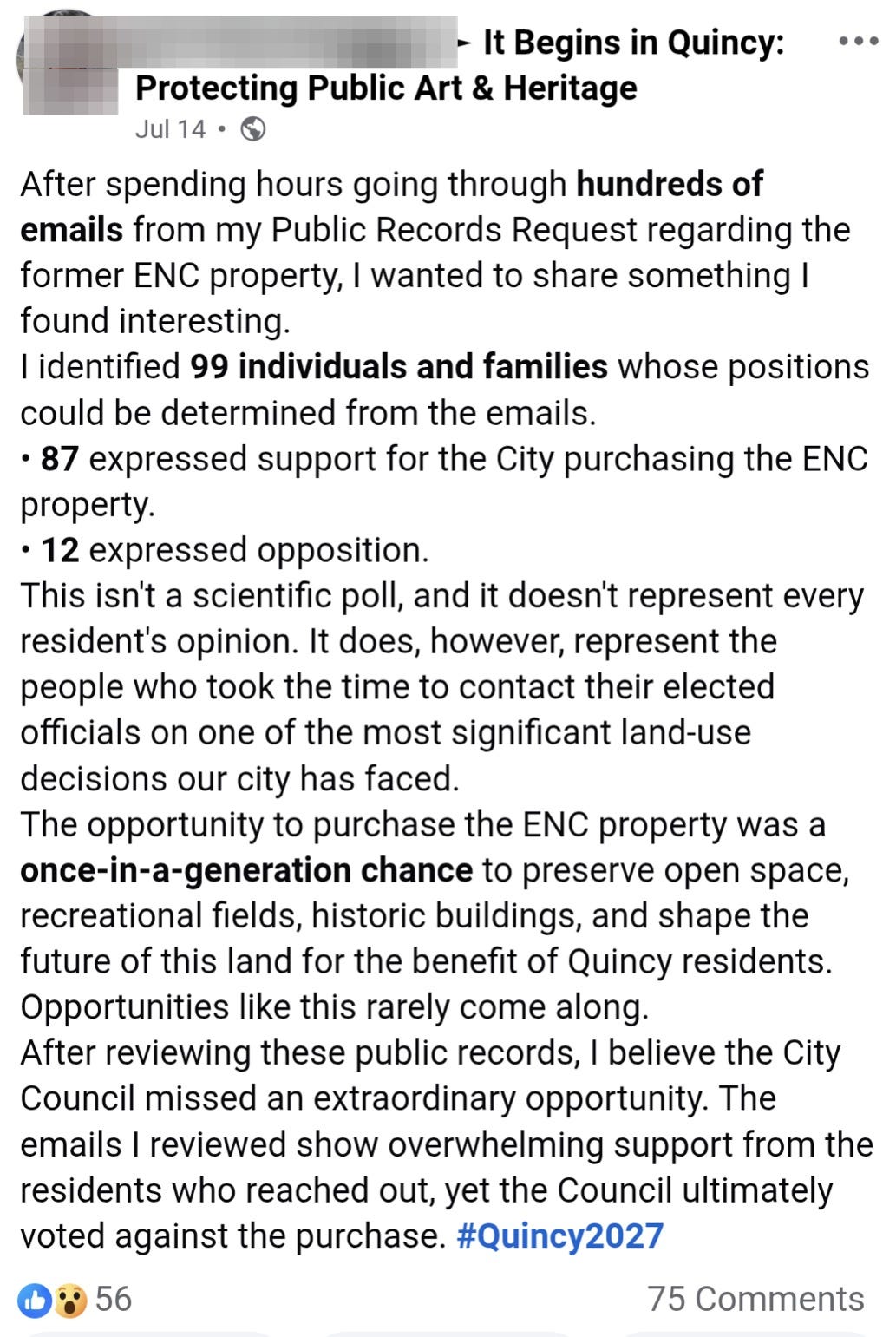
Many residents assume that emails to their elected officials are private. That’s not always the case. Depending on the circumstances, another person may later obtain those communications through a public records request. Portions of a record may be withheld or redacted if a legal exemption applies.
During our reporting, we found examples of residents obtaining constituent correspondence through public records requests. We do not know what, if anything, was routinely redacted before those records were released, nor are we aware of any general requirement that correspondents be notified when their emails are produced in response to a public records request. The productions we reviewed also suggest that requests may result in the release of far more correspondence than a requester ultimately finds useful, meaning your email could become part of a records production even if no one was specifically looking for it. The safest assumption is not to guess where the line is. If you email an elected official or government employee, don’t assume your message will remain private simply because you don’t consider it “public business.” The emailed records discussed in this article were retrieved by the City’s IT Department and provided to the requester without notice to the original sender or recipient.
For many readers, none of this will matter. Others may decide to be more thoughtful about what personal information they include when writing to their elected officials. Either way, we believe residents should understand how the Public Records Law may apply before they hit send.
One Email, Two Different Paths:
Imaginary Resident Lionel Fakeman sends an email to his city councilor urging them to support a proposal before an upcoming vote.
Scenario 1: Lionel emails the councilor’s City email address.
Months (or moments) later, another resident submits a public records request seeking emails sent to that councilor about the proposal. During AJQ’s reporting, we reviewed examples in which the City’s IT Department retrieved responsive emails stored on the City’s email system and provided them to the requester. Neither Lionel nor the councilor was notified that Lionel’s email had been included in the records production.
Scenario 2: Lionel sends the identical email to the councilor’s personal email address.
The email is not automatically any more—or any less—of a public record simply because it was sent to a personal account. If it concerns public business, it may still be subject to disclosure under the Public Records Law.
None of this is to suggest that a public record may lawfully be withheld simply because it resides in a personal account. Rather, someone must still review the requested records and determine whether any legal exemptions apply before they are produced. Whether an email ultimately qualifies as a public record depends on the law and the facts—not simply on which email address was used. Our reporting suggests, however, that the way records are located and reviewed can differ depending on where they are stored.
The takeaway
The content of the email did not change. The process used to locate it did.
That distinction may matter more than many residents realize. Requests involving non-city accounts generally follow a different review process before records are produced.
Why All This Matters
This article does not attempt to determine whether any particular response complied with the Public Records Law. Instead, it examines how a diverse group of requesters—including professional journalists, residents, activists, and elected officials—experienced the public records process and the patterns that emerged from those experiences.
The Public Records Law is one of the principal ways residents can understand how their local government operates. Whether someone is researching a neighborhood project, reviewing municipal spending, investigating an issue for publication, or simply trying to understand a decision made by City Hall, access to public records allows citizens to verify facts rather than rely on rumor or speculation.
Government transparency is not measured only by what records are eventually released. It is also measured by whether residents believe the process is coherent and applied consistently—whether they are journalists, elected officials, or simply neighbors trying to understand how their government works.
⁂
This article is the first in a two-part AJQ series examining Quincy’s administration of the Massachusetts Public Records Law.
Coming next: AJQ follows three public records requests from submission to resolution. One quickly produced emails between a city councilor and the City Solicitor. Two others took a very different path, involving delays, denials, and review by the Massachusetts Supervisor of Records. Together, they offer a closer look at how the Public Records Law works in practice.
Comments
Nothing yet. Say the first thing.
Sign in to join the conversation.