

If you ask ten people what a public records request is, most will tell you it’s how you “FOIA” the government.
Close enough for jazz.
“FOIA”, pronounced “FOY-uh,” is an acronym for “Freedom of Information Act.” This law is the federal version of the Massachusetts Public Records Law we have been discussing. The acronym has even become a verb, with people saying they’re going to “FOIA” records from the government. It’s very common to hear people, some of whom know the difference, say “I’m going to FOIA the document name from City Hall.” While not strictly accurate, the Records Access Officer will still know what you mean.
As discussed in Part One, the Massachusetts Public Records Law gives anyone the right to request documentary material made or received by a government agency or public employee. These records are presumed to be public unless a specific exemption applies. You don’t need to be a lawyer. You don’t need to be a journalist. You don’t even need to live in the city whose records you’re requesting.
The process is designed to be straightforward: ask for records, the government searches for responsive documents, and either produces them or explains why it cannot. But in practice, the experience can vary dramatically.
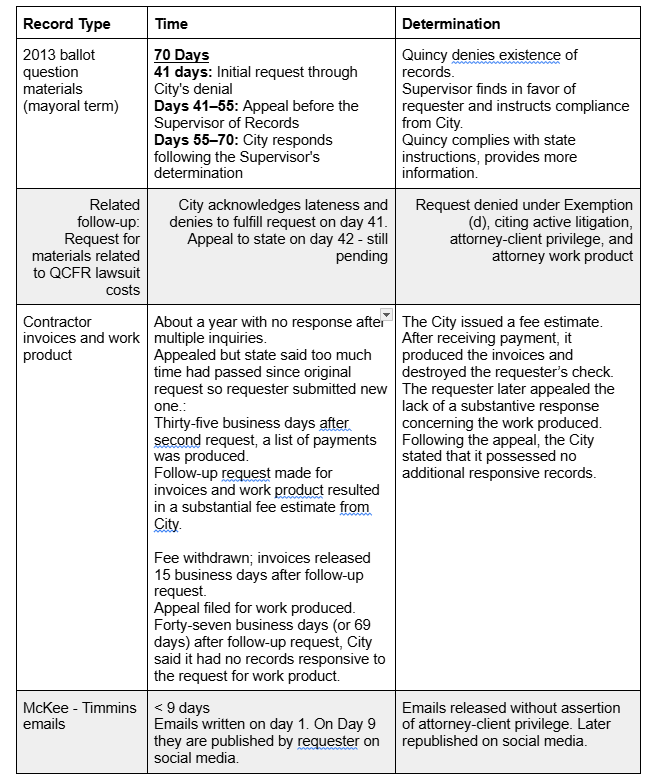
To understand how Massachusetts' Public Records Law works in practice, AJQ reviewed three very different requests—one involving emails, one involving contractor records, and one involving attorney communications. Together they illustrate both the power and the limitations of the law.
The following three (and a half) requests produced three very different experiences.
The First Request: “Records? What Records?”
My first appeal to the Massachusetts Supervisor of Records began with what I thought would be a straightforward request.
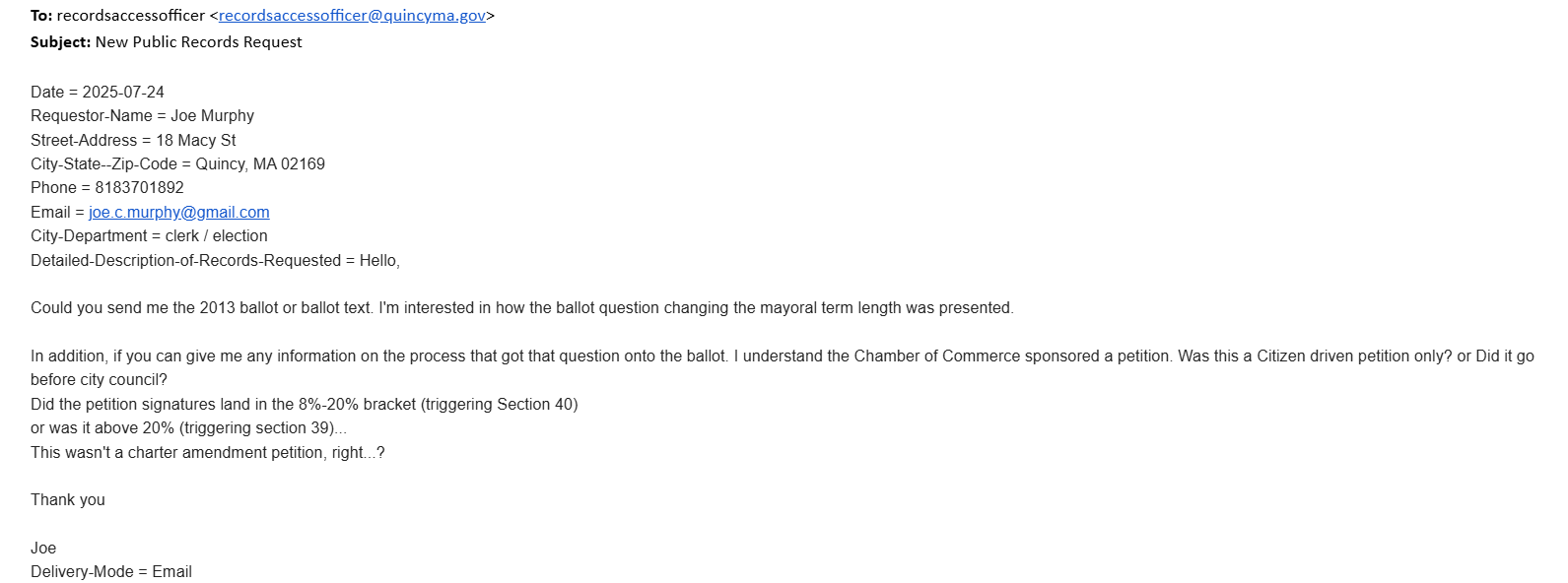
In 2025, I had agreed to help with a local ballot initiative. I put my name on the petition started by Quincy Citizens for Fair Raises. Because I was unfamiliar with the ballot petition process, I wanted to understand how Quincy had handled its last successful ballot initiative—the 2013 question that extended the mayor’s term from two years to four.
I submitted a public records request asking for the ballot language and records showing how the question made its way onto the ballot. I also asked whether it had proceeded under Section 39 or Section 40 of the Quincy City Charter and whether it had been treated as a charter amendment.
The City’s response, however, focused almost entirely on ballot retention laws.
City Solicitor James Timmins explained that municipal ballots are retained for only 30 days and concluded that there were “no records in the custody or control” of the City Clerk’s Office responsive to my request.
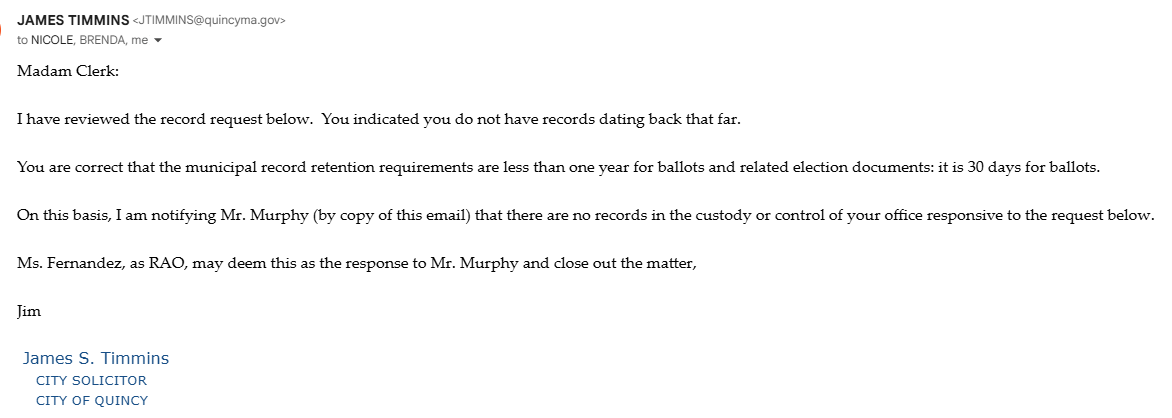
That wasn’t the information I was actually trying to obtain.
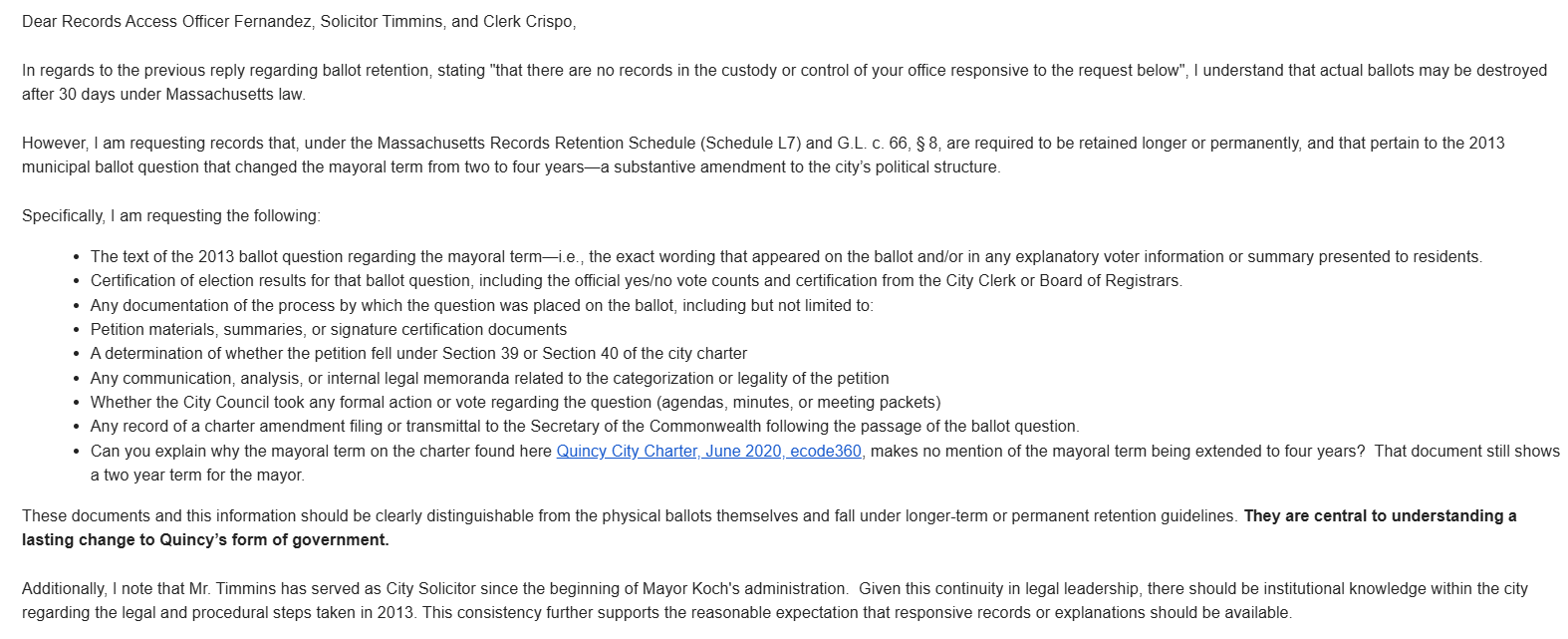
The physical ballots themselves were only a small part of my request. What I really wanted was the documentary history behind a permanent change to Quincy’s form of government—records that should exist independently of the ballots, such as the official ballot language, certified election results, petition documents, legal analysis, City Council records, and any filings made with the Secretary of the Commonwealth after the measure passed. Realizing we were talking past one another, I submitted a follow-up request clarifying that I was seeking those records rather than the ballots themselves.
I explained that these records “should be clearly distinguishable from the physical ballots themselves and fall under longer-term or permanent retention guidelines” because they document “a lasting change to Quincy’s form of government.”
I also noted that James Timmins had served as City Solicitor throughout Mayor Koch’s administration. Given that continuity, I argued there should be institutional knowledge within the City regarding the legal and procedural steps taken in 2013, reinforcing my expectation that responsive records—or at least an explanation of what became of them—should be available.
Timeline: A Request That Wouldn’t Stay Closed
July 24, 2025
I submitted a public records request seeking records related to the 2013 ballot question extending the mayoral term from two years to four years.
July 25
City Solicitor James Timmins responded that municipal ballots are retained for only 30 days and concluded that there were “no records in the custody or control” of the Clerk’s Office responsive to my request.
Later that same day
I clarified that I was not requesting the physical ballots themselves, but records surrounding the ballot question, including:
Official ballot language
Certified election results
Petition documents
Legal analysis or correspondence
City Council records
Filings with the Secretary of the Commonwealth
July 28
The City acknowledged receipt of my clarified request and informed me it was being processed under the Massachusetts Public Records Law.
Then, more than a month later...
After requesting a status update, I was surprised to learn that my request had actually been considered closed since July 25—before my clarification had ever been substantively addressed.
That didn’t make sense. The City had acknowledged my clarified request on July 28 and indicated it was being processed.
I responded:
“Respectfully, my request should not be considered closed. As I previously explained, Mr. Timmins has not been responsive to my inquiry. To clarify, I am not requesting actual ballots themselves—I am requesting the related documentation surrounding the ballot initiative, which by law cannot be deleted (signed paperwork, ballot text, etc.). If it is your position that no such documentation exists, I would appreciate clarification as to what basis supports the mayor’s four-year term. The charter still says two-year terms, so there must be some signed documentation declaring his term changed.”
This time, there was no further response from the City.
So I appealed to the Massachusetts Supervisor of Records.
In my appeal, I explained that the City had answered a different question than the one I was asking:
“Solicitor Timmins’ July 25 response addressed only the retention of physical ballots and election materials. My clarified request sought a broader category of records—including ballot language, certified election results, legal analysis, petition documents, City Council records, and charter filings—that are distinct from the ballots themselves and subject to longer retention requirements.”
The Supervisor of Records agreed that the City’s response was inadequate. The determination did not order Quincy to produce any records. Instead, it concluded that the City had failed to adequately explain whether responsive records existed or, if they did not, whether any responsive records had been destroyed in accordance with the applicable records retention schedule.
The Commonwealth ordered the City to issue a new response.
The City’s new response wasn’t what I expected.
Rather than sending a new letter addressing my questions, the City sent back a copy of my appeal with several boldface annotations inserted into the document. After confirming with the Records Access Officer that the bold text constituted the City’s official response, I was left feeling that many of my questions still had not been answered.
By then, it was October. Quincy Citizens for Fair Raises was beginning its lawsuit over the 2025 ballot initiative, and my attention shifted to more immediate events. I decided not to pursue the matter further.
It was an early lesson in how the Massachusetts Public Records Law works.
Winning an appeal doesn’t necessarily mean receiving the records you requested. Sometimes it means the government must provide a better explanation. Whether that explanation ultimately answers the requester’s questions is often a different matter.
Back for seconds…
Less than a year later, I found myself filing another public records request—once again arising from the same broader controversy over Quincy’s ballot initiative process.
My first request sought to understand how the City’s successful 2013 ballot initiative had unfolded. I never received the records I was looking for, and before I could pursue the matter further, more pressing events intervened.
Our own 2025 ballot initiative had been rejected after the City determined that roughly 36 percent of the signatures we collected were invalid, despite many signers also printing their names. Quincy Citizens for Fair Raises challenged that decision in court. The judge later ruled that the Registrars should have considered the printed names when evaluating signatures and ordered a new review.
The litigation reinforced something I had already learned through the Public Records Law: winning doesn’t always mean getting the outcome you want immediately. Sometimes it simply means the process must begin again under the proper legal standard.
As the litigation continued, a different question began to interest me:
How much was the City spending to oppose certification of the ballot petition?
To find out, I filed another public records request seeking invoices, engagement letters, billing statements, payment records, and other documents relating to the City’s outside legal expenses.
June 9 — Not in Receipt of Receipts
On June 9, 2026, I submitted a public records request seeking records sufficient to show what the City of Quincy was spending to challenge the Quincy Citizens for Fair Raises ballot petition in court.
Rather than asking for legal strategy or attorney communications, I requested administrative and financial records: invoices, payment records, engagement agreements, litigation support expenses, budget information, and records identifying any employee compensation specifically attributable to the litigation.
That same day, the City’s Records Access Officer acknowledged receipt of my request and advised that it would be processed in accordance with the Massachusetts Public Records Law.
June 17 — A Piece of the Puzzle
Eight days later, during a City Council budget meeting, City Solicitor James Timmins publicly reported that the City had spent $110,847.29 in outside legal fees to defend the city in the ballot initiative signature lawsuit.
That caught my attention. The figure seemed high given that the plaintiffs had litigated the case for less than $20,000 in legal fees.
The very information I had requested appeared to have already been gathered—at least in summary form—for presentation to the City Council. I assumed the underlying records would soon follow.
Instead, I heard nothing..
July 19 — Following Up
More than six weeks after filing my request, I emailed the Records Access Officer.
I wrote:
“It’s been about 6 weeks since I made this request. I’m surprised it wasn’t fulfilled in a timely manner since Solicitor Timmins provided the total amount paid on this matter to the City Council after I made this request (approx. $110k). So it seems that the work of collecting all this was done.
If this was fulfilled and I missed it, please let me know when and how it was transmitted.”
The next morning, I received my first substantive response.
July 20 — A River in Egypt
City Solicitor James Timmins replied on behalf of the City’s Records Access Officer.
His email began with an acknowledgment that caught my attention:
“Brenda: I must have missed the June 9 request referral from you (and I acknowledge you generally refer matters such as this to me). I handled the billing total question, but we are not giving out any other information.”
He then denied my request in its entirety, writing:
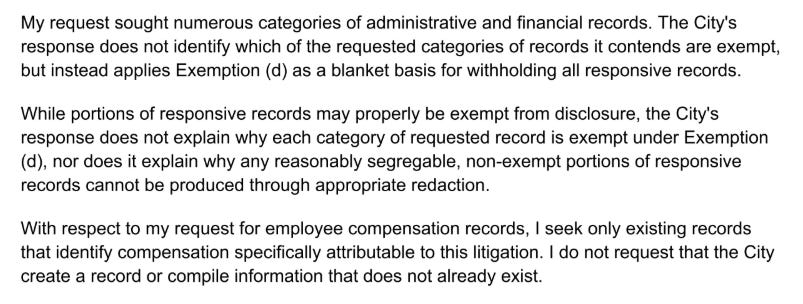
“The City will not be producing any records responsive to your request... this matter remains in active litigation and the records involve communications among counsel regarding mental impressions, trial preparation and related communications protected by the attorney-client privilege.
In making this decision, I am applying Exemption (d) to the Massachusetts Public Records Law.”
So, for the second time in less than a year, I appealed to the Massachusetts Supervisor of Records after the City declined to produce the requested records.
Story Two:
Behind the wrought irony fence
Our second story begins with a spreadsheet listing nearly 40 payments totaling more than $130,000 to a City contractor—and a request to see the work produced under those invoices.
According to documentation provided by the requester, their inquiry began after they heard that the contractor may have been performing financial transparency work for the City. They first searched employee and federal-funding records for mention of the contractor but did not initially find a clear answer.
Sometime before July 2024, they submitted a records request specifically seeking information about City money paid to the contractor. On July 11, 2024, they followed up, writing that they had “never received a reply” to that earlier request.
The City’s records coordinator acknowledged the request that same day. The coordinator said the request had been forwarded to the Human Resources Department and that follow-up regarding the contractor had been requested.
The requester followed up again in August and November 2024. On June 23, 2025, they wrote:
“I never received anything on the two records requests below. Please advise!”
On June 30, 2025, the requester appealed the lack of a response with the Secretary of State’s office, which responded that because the appeal had occurred more than 90 days after the initial records request, a new records request had to be made. The requester submitted that second request on July 1, 2025.
On August 20, 2025, 35 business days after the second request, the City responded to both of their outstanding matters in a single email. It provided payroll spreadsheets along with the previously mentioned spreadsheet listing nearly 40 payments totaling more than $130,000 to the contractor. Later that day, the requester used those invoice numbers to submit a new request:
“I would like to ask for all of the invoices and work produced in the [contractor] spreadsheet please. Thanks!”
The request had two distinct parts: the invoices themselves and the work produced under them.
On September 3, 2025, a City finance official explained:
“The invoices you have requested will require a search of our warrant records. Warrant invoices are maintained as paper documents.”
The City estimated that the search would take approximately eight hours. After accounting for the first two hours, it calculated a fee of $210.72.
The requester delivered a check authorizing the search on September 8.
Two days later, the finance official reported internally:
“We’ve gathered all the invoices and copies of the checks that go along with them.”
On September 11, the City forwarded those records to the requester. It did not charge the estimated fee and said it would destroy the requester’s check.
But the requester was still seeking the second part of the request: the work produced under the invoices.
That same day, they again asked for:
“The work produced from all these invoices.”
After receiving no substantive answer to that portion of the request, they appealed to the Massachusetts Supervisor of Records.
The Supervisor reviewed the correspondence and concluded:
“It is unclear whether the City possesses additional responsive records.”
The Supervisor ordered the City to respond within 10 business days in a manner consistent with the determination.
On October 28, 47 business days after the third request, an assistant city solicitor responded:
“There are no additional documents responsive to your request in the City’s possession.”
The requester replied:
“As a taxpayer, I’m disappointed that no work product came of all these invoices, but I appreciate the response.”
The records establish that the City produced invoices and copies of checks associated with the contractor. They also establish that, after an appeal, the City stated that it possessed no additional records responsive to the request for the work produced under those invoices.
There is an irony in a contractor paid in part for financial-transparency work becoming the subject of a records request that yielded no additional records showing the work produced. But that absence does not establish that no work was performed. It establishes only that the City ultimately said it possessed no additional responsive records.

What the Public Records Law Can—and Cannot—Do
This story is also a reminder that it is important to understand what the Massachusetts Public Records Law is—and what it is not.
The law gives citizens the power to ask the government for its paper trail. It can require a public body to produce existing, nonexempt records and to clarify whether it possesses anything further. In this case, the records process eventually produced the invoices, copies of the checks and a direct answer from the City: it had no additional documents responsive to the request for the work produced.
But the Public Records Law is not, by itself, a law about stewardship. It does not determine whether the City received fair value for the money it spent. It does not decide whether the contractor performed the work. And a response stating that no additional records are in the City’s possession does not explain whether such records never existed, were not retained or may have been maintained elsewhere.
Those questions may require different forms of oversight. If required records were not retained, separate records-retention laws and schedules may apply. If taxpayer money was spent irresponsibly, the Massachusetts Office of the Inspector General may have a role.
The Public Records Law is one tool in the accountability toolbox. It is a crowbar for oversight: it can pry open the government’s file cabinets and reveal what is—or is not—inside. It is not a hammer that can knock sense into the system.
Story Three:
Public Records Scratch
Not every public records request ends in an appeal or uncovers previously unknown information. Sometimes the most revealing aspect of a request is how quickly records are reviewed and released—and what that response suggests about a public body’s approach to similar requests.
In one instance, a requester sought emails between Ward 5 City Councilor Maggie McKee and City Solicitor James Timmins. The request was remarkably specific, identifying a particular exchange between two public officials concerning a narrow subject matter. The records were produced within nine days.
That response stands in marked contrast to the experiences described earlier in this article. My own requests required repeated follow-up and ultimately two appeals to the Massachusetts Supervisor of Records. Another requester waited more than a year, submitted multiple requests, made two appeals to the state and delivered a check for more than $200 before ultimately receiving some of the requested records—and a response stating that the City possessed no additional records showing the work produced.
In this third example, however, politically sensitive correspondence was located, reviewed, and released without similar delay. The substance of the correspondence made its release particularly consequential. The emails arose from a dispute in which Mr. Timmins had publicly accused Councilor McKee during a City Council meeting of violating the Open Meeting Law. The correspondence therefore concerned more than a routine exchange between a councilor and the City’s legal department; it related directly to a public legal accusation made by the City’s chief legal officer against an elected official.
The City’s handling of the request is also notable. The correspondence consisted of communications between an elected official and the City’s chief legal officer. The City released those emails without asserting attorney-client privilege as a basis for withholding them, even temporarily.
That differs from the City’s response to my request seeking records concerning the cost of outside counsel in the ballot-petition litigation. There, Mr. Timmins broadly invoked attorney-client privilege and attorney work product in denying a request that largely concerned invoices, payments, engagement documents, and related financial information. Yet no comparable assertion of privilege appears to have prevented the release of correspondence between the City Solicitor and an individual councilor.
The contrast is difficult to overlook. In one matter, communications between a councilor and the City Solicitor were released without any apparent claim of attorney-client privilege. In another, attorney-client privilege was invoked broadly to withhold records relating to outside legal expenses.
Although the City employs assistant city solicitors, the privilege determination in this matter appears to have rested with Solicitor Timmins himself—one of the participants in the correspondence—rather than with an uninvolved assistant solicitor.
We also contacted Councilor McKee, who confirmed that she received no notice or warning from the City that her emails would be released in response to a request for records.
Once released, the emails were republished on social media with commentary, graphics, and political analysis. They became the basis for extended public discussion, illustrating that the Public Records Law is not merely a mechanism for obtaining information—it also shapes how that information is used in public debate. Once government records are lawfully released, they generally become available for anyone to quote, analyze, republish, criticize, defend, or incorporate into journalism, advocacy, or political commentary.
The Public Records Law does not require every request to be handled identically. Different requests present different legal and practical issues. But when requests involving politically significant records receive markedly different treatment, questions about consistency are understandable.
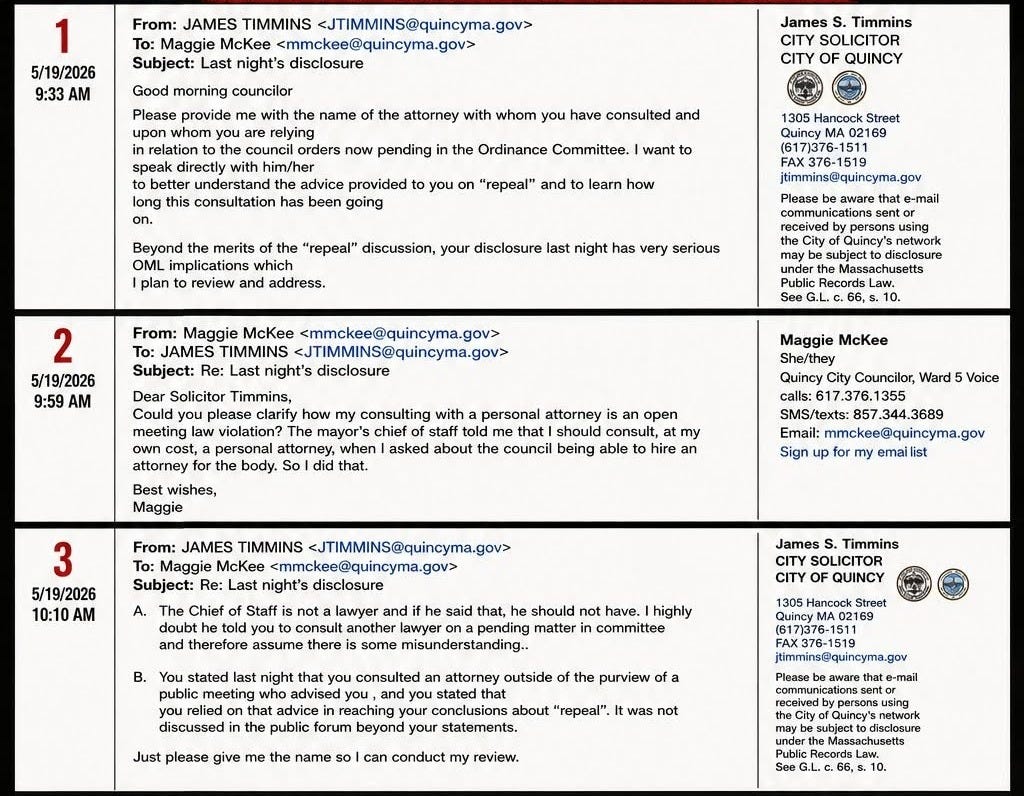
Supporting-member extra: A full graphic is provided for paid or founding members.
Without assigning motive, the contrast remains noteworthy. A narrowly targeted request by someone whose public commentary has generally supported the current administration was fulfilled within a relatively short period of time. By comparison, requests submitted by individuals who have frequently criticized the administration—including those described earlier in this article—followed a different path, involving delay, denial, and appeals to the Massachusetts Supervisor of Records. Readers may draw their own conclusions about those differing experiences.
That illustrates both the power and one potential unintended consequence of the Public Records Law. Transparency can expose government conduct and inform public discussion. At the same time, the possibility that communications with public officials may later become the subject of widespread public discussion could discourage some residents from communicating as candidly with their elected representatives.
Three Stories. Three Outcomes. One Law.
I remain strongly in favor of the Public Records Law. Its benefits to transparency and accountability far outweigh the concerns described here. But support for the law does not require ignoring the ways its use can sometimes discourage candid communication or expose ordinary residents to public scrutiny they neither deserve nor anticipate.
These three (and a half) requests produced three very different experiences.
One (and a half) resulted in appeals over the adequacy of the City’s response.
One demonstrated how procedural deadlines can quietly shape the outcome of a request.
One produced records that quickly became part of a public political debate.
None of those experiences, standing alone, tells the whole story about Quincy’s administration of the Public Records Law. Together, however, they illustrate that requesting public records is rarely as simple as filling out a form and waiting for an email.
Sometimes records arrive in days.
Sometimes they require months of persistence.
Sometimes they require appeals to the Massachusetts Supervisor of Records.
And sometimes the process itself becomes part of the story.
Hi folks,
I hope everyone is enjoying the Summer. I can’t believe we have made it to the end of July already.
If you made it to the end of the article, thank you for your continued interest. I know these past two articles have been long. I hope you found these explanations informative and at least a bit fun or interesting.
I have some day-job stuff going on the next couple weeks so I’m not sure when my next article will come out. As always, drop me a line if there are any topics, tips, or controversies you want my take on.
Talk to you all very soon.
Joe
Supporting-member extra: Paid AJQ subscribers receive an expanded Public Records 101 guide here, including deadlines, fee rules, and appeal tips.
Sidebar: Public Records 101
Who can file a request?
Anyone. You do not need to live in Massachusetts, be a journalist, or explain why you want the records. Generally, the purpose of the request does not determine whether a record is public.
What counts as a public record?
The definition is broad. It includes documentary material or data made or received by a Massachusetts governmental entity, regardless of its physical form. That can include emails, photographs, recordings, spreadsheets, reports, contracts, invoices, and other electronic or paper records.
Do I need to use an official form?
No. Massachusetts law does not require a particular form. Requests may be made orally or in writing, but writing is strongly recommended: it creates a clear record of what you requested and is necessary if you later appeal to the Supervisor of Records.
Does the government have to answer my questions?
Not necessarily. The law generally requires the production of records that already exist; it does not require an agency or municipality to answer questions, conduct research, or create a new report. A useful approach is to request “records sufficient to show” the information you are seeking.
How quickly must the City respond?
The City must provide the records or issue a legally sufficient written response within 10 business days. That initial response may explain that more time is required. For a municipality, the proposed production schedule generally may not extend beyond 25 business days from the original request unless the requester agrees or the Supervisor of Records grants an extension.
Can the City charge a fee?
Sometimes. In a municipality with more than 20,000 residents, the first two hours of qualifying work are generally free, and the hourly rate ordinarily may not exceed $25 without approval from the Supervisor of Records. Any estimate should be itemized and made in good faith. A records access officer generally loses the right to charge a fee if the required response was not issued within 10 business days.
Can the government deny a request?
Yes, but it must identify the exemption or legal privilege being invoked and explain specifically why it applies. An exemption usually does not justify withholding an entire document when nonexempt portions can be separated and released with redactions.
Can emails or other electronic communications be public records?
Yes. Electronic records are treated like paper records, and government-related emails may be public records. Whether something is public generally depends on its content and connection to government business—not merely whether it is stored electronically.
What if the City does not respond—or I disagree with its response?
You may appeal to the Massachusetts Supervisor of Records. An appeal concerning a response generally must be filed within 90 calendar days of that response. When no response is received, the appeal generally must be filed within 90 calendar days of the original request. The appeal should include the written request, any response, and a brief explanation of the dispute.
Does winning an appeal guarantee that I will receive the records?
No. The Supervisor may order the government to produce records, justify a withholding, revise a fee estimate, conduct an adequate search, or issue a new response. As the examples in this article show, a successful appeal may require the process to continue rather than immediately delivering the documents.
Comments
Nothing yet. Say the first thing.
Sign in to join the conversation.