
Meeting Preview
The Quincy City Council heads into its final meeting before the summer break Monday night with an agenda that reads less like routine municipal business and more like a test of the new council majority’s governing philosophy. Councilors will consider a series of measures aimed at increasing transparency, strengthening oversight, and undoing some of the city’s most controversial recent decisions.
Among the most significant items are proposed ordinances requiring earlier public release of council materials, strengthening the independence and authority of the City Auditor, and revisiting the elected officials’ pay raises approved in 2024. The agenda also includes measures that would repeal the mayor’s raise, repeal the council’s raise, and eliminate the automatic annual raise mechanism adopted in the wake of Salarygate. Whether those proposals advance or stall, tonight’s meeting will offer one final indication of where the council’s reform efforts stand before members disperse for the summer.
The meeting will also begin with a review of yet another Open Meeting Law complaint, this one stemming from last week’s proceedings. We’ll have a more detailed analysis of that complaint and the legal issues involved in the following section.
No matter what happens tonight, this council has made its presence felt during its first six months in office. Open Forum has become a popular feature of council meetings, giving residents a direct opportunity to address their elected officials. The council spent more than 30 hours deliberating the FY2027 budget and ultimately approved approximately $1.67 million in reductions. Some may argue the cuts were more scratch than slash, but even modest reductions marked a dramatic departure from the largely unquestioning budget approvals of recent years. Most notably, the council rejected Mayor Koch’s proposal to purchase the former ENC campus for $21 million, defying pressure from both the administration and many members of the public.
After a summer spent away from budget season and City Council chambers—and with more opportunities to hear directly from constituents—the question is what version of this council returns in September.
Will it come back chastened by six months of controversy and resistance? Or emboldened by a willingness to challenge the way Quincy government has traditionally operated?
If the first six months are any indication, I’d put my money on the latter.
Analysis of tonight’s Open Meeting Law Complaint.
This has become standard fare for Council watchers. It seems it wouldn’t be a Quincy City Council meeting without an Open Meeting Law complaint ironically conjured by the City’s own solicitor and then Channeled through a resident of another town.
The Solicitor solicits... err, elicits another Open Meeting Law complaint from Weymouth

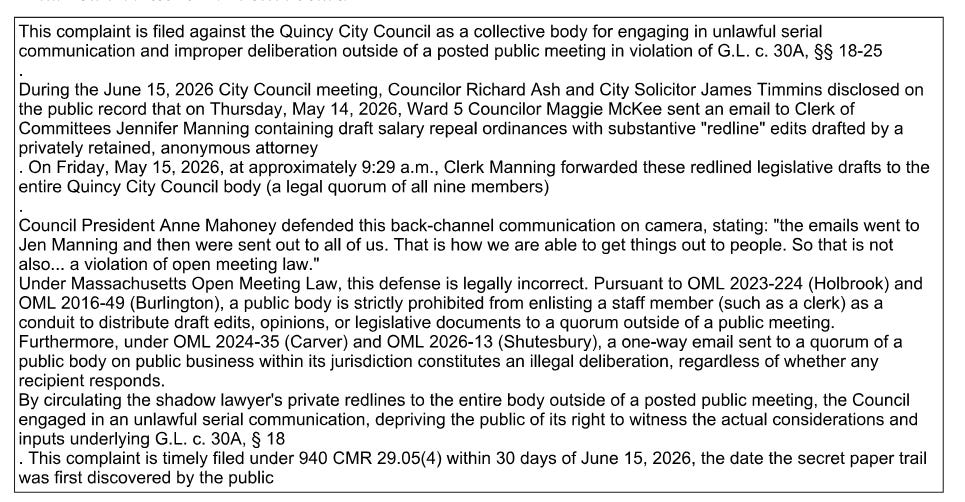
A recently filed Open Meeting Law complaint alleges that the Quincy City Council engaged in unlawful deliberation outside a public meeting during consideration of the proposed ordinance to repeal the 2024 mayoral and city council pay raises.
The complaint stems from events discussed publicly during the June 15 City Council meeting.
According to statements made during that meeting, Ward 5 Councilor Maggie McKee submitted a revised version of the repeal ordinance to Clerk of Committees Jennifer Manning. The revised ordinance reflected changes developed with assistance from outside legal counsel retained by McKee. Councilors later received a version identifying the proposed revisions before a future meeting.
The complaint argues that the circulation of the revised ordinance constituted unlawful deliberation by a quorum of the Council outside a posted meeting.
The complaint further argues that the use of the Clerk as an intermediary did not cure the alleged violation and cites four Attorney General Open Meeting Law determinations in support of that position.
The legal question is relatively narrow:
Did the circulation of the revised ordinance amount to deliberation under the Open Meeting Law, or was it simply the distribution of a legislative document for future public discussion?
What the Attorney General Says About Document Distribution.
The Massachusetts Open Meeting Law defines deliberation broadly. However, the law also contains an important exception.
The Attorney General’s Open Meeting Law guidance states that the distribution of reports or documents that may be discussed at a future meeting generally does not constitute deliberation, provided that no member expresses an opinion when those materials are distributed.
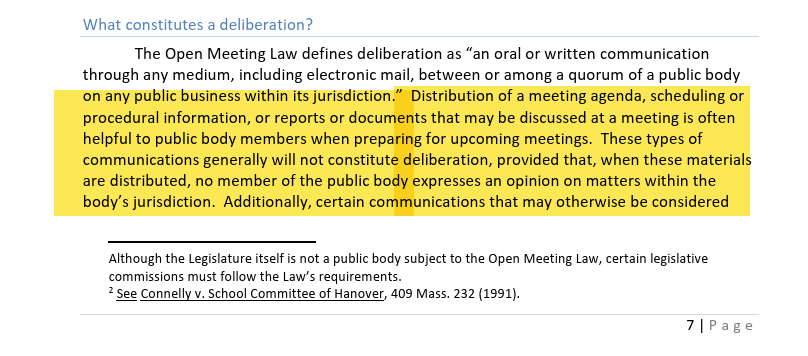
That distinction is important because the publicly known facts currently establish that a revised ordinance was distributed. What remains disputed is whether any councilors engaged in the type of communication that the Open Meeting Law prohibits.
The Cases Cited in the Complaint
The complaint relies heavily on four Attorney General determinations. (You can look them up here)
A review of those cases shows that each involved conduct beyond the mere circulation of documents. If one were to look at the determinations cited in the complaint, they can give the appearance of legal rigor, but in reality the cases do not really apply to this situation.
Burlington (OML 2016-49)
In Burlington, planning staff contacted board members individually to determine whether they supported filing an appeal. Staff then reported those positions back to the chair, who acted based on the responses. The Attorney General found that the board had improperly used staff to poll members and reach a decision outside a public meeting.
The complainant cites Burlington for the proposition that staff cannot be used as a conduit between members. But Burlington involved staff actively polling board members, collecting their positions, and reporting those positions back to the chair so a decision could be made outside a meeting. The case was about reaching a decision through staff, not merely distributing a document.
Holbrook (OML 2023-224)
In Holbrook, a planning board chair negotiated with a developer and then sought other board members’ views before a meeting. The Attorney General found that the chair had engaged in prohibited polling and serial communications outside a public meeting.
The complainant cites Holbrook as a case involving a clerk forwarding information to members. In reality, the violation occurred because the chair was negotiating with a developer and using email and follow-up communications to determine where other members stood before the meeting. The Attorney General found improper polling and serial deliberation, not improper document distribution.
Carver (OML 2024-35)
In Carver, a redevelopment authority chair sent an email advocating a specific position to legal counsel while copying a quorum of the board. The Attorney General found that the email constituted deliberation because it expressed substantive views on a matter within the board’s jurisdiction.
Carver involved a chair sending an email to a quorum that expressly advocated a position on a matter pending before the board. The Attorney General found a violation because the email communicated the chair’s views; notably, the same determination acknowledges that communications memorializing discussions already held during a public meeting do not constitute improper deliberation.
Shutesbury (OML 2026-13)
In Shutesbury, a select board member sent an email expressing his opinion regarding a committee appointment while copying a quorum of the board. The Attorney General found that the email violated the Open Meeting Law because it contained the member’s opinion on a matter within the board’s jurisdiction.
The Shutesbury determination involved a board member emailing a quorum and expressing his opinion about a matter within the board’s jurisdiction. The Attorney General repeatedly emphasized that the violation arose because the email contained the member’s opinion, not simply because an email was sent to multiple members.
In all four cases, the Attorney General found evidence of polling, advocacy, opinion-sharing, or efforts to determine members’ positions outside a public meeting; none of the cited determinations involved a councilor submitting a revised legislative draft to a clerk for distribution without any publicly identified polling, responses, or member-to-member discussion.
The Question the Complaint Must Answer
All four cases cited by the complaint involve one or more of the following:
Polling members;
Gathering members’ positions before a vote;
Serial communications among members;
Advocacy or expressions of opinion on public business.
The key question is not whether these cases involved Open Meeting Law violations—they did. The question is what, if anything, about the conduct described in those cases is materially similar to the conduct alleged in Quincy.
At present, the publicly discussed facts establish that a revised ordinance was submitted to the clerk and distributed to councilors. Nothing more.
The central question for the Attorney General’s Office will likely be whether that distribution was accompanied by the kind of polling, opinion-sharing, advocacy, or member-to-member communication that the Open Meeting Law prohibits.
That distinction is likely to determine whether the complaint succeeds or fails.
Comments
Nothing yet. Say the first thing.
Sign in to join the conversation.