
More than three months after a dispute during public comment at a Quincy City Council meeting, the Massachusetts Attorney General’s Office has declined to review an Open Meeting Law complaint filed by Ann Walker.
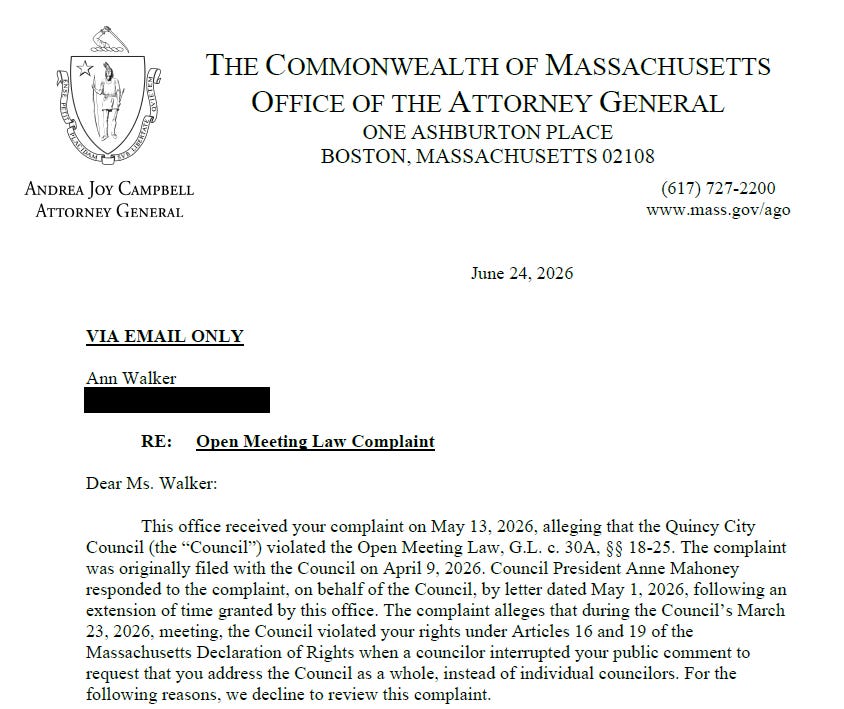
Importantly, Assistant Attorney General KerryAnne Kilcoyne did not determine whether Council President Anne Mahoney handled the exchange correctly. Instead, the Division of Open Government concluded that Walker’s allegations, even if true, would not constitute a violation of the Massachusetts Open Meeting Law.
Ms. Walker, who identified herself during public comment as the wife of a Quincy firefighter and stated that she does not reside in Quincy, addressed the Council regarding funding for firefighters’ protective gear.
During her remarks, Walker briefly directed comments toward an individual councilor. President Mahoney interrupted, instructing Walker that she could address the Council through the chair rather than direct remarks to individual councilors—a common parliamentary practice rooted in Robert’s Rules of Order.1
Walker responded:
“I’ll talk to you as a board. [When addressing the body] as a City Council, I can do what I want while public speaking.”
She then continued with the remainder of her prepared remarks, criticizing the Council’s decision to postpone action on firefighters’ request for additional turnout gear.
Video of the comments in question
Walker subsequently filed an Open Meeting Law complaint alleging that President Mahoney improperly restricted her public comments.
Under Massachusetts law, Open Meeting Law complaints must first be filed with the public body alleged to have violated the law. The public body has an opportunity to review the complaint and issue a written response before the matter may be referred to the Attorney General.
The Quincy City Council considered Walker’s complaint during its April 27 meeting.
According to the meeting minutes, President Mahoney stated that the Council concluded the complaint did not identify a violation of the Open Meeting Law, noting that the meeting had been properly noticed and conducted. She added that the Council takes transparency and public access seriously and could review its public comment policies in the future if necessary.
Ward 6 Councilor Deborah Riley observed that the complaint appeared to allege a First Amendment issue rather than an Open Meeting Law violation and suggested that such concerns would need to be pursued through a different legal avenue.
The Council then voted unanimously, 9-0, to authorize President Mahoney to submit the Council’s official response to Walker and the Attorney General.
The Attorney General’s determination focused not on whether Mahoney’s actions were appropriate, but on whether Walker’s allegations fell within the scope of the Open Meeting Law.
“The Division of Open Government’s review concerns compliance with the Open Meeting Law,” the determination explains. “The Open Meeting Law does not require that a public body allow public participation.”
The Attorney General further explained that the law gives the chair authority to regulate public participation when a public body chooses to allow public comment.
“Under the Open Meeting Law, the chair of the public body has discretion to decide whether to permit public comment and gives clear authority to the chair to conduct the meeting and to regulate who may speak to the body.”
The determination also cites the Open Meeting Law itself:
“No person shall address a meeting of a public body without permission of the chair...”
At the same time, the Attorney General emphasized that encouraging public participation remains a best practice.
“We do, however, encourage public bodies to allow for as much public participation as time and circumstances permit.”
The determination notes that Walker cited the Supreme Judicial Court’s decision in Barron v. Kolenda, which held that certain content-based restrictions on public comment may violate the Massachusetts Declaration of Rights.
The Attorney General did not reject that legal principle. Instead, the Division explained that it “has consistently declined to review allegations concerning restrictions on public comment or compliance with the United States Constitution or Massachusetts Declaration of Rights.”
Accordingly, the determination concludes:
“Where the allegations raised in your complaint, even if true, would not constitute violations of the Open Meeting Law, we decline to review the complaint.”
With four recent Open Meeting Law complaints stemming from Councilor Maggie McKee’s decision to seek outside counsel, the Walker determination illustrates an important point for both public officials and residents: filing an Open Meeting Law complaint does not necessarily mean the dispute involves the Open Meeting Law. Before reaching the merits of any complaint, both the public body and, if necessary, the Attorney General must first determine whether the allegations describe conduct governed by the Open Meeting Law.
The Walker determination arrives during a period of heightened use of the Open Meeting Law complaint process in Quincy. Unlike court actions, Open Meeting Law complaints are relatively simple to file, require no attorney, and generally involve no filing fee or other financial cost. As a result, they present a relatively low barrier to entry while still having the potential to generate significant public attention.
In future AJQ articles, we will examine how Quincy’s elected bodies handle Open Meeting Law complaints and explore broader questions about the role of the complaint process, including whether it is always being used in good faith.
In Robert’s Rules of Order Newly Revised (12th ed.), this rule is explicitly detailed under Section 43:19, which falls under the broader category of “Decorum in Debate.” Per Rule Fifty-Four “Parliamentary Procedure” The Council shall be governed by “Robert’s Rules of Order Revised” in all questions of parliamentary practice not provided for by special rules or orders.Council Rules
No posts
Comments
Nothing yet. Say the first thing.
Sign in to join the conversation.