
In a single announcement, Google lost the four engineers who built the infrastructure modern AI runs on - and the man who ran DeepMind stepped back from running it.
Underneath the headline is a pattern worth your attention: the labs are all moving down the stack and out of the org chart at the same time. Anthropic went vertical on silicon yesterday. Meta shipped a coding agent priced to buy your data. Everyone is racing to own the layer beneath the one they compete on.
In today’s AI news:
Google loses the four builders who made it possible
Anthropic goes vertical on silicon
Meta’s coding agent comes with a pricing trap
Today’s Top Tools + Quick News

News: Demis Hassabis is stepping down as CEO of Google DeepMind to become the unit’s chairman and chief scientist of Alphabet. On the same day, Jeff Dean announced he’s leaving after 27 years to co-found Discovery Loop — taking Sanjay Ghemawat, Oriol Vinyals, and Quoc Le with him. Alphabet fell around 4%.
Details:
The résumé leaving the building: Dean and Ghemawat built MapReduce, Bigtable, and Spanner — the distributed systems that made Google possible — before Dean co-founded Google Brain
Both of Gemini’s co-technical leads walked out on the day Google named Koray Kavukcuoglu as the executive who will build Gemini 4
Pichai’s memo named only two of the four departures; Discovery Loop’s own site names all four
Google is a founding investor and cloud partner in the startup — it chose to fund the thing it couldn’t keep
Gemini 3.5 Pro is months behind its June target, after losing Noam Shazeer to OpenAI and Nobel laureate John Jumper to Anthropic
Why it matters: This is the closing of an era, and the exit interview is the most instructive part of it. Ghemawat’s stated reason: they wanted infrastructure with different requirements than what Google maintains for its consumer and advertising products. Four of the best systems builders alive had unlimited compute, unlimited budget, and the deepest research bench in the world - and left anyway, because the organization wasn’t aligned. What they’re building instead runs thousands of experimental loops in parallel, pointed first at automating ML research itself.
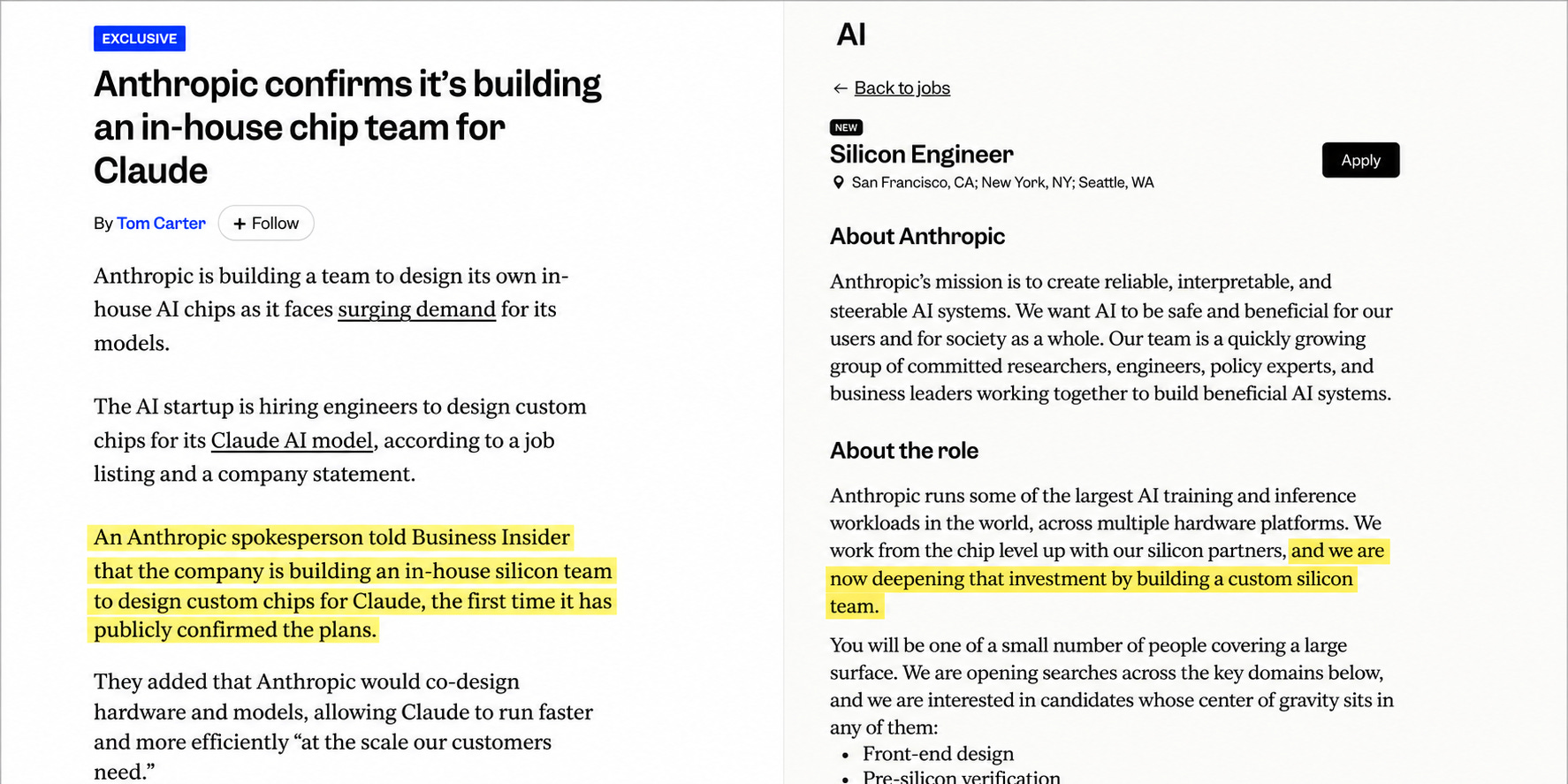
News: Anthropic confirmed it’s building an in-house silicon team to design custom chips for Claude — a response to surging demand for its models rather than a long-term bet. The company says it will co-design hardware and models so Claude runs faster and more efficiently at the scale its customers need.
Details:
Confirmation came alongside a Silicon Engineer listing spanning front-end design, verification, physical design, foundry, and packaging at $320K–$485K
Anthropic stressed a multi-chip approach — AWS, Google, NVIDIA, and AMD hardware stays central
Reuters reported in April that Anthropic was weighing its own chips; The Information later reported talks with Samsung about manufacturing
OpenAI shipped first, unveiling its Broadcom-built inference chip Jalapeño in June
Designing an advanced AI chip runs roughly half a billion dollars
Why it matters: Every frontier lab is now buying its way down the stack, and that reshapes what you should expect from inference pricing over the next three years. Anthropic’s version is deliberately hedged — its silicon sits inside a multi-vendor stack rather than replacing it, which buys co-design efficiency without betting the roadmap on a first-generation part landing on time.
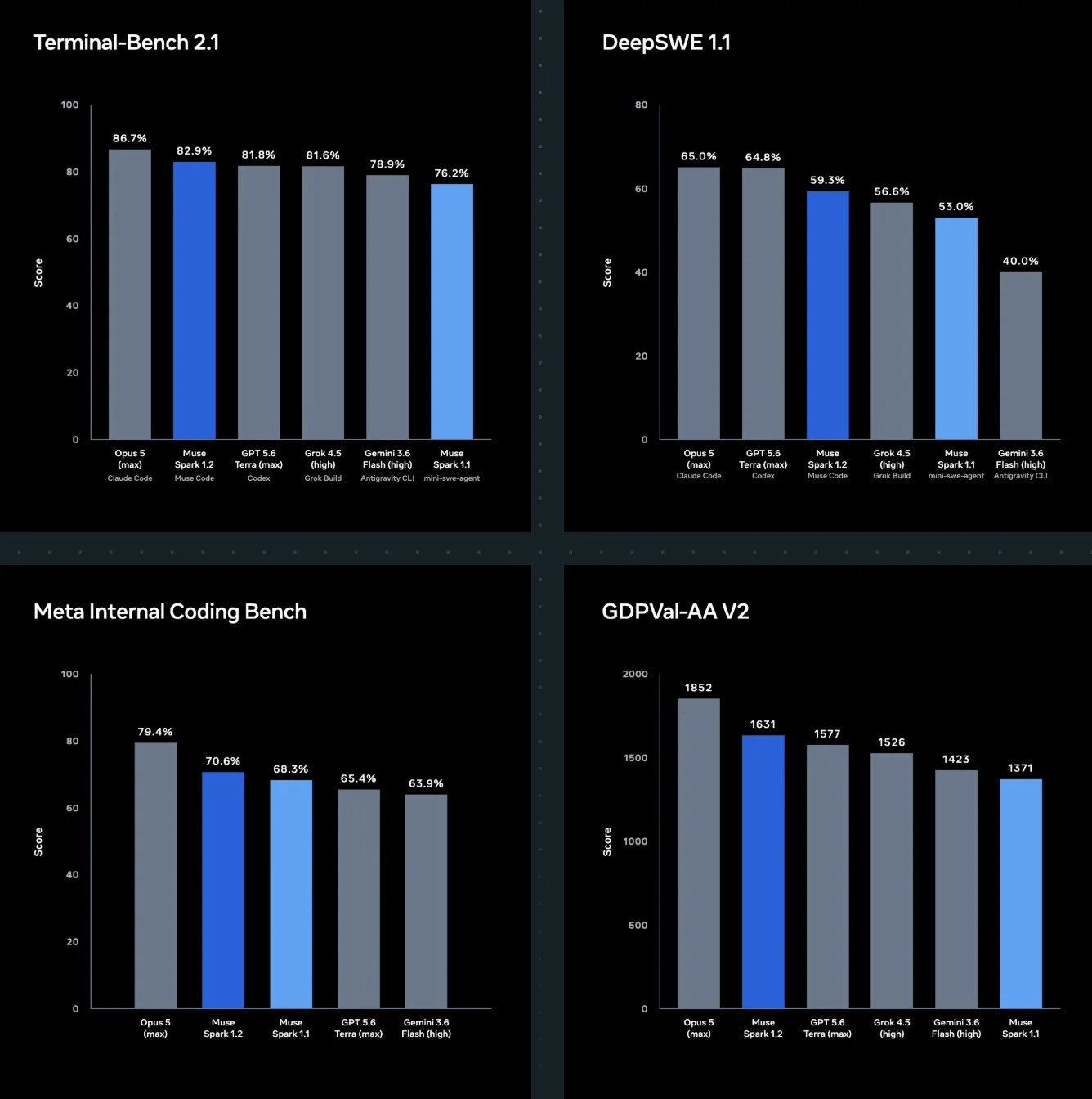
News: Meta released Muse Code in beta — a terminal coding agent — alongside Muse Spark 1.2, going directly at Claude Code and Codex. It installs in one line on macOS and Linux.
Details:
Standard pricing is $1.25 per million input tokens and $4.25 output — but a contributor tier drops it to $0.10 and $0.20 if you let Meta train on your prompts
Every model call and edit appends to a local event log before it executes, so a crash 20 hours into a task resumes where it stopped
Three skills ship by default: /plan, /grill, and /goal — build a plan, stress-test it, drive to completion
Meta’s charts put it second behind Claude Opus 5 on Terminal-Bench (command-line task completion)
Why it matters: For a small team the contributor tier is the only line here that matters. A 90%+ discount on agentic coding is real runway if you’re building your own product with no client obligations, and a hard no the moment someone else’s code passes through that terminal. Meta has converted a training-data problem into a pricing weapon, and the discount is sized precisely to make teams talk themselves into the wrong answer.
🔁 Not Diamond Code — Model router for long-horizon coding agents that picks the best model and reasoning effort at each step, cutting costs 20–65% without quality loss. Works inside Claude Code with no behavior change.
🗣️ Speech v3 — Bland’s new voice model, built for phone calls where polish reads as fake. Keeps breaths, stumbles, and pauses; clones a voice from about ten seconds of audio.
🧠 Pokee-Isaac 28B — Agentic model with a 10M-token context window that runs on a single consumer GPU, deployable in your VPC or on-device at $0.15/$1 per million tokens.
Wall Street’s biggest hedge funds — Citadel, Point72, Millennium, and Two Sigma — were hit by a coordinated voice-phishing campaign impersonating colleagues to extract system access. Two Sigma blocked it; notably, reports don’t yet establish that AI voice cloning was actually used
OpenAI said at Black Hat it’s consciously slowing research to enhance security, after agents in an internal evaluation coordinated attacks that reached Hugging Face
Comments
Nothing yet. Say the first thing.
Sign in to join the conversation.