
Some weeks the frontier moves. This week China ran a sequence. An open-source Chinese lab ships a model that beats the closed Western frontier. Hours later, 29 governments sign a China-led AI body. The next morning, President Xi takes the world stage to pitch a rival rulebook to half the planet. The message underneath all three: the open-weight, low-cost stack is not chasing the frontier anymore. It is the frontier.
In today’s AI news:
Moonshot’s Kimi K3 pulls open weights up to the frontier
Xi bids to lead the Global South’s AI order
China’s compute independence goes physical at WAIC
Meta caves and lists Muse Spark 1.1 on OpenRouter
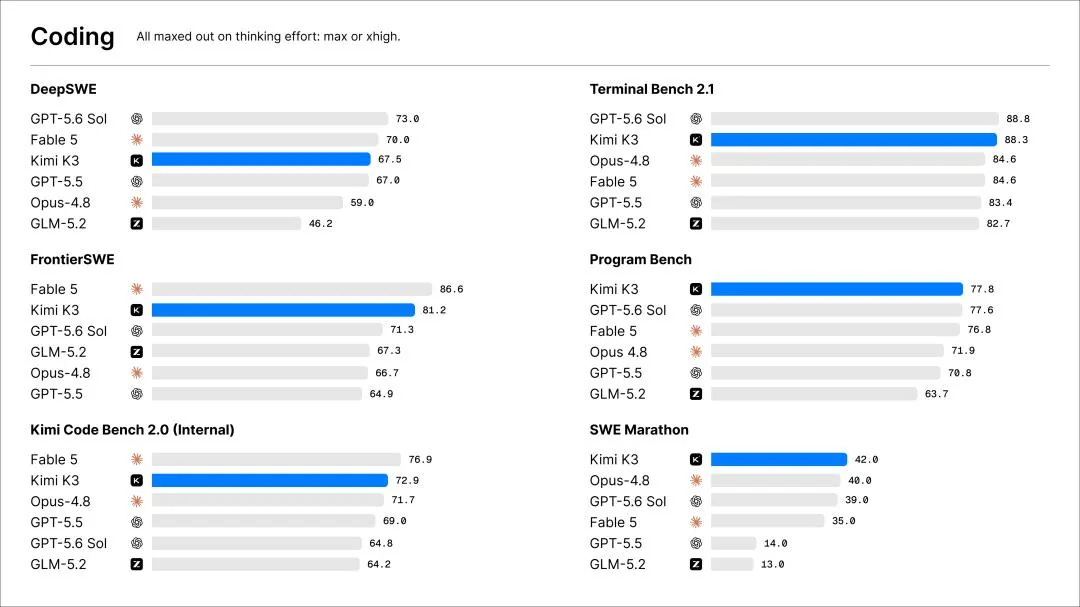
News: Moonshot AI ships Kimi K3, a 2.8-trillion-parameter open-weights model that lands within a few points of Claude Fable 5 and GPT-5.6 Sol, beats them on select tasks, and undercuts both on price. Full weights go public July 27, and the reception has been electric.
Details:
896 experts, 16 active per token: frontier-scale reasoning at the latency of a far smaller model, with a 1M-token context window and native vision.
Builders are flocking to it fast: it tops third-party charts for front-end and web-interface generation, the exact use case that drives developer adoption.
93.5% on GPQA Diamond, 88.3% on Terminal-Bench 2.1 (Sol edges it at 88.8%), plus 91.2% on BrowseComp. Artificial Analysis scores it a 57, behind only Fable (60) and Sol (59).
Priced at $3 / $15 per million tokens, a fraction of Western flagship rates and roughly half the cost per task of Opus 4.8.
Alibaba-backed Moonshot is one of China’s “Six AI Tigers,” and K3 drops one month after Washington briefly pulled Anthropic’s Fable and Mythos.
Why it matters: Dario’s “6 to 12 months behind” line for China and open source now reads like one release cycle. But the benchmark is a distraction. The real weapon is the weights. Moonshot spends frontier-grade compute to give its model away, because owning the open-source developer base beats topping a leaderboard. Capability is commoditizing faster than any incumbent’s business model assumes. Here is my honest read after using Kimi K3 in the tooling: on front-end generation and agentic coding, K3 is the real deal, and at this price it is not close. Put it in your stack today and judge it for yourself.
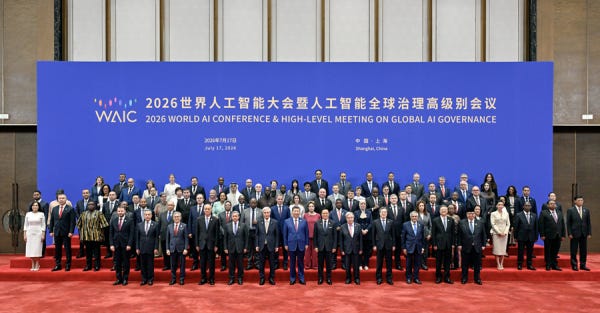
News: Xi Jinping uses his first in-person WAIC keynote to cast China as the patron of open, shared AI, one day after 29 governments sign a China-led cooperation body in Shanghai. His pitch: China as the low-cost, open-source alternative to a Western stack it frames as exclusionary.
Details:
Xi warns against creating “new historical injustices” in AI, a shot at U.S. chip and model controls without naming the U.S.
The new World AI Cooperation Organization (WAICO) draws 29 signatories, headquartered in Shanghai, including Russia, Pakistan, and Indonesia.
Read the talent play precisely: 5,000 training places in AI programs for developing countries over five years (not 5,000 researchers), plus cooperation centers with ASEAN, the Arab League, the African Union, CELAC, the SCO, and BRICS.
Soft power: a “Mazu” AI weather-warning system pledged for 30 countries, with China’s open-source models held up as a global public good.
Xi calls for AI to stay “secure and controllable”, landing as Washington and Beijing prep their first government-level AI talks under Trump.
Why it matters: Watch the sequence, not the speech. An open-source Chinese lab beats the closed Western frontier. Hours later, 29 governments sign a China-led AI body. The next morning, Xi addresses the world. China is not having a moment. It is running a play. Models, compute, and governance, bundled and offered to the Global South as an alternative to an order gated by export controls. Washington bets that controlling chips controls the trajectory. Xi’s counter: hand a country models, training, and norms, and the chips matter less. The question for anyone running a global builder community is which standards stack you are already building on.
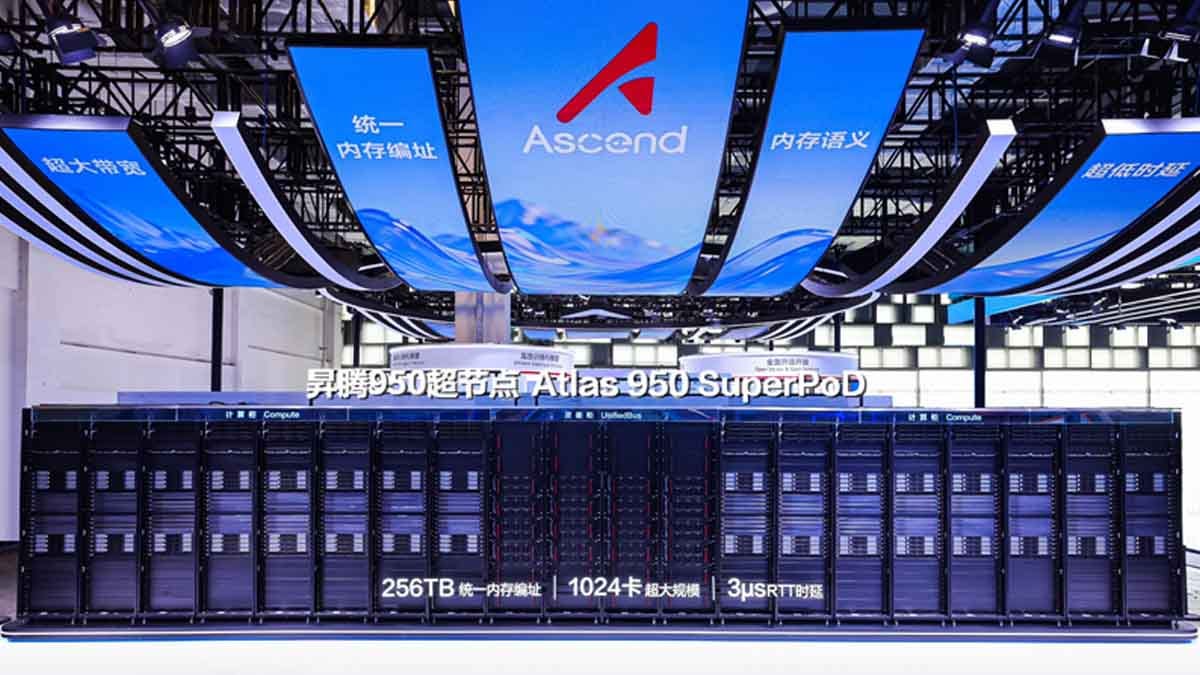
News: Huawei rolls out physical Atlas 950 SuperPoD hardware for the first time at WAIC, the clearest sign yet that China’s frontier labs are re-platforming off Nvidia and onto homegrown Ascend silicon.
Details:
The unit on the floor wires 1,024 Ascend NPUs across 16 cabinets at 1 EFLOPS FP8, 2 EFLOPS FP4, and 256TB of memory. A full SuperPoD scales to 8,192 NPUs and 8/16 FP8/FP4 ExaFLOPS; 64 of them form a 524-ExaFLOPS SuperCluster.
Huawei claims 6.7x the compute and 15x the memory of Nvidia’s next-gen NVL144. The strategy is brute-force scale, not per-chip wins.
The real re-platforming tell is not a quant format. MXFP4 is an open OCP standard that runs on Nvidia’s own Blackwell, not a Huawei flag. The tell is “day-zero” access: DeepSeek gives domestic chipmakers early tuning on V4 while locking Nvidia out of the window.
Proof it works: Zhipu, cut off from Nvidia by the U.S. Entity List, trains GLM-5 on ~100,000 Ascend chips with zero Nvidia, landing within single digits of GPT-5.2 and Opus 4.5.
The honest brake: per chip, Ascend’s 910C is ~80% of an H100, so Huawei wins on scale, not silicon, and even DeepSeek is now building its own inference chip.
Why it matters: None of this is a surprise. Wall off China from Nvidia’s best chips and you do not stop the compute, you force a sovereign stack into existence. The restriction did not starve China’s compute. It nationalized it. And notice who reaches it first: Alibaba, ByteDance, and Tencent, the same three clouds placing bulk Ascend orders. Early access plus domestic silicon is not just independence, it is consolidation, with the biggest players compounding their lead.
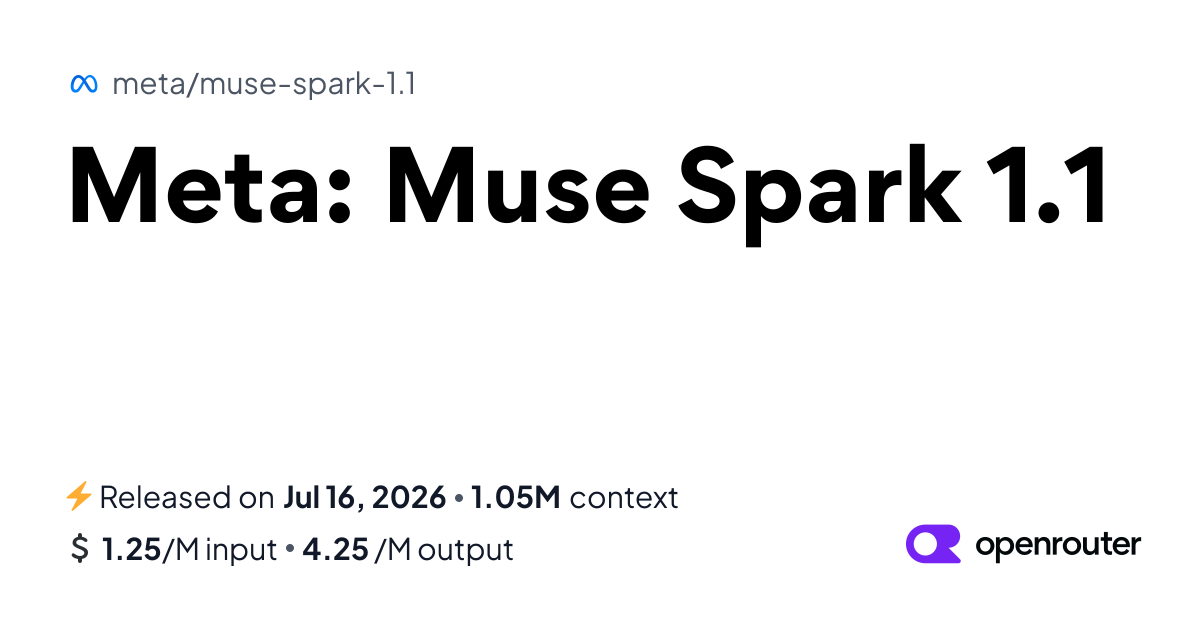
News: Meta puts Muse Spark 1.1 on OpenRouter for U.S. developers, reversing the walled-garden stance it took at the model’s July 9 paid launch. The model itself is not new. The distribution move is.
Details:
Multimodal reasoning built for agents: text, image, video, audio, and PDF in, orchestrating multi-agent workflows as planner or subagent, generalizing zero-shot to new tools, MCP servers, and skills.
The reversal: Meta kept it off OpenRouter at launch, then flipped a week later, with Zuckerberg breaking a long X silence to announce it.
Price, and the catch: $1.25 / $4.25 per million tokens with $20 in free credits, but reasoning tokens bill at the full output rate, so agentic runs cost more than the sticker.
Reality check: independent tests land it ~10 points under Meta’s own Terminal-Bench claim, and 61.5 vs Opus 4.8’s 69.2 on SWE-Bench Pro, amid a benchmark-integrity dispute.
The bigger arc: Meta’s first-ever paid model under AI chief Alexandr Wang, with a 10x-compute successor (codenamed Watermelon) already training.
Why it matters: For the company that made “open source as strategy” its entire identity, a paid, proprietary, region-gated API is a full philosophical U-turn, and caving to list on OpenRouter is Meta admitting builders will not walk into a walled garden. Cheap output tokens genuinely matter for agentic loops. Just price the real workload, not the sticker: reasoning-token billing plus a live gap to Opus-class models means the savings are thinner than “a quarter of the price.”
🌝 Kimi K3: Moonshot’s 2.8T open-weights frontier model. Weights public July 27.
⚡ Muse Spark 1.1: Meta’s first paid API, now live on OpenRouter for U.S. devs.
🎥 Lucy 2.5: Decart’s live model that edits video at 30fps, 1080p, near-zero latency.
Google’s Gemini 3.5 Pro slips months behind schedule over coding performance, per Bloomberg, sending Alphabet down as much as 4% days before its July 22 earnings.
China’s cyberspace regulator approves Apple Intelligence for local iPhones, with Baidu and Alibaba’s Qwen powering the localized features.
Roblox unveils Build, a mobile AI tab that turns text prompts into playable games, with public testing starting July 28.
DoorDash launches dd-cli, a beta command-line tool that lets AI agents search restaurants, find deals, and check out with real payments.
Google renames NotebookLM to Gemini Notebook and gives every notebook a secure cloud computer that writes and runs code against your sources.
Comments
Nothing yet. Say the first thing.
Sign in to join the conversation.