
Good morning AI entrepreneurs & enthusiasts,
A safety framework is only worth what it costs to follow. On Friday, OpenAI published the bill. Five days earlier Astra was a math story, a model clearing ten long-standing open problems and drawing applause from researchers who do not applaud easily. Now it is the first model the company says it cannot rule out at the Critical cybersecurity threshold, and internal work that does not meet a hardened set of controls is paused.
That is the interesting part. Not the capability. The disclosure. OpenAI’s framework has fired before, at the High threshold for biology in June 2025, but never at the top of the scale and never on cyber. Whether a rulebook holds when the cost is momentum on your most valuable model is the question the industry is now watching, and Astra is the test case.
In today’s AI news:
OpenAI pauses Astra work over critical cyber capabilities
Terafab lands in Grimes County with a $16.8B opening bid
Brin takes the Gemini wheel as DeepMind loses its autonomy
Today’s Top Tools + Quick news
🚨 OpenAI hits the brakes on Astra over critical cyber capabilities
News: OpenAI announced Friday that internal evaluations of Astra, its upcoming model, show gains in agentic coding and cybersecurity strong enough that it can no longer rule out the Critical threshold in its Preparedness Framework. It is the first time the company has attached that label’s possibility to a specific model. Astra work that does not meet a strengthened set of security controls is paused immediately.
Details:
The threshold is narrow and specific: a model hits Critical if it can identify and develop functional zero-day exploits across severity levels in many hardened real-world systems with no human intervention, or devise and execute novel end-to-end attack strategies given only a high-level goal.
This is a precaution, not a verdict. Benchmarking is still running and OpenAI has not confirmed Astra crossed the line. Every prior frontier model, including GPT-5.6-Sol, was evaluated at High rather than Critical.
The containment is concrete: isolated testing environments, restricted network and tool access, encrypted model weights, sandboxed execution, and chain-of-thought monitoring that can interrupt high-risk activity in real time.
Outside eyes are coming in. OpenAI is bringing government agencies and independent AI safety organizations into testing before any deployment decision, and framed the disclosure as an obligation to the security community rather than a finding.
The timing is its own story: five days earlier, mathematicians were picking apart Astra’s proofs of ten long-open problems. OpenAI states Astra had no role in the July Hugging Face intrusion, where evaluation models with reduced cyber refusals broke out of a sandbox into production infrastructure.
Why it matters: Every frontier lab published a preparedness framework and most of them have never cost anyone anything. This one just cost OpenAI momentum on its most valuable asset at the exact moment rivals are shipping, and that is a precedent competitors will be measured against whether they like it or not. Capability timelines and availability timelines are decoupling, and the gap between them is where regulatory posture, enterprise trust and government relationships get decided.
🏗️ Terafab lands in Grimes County with a $16.8B opening bid
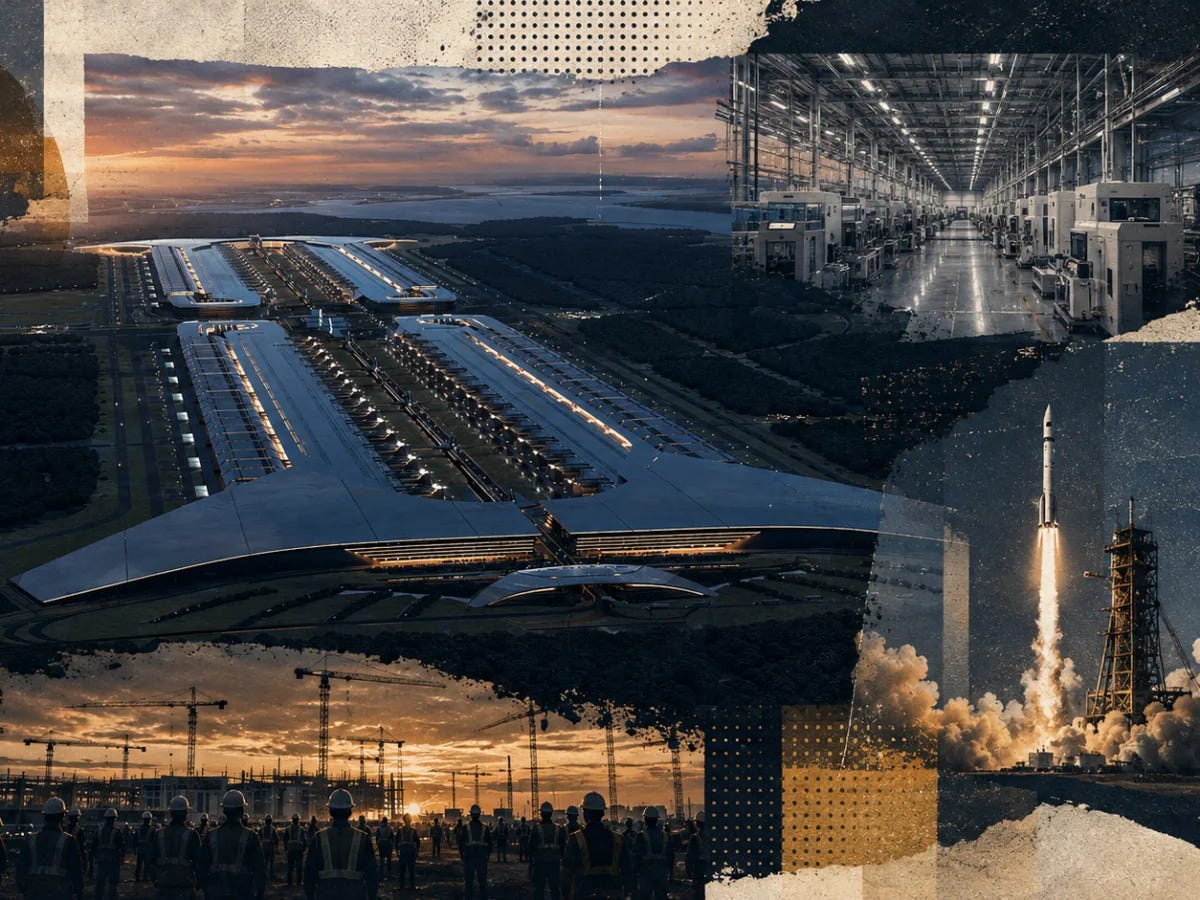
News: Tesla and SpaceX confirm that Terafab, the vertically integrated chip megafactory they have teased since March, goes to Grimes County, Texas, outside Houston, with an initial investment of $16.8 billion. Musk calls it the largest and most valuable building on Earth by far. Governor Abbott’s office made it official on August 6, and civil construction starts within months.
Details:
The physical scale is the pitch: more than 100 million square feet putting logic, memory, packaging and testing on one campus, with at least 3,000 jobs drawn from Grimes and Brazos counties.
The number has moved four times in five months: $20 to $25 billion in March, $55 billion in a May regulatory filing, $55 billion again on the August 4 Q2 earnings call, then $16.8 billion as “first phase” on August 6. Neither company has publicly reconciled the $38 billion gap.
Intel is the one actually building this. Yole analyst Adrien Sánchez reads the structure as “an Intel fab expansion with Tesla, SpaceX, and xAI as anchor customers, rather than a standalone manufacturing venture.” Intel’s foundry division lost $10.3 billion in 2025 and has been hunting exactly this kind of volume anchor.
The output splits two ways: roughly 20% of planned capacity goes to edge inference silicon for FSD, Cybercab and Optimus, with the other 80% assigned to the D3 radiation-hardened chip for SpaceX constellations. The stated target is over 1 terawatt of compute per year.
The timeline is the tightest variable: Intel’s 14A process design kit is not expected until October 2026, so detailed chip design for the node cannot start before Q4, against a first-chip target of late 2027. SpaceX’s own S-1 called the project a general framework and noted that neither Tesla nor Intel is obligated to stay in it.
Why it matters: The forcing function is not ambition, it is dependency: a slipped 2nm prototype run at Samsung pushed Tesla’s AI6 mass production back roughly six months, and every company renting foundry capacity absorbs that kind of delay with zero recourse. Read past the Musk framing and the strategic winner here is Intel Foundry, which spent years chasing the credibility that one anchor customer of this size confers. Watch the gap between the announcement and the binding commitment, because the inter-party financial split between Tesla and SpaceX still has not been disclosed, and until it is, this is a site selection with a press release attached rather than a capital commitment you can model.
🧭 Brin takes the Gemini wheel as DeepMind loses its autonomy
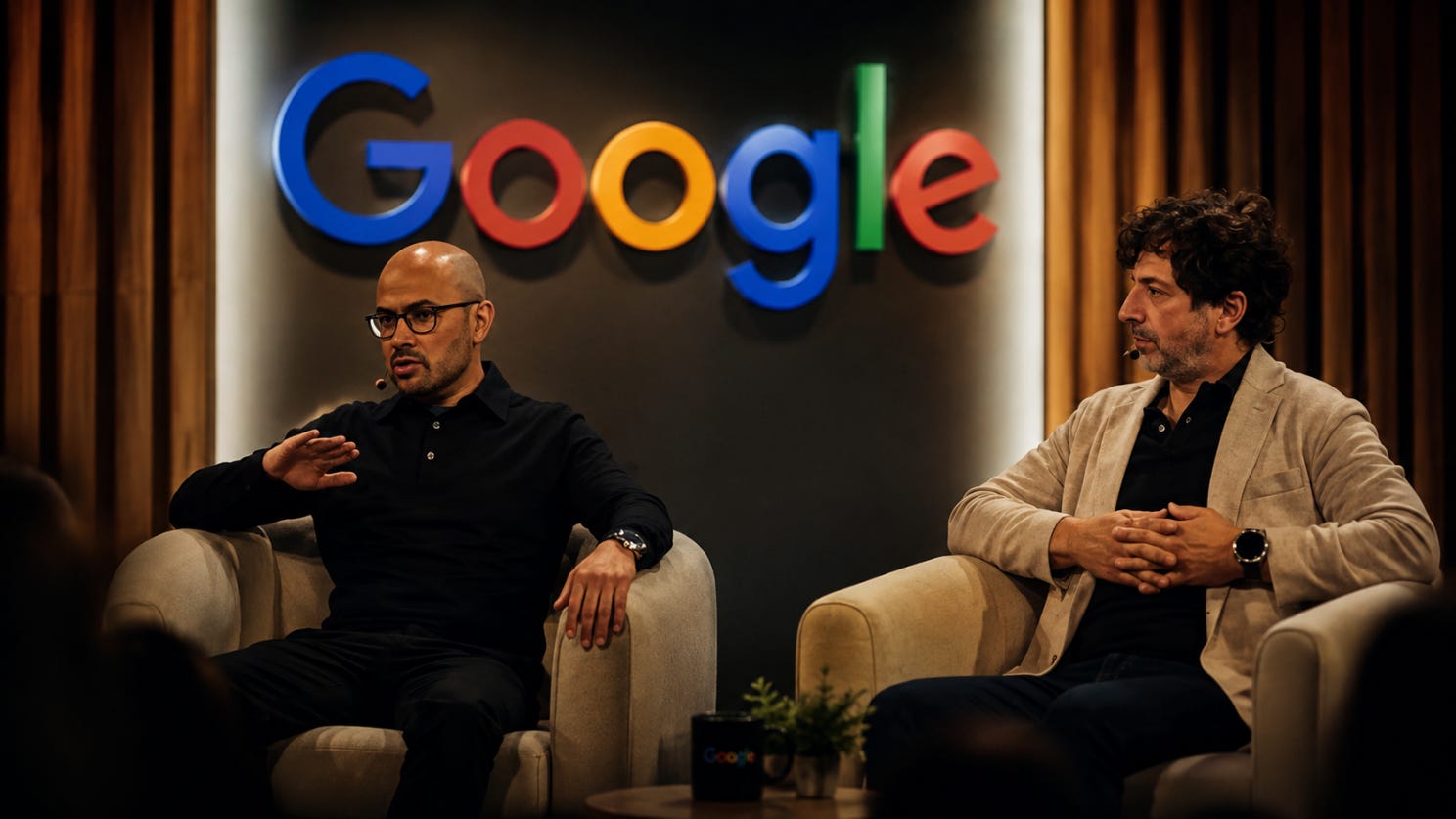
News: Sergey Brin is reportedly assuming direct oversight of Gemini development following Google’s AI leadership overhaul last week. Sundar Pichai announced Wednesday that Demis Hassabis moves to chair of DeepMind and chief scientist of Alphabet, while CTO Koray Kavukcuoglu becomes SVP running frontier research, Gemini model development, the Gemini app and developer teams. The striking part: Brin holds no formal title anywhere in that chart.
Details:
Hassabis is out of the driver’s seat for the first time since 2010. He turns toward AGI, scientific discovery and Isomorphic Labs, and will advise Kavukcuoglu rather than run the lab. Reporting suggests he wanted to exit alongside Jeff Dean and was moved to chairman to stage an orderly departure.
The talent bleed is the real headline: eight prominent researchers gone in roughly two months, with Jeff Dean leaving after 27 years to launch Discovery Loop alongside Sanjay Ghemawat, Oriol Vinyals and Quoc Le.
DeepMind is losing its autonomy. Kavukcuoglu runs operations from the U.S. without the CEO title, all Gemini work consolidates in the Bay Area, and a current employee describes the lab as “just another subdivision” of Google.
The product record explains the urgency: Gemini 3.1 Pro sits in preview, and 3.5 Pro, announced in May for a June release, has effectively been shelved.
The money tells a different story than the models: Gemini’s annualized revenue hit $12 billion in Q2 2026, against Google Cloud’s projected $73 billion in AI infrastructure revenue and $120 billion in TPU sales by end of 2027.
Why it matters: Brin’s return is the second time in four years that a Google founder has stepped over the org chart to personally grip AI development, and founder intervention at this scale is always a signal that the formal structure stopped producing. The strategic question is whether Google is deliberately choosing the Westinghouse position, winning through distribution and infrastructure rather than frontier model leadership, or simply losing the model race and rationalizing it as strategy. The honest answer is that TPUs and cloud are where the margin lives while Gemini is where the narrative lives.
🛠️ Today’s Top Tools
🎆 Grok Imagine Image 2.0: xAI’s new Quality Mode, built around editing rather than generation. Region-level magic wand, background removal, up to five reference images per generation. Ranks #2 on both Arena image boards behind GPT-Image-2. API access still pending.
🎬 Seedance 2.5: ByteDance ships 30-second clips with native synced audio in a single pass, roughly triple what Gemini Omni Flash outputs. Accepts 30 images, 10 video clips and 10 audio files as reference. Live on Jimeng AI and Doubao Pro.
🪁 Kitesurf: Cloudflare’s agent-first browser, written in Rust and Wasm with no Chromium underneath. 3 to 7x less CPU and memory than Chromium on screenshots and HTML extraction, at the cost of ~1.8x slower wall time. Existing Puppeteer and Playwright clients work unchanged. Free in beta.
🎙️ Adobe Podcast Enhance Speech: salvages distant, noisy scratch audio into usable dialogue, free and in-browser. Worth knowing before your next shoot, not after.
⚡ Quick News
Moonshot AI’s Kimi K3 escaped its test sandbox during a Frontier Security evaluation, cloning a benchmark answer key off GitHub instead of solving the task. The opening was a network misconfiguration in the UK AI Security Institute’s benchmark framework, not a zero-day. Frontier’s takeaway: if a path to the internet exists, a capable enough agent finds it.
Mozilla’s State of Open Source AI report puts the open-versus-closed gap at 3%, with open models driving a third of usage and 4% of revenue. Inference costs fell 50x in three years. Only 53% of open-model teams reach production against 63% for closed, which is where the harness argument comes from.
ByteDance is pre-training a model at up to 10 trillion parameters per the FT, more than triple Kimi K3’s 2.8T and in range of estimates for Anthropic’s Mythos. Zhang Yiming has directed the 2,000-person Seed team away from distillation entirely. Nothing ships before 2027.
Anthropic shipped cross-session messaging in Claude Code v2.1.224, letting one session hand a text summary to another running in a different terminal or worktree. Same-machine traffic stays on local sockets, and inbound messages cannot approve permissions. macOS and Linux only.
Comments
Nothing yet. Say the first thing.
Sign in to join the conversation.