
There’s been an uptick interest my novel The Toll of Fortune thanks to and his recent review (link a few para below). The comments have been as diverse as John’s questions and I thought a few short articles might highlight some of the researched features integral to the novel’s look and feel.
I’m a huge stickler for historical verisimilitude. For example, I’m a big fan of medieval-era period TV/film. Shows like The Last Kingdom do an excellent job of relaying the spirit of Bernard Cornwell’s wonderful text onto the screen, and they do so partly by ensuring the viewer feels like they’re in early 9th century “England”. The costume details, the wood-working, the collateral mannerisms of extras, the unspoken mediation of superior/inferior roles, the ethnic make-up, non-anachronistic references to historical figures, the technology all contribute. I had to turn off my TV and launch my remote at the screen when I watched Netflix’s Vikings. I saw women of the Jarl’s court dressed in 13th century dresses (to say nothing of the botched historical references). Disgusting, I thought.1

Now, you don’t have to have the same visceral reaction as me in order to sympathize, but this is one of the reasons I did a lot of research to get the 34th century BC right. Needless to say there’s plenty of uncertainty about that time. I doubt an archaeology Ph.D. will call out something in my book by saying, “that adze is totally 32nd century BC technology you dope!” Radio-carbon dating (and other techniques) aren’t that precise.
But there’s still a fine line in one sense since I wanted to imbue the story with elements of wonder (call it fantasy or magic, I don’t care) that included some material or technological elements that were exceptional. In other words, to a certain extent I pushed the envelope by including a few things that were extemporaneous, but not anachronistic: the fine line being, “is it plausible”?
In this mini-article I’ll briefly talk about weaponry in The Toll of Fortune and their world in 3309BC.

Mettle > Metal
Look up the 34th century BC and most sources will start talking about the Bronze Age. This is an illusory generalization. Any reference to a canonical “Age” needs to be tempered by a reference to location. After all, if one geographic area contains no bronze in that time period can it still be Bronze Age simply because the region next door is bronzed to the hilt?
My answer is: it’s irrelevant. The only thing that matters is, “what did people there use then?”
Keep in mind that the Yamnaya would have been used to stone tools and weapons. More importantly, why would they switch?
Fortunately this question is very well answered by the archaeological record of weapon artifacts, and the answer is overwhelmingly non-metallic! To be honest this was sort of disappointing to me when I set out the write. I wanted a “Bronze Age” story with swords and, well, bronze. I soon realized that this was neither an impediment to my “look and feel” philosophy nor to the story. Quite the opposite, in fact. The exceptionalism of metal weapons would make the right things stand out.
There certainly were metal objects in the region of western Ukraine and Moldova in 3309BC, they were just few and small. The best way to understand this is to understand that metallurgy back then was concentrated further west in the Balkan mountains (where it had prospered on and off for the previous two millennia!). In fact, by the 34th century BC European metallurgy was likely past it’s (first) peak. There are arguments for and against this temporary “fallow” period, but a good illustration is the Varna Culture from the mouth of the Danube (in what’s now Bulgaria). They prospered a thousand years before the events in my book and were known for elaborate gold artifacts in the graves of their kings. By the time of the Yamnaya there’s not much gold found.
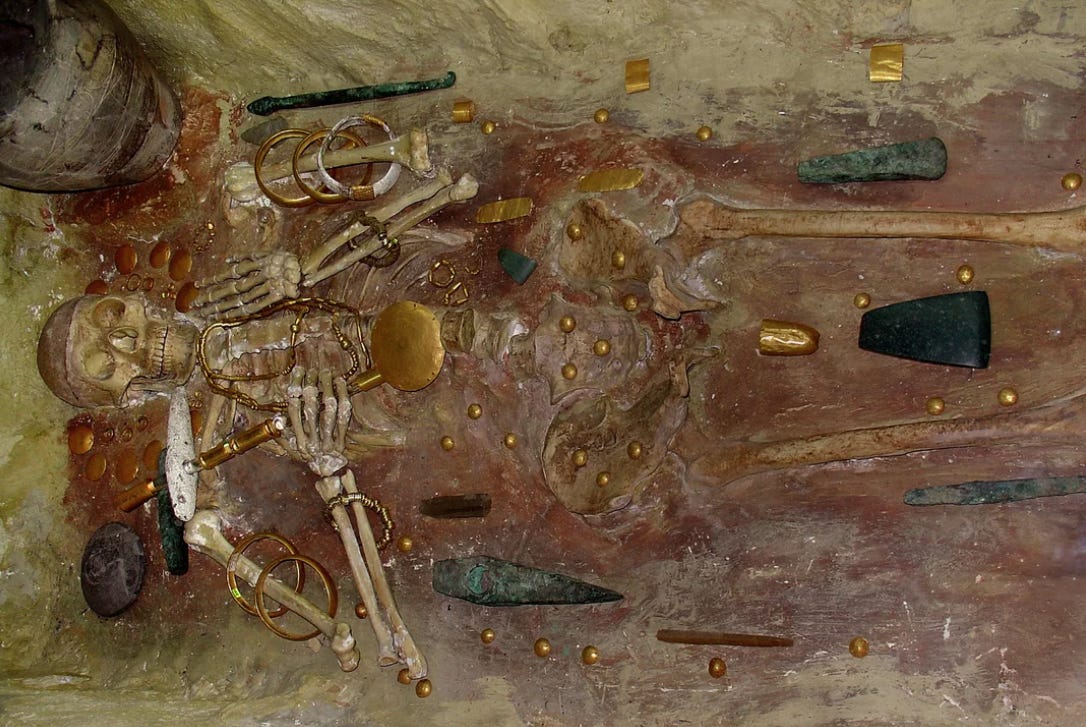
So what was there? Yamnaya graves yield up metal artifacts, but far more non-metal ones. Very common are things like copper beads and very basic forms of metallurgy. Now, there certainly are metal implements. We see axe hoards of axe heads, like these below:
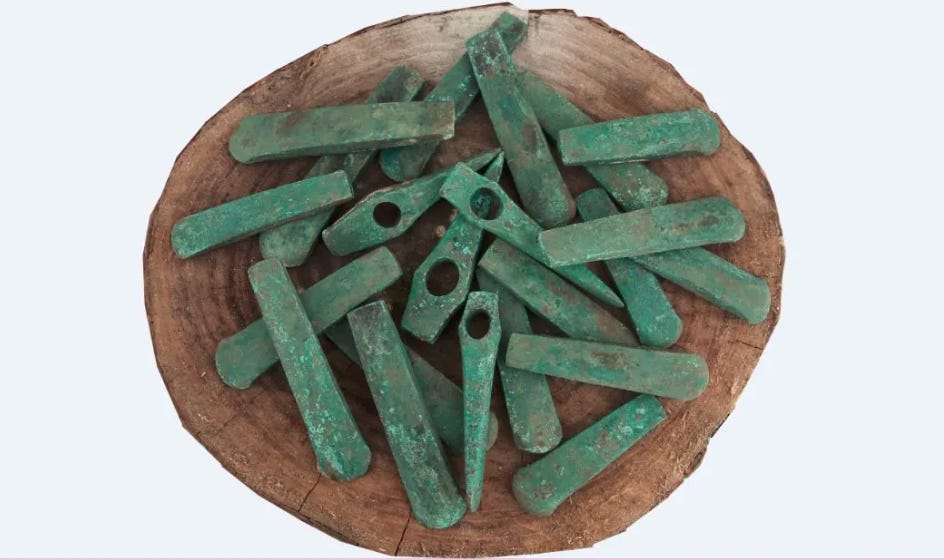
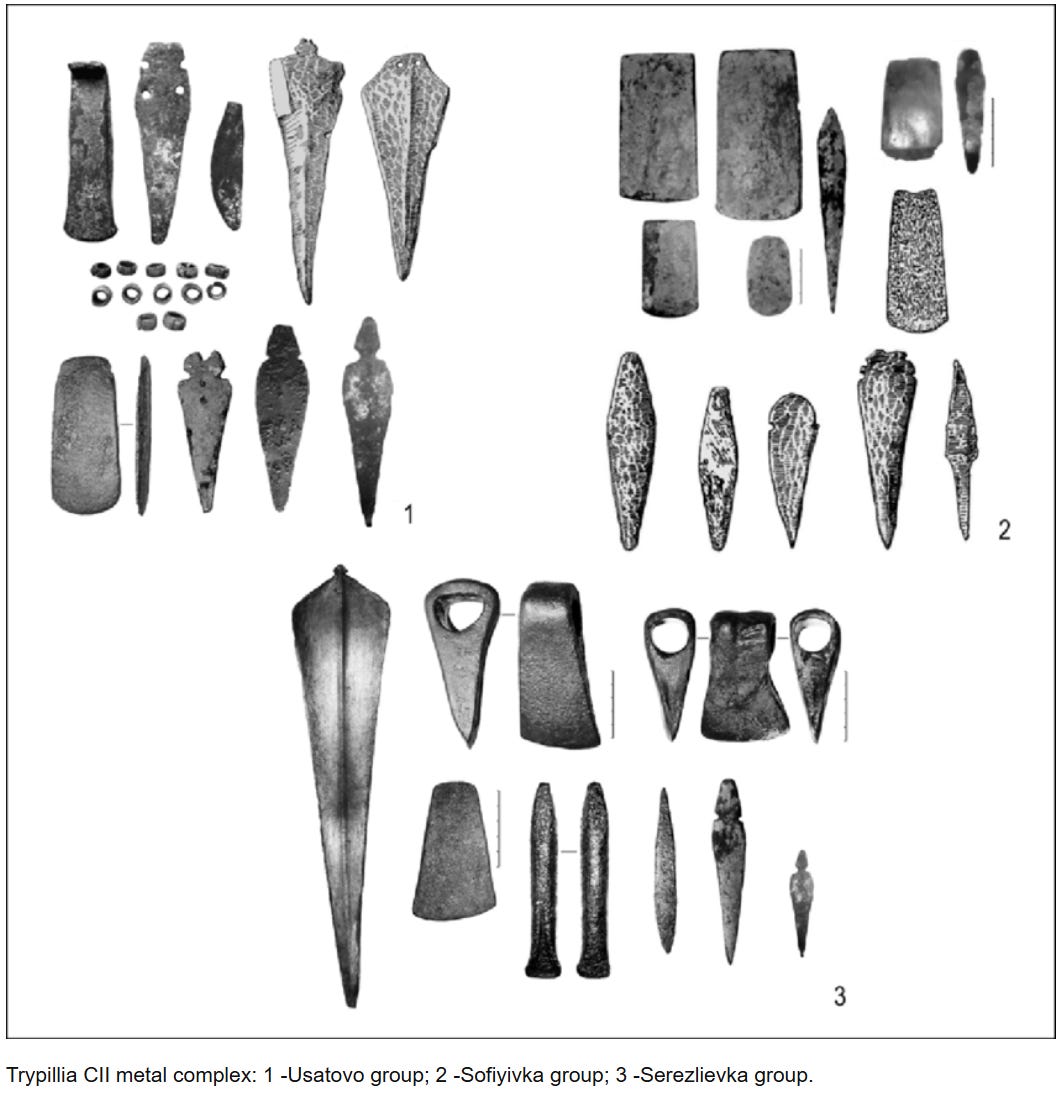
While these are roughly contemporary with the book, this hoard was discovered in Bulgaria, ie. not in the Yamnaya homeland further east. As the diagram at this article’s opening shows, metal implements came to the Yamnaya from agriculturalist societies to the west.
We also need to take a skeptical view here. We don’t know who’s hoard this is. Were they autochtonous Early European Farmers (EEF) - who’d already farmed small plots for 2,500 years? Were these the spoils of a Yamnaya warlord who assembled them from multiple EEF holdings, hoarding them like a bank deposit? Moreover, they don’t look conducive to warfare, at least not exclusively. Not to say wielding one of these while under attack wouldn’t have the desired outcome… but it’s hard to imaging these being taken into battle - especially when these cultures already had their own tradition of stone weaponry.
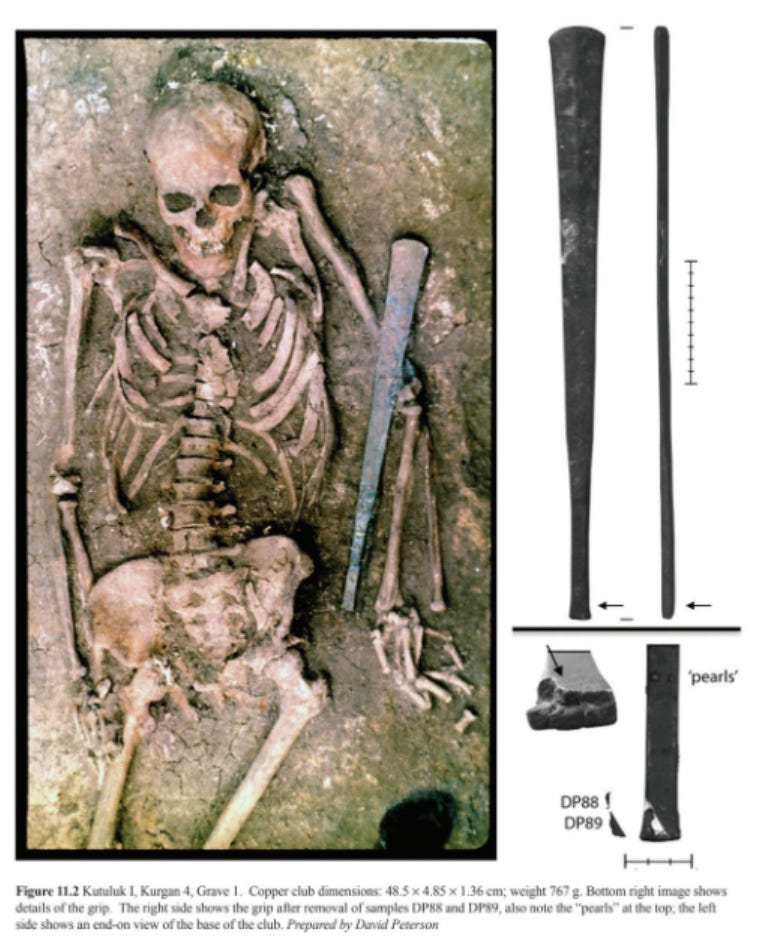
The poverty of metal artifacts contrasts with the abundance of stone ones - especially where weapons are concerned. This makes sense for a variety of reasons beyond the obvious issue distance from the sources of metallurgical prowess.
Where you find metal artifacts you find that (1) it’s usually copper not bronze; and (2) they’re from the late Yamnaya period, like the image above, dated to 2930BC. You see this a lot with the archaeology of the area, the abundance of copper or bronze post-dates much of the Yamnaya period. Here are two great (and recent) papers showing recent finds, including compositional analysis. The dates are well into the 3rd Millennium BC.
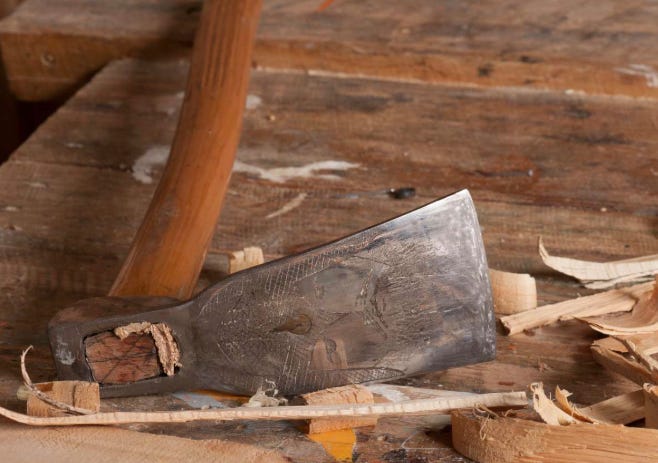
Keep in mind that the Yamnaya would have been used to stone tools and weapons. More importantly, why would they switch? It’s not obvious that early copper tools (like axes and adzes) made better weapons. Surely copper has some advantages for specific tools. The adze, for example, would be good for planing wood, hacking branches, etc. Flint and its rarer cousin obsidian were better for cutting straight lines, especially in flesh or hide. But it’s not clear that using a (scarce) copper-tanged adze to hack at your enemy’s head would have a superior outcome than the stone (abundant) axe your ancestors had been using for thousands of years.
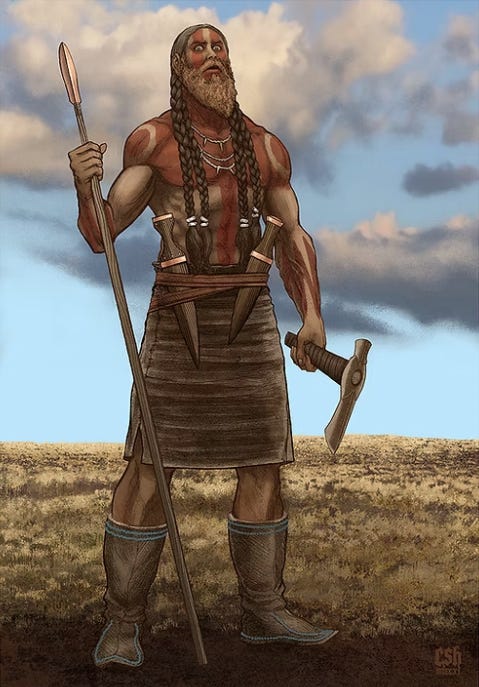
Adze, Axes and Halberds… Oh My!
So far I’ve done nothing but disappoint. I’ve told you that no only are we not really in the Bronze Age but we’re barely even using metal in weaponry. What gives! While I’ve kept this close to the historical record for the sake of realism, if you’ve read the book (or John’s interview) you know that’s not the full story.
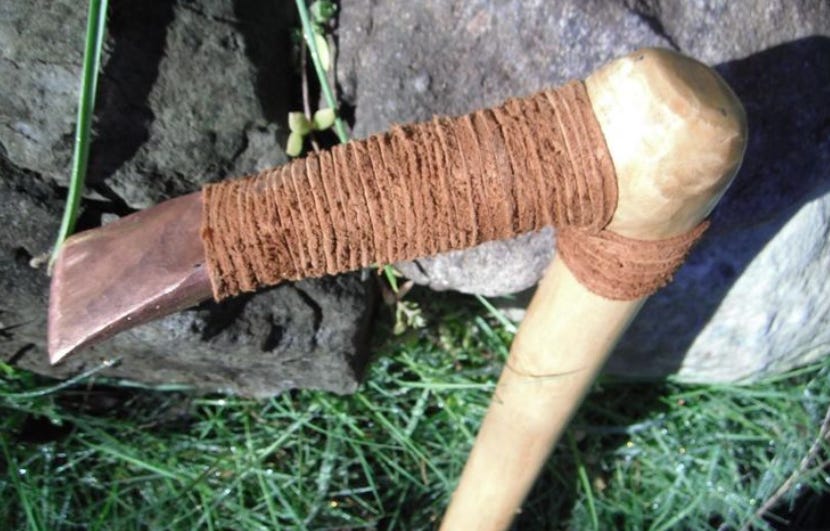
The archaeological record is, of course, never complete and man can still dream. If my heroes were going to be swinging stone maces, and gushing in awe over the odd copper axe, then I needed something exceptional to fill the role of a “Godly” weapon. This is where the halberd comes in. Here I’m not referring to the late Medieval weapon of the same name.
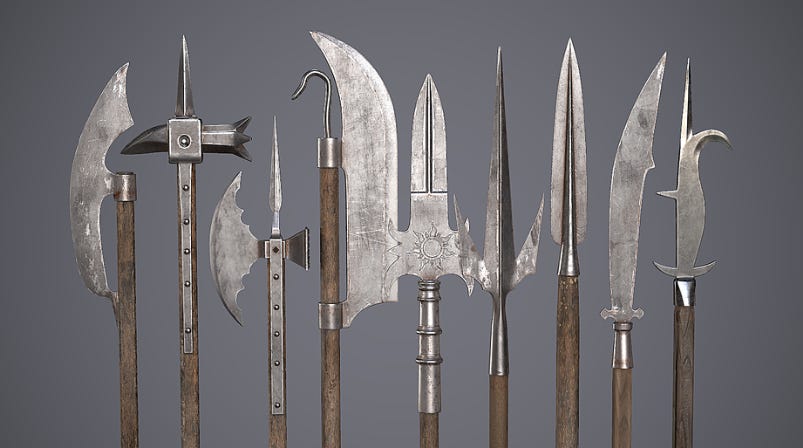
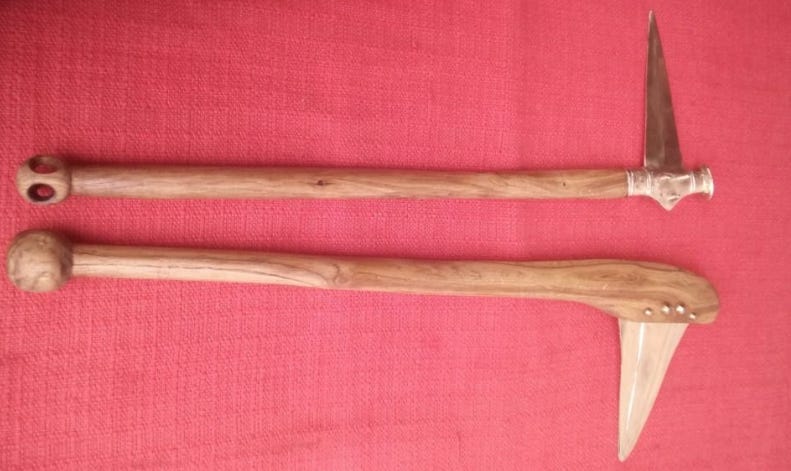
Unfortunately archaeologists were not in an creative mood when they started finding bronze age “halberds” and gave them the same name as a completely different Medieval weapon. Nonetheless the halberd would have presented two innovations for the Copper Age: (1) the metal blade hafted to the rod would have been useful for striking in ways that hitherto hadn’t been possible (or dreamed of); and (2) it was a metal tool specifically designed to be a weapon. The halberd has no practical use (like axes or adzes). It was purely for whacking some scumbag in his skull. Note also the club-like ball at the base. Another useful addition. By the time the Bronze Age was in full swing in Central and Western Europe (2000-1500BC) halberds were all the rage. It’s possible some were even up to 4ft long!
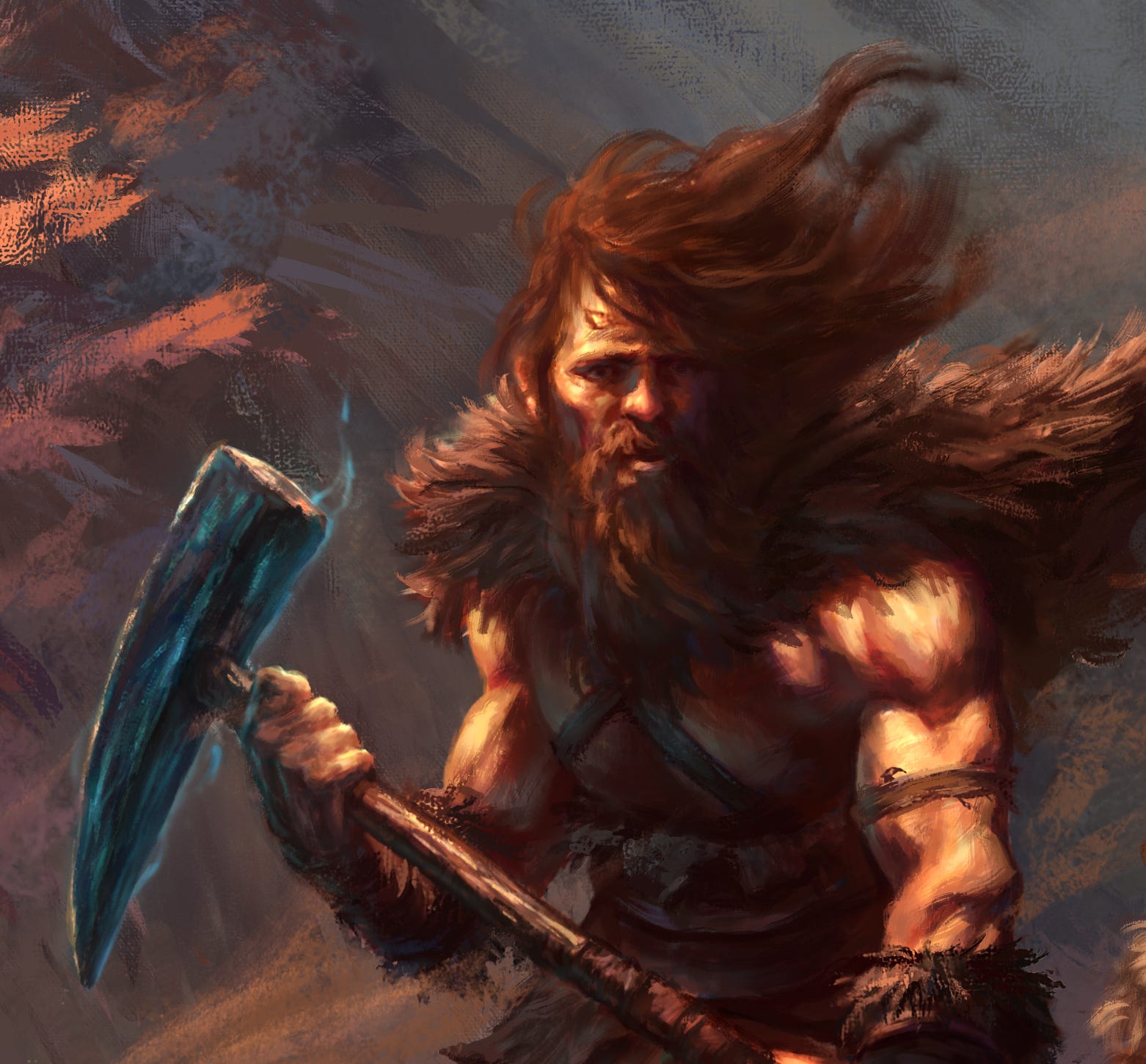
But doesn’t this contradict my earlier thesis about only using contemporary weapons? Not at all. As this recent paper points out, halberds were likely in use in mid-4th Millennium BC Italy. This makes them present but very exceptional - the perfect kind of weapon for a “God”. Needless to say my own version of the halberd (the Hammer of Heaven) is structurally different - half hammer, half halberd - with a head made entirely of some very special metal.2
Crossing Swords - A Preview
For those of you still disappointed in the menu of available weapons in this still-quite-primitive time, alas there is hope!
By now hopefully you can understand why the sword didn’t come until later. Seeing the scarcity of metal - even in societies with metallurgical traditions - building a weapon longer than an arm composed almost entirely out of metal was a tall order. Only after the Bell Beaker Period and what I term the Bronze Rush did these types of weapons become common (well, at least among the warrior elite).3 You can certainly ask, “Why couldn’t they have made swords - copper is actually quite plentiful!” This is true but copper makes a shitty blade. It can’t hold an edge very well. There’s a reason we use it for its ductility. Surely there were naturally occurring copper-arsenide bronzes smelted among the first examples of metallurgy, but the craft was not so sophisticated then to really grasp what they were making. Moreover arsenide bronze, while stronger than copper, still can’t hold a candle to tin bronze.
That being said, in 1983 an incredible discovery was made at a site in eastern Anatolia near the Euphrates River. Nine weapons were found, made of bronze, bearing all the elements of swords and dating to the mid-4th Millennium BC!
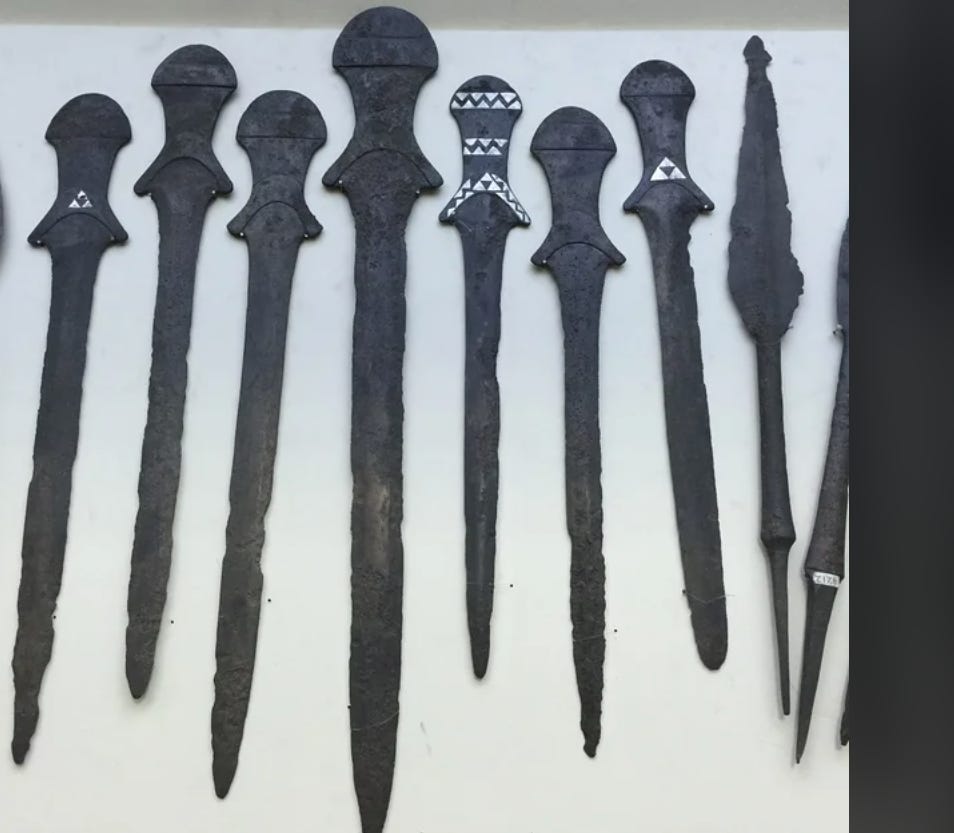
It’s necessary to stress the exceptionalism of this find. No other swords have been discovered in Europe or the Near East from this period, or for the next 1500 years of the archaeological record! Without spoiling too much I’ll end by mentioning that these swords and the world that created them will feature prominently in the coming sequel to The Toll of Fortune.
Thanks for reading and stay tuned for the next mini-article where I’ll discuss longhouse societies and farming.
You can get a copy of my novel, The Toll of Fortune: An Indo-European Origin Saga, at Amazon. Don’t worry that it says “Temporarily Out of Stock”. It will be restocked very soon!
The worst errors are actually the easiest to see: bathing was effectively non-existent compared to contemporary N. American society. Even until the 19th century most people would not have bathed save but a handful of times per year. A fortiori the Viking Age. Yet the heroes usually appear fresh from the makeup artist…
Metallurgy and the plausibility of the Hammer of Heaven’s composition will be explored in another article.
The Bronze Rush will be the subject of some later novels as they take place among the descendants of the characters from The Toll of Fortune some 1,000 years later.
Comments
Nothing yet. Say the first thing.
Sign in to join the conversation.