
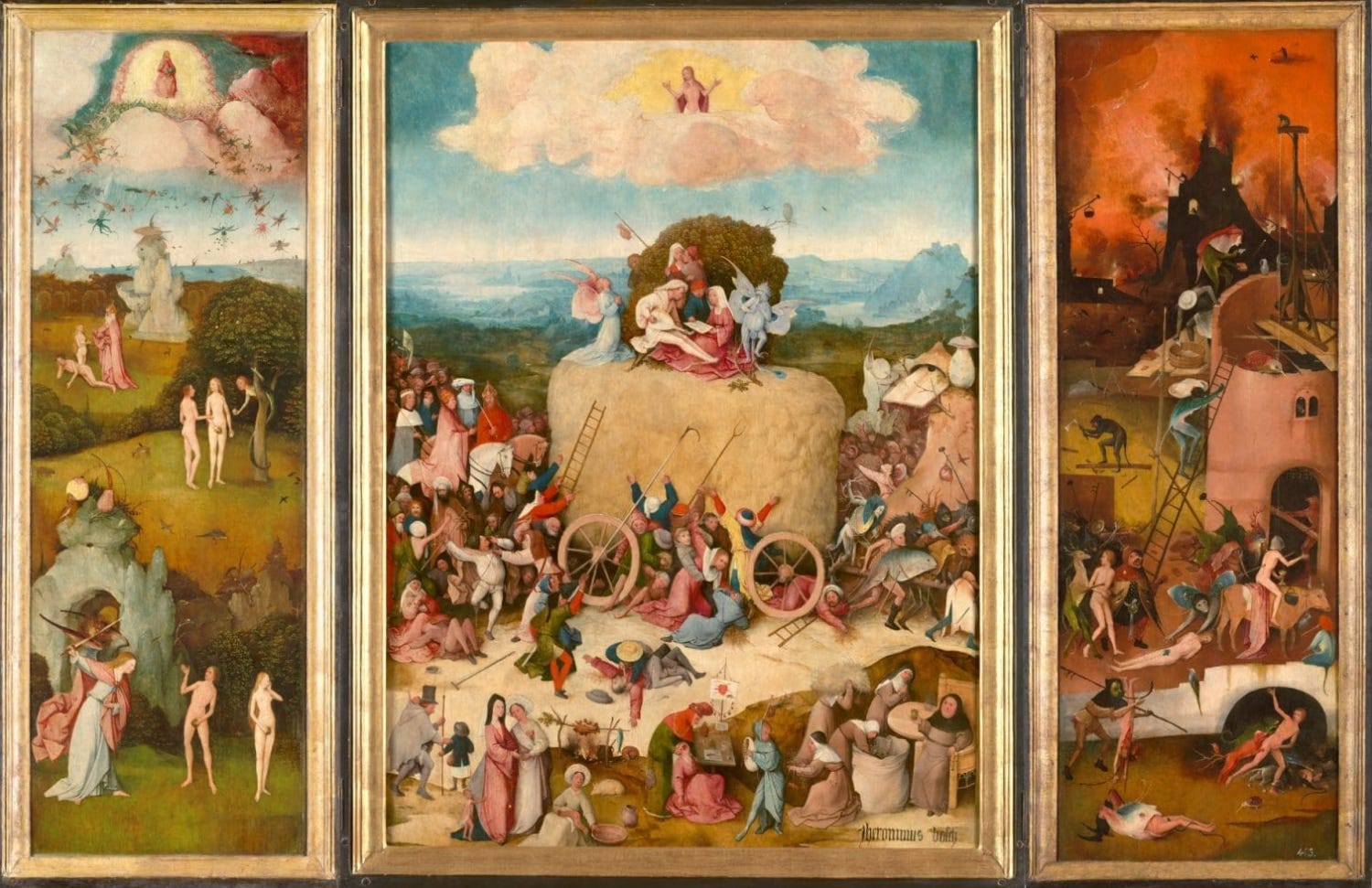
Can the soul be extinguished? Are some cultural forces structurally purposed to crush the soul? Can the soul be restored? History may have answered these questions in the negative, despite the dominant discourse steering us away from its uncomfortable conclusions. This essay, however, reconsiders these impolitic conclusions from the lens of prehistory and reveals how preternatural, meta-cultural forces explain the historical trajectory of Man’s soul and how it’s integrally connected with our current civilizational malaise.
This trajectory is relevant today as State power grows to levels that only a Sumerian God-King could have dreamed of. The ultimate power, the power to enslave not just the body but the mind rests just over the digital horizon. The Panopticon State needs only a cyberpunk One Ring to cover the world in a permanent Pitești Prison, and if the State has the ability to reach our thoughts, why not grasp for the soul as well. After all, what’s a Hell for?
We have been here before. Mass forced labor - the essence of slavery - began with the invention of agriculture in the Neolithic period. The State - founded on that labor’s surplus - came a few thousand years later with it’s own upgrades in degradation. Five thousand years ago the hard-labor economy permeated Europe and the State’s first roots strangled the natural political rights of men, anastomosing from its source in Sumer. Life was bleak and the future seemed bleaker still. It was then that a group of marginal pastoralists from the Pontic Steppe launched onto the world stage, trampling the roots of incipient Statism and emancipating the souls of the bound.
Five Grains and Seven Millennia Ago…
To fully appreciate how Indo-European culture brought about a revolution let’s back up a bit and consider the dawn-time of the soul: the Paleolithic rise of Man. The Hunter-Gatherer’s life was no paradise. He was constantly at the mercy of the elements and the migrating herds, hunted by Neanderthals (for a time) and still at war with his fellow man when resources were scarce. But let’s face it: the life of the wild hunter was vastly preferable to the drudgery that came with agriculture.
Around 9000 BC some Hunter-Gatherers (HGs) in the Middle East started settling down. Within a couple millennia most HGs in that region had exchanged hunting for the trophic reliability of agriculture. The subsequent invention of pottery also meant that food could be securely stored for times of scarcity or transportation. However, this security came with a steep cost.
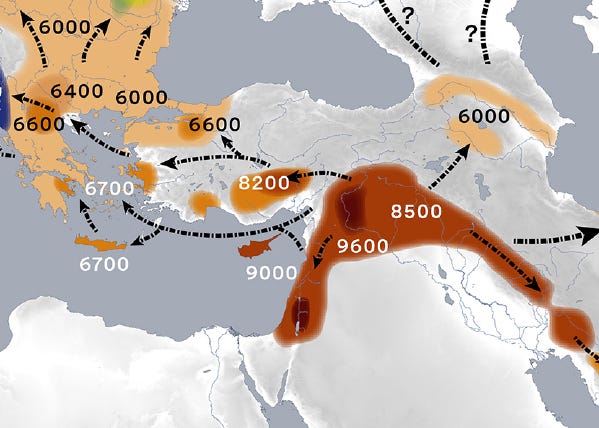
I’m only being slightly glib when I say this was Man’s first Faustian bargain. Certainly farmers weren’t mere prisoners on their land - they still hunted and fished. Increasingly though they abandoned the hunt, as ungulate domestication made protein easily accessible. Eventually the skill was lost altogether. What replaced it was repetitive, back-breaking labor, all day, month and year. Agricultural Man became a drone of the field. Agriculturalists soon discovered they hadn’t just bound themselves to the land but also the succeeding generations.
Labor must have been arduous as productivity was low. The Agriculturalist might toil from dawn until dusk with the only reward being a bowl of barley porridge. It got much worse. The bargain for food “security” was no guarantee. Neolithic farmers practiced subsistence agriculture (as most farmers did until the early Modern Era) and were at the mercy of Nature’s vicissitudes. Unstable climate was no friend to the HGs either but to the incipient farmers it was the hand of death1. They were now completely dependent on grain harvesting and animal domestication. If the climate worsened then reduced harvests simply meant dying. Migrating to better farmland was still possible, but having lost the ability to hunt it was a gambit. Besides, by the mid-Fifth Millennium BC there was little unoccupied farmland.
To make matters worse many farmers domesticated just five types of grain as their main staples. Certainly their diets were supplemented with some animal protein, but beyond that there was little diversity. Given the primitive state of agriculture it created a huge health challenge.
Consider for a moment the bread aisle of your local supermarket. In almost every case, you’ll see an arsenal of fortifying agents (niacin, iron, calcium, thiamine, riboflavin, folic acid, whey) along with an alien bestiary of other chemicals. During WWII it was decided that the foregoing supplements should be added to flour to make up for its paucity of nutrients. Many grains, though calorically dense, are notoriously low in vitamins and minerals. Requiring these additions to flour and milk seemed like the sensible thing to do for a population reeling from the Great Depression.
The first Agriculturalists in Europe and West Asia lived off of emmer, einkorn, barley, rye or millet almost exclusively. Compounding the lack of nutrients, millet actually contains abundant anti-nutrients in the form of phytic acid, which inhibits the uptake of vitamins. These wheat grains were selected over the millennia for their durability in semi-arid regions like Mesopotamia - taking the high calorie count as an acceptable trade-off - but in the end it was a Devil’s bargain with an increasingly low return.
One can easily imagine how this cycle might play out. Over the centuries inevitable droughts and famines would progressively push some farmers to destitution. The survivors would seek new farmlands but eventually these were maxed out or taken. Those farming communities untouched by drought would then be confronted by those migrating drought victims, who might offer their labor in exchange for food. The natives would keep the lion’s share for themselves as their prerogative and the migrants, grateful at first for their lives, accept less. Inevitably the migrants become resentful, fueling strife. At some point tensions reach a boiling point and the newcomers would be beaten down. Eventually any difference between their station as migrant laborers and slaves dissolves.
It’s possible that the migrants might win out in a few lucky cases, but given their reduced share of the calorie-count this is less likely. Thus a class of permanent slaves is created out of the migrants while the natives become the master class. What was supposed to be a respite from the constant struggle of hunting now morphed into a novel social compact between new types of humans: slave and master.
Was slavery only an innovation of the Neolithic? Didn’t HGs also have slaves?
While the capacity, or desire, to control another human is universal, enslavement before sedentism was very challenging. HGs live in small bands and confining more than a few slaves would be difficult. Hunter-Gatherers, not being accustomed to labor, also make poor slaves. They can and would flee without systematic confinement and unlike farmers the wilderness is their natural habitat.2
With his in mind it’s easy to see how scattered, peaceful farming communities could coagulate into clusters of hierarchical slave-owning hell-holes. For predatorily-inclined masters it would be all too tempting to take this process to the next level. Moving from incidental slave-ownership to outright coercion of nearby vulnerable communities would have been the next stage evolution. Within a few centuries whole populations would have transformed from communal land-labor to chattel slavery, hopelessly toiling until death. This is what happened in many parts of Mesopotamia where indenture to a tiny fraction of masters/owners became the norm. Meanwhile, just below the masters a cohort of specialized laborers entrenched themselves as overseers, priests and clerks forming the new “elites”. Never forget that this is what historians and academics have traditionally called the “birth” of civilization.
La Mort Dans L’ Ame
The Mesopotamian model was not the only way that former HGs lost their freedom (and soul) to perpetual toil. The Neolithic Agriculturalists of nearby Anatolia (called the ANFs) might have been less geographically constrained - by 4400BC they’d settled effectively all of Europe - but they left none of their propensity for confinement behind. No longer able to hunt (in a continent of virgin forest), they would have been effectively quarantined to pockets of land suitable to their limited form of agriculture.
Whether because of their new reality, convenience or tradition most early Neolithic farming communities lived in a single, giant house - called a longhouse. These were dark, dank and disgusting domiciles where several extended families dwelt. There was no privacy. Everything was everyone’s business and no one escaped the watchful eye of the longhouse elders. Longhouses had no windows for light, no chimneys to channel smoke and obviously no running water or sanitation. In fact one of the main reasons we know so much about Neolithic life is from archaeological excavations of the “middens” surrounding the dwellings. Garbage was heaped on a pile not far from the house. There animal remains, rotting food, excrement and other detritus would putrefy within wafting-distance. Naturally this bred pestilence and vermin proliferated.
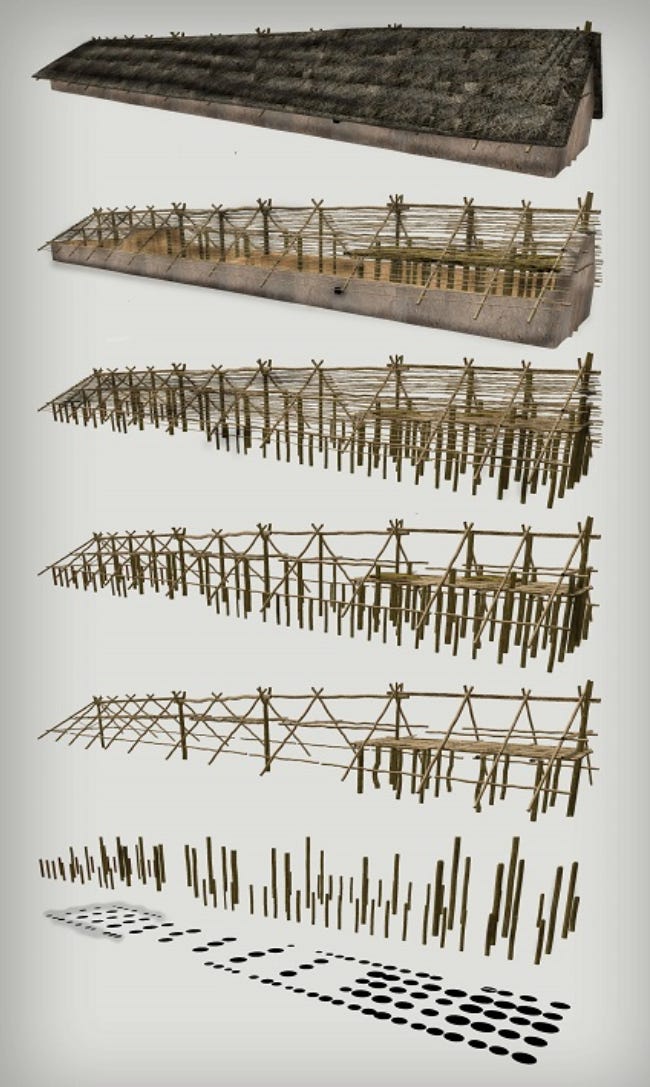
Whereas the remains of HGs are rarely found with evidence of disease, farmers’ remains often show signs of the usual suspects: cholera, typhoid fever and dysentery. The confined, unaerated longhouse would have been an incubator for these. Throw in domesticated animals and the potential for zoonotic plagues turns the longhouse into a veritable petri dish of contagion. Life expectancies dropped, infant mortality rose and quality of life disintegrated.
Yet the farmers continued to multiply at a prodigious rate compared to HGs. I won’t go into the details of why that was, but suffice to say that the constant mobility of nomadic life is not conducive to high fertility. Sedentism, even with higher mortality, is.
Crowded, dark, dirty and sickly. This would have been the dominant lifeway of the Early European Farmers (EEFs). Surely the farmers would have spent their time outdoors then? Perhaps, but this was Europe, not Anatolia. The weather is not as clement, the winters can be brutal by comparison and one would not want to venture too far from the settlement. The arable valleys were theirs for grazing or farming but the woods and hills still belonged to the hunter-gatherers. Taller, stronger and healthier than the Agriculturalist newcomers, the HGs were at best strange-looking traders, at worst foreign giants or monsters.
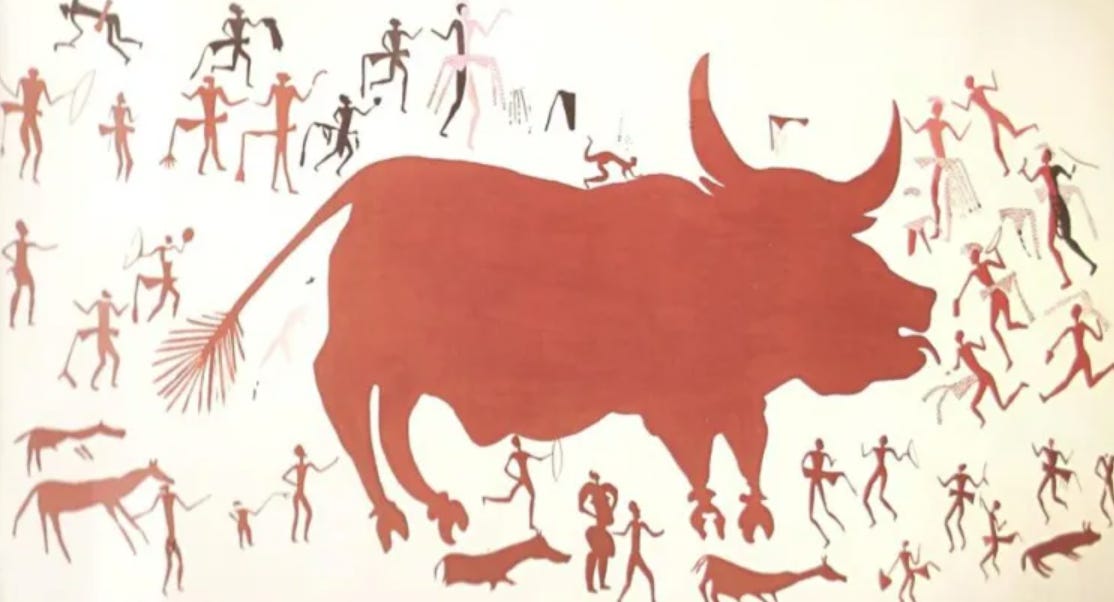
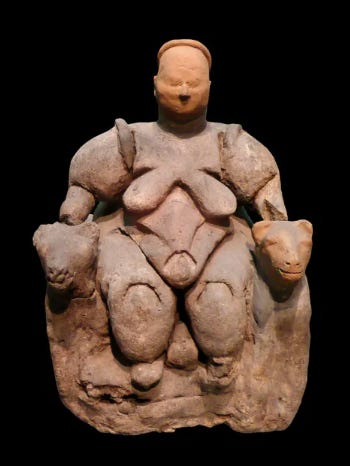
While we’ll never know what life was really like, when you look at early proto-farming communities such as Çatalhöyük you get a sense. Narrow rooms with low ceilings and no light. Smoke obscuring crimson images of dangerous beasts set in massive relief against walls the color of bone. Dominating all of it was a corpulent matriarch-goddess, featuring the same cretinized features of the Venus of Willendorf. The all-seeing All-Mother, ready to judge and devour her kin.
Of course this is just one impression. Perhaps the menacing “Venus” figure is there to hand out hugs and the hadal depictions of horned, slavering beasts were just the equivalent of a hunting manual. The EEFs were not the same people as their ancestors at Çatalhöyük but the essence of their lifeways remained eerily similar: close-quarter living with little fresh air or light; a meagre and monotonous diet low in nutrients; Incessant manual labor surrounded by filth; and all under the watchful eye of ubiquitous female deities and figurines.
The Power of Risk
In the course of a thousand years the Early European Farmers had spread from the Bosporus to the British Isles. Reproducing their package of brutish longhouse living and matriarchal worship wherever they went, they pushed their way of life to the ends of the Earth. By the mid-5th Millennium BC they’d reached land’s end throughout all Europe, save the vast, remote wildernesses of the interior. It was into this Hobbesian diaspora that the Yamnaya (the first speakers of Proto-Indo-European) burst around the close of the 4th Millennium BC. The contrast could not have been more jarring. Used to wide open spaces, the Yamnaya would have found (literally) small men tending to gardens and worshipping pyknic figurines in the reek of a dim longhouse. The Yamnaya moved fast and broke things.
The farmers may have lived nasty lives but as long as the weather cooperated there was usually food to sustain them. In fact it’s only with large agricultural bounties that EEFs like the Cucuteni-Trypillia culture could have sustained multiple settlements in the thousands. Unfortunately the weather did not cooperate as the 4th Millennium BC moved into it’s second half: it grew cold and it grew dry (in eastern Europe). Add to this a nutrient-impoverished diet and a cloistered way of life and we get a pretty vivid picture the people the Yamnaya encountered.
Where the long winters and drought killed off the EEFs it had a surprisingly different effect on the Yamnaya - pastoralists of the steppe. With the onset of colder/dryer weather they too stared down starvation - foraging as they were in the sheltered valleys of the west Eurasian plains. In this moment of bad fortune they made what was anthropologically a ‘Hail Mary pass’. Surrounded on all sides by the endless waste of grass they took their horses and their cattle and gambled on the barely-known.
The gamble paid off. Horses (unlike other ungulates) will screef away the snow to get to the grass underneath - enabling them to survive winter on the plains. The Yamnaya’s ancestors had survived off horse meat for hundreds of years, so this made the plains viable habitat year-round. Cattle required transhumant migration across multiple ranges through the growing season, so as long as winter foraging was possible herds survived. They were already familiar with the wagon and over the centuries had made continual improvements thereto.3 At first they adapted to the steppes. Then they thrived.
One small step into an risk-based lifestyle had become one giant leap forward for technology, prosperity and a hinterland culture destined for greatness.
Their gambit successful, they unleashed the power of risk. Raising cattle was difficult enough, so they began rustling too. This risky endeavor involved sneaking up on an unsuspecting neighbor or tribe and making off with their herd. Naturally they had to be prepared for violence and the defender usually had an advantage. So they took another risk.
Somewhere on the range a patient Yamnaya warrior found a lost foal, unafraid of humans and tractably smitten to follow its new herd alpha (or so one possible scenario goes). As the foal became a mare the warrior attempted to mount the animal (as friends had tried and failed in the past - some to their demise). This time the mare accepted the warrior on its back without much complaint. This clever Yamnaya realized that if he bred the friendly beast there would be mares and stallions socialized to humans like this one. Repeating this process, breeding only the tractable ones, and drawing in other horses deemed suitably docile, they domesticated the horse and changed the course of history.
Mounted warfare was still thousands of years away, but being able to travel by horse reduced the vast plains from featureless wastes to a network of roads. Not only could neighboring herds be approached with near secrecy for cattle-rustling, but atop horses they could range their herds further and faster than ever imagined. Distances once thought inconceivable could be conquered in a season. Herds need not trample the same overrun fodder when fresh browse was now within reach. With luck an enterprising young man could take several dozen head, venture into the deep unknown and return a generation later with thousands of cattle at his back and a large family to boot.
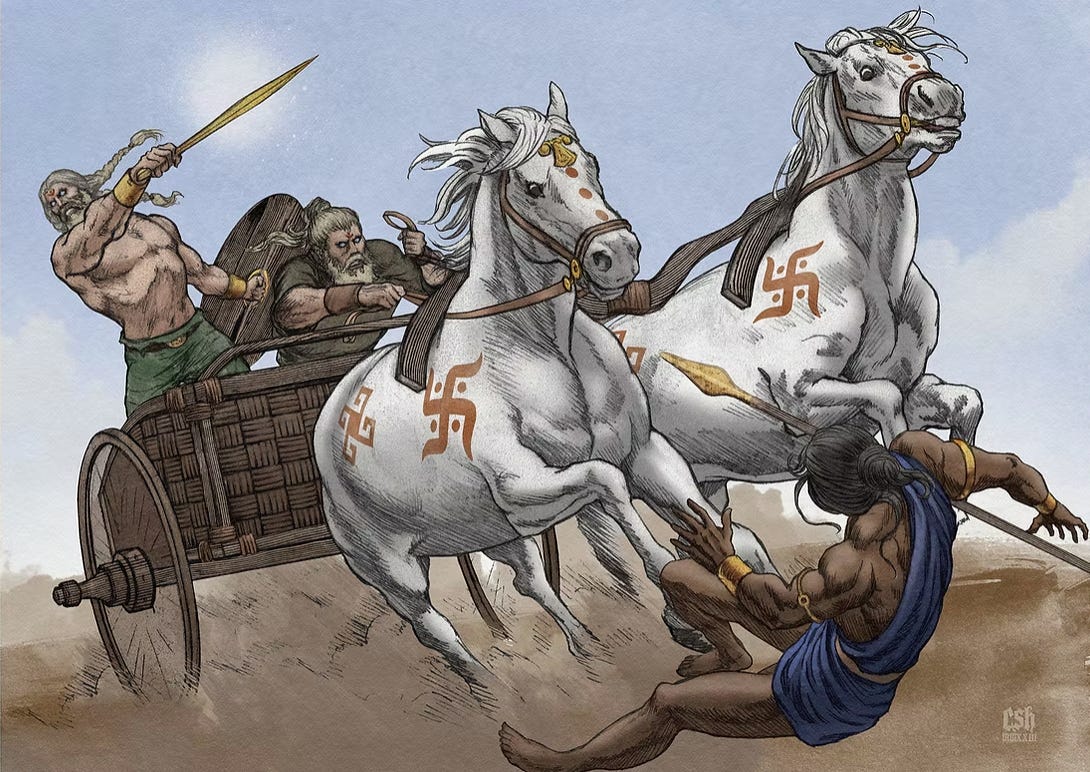
Even more revolutionary, enemy tribes could be surprised in the middle of the night for a quick smash-and-grab. Powerful foes miles away could be approached without warning, slaughtered in their sleep and the Yamnaya warriors could abscond just as fleetingly. It was the discovery of stealth as much as the discovery of wealth. One small step into an risk-based lifestyle had become one giant leap forward for technology, prosperity and a hinterland culture destined for greatness. Spurred on by their good fortune and sacrifice (many must have died in the attempt) they set their sights on the west, the lands of that hapless human domesticate: the Agriculturalist EEF.
The Plutonic and the Uranic
The Early European Farmer lived under conditions that the Indo-European found abhorrent: a complete lack of freedom, never a moment alone or beyond the watchful eye of the Den Mother; squalid living conditions contaminated with a growing roster of diseases; adulation of female idols and a bias for the persistence of a communal “family” - over the “natural”, nuclear family. It should come as no surprise that our notion of “natural” is largely drawn from these steppe herders who viewed their own lifeways (primacy of kinship, honor culture, cattle rustling, hereditary wealth accumulation, risk-taking) as a quasi-theurgical cultural package - not surprising given how successful it had been. In a few centuries they’d gone from marginal foragers to masters of their lands, while the peoples of Europe eked out an ever more marginal existence at the fringes of survival. A few centuries later those riders would be masters of Europe.
In Mesopotamia those clusters of hierarchical farming societies had metastasized into full-on slave societies. The surpluses of unfree labor brought many riches to the elites, including the features of urban life: permanent architecture (to honor the Gods, of course), resplendent art and raiment (again, all to honor those Gods) and a division of labor that favored resource allocation to an ever-growing caste of priests, palace retinues and rent-seekers (obviously, to honor the…).
The Mesopotamian Urbanite lived an even more abysmal existence than his distant EEF cousin. While contact between steppe pastoralist and Mesopotamian would have been infrequent, it’s worth noting that both cultures began their rise at approximately the same time.4 Mesopotamian Urbanites labored at the whim of the urban ruler - often a “God-King” - whether in the fields or the city. Examining the sociology of the more distant Sumerians is not my intent here (I wish to focus on Europe), but it’s very telling that after Semitic civilization (ie. the Akkadian, Ugaritic, etc) replaced Sumer the word they adopted for “ruler” was borrowed from their former overlords’ lexicon, a cognate of Sumerian for “owner” or “master”.
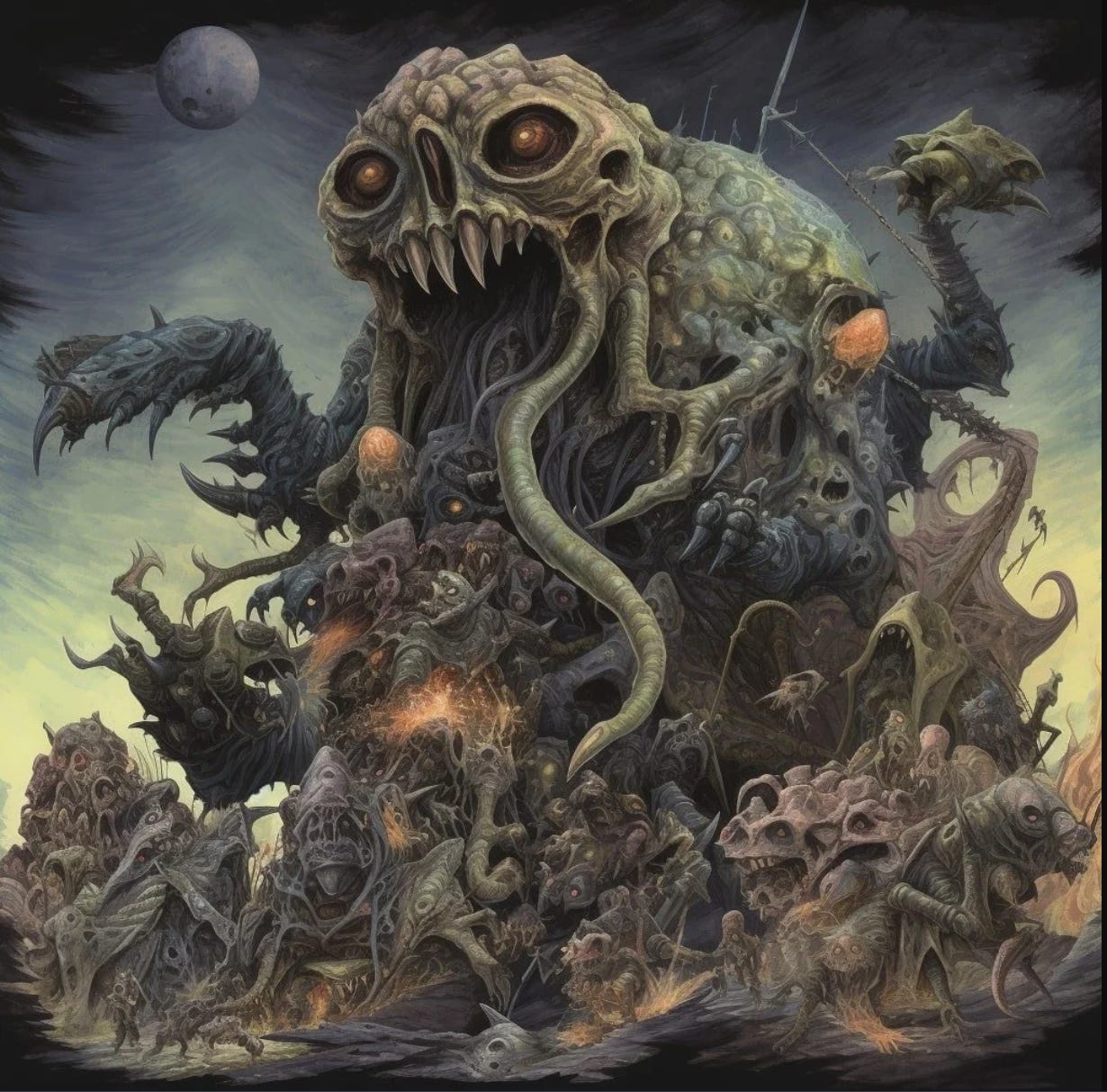
All of these lifeways (or cultures, practices, religions, belief-systems, epistemologies, etc), have as their ultimate telos the crushing of the soul and deprivation of human spirit. I call them the Plutonic.
The Urbanite had once farmed the land like the EEF, but after many cycles of feast and famine had found himself indebted beyond his ability to pay. Gradually the wealthy courtiers of the God-King assumed those debts in exchange for ever more privative forms of bondage until they were slaves in all but name. If the European farmer’s life was tedious drudgery, the Mesopotamian lived in soul-crushing hopelessness. This was no coincidence or side-effect. This was the purpose of that particular human lifeway, begun in the Neolithic, that impounds the body and asphyxiates the soul so it may never again threaten those holding absolute social and political power.
This soul-destroying lifeway is not necessarily coextensive with a particular philosophy, culture or religion (though some come very close, cough cough…) so it would be inaccurate to use any extant labels. Instead we need new referents, shorn of political baggage to refer to such lifeways. These are the lifeways that institutionalize bludgery and rent-seeking, justifying it with rhetoric as righteous as it is specious; the cultures that manufacture consensus through insinuation and ostracization instead of deliberation and franchise; the practices that penalize risk-taking and enforce “safety”; the religions that demand submission of the body and coercion of the conscience; the belief-systems that reduce politics to meaningless performance and decision-making to formal ritual; and those epistemologies that imbricate causation beneath layers of unctuous explanations and excuses. All of these lifeways (or cultures, practices, religions, belief-systems, epistemologies, etc), have as their ultimate telos the crushing of the soul and deprivation of human spirit. I call them the Plutonic.
Technocratic urban dystopia is the epitome of this lifeway and it’s no coincidence that the first Agriculturalist-to-Urbanite “civilizations” evolved directly in that direction. No matter in which historical period it manifests, it always involves the death of the individual, distinction, reason and reality (other than to coopt the definitions thereof to preserve the ruling class).
On the one hand the Plutonic is mostly entropic. It’s professed goals are to make everything equal and featureless. However it is entropy in the hands of humans. There it takes on an especially evil dimension. Humans are naturally hierarchical and in the quest to erase all difference human elites will nonetheless preserve their own differences (of status and resource allocation), impoverishing the vast majority even more than entropic forces alone are capable of. In this sense it is not strictly entropic, as such a system would gravitate to a homogenous attractor, like equal poverty. In a strictly entropic system even the ruling class would eventually be impoverished and shorn of power. Thus a distinguishing feature of a Plutonic system is that the ruling class always pays lip service to righteous concepts (like “equality”) while extracting ever more resources to maintain their status. The Plutonic is therefore the apotheosis of hypocrisy.
It is a religion of submission that may publicly eschew its most incriminating doctrines with lip-service to ‘tolerance’ or ‘compassion’ or whatever preposterous lie credentialed credulity will swallow.
This variation from pure entropy exposes a susceptibility of Plutonic systems. The energy required to sustain the ruling class cannot be exhumed from the corpse of the body politic. Once that body is exsanguinated the elite must devour itself. Thus the Plutonic consumes its own in a spiral of internecine purges. In theory this ought to destroy the very elite responsible for such evil. In reality this process can take centuries where no exogenous shocks disrupt its devolution. Moreover, some exogenous forces may act to provide material sustenance for a decaying elite. History is replete with such examples.5
There’s no need to generalize the Plutonic to any single culture/religion/belief-system. You can already see for yourself its manifestations infecting our institutions, if not at the very heart of certain creeds and secular cultures. It is more than just a ‘Death Cult’. It is a death cult masquerading as soothing self-flattery in order to dull the natural reaction of men to fight or flee. It is a religion of submission that may publicly eschew its most incriminating doctrines with lip-service to ‘tolerance’ or ‘compassion’ or whatever preposterous lie credentialed credulity will swallow. It is worse than death, as death almost always creates new life. The Plutonic will preserve itself in a state of putrefaction longer than the memories of most men.
Contrast this with the lifeways introduced by the Indo-Europeans. Through good fortune and self-sacrifice they evolved a system that embodies the opposite of the Plutonic. Theirs prioritized leadership and distinction. They elevated risk-taking per se and invented a system of reputational legacy (the heroic story) to preserve the lessons of those who embodied it6. They institutionalized systems of honor and liability justified by common-sense and self-evident truth. They practiced religions that elevated sacrifice above obedience and emphasized conformity only with the natural order of things. They constituted political systems that comingled participatory consent with executive impetus. And they did so with an understanding that cause begets effect. They collectively understood that sooner or later there was a “bill to pay” and burdening future generations with that debt was an unconscionable wrong. For these reasons I call this system the Uranic, after Ouranos the Olympian God of the Heavens.
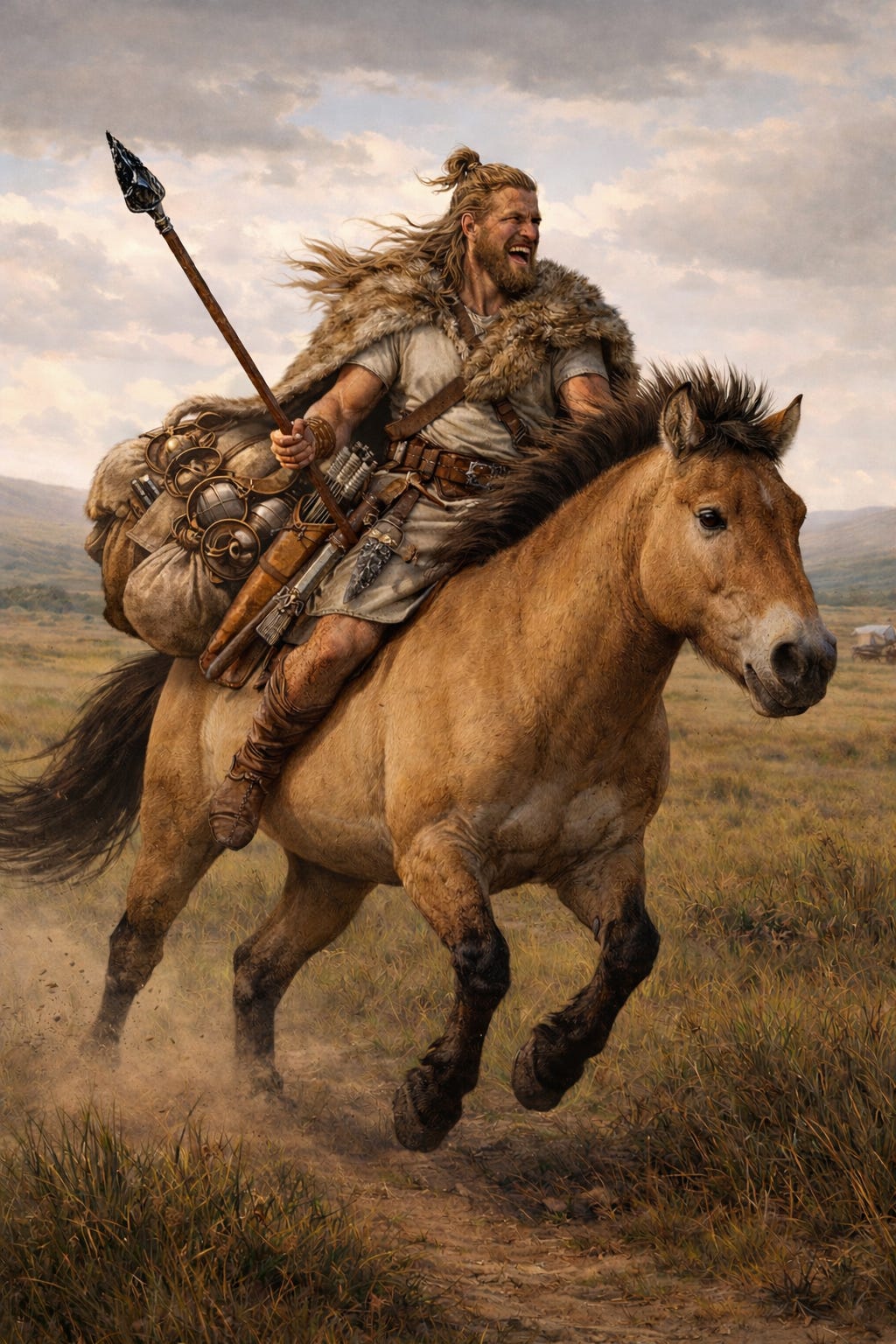
Uranic systems are highly extropic - that is, they reduce entropy and create spontaneous ‘hierarchical order’ when given the chance. Chance (not randomness) is at the heart of the Uranic. It offers up opportunity though man must be capable of realizing and exploiting it to fully manifest its potential. Apologists for the Plutonic will say that the Uranic “tempts” its adherents to ruin with lucrative windfalls, guaranteeing nothing in return. Though a mischaracterization of the Uranic, it is true that many outcomes are negative - it is not for the faint of heart. Its outcomes will always be unequal and sometimes wildly so.
That’s why it also has an integrated system of communal anamnesis: story-telling. It offers adherents a shot at greatness and longevity through cultural memory and expression. Those who live by its whims are heralded as heroes, their deeds recalled to memory and sung here on Earth long after they are gone. Either your risks will result in material prosperity or with a collective legacy. Glory lives on.
Beowulf summarizes this philosophy best when he rallies Hrothgar to take on Grendel:
For every one of us, living in this world
means waiting for our end. Let whoever can
win glory before death. When a warrior is gone,
that will be his best and only bulwark.
This is not elegy. This is what men like Beowulf, and all his fathers, believed. Thus present acts of bravery are married to the promise of glory in a never-ending struggle to wrest legacy from oblivion. To the Indo-Europeans a warrior (the pinnacle of the risk-taking archetype) never dies so long as future warriors extol his exploits. Many examples of this exist in the Indo-European literary pantheon. Take stanza 77 of the Hávamál (fittingly from the part called “Gestaþáttr” - the guest’s section):
Deyr fé,
deyja frændr,
deyr sjalfr it sama;
ek veit einn,
at aldri deyr:
dómr um dauðan hvern.
Which I’ve liberally translated with poetic élan here:
Cattle? They die.
Your kindred friends? They die too.
And You?
You’ll die all the same.
Yet one thing that never dies
Still I can name:
The fate condign the glorious dead,
Each man bestowed his fame!
It’s worth contrasting this with the ontological disposition of Agriculturalist/Urbanist cultures (ie. those descended from the Sumerian and Proto-Semitic tradition) from Psalm 103:15-16.
As for man, his days are as grass: as a flower of the field, so he flourisheth.
For the wind passeth over it, and it is gone; and the place thereof shall know it no more.
Once you are dead you are gone and not only will others not remember you, but you have even been materially erased from your native homeland. I can’t think of a more telling contrast in eschatological emphasis.7 In fact the Yamnaya were early and frequent adopters of burying important men (the greatest and most successful risk-takers?) in giant mounds, visible from miles across the steppe and ages across time.8
Thank you for reading so far. This Substack is provided free because I don’t believe in paywalls. If you have enjoyed this post, and have the means, please consider making a pledge.
Our Indo-European forebears wielded language both as a weapon to assimilate conquered cultures and as a shield to preserve their traditions, especially the tradition of glory as a reward for risk-taking. How else have the epic poem, the troubadour’s romance, the swashbuckling-adventure tale, and the blockbuster movie endured and proliferated over millennia? What other way would the Uranic promise of eternal glory be kept without words and voice? No other “Meta-Culture” has continued to put as much emphasis on its oral and literary traditions… and there’s a reason for that.
Sympathy for the Devil
If you take the soul’s existence for granted then it ought to be uncontroversial that how one lives one’s life has a determinative impact thereon. The notion that profitless labor and abject servitude denigrates the soul finds at least superficial agreement across the political and historical spectrum. Thus we are confronted with the stark teleological divergence between the two meta-cultural systems: the Uranic and Plutonic. One offers risk, guarantees nothing in return, but rewards heroes and opportunists with either material wealth or eternal remembrance. The other system offers no risk and guarantees security (abstract or tangible) but the only eternality it offers is beyond the reach of this life (and, coincidentally, its scrutiny).9 Thus men either undertake vainly to be like Gods or exchange their souls for daily bread at the longhouse door.
The Plutonic guarantee of security (food/housing/protection) requires the exchange of personal freedom, which in turn deprecates the soul. The greater the promise of security the greater the deprivation of freedom and the more laborious the prestations, with commensurate psychical degradation until reduction to slavery erodes all pretense to a bargain at all.
The Uranic system creates a different bargain. It offers no security, let alone any guarantees of it. Instead it offers a chance at great prosperity on a sliding scale: taking big risks could yield big rewards (though death is more likely). The reward for taking small risks is nothing, thus the man who risks nothing assumes the same animastic station as his Plutonic counterpart. The Uranic, however, does not deprive its adherents of freedom. Unlike the Plutonic where one is in debt (for security, food, etc), the Uranic man remains free to bind himself in accordance with his own will in order to take the risks he so chooses. Therein lies the dilemma. It is your choice to indenture yourself, remembering that no choice is created equal. Your constraints are merely the natural order of things: business relations, friends, family, the supernatural powers beyond reckoning. Obviously great risks require great deeds, which will almost certainly constrain you - either through the undertaking of great labors or in opportunity costs. But a constraint owing to choice is hardly a privation in the nature of oppression, just as no one consoles the Plutonic slave that ‘working hard is its own reward’.

The Uranic does make one representation that you could characterize as a conditional promise: your legacy. It’s conditioned not on the will of the Gods but on fellow humans. The conditions precedent here are that (1) your deeds aspire to some form of worthiness in your fellows’ eyes; and that (2) there are a sufficient number of such fellows to perpetuate your memory. The Uranic is thus a nexus of bargains and obligations upon the undertaker and also upon his confraternals. Any civilization that upholds the Uranic system is thus a pact between living men to aspire to greatness through daring enterprise and between generations to venerate such aspirations. If either defaults the entire system collapses, like we are witnessing today.
With the Plutonic bargain, in its purest form, there’s no selling only part of your freedom (at least not in practice) because the Plutonic man has no bargaining power. Think of the Mesopotamian farmer fleeing his drought-ridden lands for new ones. When he comes upon the next fertile valley, already filled with prosperous farmers, he has no leverage to dictate terms. Either he becomes their laborer or dies of starvation. Gradually the more prosperous farmers became the masters and eventually the God-Kings.
The Uranic bargain, in its purest form, does not embody “giving up” freedom. If the Uranic man parts with some degree of it, it is voluntary. He bargains in exchange for some anticipated return, though no man has infinite freedom to bargain. Natural Law also circumscribes many exchanges, for example a son may be required to unconditionally obey his father, but the father must also teach him to be a man and so on - thus it is a moral covenant based in Natural Law.
In most other cases though he may bargain away some of his freedom, binding himself by oath. Or he may effectively bargain it away by undertaking certain deeds. If he succeeds he can thank his own ingenuity, as long as he also gives Fortune its due. If he loses his gambit he still dies knowing this brethren will remember his deeds (if they were worthy), or at the very least his soul will receive its toast each time his fellows ritualize deeds of derring-do. He has found Beowulf’s bulwark where not even the grass remembers the Plutonic man’s footsteps.
A Race of People For Whom Psycholysis is of no Use Whatsoever
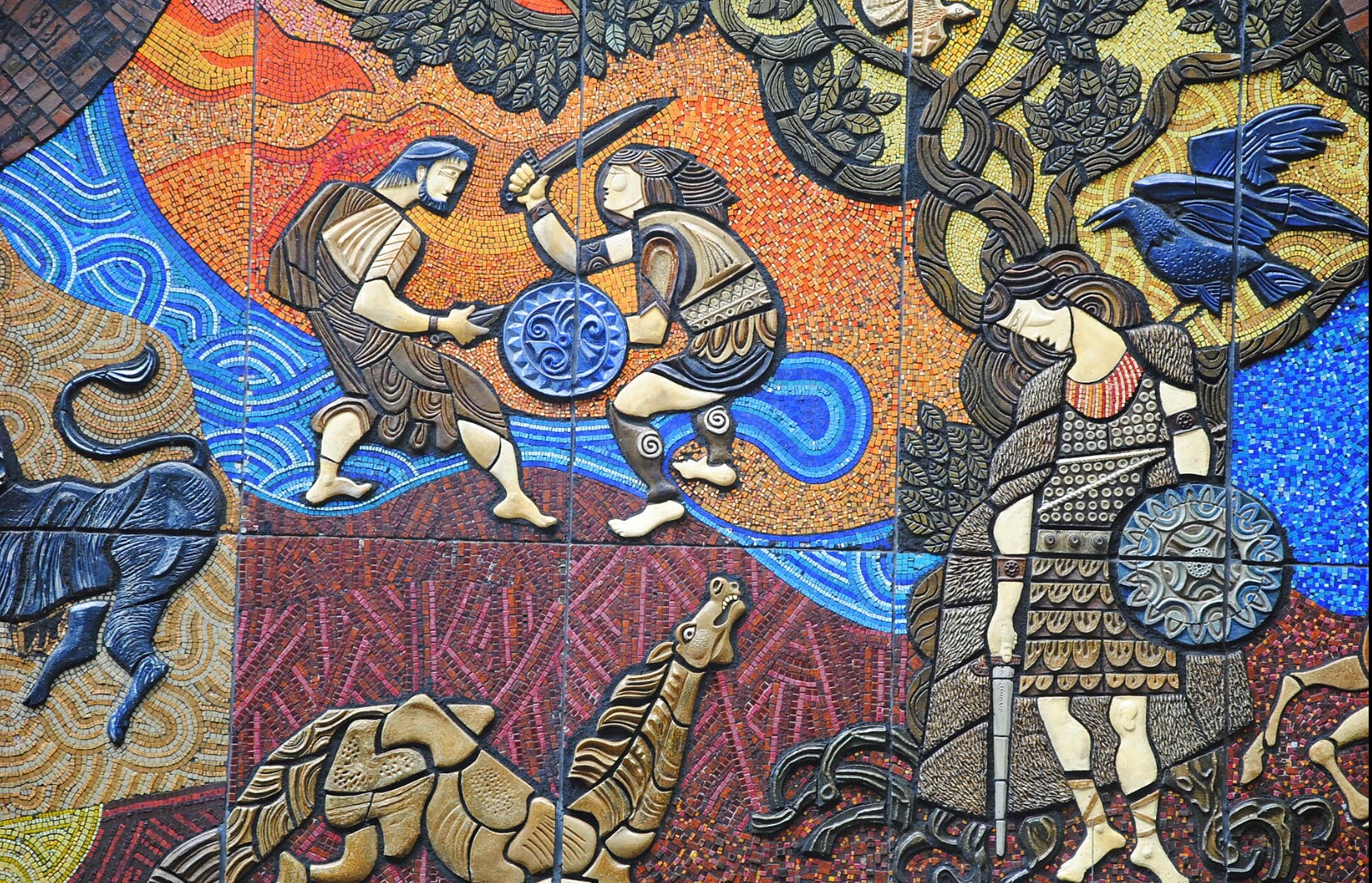
So it was when the Yamnaya burst out from the steppes to rescue the soul of man from the smothering embrace of meta-cultural Plutonism. The Yamnaya swept over the decaying settlements of EEFs one after another. This wasn’t a case of superior weaponry or greater numbers. In fact the EEFs were technologically superior in many ways with more access to metal than the Yamnaya. Their settlements were generally better defended, some evening sporting defensive bawns or mounds of earth. Their numbers would have still been substantial (if not overwhelmingly large in some cases).
Still they fell. This was because the EEFs were Plutonic creatures in the late-stage of decline. Ritualizing in their longhouses, enfeebled by disease and malnutrition, and beholden to their emasculating Earth Mother worship, it’s hard to picture them offering a successful resistance. One can imagine their elite coming up with every excuse imaginable for their defeat - save self-responsibility. One can also imagine the more truculent EEFs witnessing this invasion as a form of salvation. Some may have even been grateful to the steppe warriors for burning it to the ground. No more living in the smoky dinge of the longhouse. No more kowtowing to the Den-Mother or other superannuated elders. For those types this would have felt like liberation, a resurrection of the soul after millennia of humiliating infantilization.
The longhouse system of central provisioning of material, spiritual and moral sustenance has only one evolutionary end: Mesopotamian-style Urbanism. This is not to say that all lifeways evolve ineluctably towards the squalid tyranny of Uruk or the soulless utopia of Jodorowsky’s City-Shaft. Nor is staging a steppe pastoralist intervention the only way to prevent that destiny. For example, there were HG societies that overcame the EEFs, though this was rare. Most HGs also did not adopt the Agriculturalist lifestyle for obvious reasons.10
Ultimately though the HG lifeways gave way to the Agriculturalist ones. The attraction of Plutonic urbanism and its gateway drug, the longhouse, operated with both carrot and stick. On the one hand it offered tantalizing material abundance (how does the Yanomami warrior resume his ancient lifeways when presented with unlimited porn, Big Macs and vapes?). With the other hand it wielded its stick: farmers easily out-populated HGs over time and reduced those at the margins to debt peonage and bondage. Once the process was complete it had dissolved the soul of men and converted the dynamism of free labor into the internally irresistible prerogatives of a sclerotic elite. I call this psycholysis. Eventually elites’ wealth extraction produces social contraction as the foundation of the pyramid crumbles. This begets further intra-elite competition (usually through purges). The bottom classes are usually too weak of mind, body or soul to effectively overthrow their masters and the end is only propagated by an exogenous shock - such as a usurpation of elite roles by stronger outsiders. Readers of Peter Turchin will recognize this motif.
Thus present acts of bravery are married to the promise of glory in never-ending struggle to wrest legacy from oblivion.
The Indo-Europeans were such outsiders. Their consciousness was sensitive to the landscape of fortune: like a compass needle it always pointed towards the greatest opportunity. This is hardly surprising given the many generations our ancestors spent on the steppe seeking wealth and reputation. Their subsequent history of seafaring only steepened this mimetic gradient. For much of history the world was one big frontier to explore. As much as the unknown caused fear among EEFs, it was coveted by the Indo-Europeans. The unknown brought the potential of a large windfall, even if most forays ended in death. That desire for aggrandizement, whether through wealth, glory or power, comes dyed in the wool for people of Indo-European ancestry. It is as natural as the shining sky.
Yet as I wrote in “No Country For Old Europe” once there are no more lands to conquer, once there is no longer a frontier, it’s only a matter of time until the Plutonic re-emerges as the dominant lifeway. Plutonic civilization needed only the elimination of conveniently accessible frontiers to spread the shadow of risk-aversion across Western civilization. There are still frontiers on Earth (the Antarctic, the Arctic, the deep oceans, etc) but incentives have been reoriented away from risk-taking to resource “management”. Instead of adventurers forming joint-stock companies to discover the limits of our planet, we have feminized boards of directors and consultancies deferring to committees, expert assessments and white papers. Capital is allocated to share-buybacks and competitor acquisition, rather than exploiting those frontiers. Product pipelines are purchased instead of novelty grown in-house. And all under the scolding eye of “regulators”, as eager to stifle fortune-seeking with transaction costs as they are to smother that impulse with low interest rates and easy money. It’s no coincidence that the monetary expansion we’ve seen in our lifetime was both a Plutonic wealth transfer from the productive populations to the elites and a de facto default on our civilizational obligations. In a world without frontiers Robert Frost was wrong, the world will end in ice.
Some also say the world will end in Space though, that the “final frontier” is Spengler’s Aenean destiny awaiting us. Thus we should not fear the Plutonic capture of the soil because they can’t take the sky from us. There is surely some truth to this. Perhaps shedding the weighty coil of a home-planet’s gravity well is a meta-cultural litmus test for any species. Fail that and civilization probably circles the drain for posterity, somewhere between mouse utopia and an Eloi/Morlock dynamic. Escape the well and a myriad of new frontiers opens up.
However with a galaxy of possible rewards the price is an austere one. There is no more inhospitable and unforgiving a “terrain” for humans than Space. Our horse-riding ancestors made the leap onto a “desert” of grass, but outer space makes the steppe look like the Garden of Eden. Our ancestors had horses and cattle that could feed in that so-called “desert”. The future Indo-European man will have to find a commensurate resource to sustain him. But this time the reward will be a chance at everlasting glory writ large, a chance to dominate the Heavens and become the very Gods their ancestors once worshipped. Even if we fail to grasp that Godly station it is the reach that will grant us immortality.

There is evidence that agriculture might have developed much earlier than ~9000BC, ie. before the Younger Dryas Period but was stanched by such climatic instability.
Some might protest that HGs did have slaves. Simply look at the trade in slaves amongst natives of North America in the Pre-Columbian period. While some HG tribes of the Americas did have slaves, these slaveholding cultures were not mere Mesolithic HGs. The Haida (of the Pacific northwest, for example) had plenty of slaves but were effectively sedentary with virtually permanent longhouses and a very hierarchical society. Likewise for the Calusa for Florida.
Read David Anthony’s still-relevant The Horse, The Wheel and Language for the best monograph on this process.
The rise of the first Sumerian “city” Uruk roughly coincides with the rise of the Yamnaya and their push out of the steppes into central Europe, around 3300 BC.
China joining the WTO and becoming a forced buyer of US dollars is a textbook example of this.
While the epic of Gilgamesh would certainly qualify as a heroic story, there’s no indication that it was used intentionally for this purpose in the same way that story-telling persisted as a means in Indo-European cultures to promote heroism. The Sumerians (and successor cultures) didn’t even have a word for “epic” or “myth”. By the Akkadian period (early 2nd Millennium BC) the poem was being advanced as a didactic story not as a moral fable, and this is long after the Indo-Europeans had arrived on the scene. By then there would have been substantial material and cultural contact between these two metacultures.
Obviously there is more to each belief system concerning death and the afterlife, but disentangling purely Proto-Semitic beliefs from European Christian ones (themselves influenced by Pagan traditions) is difficult after 2000 years of assimilation. Most Christians of European traditions believe in either a heavenly afterlife with God or eternal torment in Hell, but these are not Semitic interpretations of scripture. They were more likely adopted in order to conform religious doctrine with cultural notions of causation and systems of moral order. Jews notionally believe in Heaven and Hell but it’s orders of magnitude less important than in European Christianity. Moreover some Indo-European successor cultures are famous for their promises in the afterlife, such as Valhalla or the Elysian Fields. However, in its original form Valhalla was inaccessible to all but the greatest heroes and hardly qualifies as a dispensational compact between Odin and his followers.
A more charitable interpretation of this Psalm or Tehillah (תְּהִלָּה) is that man is insignificant compared to God as the grass is to the field, and only through God can one achieve immortality. This is why I use the word “emphasis” as it is a matter of where the focus is placed. The Semitic system of beliefs is not characterized by its epic or heroic poetry, and even its rare examples (like the Epic of Gilgamesh) don’t extol the same importance of retelling the deeds of great men.
The question of who were the first to build kurgans (aka. tumuli or burial mounds) hasn’t been definitively answered. The Maykop surely built some of the largest in the Eneolithic (Copper Age) which predate the Yamnaya. They were not an Indo-European people. However other steppe IE-related peoples , like the Khvalynsk Culture, were building proto-kurgans in the mid-5th Millennium BC.
It could be argued that the need for Proto-Semitic religions to invent the idea of admission to Heaven is a sop to this otherwise depressing eschatology. After all, if we’re just meat-sacks awaiting conversion into fertilizer what’s the point in toiling for the God-King. Whereas if said meat-sacks can be sold on a promise of Heaven (or 74 virgins or what-have-you) then maybe they’ll stay in their lane. This, quite obviously, doesn’t disprove the afterlife but rather the unscrupulous nature of ruling elites to concoct mass fantasies.
The most significant deviation from this norm was the mid-5th Millennium BC return of HG dominance in parts of northern France (chiefly associated with the Michelsberg Culture). There was a recovery both of HGs cultures and a rise in HG haplogroups in the genetic profile of burial DNA. But even here this is interpreted more as a resurgence of those “indigenous” cultures rather than their assimilation to EEF lifeways.
Comments
Nothing yet. Say the first thing.
Sign in to join the conversation.