
I watched Sam Altman’s interview defending the resources AI consumes. He said that the water consumption of data centers is exaggerated, ‘fake’, and compared it to the resources humans consume while growing up and becoming trained workers over 20 years.
That answer felt simply inhumane.
It reduced human development to a capitalistic ROI calculation, overlooking the deeper values and purposes behind all the struggles, time, and exploration humans have experienced historically and in the present—individually and collectively, cognitively, spiritually, and physically.
How frightening is that kind of answer from a CEO helping shape the technological future of human society?
I remembered a phrase that once touched my heart in college:
there are certain things that should never be accelerated without harming their integrity—education, farming, and raising children. They are forms of cultivation, not production. They require patience, integration, and time.
The Seasons We Used to Wait For
I often miss those slower times when we all had to wait for certain seasons to have certain fruits because they were best in that moment.
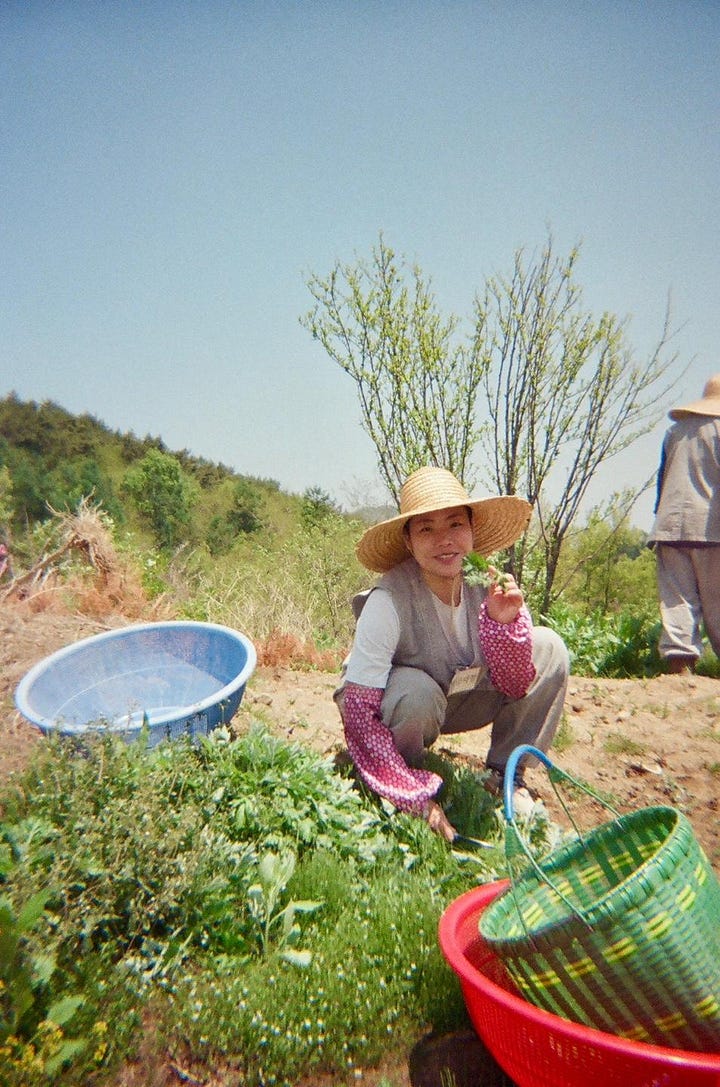
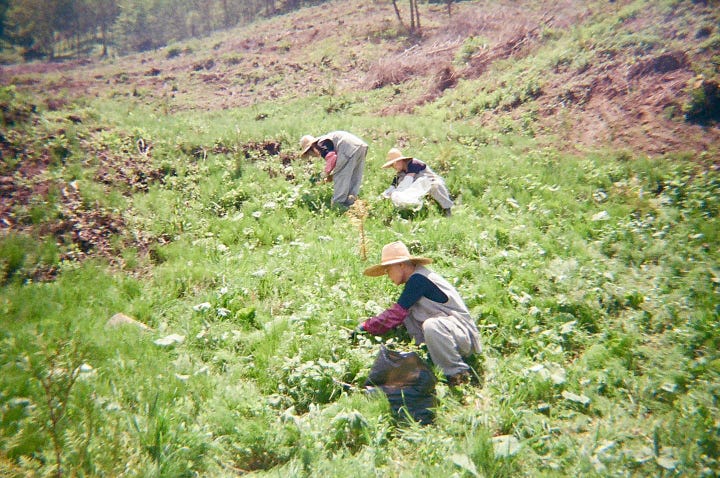
In early spring, we went outdoors to collect the freshest and softest mugwort and wild greens. If that short window passed, the mugwort became wild and strong and was no longer edible. We cooked them into rice cakes and spring green soups.
I always waited for spring strawberries.
Winter apples as big as my face—juicy, firm, and naturally sweet.
Fall persimmons dropping naturally from trees, which we froze like sherbet ice cream.
That was the law of nature.
Nature offered abundance throughout the year, but always in the most suitable and nourishing form from the land, water, season, and hard work by numerous unknowns.
And like the Buddha said—it was all desire.
Desire wanted strawberries, coconuts, mangos, chocolate, and coffee all year long, no matter where we were.
Now local souvenirs barely mean anything. Whenever I travel, I pick something up at stores, only to realize later that the same item exists on Amazon, in supermarkets, or at Costco.
The joy of rarity—the joy of difficulty, of seasonal availability, of discovering something that only exists in one place—has slowly disappeared.
Only later did I realize these moments were quietly teaching me the same lesson. The seasons of childhood, the waiting on a small island in Nicaragua, and the women stirring fruit into jam in Tanzania were all pointing to the same truth: happiness grows slowly in the spaces where life is allowed to unfold at its natural rhythm.
And only when we stop categorizing between ‘happiness’ and ‘unhappiness’ based on our desire.
The longest time I waited for a local town bus was on Ometepe Island in Nicaragua. I don’t even remember how many hours, over two hours maybe?
There didn’t seem to be one fixed thing called “time.”
A bus timetable was posted at the stop, but no one seemed to know which bus would come or when it would arrive.
I, the city girl, was the only one filled with anxiety, anger, and stress at first. I was used to live-tracking every bus movement and route so I could be ‘efficient and productive’ throughout the day.
After the second day, I lost ‘time’ on this magical island which was truly timeless.
I learned how to live without the rigid concept of time.
Waiting was simply part of life.
And part of the joy of travel.
I was the foolish one trying to cling to the notion of “time management.”
I strolled around the block. I watched the sun slowly lower in the sky. A farmer passed by with a cow, a baby donkey circled around me, seeking some affection. School children rode home laughing on bicycles. I met two European girls and we sat on the ground, learning about each other’s lives. Everything and every scene on the same spot.
I lived at my moments.
Then eventually, from the distance, an old chicken bus appeared. I had almost forgotten that I had been waiting for it. Waiting no longer made me anxious. It was my perception that had changed.
A Different Kind of Abundance
In Tanga, a small coastal city in Tanzania, I began in earnest a project that had long lived in my heart—Inner Peace to World Peace.
I had finally arrived in Africa, the womb of humanity, the continent where I had dreamed of working since childhood.
The journey was long: thirty hours from Toronto via Egypt, then a seven-hour bus ride from Dar es Salaam, and finally thirty minutes on a local tuk-tuk motorcycle taxi to a remote village.
At the office-slash-temporary lodging of the Dira Women’s Organization (DIWO), several shy young women welcomed me—Joyce, Miriam, Tatu, and Zena. Volunteers for the organization, they became my project crew, interpreters, cooks, and even cleaners.
They had prepared a small, clean room for me with great care.
In the bathroom, two large buckets of water were waiting.
My ration.
Enough for washing my face, showering, and flushing the toilet—for the next two days.
Major construction was underway nearby on the East African highway connecting Tanzania, Kenya, and Uganda. Water and electricity were restricted.
The faucet—the one I used to twist open endlessly in the city—produced not a single drop, no matter how I turned it.
The difficult days began.
We saved solar power during the day so we could use light at night. Internet was almost nonexistent. In the countryside, night arrived early and naturally. Communication with the outside world faded, and our days ended early.
Strangely, the simple routine felt full and peaceful.
Women from their twenties to their sixties gathered for our leadership workshop. Each morning we began with a short meditation, and each evening we closed with one.
The breathing practice was unfamiliar to many of them at first, but after a few days they seemed to relish the calm it brought. Some even asked if the meditation could be longer. For women exhausted from physical labor, those quiet moments brought deep rest—and sometimes a small nap.
Meditation transcended nationality, language, age, and gender. The human capacity to return to inner quiet belongs to everyone.
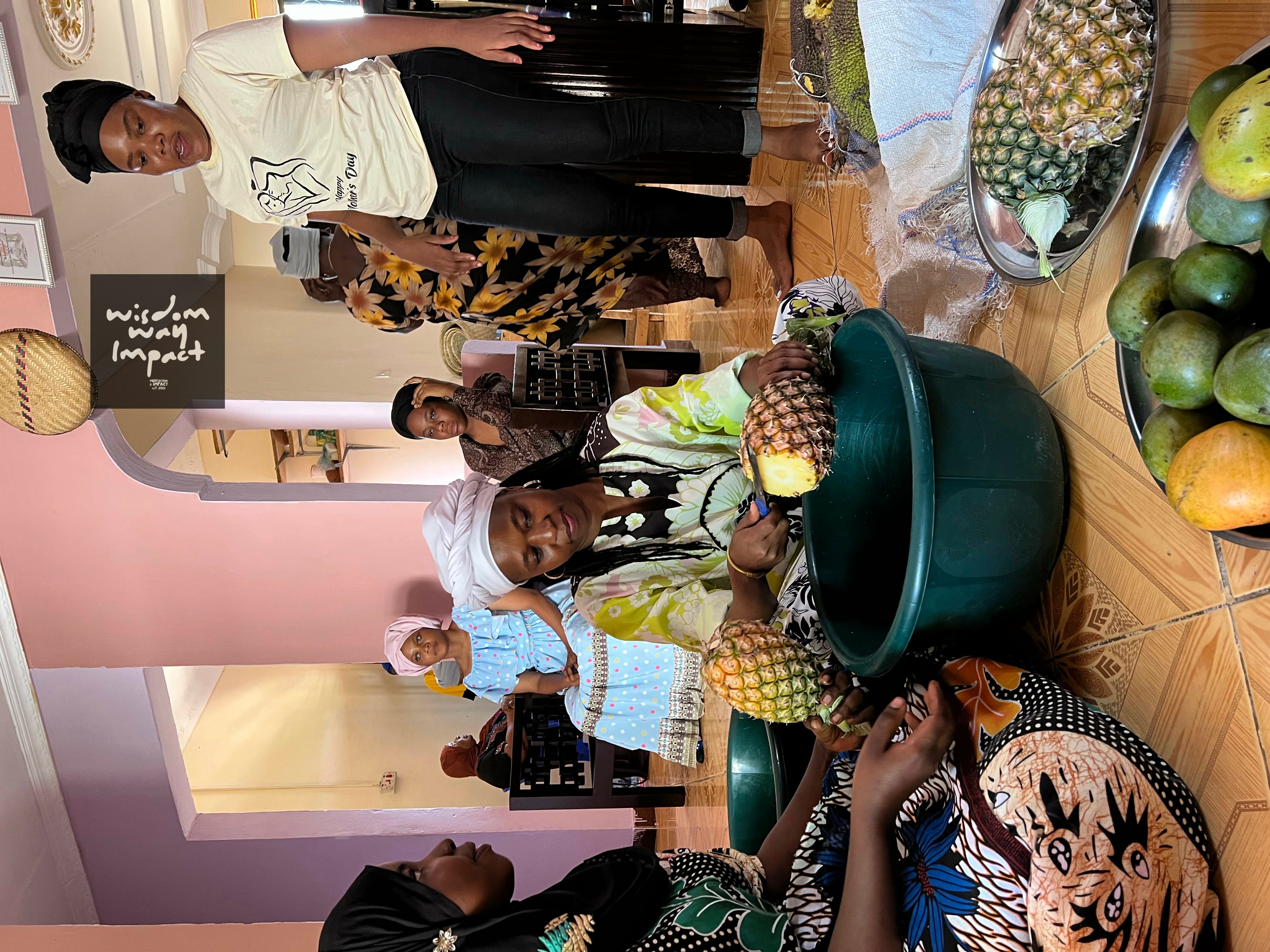
On the final day of the workshop, we ended our leadership training with a jam-making practicum. Tanga’s pineapples—sweet and bursting with juice—felt like gifts from the African earth.
From morning until night, we peeled, chopped, and boiled fruit into jam. Only after dark did we finish filling small jars of pineapple, jackfruit, and guava jam for everyone to take home.
Twelve hours of work. People rotating around the stove, stirring large pots of boiling fruit.
When it was finally done, everyone left glowing with satisfaction at the taste we had created together.
And those jams were just heavenly—no jams from supermarkets like Costco or Whole Foods were comparable at all.
The Question Is Not Why
People often trap themselves in endless questions:
Why was I born?
What is the purpose of my existence?
What is the reason for my life?
Here is the truth I learned from my teacher—something that changed everything for me: There is no reason you were born. You live because you were born.
If you cannot figure out why you were born by tonight, that does not mean you will die tonight.
If life had a fixed reason, then failing to meet that reason would mean you had failed at life.
But that is not how life works.
You are already here.
Breathing.
Living.
Feeling.
So the real question is not why.
The real question is how.
How are we going to live this life that is already happening?
Even if you do not know your “purpose,” you do not suddenly disappear tonight. Life continues. Your precious clock keeps running while you are squeezing your brain trying to find the ultimate reason for your existence.
Instead of obsessing over why and wasting our valuable moments, ask:
How can I live with less suffering?
How can I live with more freedom?
How can I live with genuine happiness?
That’s exactly how I learned to enjoy moments in Ometepe—not asking why the buses weren’t coming, why things were this way, or why people weren’t changing anything. Instead, I started looking at how I could still indulge in the moment.
Happiness is not ice cream.
Not designer bags.
Not luxury cars.
Those are pleasures—conditional ones.
If they disappear, the happiness disappears too.
A week in Tanga, my slow seasonal childhood, and the long wait on Ometepe Island all taught me something similar:
Happiness does not come from systems or infrastructure.
Water, electricity, and internet can improve quality of life, yes. But they do not automatically bring peace of mind.
Real happiness often grows from connection, relationship, and awareness.
From walking together while carrying water.
From sharing dreams of business beside an old machine.
From laughter over a single jar of jam.
National income and development do not equal a country’s true well-being.
Some people laugh deeply without electricity.
Others live in wealthy cities and carry depression their entire lives.
Happiness is not a visible system. It is a felt sense of community and an awakened heart. And it may begin with something very simple:
Sincerity toward yourself, or the person beside you.
Right now.
Real happiness is what remains when conditions change.
Peace.
Connection.
Integrity.
Freedom of mind.
Your own state of mind.
Values you can name.
So do not be too serious searching for some cosmic, mysterious reason.
That question is not as philosophically profound as we think.
How can I make this life more meaningful?
How can I make it more valuable?
What can I contribute?
You are already here.
Live fully.
Live honestly.
Live awake.
That is enough.
Think more about how we want our days to be shaped.
Being itself is already enough reason to live on this earth. Life is not about winning. Not about compressing time to become more functional, productive, or operational.
ROI is not the only formula for a conscious, thinking human life.
Thanks for reading Wisdom in Motion: Letters & Dispatches on Peace & Wellbeing! This post is public so feel free to share it.
No posts
Comments
Nothing yet. Say the first thing.
Sign in to join the conversation.