
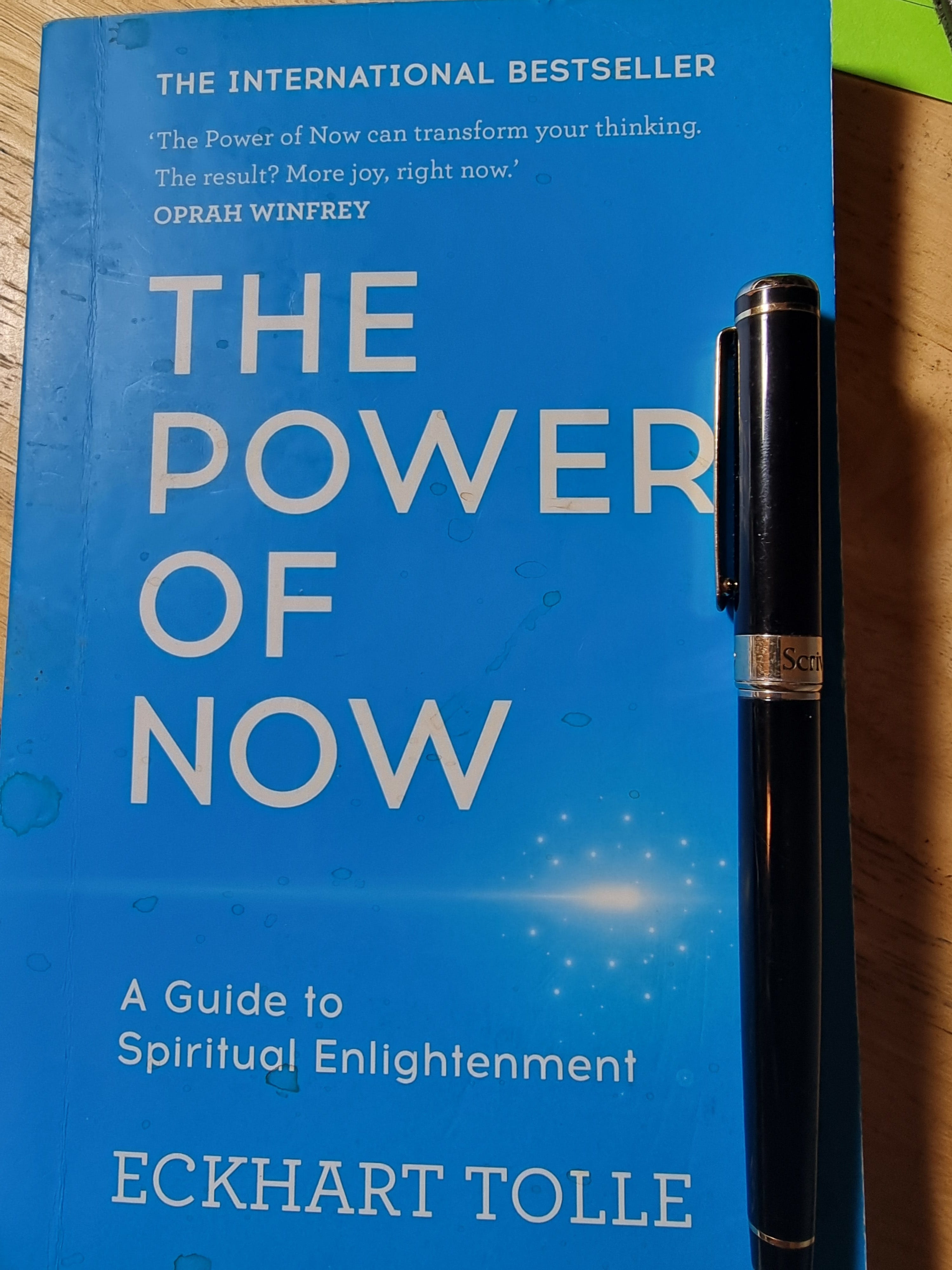
This isn’t really a post about technology. It’s about reading — something I care deeply about.
More specifically, it’s about a question I keep returning to: how do we read physical books more deeply, not just more often?
Somewhat counter-intuitively, I’ve come to believe that AI — in my case, ChatGPT — can help us read better, not shallower. Used well, it doesn’t replace the book. It sharpens our attention to it.
Take The Power of Now by Eckhart Tolle. It’s a modern spiritual classic built around a single, radical claim: liberation comes from fully inhabiting the present moment.
I’ve picked up this book many times over the years. I’ve reread sections, underlined passages, reflected on ideas — and yet I’ve never quite read it straight through in a conventional way.
Recently, I tried a different approach: using structured prompts to explore the book quickly but deeply. What follows is the result.
Two quick caveats. First, this approach would be even richer if done collectively — sharing notes, interpretations, and disagreements with others. Second, it works best with dense, reflective books that reward slow thinking and critical engagement.
At its core, Tolle’s argument is surprisingly simple.
The present moment is all that truly exists. The past lives only as memory. The future exists only as anticipation. Most suffering arises because we mentally live somewhere other than where we are.
Peace, in this view, isn’t achieved by fixing life. It comes from meeting life as it is.
Much of what blocks this is the ego — the voice in the head that insists something should be different, that identity must be defended, that fulfillment lies elsewhere. Tolle’s key move is subtle but powerful: you are not your thoughts; you are the awareness that notices them.
When we identify completely with thought, suffering follows. Anxiety grows out of imagined futures. Regret is built from replayed pasts. Identity hardens into stories we feel trapped inside. Freedom begins when thoughts are observed rather than believed.
Tolle also introduces the idea of the pain-body: accumulated emotional pain from the past that gets activated by stress, conflict, or fear. You don’t fight it. You don’t analyse it away. You observe it without judgment — and in doing so, it loses its grip.
Acceptance plays a central role here, but not in the sense of passivity. Acceptance doesn’t mean liking what’s happening or giving up on change. It means not resisting reality internally. From that clarity, action becomes cleaner and less reactive.
Awakening, in Tolle’s framing, isn’t mystical fireworks. It’s stable awareness without compulsive thinking. Simple anchors — the breath, bodily sensation, listening without labels — dissolve ego automatically.
Time itself isn’t the enemy. Clock time is useful. Psychological time is not. Use time to plan, but don’t live there.
Perhaps most provocatively, enlightenment isn’t extraordinary. It’s deeply ordinary: full participation in life without inner resistance.
If all of this had to be reduced to one sentence, it might be this: suffering ends when attention returns from thought to presence.
What makes The Power of Now compelling is how immediately practical it can be.
Several times a day, you can pause and silently name the moment: “This is what now feels like.” No analysis. Just noticing.
Thoughts can be treated like weather. Instead of arguing with them, you note them — “interesting thought” — and let them pass. Over time, they lose their authority.
The body is one of the most reliable anchors. Bringing attention into the hands, feet, chest, or breath — even for a few seconds — interrupts compulsive thinking.
When something goes wrong, the sequence matters. First accept that it’s happening. Then decide whether to act, adapt, or walk away. Acceptance removes the emotional drag that distorts decisions.
Emotional reactivity is another training ground. When irritation or defensiveness appears, resist the urge to explain or justify it. Just feel it. That’s how the pain-body runs out of fuel.
Small pauses matter. Before responding in a tense moment, take a breath, feel your feet, and then speak. The difference in tone is often immediate.
Identity itself becomes lighter when you notice how often you narrate yourself — “this always happens to me,” “I’m just not that kind of person.” These are stories, not prisons.
Doing one thing at a time, fully, turns ordinary actions into grounding practices. Walking, eating, typing — all become opportunities for presence.
Time works best as a tool, not a habitat. Plan deliberately, then stop mentally living in the plan. When future thoughts arise, gently return to what’s required now.
At the end of the day, letting the mind stop rehearsing — noticing the breath and allowing the day to be as it was — creates real rest.
A useful rule of thumb emerges: if you’re aware of what’s happening, you’re already present. No special state required.
Across the book, certain themes recur.
On time and the present moment:
“Realize deeply that the present moment is all you ever have.”
“Nothing ever happened in the past; it happened in the Now.”
On thought and identity:
“You are not your mind.”
“The ego is a false self, born of thought.”
On suffering:
“Suffering is necessary until you realize it is unnecessary.”
“Where there is anger, there is always pain underneath.”
On awareness:
“Awareness is the greatest agent for change.”
“Being aware of your thinking is the beginning of freedom.”
On acceptance:
“Whatever the present moment contains, accept it as if you had chosen it.”
“Inner peace begins the moment you choose not to allow another person or event to control your emotions.”
Taken together, they point to a simple synthesis: presence replaces ego, acceptance dissolves suffering, and awareness is freedom.
The book unfolds in a clear progression.
It begins by showing how identification with thought creates suffering, then introduces the pain-body as accumulated emotional memory. From there, it turns to the present moment as the only real access point to peace.
The ego’s strategies for avoiding presence are exposed — drama, complaint, identity — followed by a deepening exploration of presence as felt aliveness rather than emptiness. The body becomes a gateway. Silence and stillness open onto something deeper.
Relationships are reframed as mirrors of unconsciousness and, potentially, as tools for awakening. Happiness is distinguished from peace. Finally, surrender is introduced not as defeat, but as alignment with reality.
The Power of Now argues that suffering arises from identification with thought and psychological time. By repeatedly returning awareness to the present moment — through the body, stillness, and acceptance — the ego dissolves without force. Peace is not created by fixing life, but by meeting life without resistance.
At its heart, The Power of Now makes a single claim: human suffering is sustained by unconscious identification with thought and time, and freedom emerges through present-moment awareness.
Most stress comes from living mentally in memory or anticipation. The ego forms around these thoughts and defends them. Suffering isn’t caused by events, but by resistance to what is. Awareness, when applied without judgment, naturally weakens the ego’s grip.
The present moment is not an idea but a direct experience, always available. The body provides a reliable anchor into that experience. Acceptance doesn’t eliminate action; it clarifies it. Relationships expose unconscious patterns, but can also accelerate awakening. Happiness depends on conditions; peace does not.
The book reframes transformation not as self-improvement, but as disidentification from thought. Presence is not something to achieve. It’s what remains when resistance ends.
Using this prompt-based approach, I reached a deeper understanding of The Power of Now in about twenty minutes than I had through years of intermittent reading. The book didn’t become simpler — it became clearer.
For me, this confirmed something important: AI, used thoughtfully, can help us read not faster, but more honestly and more deeply.
No posts
Comments
Nothing yet. Say the first thing.
Sign in to join the conversation.