
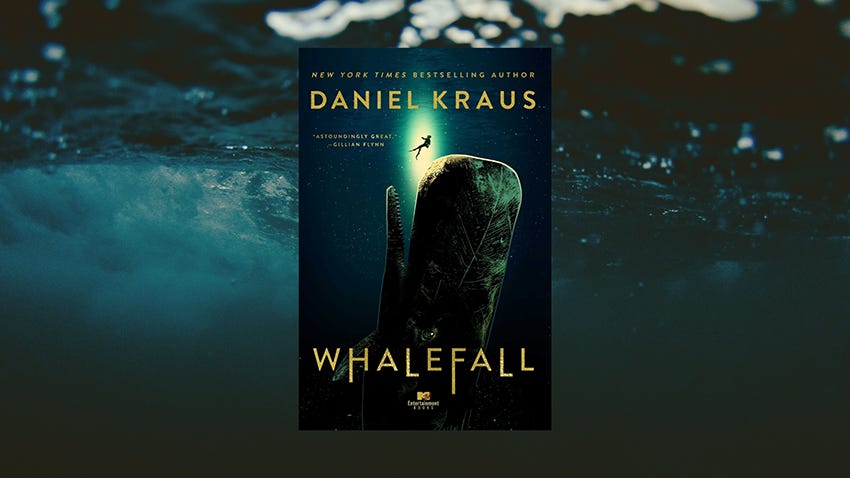
Daniel Kraus’s Whalefall belongs firmly in that last category.
When news emerged that the novel was being adapted for the screen by director Brian Duffield, with Kraus himself co-writing the screenplay, my first reaction wasn’t excitement. It was apprehension. Some novels seem almost impossible to film. Their emotional power comes not simply from what happens, but from what is happening inside the mind of the protagonist. Strip away the internal dialogue and you risk reducing something profound into little more than an expensive survival thriller.
Yet everything about this adaptation suggests the filmmakers understand what made the novel extraordinary in the first place. Rather than merely recreating the spectacle of a young diver trapped inside a sperm whale, they appear intent on preserving the emotional heart of the story. Kraus co-wrote the screenplay alongside Duffield, who has repeatedly spoken about wanting to capture Jay’s internal struggle without losing its intimacy.
That matters. Because Whalefall was never really about a whale.
The premise sounds absurd enough to invite comparisons with Jonah. Seventeen-year-old Jay Gardiner dives into the Pacific searching for the remains of his deceased father. A giant squid attacks. A sperm whale arrives to feed. Jay is swallowed alive with only an hour of oxygen remaining.
Hollywood could easily market it as The Martian underwater or 127 Hours inside a whale. Those comparisons are understandable. The tension is relentless. Every page becomes an exercise in calculating oxygen, pressure, anatomy and impossible odds.
But beneath the survival story lies something much deeper. Jay is not simply trying to escape the whale. He is trying to escape the weight of his father.
As the oxygen dwindles, memories surface. His father, Mitt, was both mentor and tormentor. A gifted diver. A difficult parent. A man whose fierce love was often expressed through impossible expectations. Jay carries admiration, resentment, grief and guilt all at once.
Anyone who has wrestled with a complicated parent recognises this emotional terrain. Love is rarely tidy. Families leave us with gifts and wounds in equal measure.
That is what makes Whalefall so devastating. The whale becomes less a monster than a sanctuary for reckoning.
Its darkness forces Jay into the one place he has spent years avoiding: his own heart.
For readers of faith, it is difficult not to hear echoes of the ancient story of Jonah. Yet Kraus wisely resists making it a simple allegory. Jonah entered the fish running from God. Jay enters the whale running from grief and both emerge changed.
The Bible is full of wilderness experiences that are less about punishment than transformation. Again and again Scripture reminds us that God often does God’s deepest work in places we would never choose to enter.
The belly of a whale becomes another wilderness. Not because God has trapped us there. But because there are truths we can only hear when every distraction has been stripped away.
Perhaps that is why Whalefall resonates so powerfully in our own cultural moment.
We live in an age expertly designed to help us avoid grief. We scroll through it. We stream over it. We medicate it. We distract ourselves from silence because silence might force us to confront what still hurts.
Jay has no such luxury. Inside the whale there is nowhere else to look.
The remarkable achievement of Kraus’s novel is that he balances breathtaking scientific and natural realism with profound emotional insight. The anatomy of the whale. The chemistry of oxygen deprivation. The mechanics of scuba diving. Every detail feels meticulously researched. Yet the science never overwhelms the story. Instead, it grounds the emotional journey in physical reality.
Every shrinking breath mirrors the emotional suffocation Jay has experienced for years. Every painful decision becomes an act of choosing life.
The adaptation appears to understand this balance. Casting Austin Abrams as Jay and Josh Brolin as Mitt feels inspired. Brolin possesses exactly the kind of physical presence required for a father who looms large even after death, while Abrams has repeatedly demonstrated an ability to communicate vulnerability without sentimentality. Early footage suggests the film will preserve both the visceral survival elements and the father-son relationship that gives the story its emotional weight.
That relationship is the film’s true special effect.
Because every viewer has someone whose voice still echoes inside them. A parent. A mentor.
Someone they long to impress long after they’re gone. Someone whose approval still shapes the choices they make.
The whale merely gives those voices nowhere to hide.
As Christians, we often speak about resurrection as though it begins after death. But Whalefall reminds us that resurrection can begin much earlier. It begins whenever we stop allowing old wounds to define us. Whenever forgiveness becomes possible. Whenever we discover that survival is not simply staying alive but learning to live freely.
There is another reason I hope this film succeeds.
Modern cinema often mistakes spectacle for significance. Bigger creatures. Bigger explosions. Bigger visual effects.
Yet audiences continue to respond most deeply to stories about ordinary people facing extraordinary emotional truths.
That is what Whalefall offers. Not simply a man inside a whale, it offers a son inside his own memories. A young man discovering that the hardest escape is not from the belly of a beast, but from the stories we keep telling ourselves about who we are and whether we were ever enough.
If the film captures even half of what Daniel Kraus achieved on the page, audiences won’t merely leave talking about the whale.
They’ll leave thinking about their fathers. Their children. Their grief. And perhaps, quietly, about the strange places where grace sometimes finds us.
Sometimes, the road back to life runs through the darkest depths imaginable and the belly of the beast is where healing finally begins.
No posts
Comments
Nothing yet. Say the first thing.
Sign in to join the conversation.