
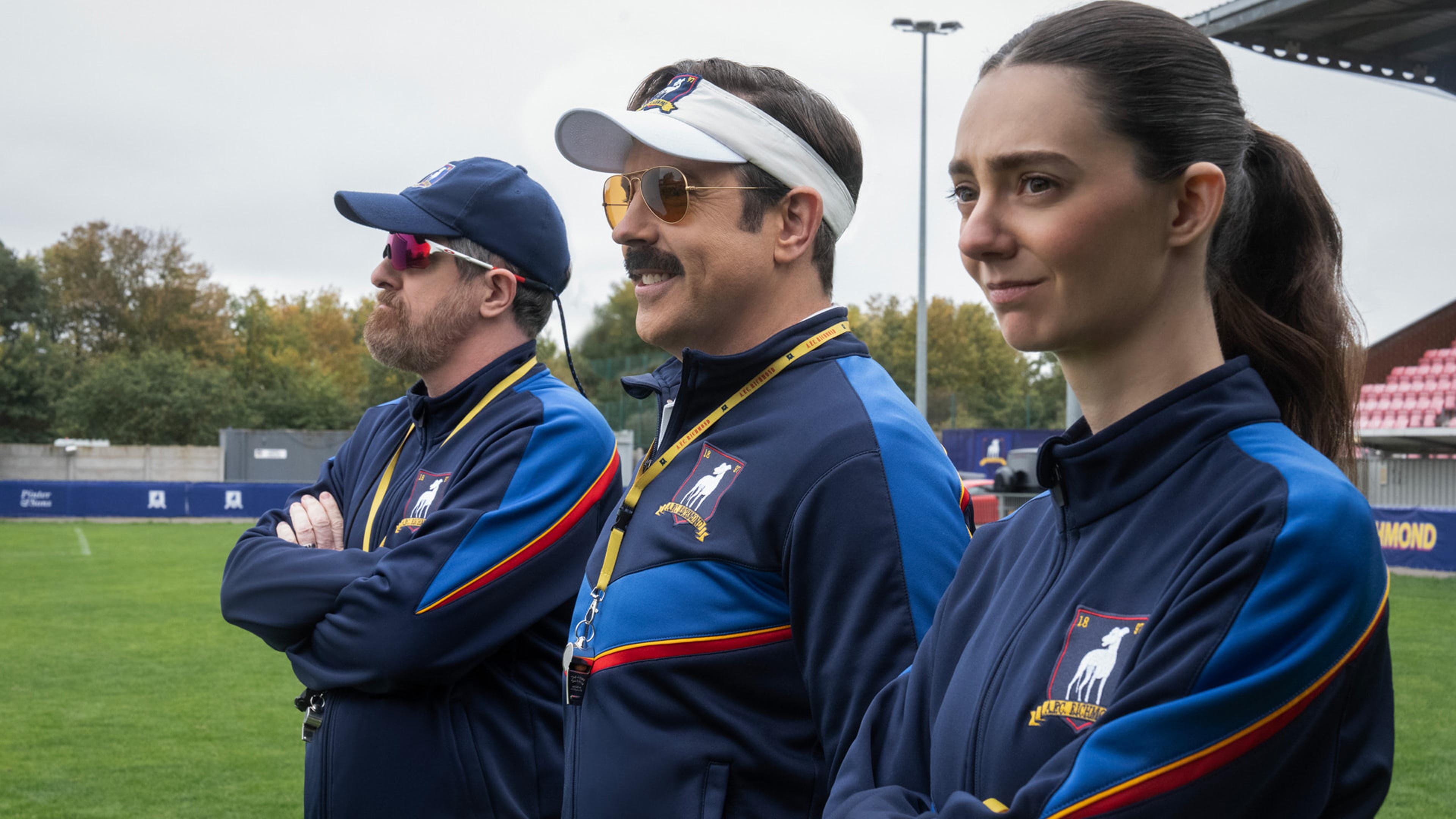
Brendan Hunt, Jason Sudeikis, and Tanya Reynolds in Ted Lasso Season 4 Apple TV
I have been rewatching Ted Lasso from the beginning because season four has finally arrived. And why not?
Of all Ted’s pearls of wisdom, one of my favourites is a scene in season one episode eight that has stuck long after the jokes, the football matches and even the magnificent collection of Ted’s anecdotes. It’s a scene that when it first aired back in 2020 had people racing to Google Walt Whitman, and for better or worse, I wanted to unpack it here.
The scene is when Ted is playing darts against Rupert Mannion, Rebecca’s arrogant and deeply unpleasant ex-husband. Rupert has underestimated him and has assumed Ted is exactly what he appears to be: an American football coach who knows very little about football, even less about English football and certainly nothing about darts.
As Ted prepares to throw, he tells Rupert about being underestimated throughout his life. He remembers driving his young son to school and seeing a quotation attributed to Walt Whitman somewhere that has resonated with him ever since: “Be curious, not judgmental.”
And then Ted explains what it meant to him.
The people who had belittled him had never been curious about him. They thought they already knew who he was. They didn’t ask questions. They simply judged.
And suddenly the entire philosophy of Ted Lasso is sitting there on a dartboard: Be curious, not judgmental.
It is one of those wonderfully simple ideas that sounds almost embarrassingly obvious until you realise how rarely we actually practise it, because judgement is easy, Curiosity takes a lot of work.
We judge people constantly by making assumptions about their intelligence, their politics, their faith, their motives, their appearance, their relationships, their choices and their character. We do it. All. The. Time.
Most of all, we do it when we think we already know the story.
Curiosity asks us to pause: What if there’s something I don’t know? What if there is another story here? What if the person I have dismissed has something to teach me?
That there is the moral centre of Ted Lasso.
And it is why the show became so much more than a comedy about an American coach who somehow finds himself managing a struggling English football club.
Ted’s great gift isn’t that he is always right. He isn’t. It isn’t even that he is endlessly positive, despite the memes and the relentless optimism.
Ted struggles, he gets things wrong and avoids difficult conversations. If the first three seasons of the show taught us anything, he carries pain that he doesn’t always know how to name. His gift is that he remains interested in people. He wants to know them. When he meets someone, he asks questions, he is curious.
There is, however, a small problem. Walt Whitman didn’t write those words. In 2020 when the first season aired it caused quite a stir. The quotation has been attributed to Whitman over the years, but scholars of Whitman’s work have found no evidence that he ever said or wrote “Be curious, not judgmental”.
The line appears to have a much more recent origin and was already circulating with the Whitman attribution before Ted Lasso made it famous.
So Ted Lasso is, technically, wrong, and I actually love that, because if Ted’s philosophy is “be curious, not judgmental”, then the quotation itself gives us an opportunity to practise it.
Don’t simply believe something because you’ve heard it before. Be curious. Look it up. Ask questions. Discover what is actually true.
It would be very easy to become judgmental about Ted getting the quotation wrong but that misses the point. The quotation matters because of what Ted does with it. He turns four words into a way of seeing people and viewing the world. And that is 100% more important than who originally said them.
I don’t think there is really enough curiosity around.
Judgement assumes we have arrived at the answer. Curiosity admits that we haven’t and there’s more.
Most importantly, judgement puts us in the position of being the person who knows and curiosity puts us in the position of being the person who might learn something. That requires humility and it also requires patience and the world we inhabit doesn’t particularly reward either.
Social media encourages instant reactions. We are invited to comment before we have read an article and condemn before we understand the circumstances. The algorithm loves a bit of judgement because judgement produces engagement.
Curiosity requires us to stop scrolling and start listening. It asks us to resist the satisfying certainty of “I know exactly what this is about.” Because usually, we don’t.
This is also why Ted’s philosophy works as a leadership lesson.
When Rupert looks at Ted, he sees someone he can beat. Ted looks at Rupert and sees someone he wants to understand. That doesn’t mean Ted excuses Rupert’s behaviour. That is an important distinction.
Being curious doesn’t mean abandoning moral judgement altogether. It doesn’t mean excusing harmful behaviour or refusing to establish boundaries. It means asking what lies underneath our first reaction.
The same principle runs through the relationships at AFC Richmond.
Ted doesn’t see Nate simply as an awkward kit man. He sees someone with talent and sees and believes in him. Rebecca is not simply the club’s owner who is trying to destroy her ex-husband’s football team. Ted gradually discovers the hurt beneath her revenge and they become friends. Roy Kent isn’t merely an angry, ageing footballer who swears at everyone, he’s someone who is frightened about what happens when the thing that has defined his entire life comes to an end. And Jamie Tartt isn’t simply an arrogant young footballer, he’s a young man who has been taught that love and approval are things you earn by being the best. Even Coach Beard, who often seems to exist somewhere on another intellectual plane entirely, is treated by Ted as a person worth knowing rather than merely the strange man who follows him around.
Ted keeps asking the question: Who are you, really?
People don’t necessarily need us to agree with them, sometimes they simply need us to be interested enough to listen.
For me, this is where Ted Lasso becomes particularly interesting because “Be curious, not judgmental” could almost be a spiritual discipline.
The curious person recognises that every human being is more complicated than the version we have constructed in our heads. So perhaps we should approach people with a little more curiosity. Not because everyone is right or their behaviour should be excused.
Ted’s kindness is therefore not simply niceness, it’s a way of paying attention. And paying attention to another human being is one of the most profound forms of respect we can offer.
Of course, the genius of the scene is that Ted doesn’t simply give Rupert a lecture. He throws the darts and wins and suddenly Rupert discovers that the person he thought he understood is considerably more complicated than he imagined.
This is why the quotation has such power, because it isn’t just advice for dealing with difficult people it’s an invitation to examine ourselves.
There is something wonderfully hopeful about curiosity because it leaves the future open. Judgement says the story is finished.
Ted believes in people not because he is naïve about them, but because he refuses to believe that the first version of a person is necessarily the final version and perhaps that is why the show has become a cultural touchstone.
For all its jokes about football and biscuits, it offers something increasingly rare: a story in which kindness was treated as strength, vulnerability as courage and curiosity as a moral virtue.
The great irony is that the man delivering the lesson gets the quotation’s author wrong. But this is further proof that Ted doesn’t have all the answers. Neither do we.
Be curious, not judgmental.
Even if Walt Whitman never actually said it.
No posts
Comments
Nothing yet. Say the first thing.
Sign in to join the conversation.