
This is the fifth of a 10-part section by section analysis of Indiana Jones and the Last Crusade. You can find links to the other nine parts at the end of this piece.
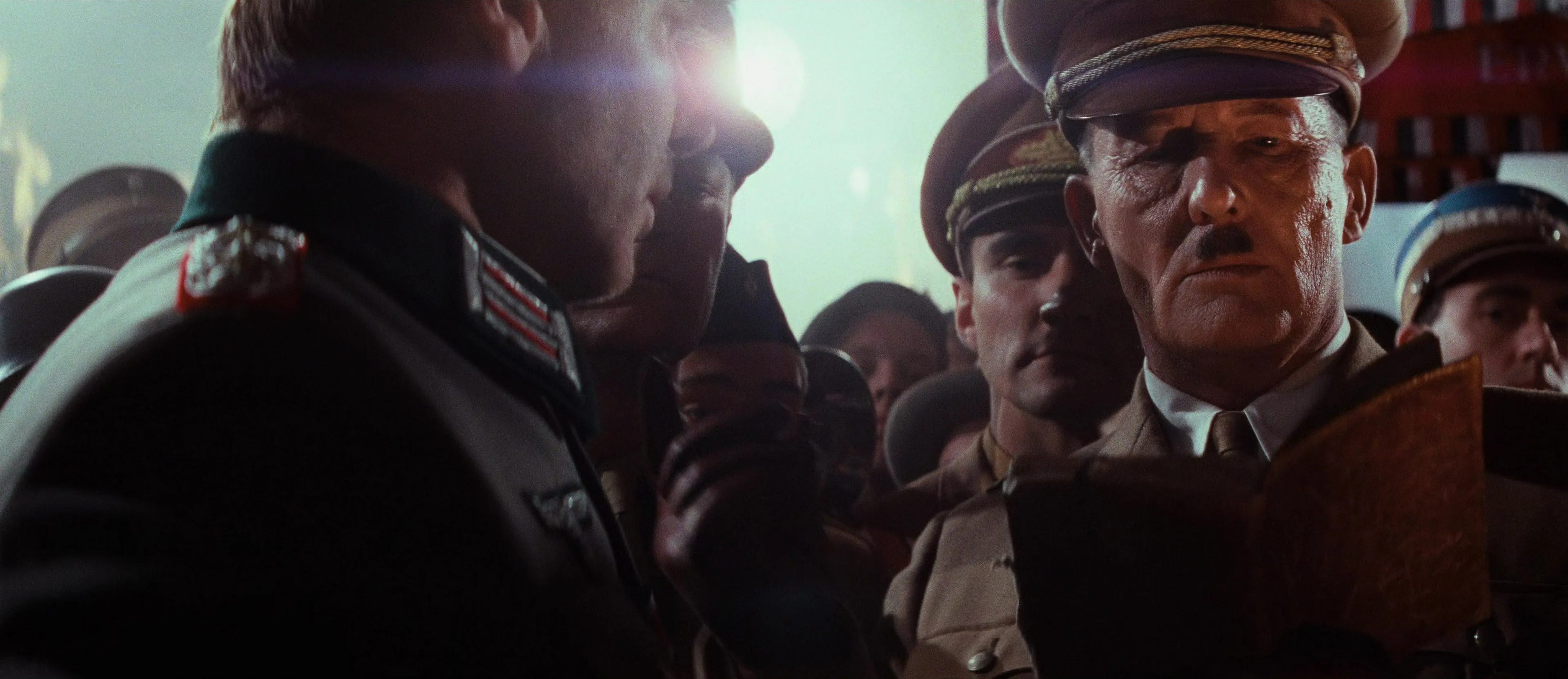
Sometimes I wonder if people remember that moment in Indiana Jones and the Last Crusade where Indy meets Adolf Hitler, because it doesn’t often get mentioned when the film is discussed. It is a remarkable scene that deserves exploration in its own right.
Last Crusade lives in the mind’s eye of audiences as an adventure romp, which it most certainly is, but there are without doubts moments of darkness and sinister suggestions and motivations that puncture the narrative, as they did in Raiders of the Lost Ark and Temple of Doom before it. Indy having to pursue Elsa to Berlin in order to retrieve Henry’s diary is one of the franchises’ most fascinating and unexpected diversions. The plot could easily have worked differently - Indy could have swiped the diary again from Elsa or the Nazis before he and Henry made their death defying escape from Castle Brunwald - but Steven Spielberg chooses to send Indy “into the lion’s den” as the character describes it.
We’ll unpack that momentarily but we should first stop and consider where the Nazis were both in 1938 when Last Crusade is set, and 1988 when the film was made.
In 1938, Hitler and the Nazis were fuelling Europe, the Soviet Union and to a lesser degree the United States with pure terror. Hitler had long established absolute dictatorial control in what he now termed the Third Reich (the first being the Holy Roman Empire lasting from the 10th to the 19th century and the second Bismarck’s German Empire from 1871 through to the end of the First World War). He was the Fuhrer, in control of his Fatherland with a thousand year, Roman-esque vision of Aryan dominance. He was annexing land around Germany—the Sudetenland in Czechoslovakia—and being appeased by anaemic Western leaders such as France’s Pétain and Britain’s Chamberlain. He was set on war, conquest and restoring Germany after decades of humiliation to absolute power. Oh, and he had a plan for anyone not white that ended up being the deadliest genocide in human history…
By 1988, history had recorded the fate of Hitler and his great project. Millions of Jews and other cultures murdered in the Holocaust but the Nazis were long consigned to the failed imperialist projects of previous millennia. Hitler took on Russia and Europe simultaneously and, once the Americans got involved, lost. He was dead. All of his confederates were dead (unless you believe one or two bonkers conspiracy theories that have made a few great thrillers over the years…). Germany was now a liberal, tolerant European economy embedded into what would soon become the European Union. Though plenty of fascists and Neo-Nazis still existed, the Nazis as an entity were primed to be laughed at rather than be scared of.
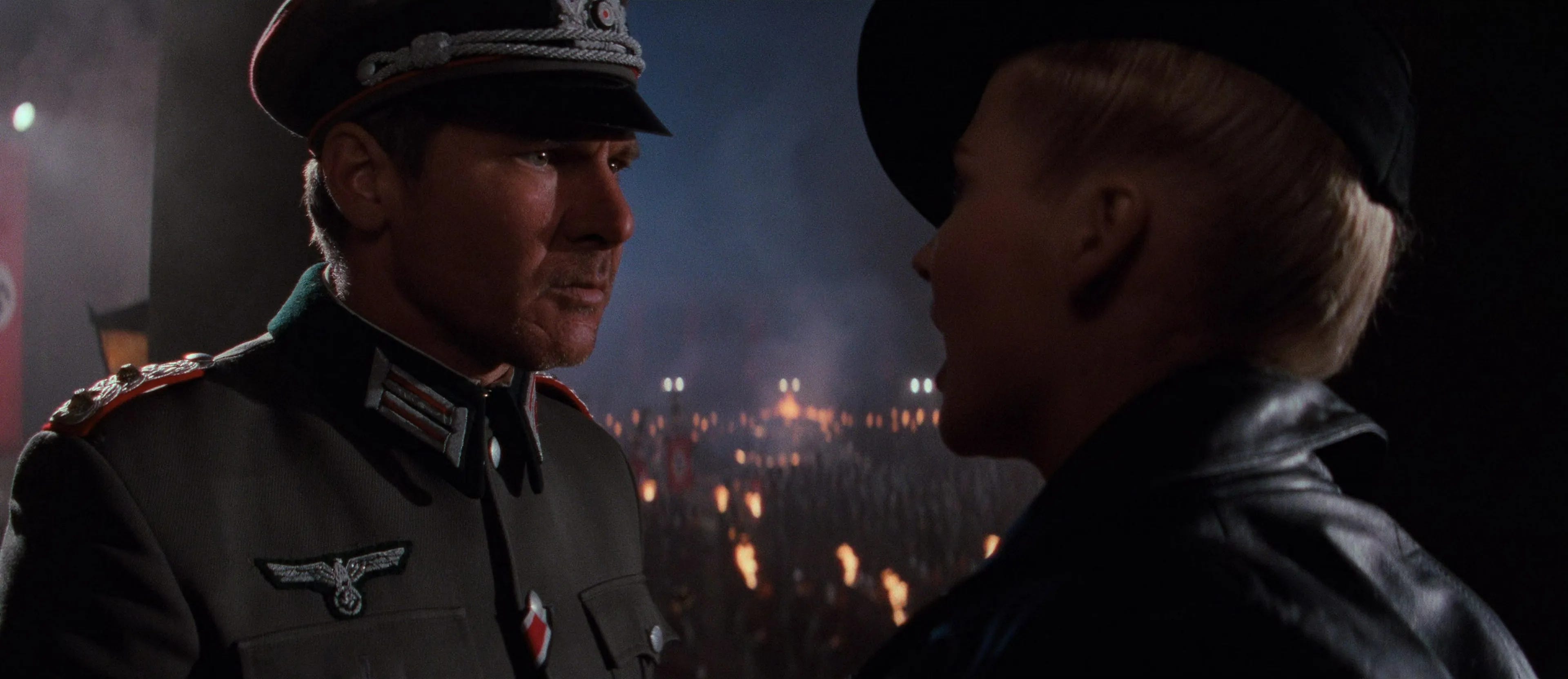
Which is precisely the space Indiana Jones inhabits both in Raiders and Last Crusade. The former had the seemingly frightening Nazi agent Toht (Ronald Lacey), but he was presented as camp and snivelling, while the Nazi soldiers around him ended up being fodder for a higher power. Last Crusade positions them in a similar way. Vogel, as we said before, is nasty, but the soldiers are there to be shot at, gunned down and driven over by tanks. In Castle Brunwald, they are played at points for comedy. Spielberg wants us to enjoy Indy punching them out. “Nazis. I hate these guys,” he tells Henry on seeing the radio room, and yep, we are right there with him.
With all this in mind, it ends up a surprise just how unnerving and powerful the sequence in Berlin is. It is Spielberg reminding us that underneath the action and adventure, a nightmarish force which Henry describes as “the armies of darkness” that will “march all over the face of the earth” (using deliberately Biblical language) stands ready to unleash itself, as it will do in a year. The rally we see is one by, as Vogel tells Elsa when he sends her off, “the institute of Aryan culture”, thereby reminding us of the eugenic centre of the Nazi project. If ever we were in doubt how much Elsa is in with these guys, Vogel explains that her presence has been “requested at the highest level.”
There is also the remarkable suggestion that Hitler very much knew of Indiana Jones and his father, or at least what was going on at the Austrian border, when Donovan gets a cable from Berlin which reads: “By the personal command of the Fuhrer. Secrecy essential to success. Eliminate the American conspirators.” Almost incredulous, he jokes to Vogel. “Germany has declared war on the Jones boys!” It’s long been known that Hitler did believe in esoterica, sending teams across the globe to try and find artefacts with occult power (which has given rise to Indiana Jones and all manner of stories in the last 80 years), so it figures he might be keeping a personal eye on the situation.
Before Indy does head to Berlin, Henry makes the point that the search for the Grail is about more than archaeology, that is it “a race against evil.” Again, if you divest this language of the Biblical aspects that are particular to Henry’s obsession with the Grail, you could be describing a nascent arms race that we will see in just short of a decade to develop a nuclear weapon. That too is certainly later couched in religious or ancient symbolism, such as J. Robert Oppenheimer’s famous misappropriation from the Bhagavad Gita, and saw Americans racing against time to develop the bomb before first the Nazis and later the Soviet’s could.
We won’t see Indy engage with the Cold War until the next film but there is a clear analogue here with artefacts such as the Grail and the Ark, which given both Raiders and Last Crusade were produced at the end of the Cold War with decades of awareness and knowledge about the arms race behind it seems not to be a coincidence.
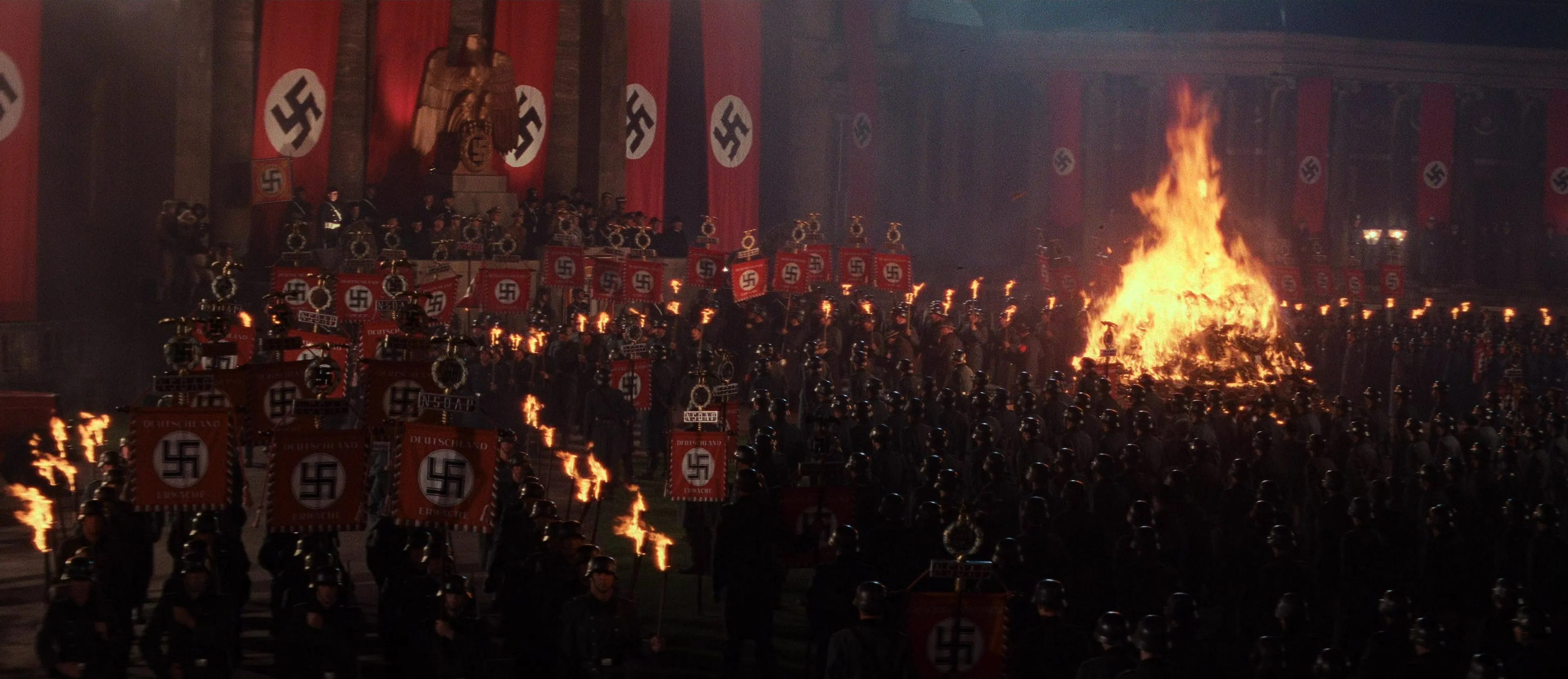
In Berlin, the first thing we see is a terrible icon of ultimate fascism - book burning. A mountain of texts inflaming a pyre, thrown on by college students and ‘Brownshirts’ (aka the Sturmabteilung, the Nazi Party’s violent paramilitary wing). The crowd are in the kind of frenzy we know Hitler inspired, waving vast swastika flags and cheering for their Fuhrer, raised on a podium. The scene is suffused in dread, amplified by John Williams’ choice to layer into his score ‘Der Königgrätzer March’, a 19th century Prussian march which the Nazis very much co-opened into their ritualistic nationalism. The pompous brass contrasts neatly the terror Indy and Henry feel stepping into this dark, alien and, compared to their field, modern world of politics. “We are Pilgrims in an unholy land” Henry quips.
As a means of blending in, with the intention of reaching Elsa, swiping the diary and quickly leaving, Indy dons the garb of a Nazi. We saw him do this at the climax of Raiders but here, the context is extremely different. He could not be closer to the centre of Nazi power if he tried. The slightest misstep and he’s dead. “All I have to do is scream,” Elsa reminds him at one point, before in her conflicted mindset allowing him to take the diary once they have a confrontation, suffused with a sexual tension. Indy has never been more exposed and closer to the churn of a dehumanising project on which his work and interest skirts the edges of. It is almost akin to stepping into an entirely different film.
Spielberg would of course in just four short years release Schindler’s List (1993), his definitive tract on the Holocaust and the Jewish experience of his forefathers, but you can see the building blocks toward how he confronts the horrors of Nazism in this sequence. It is shot at night, the flames of burning books suffusing the air of hysterical rapture. It is menacing. Spielberg even nods to the reality of the situation by briefly showing a female film director recording the rally, which is a clear nod to Leni Riefenstahl, who famously made the propagandistic picture Triumph of the Will (1935). She was a director for her technique someone Spielberg admired, even if he abhorred the project she helped spin.
Alongside this, Williams’ score helps build the sequence reaching a brilliant apogee when Indy and Henry, having got the Grail, end up swept unintentionally along the march heading toward where Hitler and his entourage now walk. When Indy literally bumps into the Fuhrer, the music crescendos and then simmers with a low drumbeat that fills the moment Indy and Hitler lock eyes. It is seconds but feels like an eternity. Hitler (as played uncredited by British character actor Michael Sheard, best known for playing a martinet teacher in British kids TV show Grange Hill) holds his gaze with dead eyes as Indy attempts to hide his terror at facing who his father considers to be evil itself. Harrison Ford also plays this uncertainty with brilliance.
The moment is electric. Hitler never speaks, as in certain portrayals that avoid focusing on the man himself. What could he possibly say that would make sense in the world of Indiana Jones? He is far more terrifying as a silent, monolithic presence, backed by armies and crowds and the marching brass of fascism. Then, brilliantly, Spielberg punctures the air for comedy. Hitler reaches not for a gun but a pen and autographs the Grail diary, entirely unaware of the significance of what he is casting off. The map, essentially, to the immortality and power he craves. A book he could well have ordered burned along with thousands of others being immolated that day. There is a glorious irony about what Hitler does and his portrayal here that few films other than Indiana Jones could get away with.
One final note. When directing the extras who played the Nazi mob at the rally, Spielberg told those raising hands in a Nazi salute to use their other hand to cross their fingers behind their back while doing so. A silent act of defiance, fifty years later, at the horror of what Hitler and his Nazi project did. As powerful an act off screen as the moment we see on it.
—
Indiana Jones and the Last Crusade
Pt 8 - The Word, Breath and Path of God
Pt 9 - That’s the Cup of a Carpenter
Pt 10 - Into the Sunset
If you enjoyed this piece, and you fancy ‘buying me a coffee’ to show it, you can hop over to Ko-fi and donate. Thanks if you do!
No posts
Comments
Nothing yet. Say the first thing.
Sign in to join the conversation.