
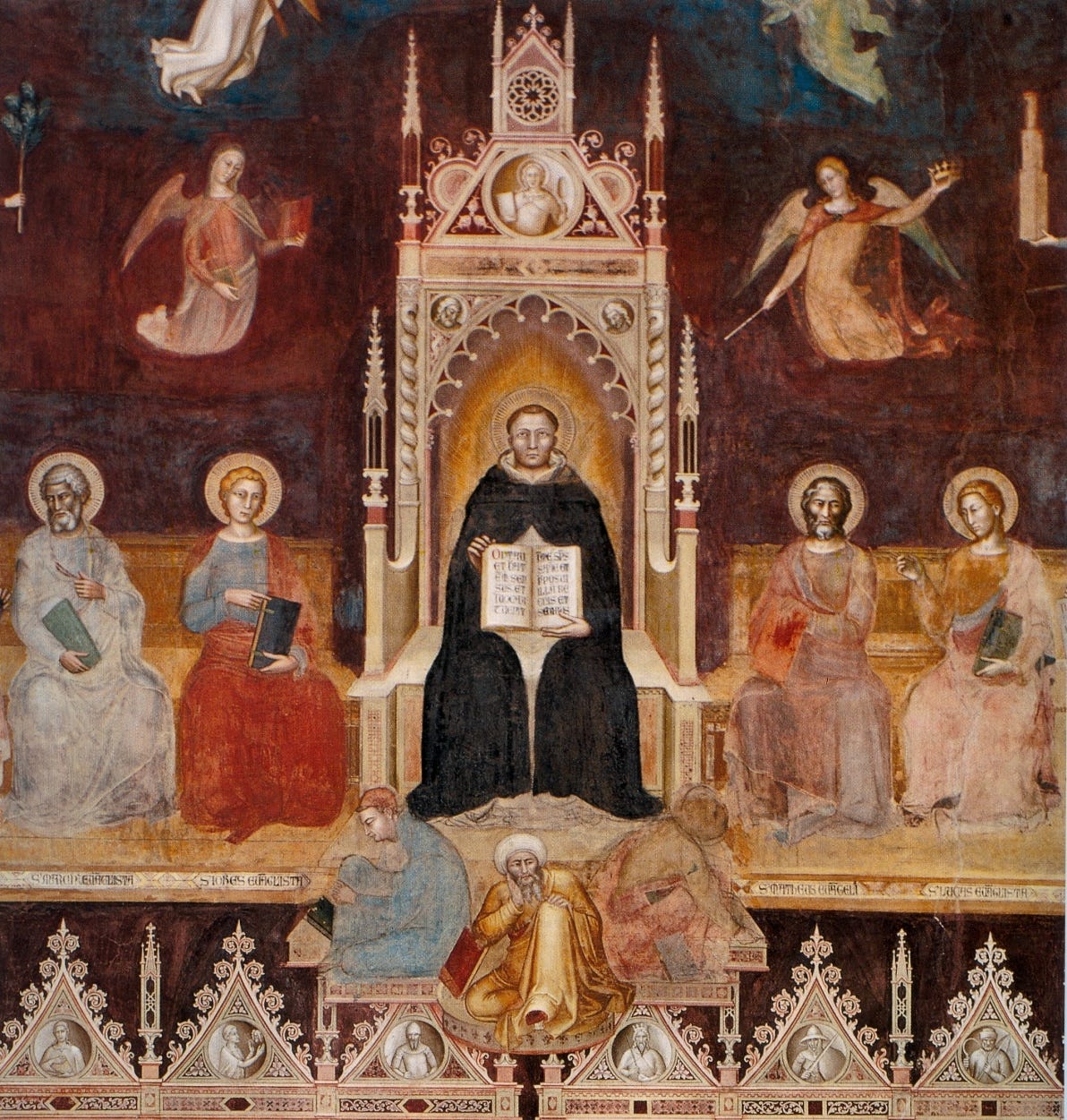
ST. THOMAS: MORTAL v. VENIAL SINS
*This Substack article is taken from an excerpt of my forthcoming book: Mortal Sin.
In St. Thomas’s De Malo, Question 7, on venial sins, the first article deals with the question of whether mortal sin is properly distinguished from venial sin (DM:VII:1). That is, the Angelic Doctor addresses whether the distinction between mortal and venial sin is a real, substantive, objective distinction, or whether it is a nominal distinction that is meaningless at bottom.
This article includes twenty-four objections. Most articles in the Summa Theologia (St. Thomas’s most well known work), by comparison, include ~3 objections. For this article the Angelic Doctor references 24 arguments for why the distinction between mortal and venial sins is not a true, objective distinction. As is evidenced by the article containing 24 objections, this is clearly not an easy question to resolve, and many people have erred on attempting to resolve it. The response that he gives, where he elaborates both the correct answer and the philosophical/theological justification for the correct answer, is 9 paragraphs long (Again, for reference by comparison: the Summa Theologia’s “responses” are often 1-3 paragraphs long).
Because of the immense value in understanding the distinction between mortal and venial sin, and how thoroughly and specifically it’s dealt with in this article, we’re going to treat of St. Thomas’s response in full. The following is a comprehensive presentation of the contents of this article.
Paragraphs 1-4
In the opening of the response, St. Thomas starts by telling us where the word “venial” in “venial sin” comes from, and then explains the three ways in which a sin is said to be venial. “Venial” comes from “venia”, which means “pardon”. So venial sins are those sins that are pardonable. On the contrary, mortal sins are derived from “mortalis”, which means “death”. Mortal sins cause the death of the soul and are not pardonable in themselves; venial sins are pardonable sins. And so a sin becomes “venial”, or pardonable, in one of three ways:
Because the mortal sin has been confessed, and by the power of God, who alone can pardon any sin, gives pardon to the sin. This is venial from the outcome.
A sin is called venial because there is a defect in the voluntariness of the act, so that those acts committed with [excusable] ignorance or weakness are pardoned either wholly or in part. This is venial on the part of the cause.1
A sin is called venial because something in the act itself does not exclude pardon. Whereas sins that are mortal, considered in itself, deserve eternal punishment and exclude pardon. This is venial generically.
This is only the first paragraph of the Angelic Doctor’s response. From here, St. Thomas commences to show all the ways in which people have erred in trying to account for the generic categorization of venial sins before finally presenting the correct (and coherent) account of what makes a sin objectively venial or mortal—that is, generically.
The following are the erroneous explanations for the distinctions between mortal and venial sins. Note: the distinctions are actual distinctions, but they do not constitute the reason for differing mortal vs. venial sin, generically:
Venial sin warrants temporal punishment, but mortal sin warrants eternal punishment. This distinction is accurate, but follows from the real distinction—it does not constitute it. Put another way, those are the effects of the difference between mortal and venial sins, but not the cause of the difference. “For sin is not of such a particular kind because this punishment is deserved for it, but rather, conversely, because the sin is of a particular kind, therefore such a punishment is deserved for it.”
Mortal sin deprives of grace, but venial sin does not. Again, this distinction is accurate, but is an effect of the difference, not the source of the difference. “But neither is this the difference we are looking for, since this difference follows as a necessary effect of the nature of sin, for from the fact that sin is of such a kind it has such an effect, and not the other way around.”
Mortal sins are in the reason, but venial sins are in the sense appetite. This would be a distinction on the part of the subject, as intellectual virtues are distinguished from moral virtues because the subject of intellectual virtue is reason itself, whereas the subject of moral virtue is the will (or rational appetite). However, this is not the way in which mortal and venial sins are differentiated because venial sins can be in the reason. “Hence even according to this difference a diverse notion of the two sins cannot be maintained.”
Mortal and venial sins are constituted by a difference in interior act—i.e. like the one being intentionally evil, the other not. This is not the case, however, because there are exterior acts that are generically venial sins (“such as speaking an idle word or telling a jocose lie and the like”) as well as exterior acts that are generically mortal sins (“such as homicide, adultery, blasphemy, and the like”). “But the diversity which is on the part of the act of the will does not diversify the genera of exterior acts, […], but exterior acts differ generically by reason of their objects.”
When you ask a teacher or priest or theologian about the difference between mortal and venial sin today, it’s likely they explain the difference according to numbers one and two. That is, they tell you that one deserves temporal punishment (viz. venial sins), the other eternal punishment (viz. mortal sins); or that one deprives of grace (viz. mortal sins), while the other does not (viz. venial sins)—but they never tell you about the source of the actual distinction between mortal and venial sin.
Having covered the first 4 of the 9 paragraphs in St. Thomas’s response, wherein he treats of the erroneous explanations of the distinction between venial and mortal sin, what’s left is for the Angelic Doctor to explain the objective difference between mortal and venial sin, which he does by first describing the nature of sin and the difference between venial and mortal sin by analogy to biological illness in the body (paragraph 5), followed by an explanation of how mortal and venial sin directly work in paragraphs 6-9.
Paragraph 5:
Here St. Thomas explains that sin consists in a disorder of the soul, just as, by analogy, illness consists in a certain disorder in the body. And so there or those that call sin “a sickness of the soul”. He then says that just as some illnesses are terminal and some are not, so some sins are incurable, and others are not.
Paragraph 6:
Here St. Thomas starts by further drawing out his analogy of sin to bodily illness, clarifying what makes an illness in the body terminal or non-terminal. A terminal illness is one in which the principle of life is destroyed in the subject; a curable illness is one in which the principle of life is not destroyed. He gives the example of a common cold as an illness that can be overcome, either on its own or with the aid of medicine, because the principle of life remains both intact, and sufficient to overcome the illness. Whereas a terminal illness, like that of late stage cancer, cannot be overcome by the principle of life within oneself, and so the disease is mortal (or terminal), resulting in the destruction of the principle of life.
Now the principle is determined by the end, St. Thomas tells us, referencing Aristotle’s Nicomachean Ethics (VI, 5 (1140b16-17) and VII, 8 (1151a16-17)), and the end of the spiritual life is love of God and of neighbor, which he draws from St. Paul’s First letter to Timothy: “For the pupose of the law is charity.” (1 Tim 1:5)2 If the principle of life in the soul is charity—love of God & neighbor—then wherever charity is attacked, objectively, you will have mortal sin; just as the disease that attacks the principle of life in the body is considered a terminal disease. “Therefore, if charity is excluded, the sin is mortal: for there remains no principle of life by which this loss can be repaired[.]” But if the sin does not attack charity, then it will be a venial sin because the principle of life in the soul which is charity can repair it. “But if the loss of rectitude be such as not to exclude charity, the sin will be venial because through the charity remaining as it were by a principle of life all defects can be repaired, for ‘charity covereth all sins,’ as is said in Proverbs 10:12.”
Paragraph 7-9
What remains to be demonstrated by the Angelic Doctor, then, is how a sin objectively attacks/excludes, or does not attack/exclude charity—because this will determine whether a sin is mortal or venial. And in paragraph 7 he briefly notes that charity can be excluded/not-excluded in two ways: one by the interior act in the sinner, that is, “on the part of the sinner”; the other by the exterior act, that is, “from the very genus of the work.”
In paragraph 8, he explains the two ways a sin can exclude/not-exclude charity on the part of the interior act.
First, he deals with how a sin does not exclude charity on the part of the sinner if the sin arises in one of the powers that is not capable of ordaining means to ends. That is, movements of sensuality, no matter how powerful, cannot of themselves be mortal sins, for the passions are in the body and not in the rational intellect, and so they cannot order means to ends. “The movement of sensuality cannot be a mortal sin but only venial, for to order something to an end pertains to reason alone.”
Second, he deals with how a sin can exclude charity on the part of the sinner (i.e. interior act) where the act would otherwise not exclude charity according to the exterior act. That is, the sinner can cause an act to be mortal by their interior act even though the exterior act is not itself mortal when the interior act is perverse enough to be itself an attack against charity (i.e. God/neighbor). “For example, if someone speaks an idle word in contempt of God, which is contrary to charity, it will be a mortal sin, but not by reason of the genus of the [exterior] act but by reason of the perverse will of the doer of the act.”
In paragraph 9, St. Thomas explains how the exterior act can exclude/not-exclude charity itself and thereby be mortal or venial, regardless of the interior act of the sinner,3 which is to say “generically mortal” or “generically venial”. For generically mortal sins, that is, those sins which exclude charity, St. Thomas explains that some acts are contrary to love of God or neighbor, when, in reference to God, “they destroy the subjection and reverence of man toward God”, or in reference to man, they “destroy the fellowship of human society.” Notice that the parameters for an act being contrary to charity are not that they consciously hate God / self-identify as an enemy of God, or premeditatively kill their neighbor; it’s that they attack reverence for God or fellowship between men. They don’t have to do evil for the sake of evil, or contemn the teachings of God while fully and consciously knowing they are placing themselves against God in doing so… No. Examples of things that attack the subjection and reverence of man toward God in paragraph 9 are “Blasphemy, idolatry, and the like,”4 and examples of attacking the fellowship between men in paragraph 9 are “theft, homicide, and the like, for men would not be able to live together where those acts would be perpetrated habitually and indiscriminately.”5 He follows this up directly by saying, “And these are mortal sins by reason of their genus no matter with what intention or will they are committed.” We don’t have to do the worst thing imaginable to God or our Neighbor for the sin to be mortal sin—it just has to attack God or neighbor, and according to the principles stated above, viz. attack the subjection or reverence of man toward God, or the fellowship between men such that if they were done indiscriminately it would make good, honest, non-paranoid accord between people impossible. (See explanation of footnote 3 below for further elaboration of relation between intention (interior act) and the exterior act.)
For generically venial sins, (i.e. those sins which objectively do not exclude charity), St. Thomas explains that these are sins that do not attack God or neighbor, and he gives the following example: “if a man should lie not in a matter of faith nor to injure his neighbor but to please or even to give help, or if someone be excessive in eating or drinking and the like. Hence these sins are venial by reason of their genus.”
Mortal Sins: Sins Against God or Neighbor
Further, St. Thomas confirms this distinction (that mortal sins, and grave matter, accordingly, pertain to sins against God & Neighbor, whereas venial sins are sins against self) in the Summa Theologia, in the second part of the second part, question 59, wherein he treats of injustice; article 4, where he asks whether every sin against justice is mortal according to its genus, to which he answers affirmatively:
“A mortal sin is one that is contrary to charity, which gives life to the soul. Now every injury inflicted on another person is of itself contrary to charity, which moves us to will the good of another. And so since injustice always consists in an injury inflicted on another person, it is evident that to do an injustice is a mortal sin according to its genus.” (ST II-II:59:4resp)
Finally, we have an objective principle of distinction between mortal and venial sins: namely, that sins attacking God or our neighbor are objectively mortal, and sins attacking ourselves are objectively venial.
From the example above about lying—“if a man should lie not in a matter of faith nor to injure his neighbor but to please or even to give help” then those sins are venial—we see that the distinction is whether the lie hurts God (lying in a matter of faith) or neighbor (lying to injure your neighbor), in which case the sin is mortal—or whether it doesn’t, and then it is venial.
When teaching my students I would always use the following example: if I lie about something bad my friend did to another kid, I sin against the victim of the bad act, and since the lie hurts another person, it’s mortal (the fact I’m trying to *help my friend not get in trouble* doesn’t make the lie not the cause of injury to the victim—therefore it’s an attack against my neighbor, and mortal). Or another example would be if I lie and say that someone I don’t like did something evil to another person when they didn’t, then that lie hurts another person, and is mortal. Whereas if, after the weekend is over, I come back to school and everyone’s talking about a party they went to, and I have FOMO, an example of a venial sin would be me lying and saying I did something fun on Saturday night when in reality I stayed home and was super bored. In this case the lie doesn’t hurt my neighbor, and it’s to embellish my own life.
This distinction between what constitutes “grave matter” in mortal vs. venial sins—namely, that mortal sins are sins that attack God/Neighbor; venial sins are sins that don’t—is the most coherent distinction I’ve ever found anywhere on the topic. Further, it’s not just that it’s easy to understand that makes it profound—it maps onto the entirety of the Christian message and the commandments summarized by Christ, himself:
36 “Teacher, which is the great commandment in the law?” 37 And he said to him, “You shall love the Lord your God with all your heart, and with all your soul, and with all your mind. 38 This is the great and first commandment. 39 And a second is like it, You shall love your neighbor as yourself. 40 On these two commandments depend all the law and the prophets.” (Mt 22:36-40)
The whole of the commandments boil down to loving God and your neighbor.
If God gives us the Ten Commandments, and the entire purpose of them is to love God and your Neighbor, it would be absurd if sins that are categorically outside of those 10 commandments (e.g. getting drunk) could lead to your eternal damnation—but it makes sense that they would encompass all that you need to understand, generically, to be right with God.
This profound and simple distinction given to us by the Angelic Doctor is a gift to the spiritual life as well. If you begin to focus all of your most serious spiritual discernment onto thoroughly loving God and your neighbor, your soul will grow immensely; your conscience will grow strong with clarity and concision; your charity will expand.
The simplicity of this conception, combined with its application across the heart of the gospel and the spiritual life—it’s articulated source being the Angelic Doctor (St. Thomas Aquinas), the greatest Doctor of our Catholic Church—all gives me great confidence that this explanation is the most substantive, the most beautiful, the most credible explanation of what mortal sin is that we have in our Catholic Church.
I encourage any of you interested in all that I have said here to go read the text of this article in St. Thomas’s De Malo, and the rest of De Malo after that!
“Nevertheless neither is venial even in this sense divided against mortal, since a person sinning from ignorance or weakness may sin mortally, as was said in previous questions.” DM VII:1resp:❡1.10-13 (See chart on Disregarded Evils in my previous Substack post, taken from the previous question in reference here—Q.3, Articles 6-12, on the relationship between ignorance, weakness, and malice to sin (DM:III:6+)—for when Ignorance/Weakness excuses mortal sin and when it does not.)
“Now the end of the commandment is charity” (1 Tim 1:5) Douay Rheims
To understand how the Overall Moral Act relates to the Interior and Exterior Acts, the following table is helpful. Overall Good Acts have to be integral—meaning they have to be good in all their parts. Evil Acts do not have to be integral, and so they can be evil in either the interior act or the exterior act, or they can be evil in both.

*Properly, the generically evil exterior act can’t have a good interior act, because the generic evil of the exterior act subsumes the interior act into itself as evil. That is, a generically evil [external] act is evil regardless of the intention of the doer, therefore the interior act itself becomes corrupted by the evil exterior act and is itself made evil.
i.e. Commandments 1-3 (according to their categories):
1. Thoughts against God (Idolatry)
2. Speech against God (Blasphemy)
3. Actions against God
i.e. Commandments 5-10 (according to their categories):
5. Unjust harm to neighbor’s person (Murder)
#6-10: rightful extensions of a person:
6./9. Unjust harm to neighbor’s spouse (Adultery)
7./10. Unjust harm to neighbor’s property (Theft)
8. Unjust harm to neighbor’s reputation (False Witness)
Comments
Nothing yet. Say the first thing.
Sign in to join the conversation.