
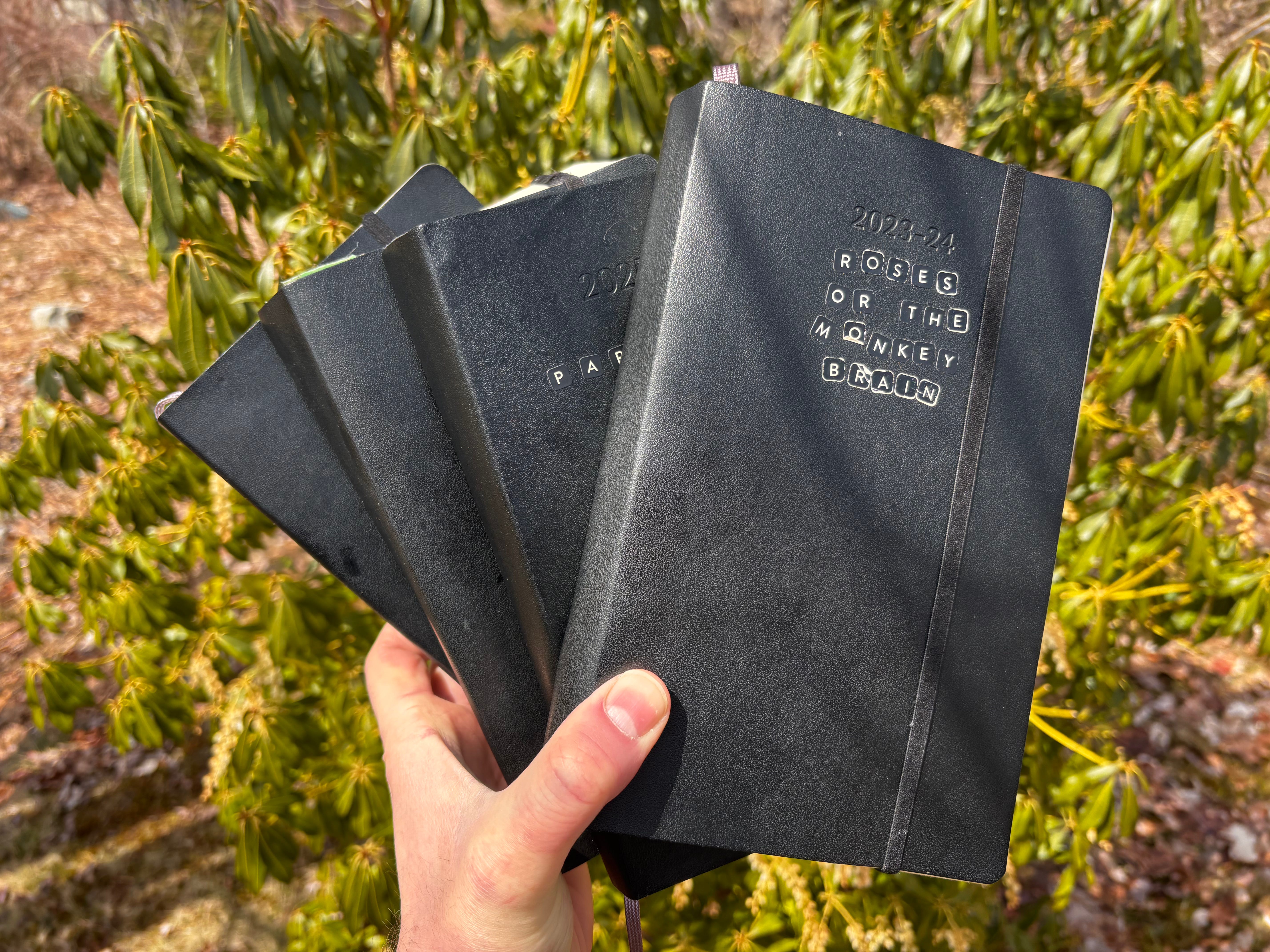
I keep a journal. I call it my ‘gurnal’ (makes it less intimidating). Some mornings I write very boring lists of what happened the day before. Other mornings, I ramble nearly incoherent madness about the nature of storytelling. This article is the first in a new series of Substack posts where I flip back to a page from yesteryear & try to make sense of some of my rants & rambles. Roll with me here…
On this day (April 12th, 2025), I set aside every theory book I’d ever read about being a writer. I wanted to approach it as a reader and list the things that a story can offer me. What do stories do for us? What is their function in our mundane, daily lives? How can we write better stories that give more?
Here’s what I scribbled down... Italic text is lifted directly from my gurnal. Non-italics are my present-day attempts to interpret the ravings of a madman.
Vivid details. Take me away from my reality and let me experience another—one that is better, more fun, or at least different enough to be interesting.
Books can give us the ability to live another life for a while. They do that better than any other medium. We spend time inside of character’s direct experience, not just watching it, but being there. Once in a while, it’s necessary to step outside of the callous real world. If a book can offer a brief escape, in a truly personal, visceral way, it becomes a core memory that someone can carry with them when they return to reality (and throughout the rest of their life if you’re really good). This is where all the world-building and emotive prose come in. Are you offering a break from the real world? Is it believable enough to ‘stick’ as an emotional anchor for a reader?
A flag to hold up proudly and say, “I’m this kind of person!”, whether that’s philosophical, stylistic, or otherwise. Permission to settle even further into myself. A clear definition of what I value, a better understanding of where I stand.
I remember reading Hitchhiker’s Guide for the first time in my early teens and immediately knowing that I loved the absurd. I wasn’t a He-man kid. I was a Zaphod Beeblebrox kid. That has carried all through my life. I don’t think Douglas Adams necessarily set out to ‘re-assure weird kids that they’re alright’, but by giving the world his absurdly humorous story, he did, intentionly or not. Can this story help someone put a name to who they are?
All the little intrigues. The subtly visible hand of the writer doing a good job of taking me on a journey. The catharsis of things coming together (or not). Like music—the rise and fall, harmony & discord, the rhythm, the payoff.
Here, I think I’m talking about ‘riding for the feeling’. A good book is just enjoyable to read, even if it’s heartbreaking. Here I think I’m talking less about the ‘lasting experience’ of the story (e.g. Escape from above), and more about the delight of it in the moment. That comes from style, pacing, dialogue, all of that. I think of it like the high you get after you have a really good conversation with someone. What did they do that made the conversation feel so good? Will someone relish how they feel as they read? Will they smirk to themselves often, or laugh, or have a good cry, etc.?
Originality. Novelty. Inspiration. The mixing of familiar ingredients in unfamiliar ways. Giving me an idea I’ve never thought about before; presenting something I never even considered. A perspective shift. The excitement of discovering diamonds in the rough.
What I’m trying to nail down here (maybe?!) is the written word’s ability to conjure up thoughts in a reader, to connect disparate threads, or invent. Does a story make me think? Is it intentionally asking me to consider an idea in a way I’ve never thought about before? A good book can plant ethical dilemmas straight into my prefrontal cortex. Books are like shortcuts to the mental exercise of facing, combining or discovering new ideas. Does this story surprise? Is it a new flavour (even if the ingredients are familiar)? Does it inspire deep thoughts?
Self-reflection. An opening of something buried deep down. A new way of understanding my struggles. A challenge (and also an excuse) to confront feelings that daily life won’t always set in front of me.
This is similar to #4, but arguably even more important. Cool new ideas are wonderful, but old, buried feelings are potentially even more poignant. A good book helps me understand things I’ve felt in the past, stresses I have in the present, or worries I have about the future. I believe most of us carry around a lot of baggage through our lives, and often, we’re actually begging for an opportunity to deal with some of it. We don’t get enough chances to air our grievances—that’s why strangers sometimes unload their life stories in the grocery store line. A story isn’t responsible for a reader’s emotional well-being, but it can give them a quiet moment to consider something they might be dealing with. Are you opening the door (empathetically) for a reader to explore emotions they may not explore otherwise?
This list isn’t meant to be extensive, and frankly, it still may not even be terribly coherent. I’ll keeping chewing on it. However, I do hope that something in this article offers a new way to improve your story (if you’re a writer) or a new way to appreciate a story (as a reader).
I now realized that I’ve been subconsciously using this list as a litmus test for every one of my stories since I wrote that gurnal entry. While none of these are easy to directly influence, they are all good targets to aim for. They are things that I believe, when carefully considered and aspired toward, have made my writing a little bit better.
Aside from plot, dialogue, punctuation, etc., is a story giving the reader any of these things? An escape, a stronger sense of identity, some delight, some novel intellectual idea, or a mirror for growth. My belief is that, regardless of genre or style, if a story offers some or all of these, it’s pretty good.
All the best with both your storytelling and your story collecting. See you here for the next time I try to make sense of past Aiyas’ scribbles. ‘Til then!
Aiyas
Comments
Nothing yet. Say the first thing.
Sign in to join the conversation.