

“Most people in America,” said Andy Warhol in his signature deadpan, “think Art is a man’s name.” If someone used the word “joy” at your place of work, most people, probably you included, would think they’re referring to a woman named Joy.
You may experience or witness joy at work when a deal is sealed, an important task is flawlessly executed, you’ve received a promotion/raise, or the meeting in Peoria has been reconfigured as a Zoom call. You may experience something like joy when a bad boss or co-worker is fired, but that’s not exactly joy (more like a healthy heaping of schadenfreude, often a perfectly acceptable stand-in).
We know what job satisfaction is and what it looks like – we know the elements that go into it. Work may be fulfilling and rewarding…or not. It can be somewhere in between, depending on the day of the week. But...joy? Yes, there are moments, but it’s not typically a word used to describe even the most aspirational employee experience.
During the recent Winter Olympics, people marveled at the palpable joy that American figure skater Alysa Liu brought to her routines. Writers and commentators described joy as a “competitive superpower,” as Liu spun and twirled her way to a gold medal with routines that combined superhuman grace with unbounded joy. Elite figure skating is supposed to look effortlessly graceful, but you can see the grim determination in every triple Lutz and double axel. The writer and performance coach Brad Stullberg spoke to the power of joy in a widely shared LinkedIn post following the games:
Liu won her first national title when she was just 13. But by 16, after competing in the 2022 Olympics, she decided she’d had enough and stepped away. She said pressure and losing her identity trying to be an elite athlete made it all miserable. But then, she said she went on a ski trip that reminded her just how much fun she could have doing a sport. Something in her brain clicked. Maybe she could bring fun to figure skating. Maybe she could approach it in a way that could be full of joy and life and love.
Chess world champion Magnus Carlsen tells a similar story. On Joe Rogan’s podcast he described treating the game as a hobby: “The thing is that chess has always been a bit of a hobby for me. Once it starts to feel like work, then it’s harder for me.” The pattern repeats among top athletes, musicians, and creators: sustainable excellence requires ruthless discipline, but it’s often a sense of joy that puts you in a “flow state,” elevating an excellent performance into a transcendent one. (Of course, this is in contrast to elite performers like the pathologically competitive Michael Jordan, who famously needed to feel “disrespected” to raise his game. Intensity is more the norm when it comes to elite performance, which is what made Alysa Liu’s conspicuous exuberance so extraordinary and refreshing. )
A report by UK-based digital transformation consultancy, Adaptavist, published a report that addressed the topic of joy through the lens of technology and digital transformation. “From Technostress to Technojoy: Understanding the Human Cost of Digital Transformation” was based on surveying 4,000 knowledge workers across the United States, Britain, Canada, and Germany. Neal Riley, their “innovation lead,” joined me on the AIX Factor podcast to discuss whether AI will make technostress worse, and what it takes to move toward what he referred to as “technojoy.
What is Technostress?
Technostress is the stress, anxiety, and mental fatigue caused by the constant use of, and pressure to adapt to, information and communication technologies in the workplace. The term was first coined in the 1980s, but it has intensified dramatically in the digital age. It often shows up as notification overload, relentless context switching between apps, difficulty keeping up with new tools, and a nagging sense that one is falling behind or may soon be replaced by technology.
Will AI Make Technostress Worse?
The following summarizes the survey’s findings per AI and technostress:
Almost three-quarters of respondents believe technology has advanced their careers. Yet more than a quarter regularly experience digital overwhelm, and 43 percent report stress or anxiety from notification overload and the constant juggling of platforms. Nearly two-thirds say technology has negatively affected their lives in the past year. One in 10 now spends an entire workday each week in meetings. Many describe a low-grade, quiet cracking, a silent disengagement born of context-switching, always-on expectations, and the creeping fear that AI will render their hard-won expertise obsolete.
The report also highlights a paradox with AI itself. Sixty percent of workers worry that critical institutional knowledge will vanish when colleagues leave. Thirty-five percent admit they are reluctant to share ideas for fear of being replaced. Even as AI note-takers and summarizers proliferate, 81 percent still rely on handwritten notes at least sometimes. One in 10 has attended (or skipped) a meeting where a colleague simply sent an AI proxy; 40 percent found the practice rude.
A Practical Roadmap to Technojoy
According to Adaptavist’s report, technojoy is the positive counterpart (or “antithesis”) to technostress. It is defined as the empowering and satisfying experience employees have when workplace technologies and AI are effectively implemented, adopted, and supported. In this environment, technology reduces drudgery, enhances collaboration across teams, and frees knowledge workers to focus on creative, meaningful tasks — turning digital transformation into a genuine source of satisfaction, career growth, and even joy at work.
So how do organizations move from technostress to technojoy? Adaptavist’s research offers a clear roadmap. The good news is that the solutions are cultural and practical rather than purely technological:
Build a culture where people feel safe asking for help. Nearly half the survey respondents ranked this among their top three priorities. When employees can admit they don’t understand a new tool without fear of judgment, learning becomes collaborative rather than humiliating.
Connect every tool to strategy so people understand the why. Workers who see how new technology serves larger goals experience far less stress. Visible leadership engagement and genuine solicitation of frontline feedback turn imposed change into shared purpose.
Provide adequate training, resources, and time. Forty-three percent of workers said they would rather have better support than fewer tools. Structured onboarding, ongoing technical help and protected learning hours prevent small frustrations from snowballing.
Establish healthy digital boundaries. Forty-four percent cited notification overload as a source of stress; 19 percent feel pressure to remain connected outside work hours. Simple norms, scheduled Slack messages, no late-night emails, and respect for vacation status keep technology from intruding on actual living.
Embrace joined-up, intuitive technology that reduces friction. Among workers who report high technojoy, 93 percent say their tools enable effective collaboration across teams. Integrated platforms that automate repetitive tasks, free people for the creative, relational work they actually enjoy.
Strike the right balance with AI itself. The technology can alleviate information overload and drudgery, but only if organizations set clear guidelines around knowledge sharing and AI etiquette.
The Place of Joy at Work
Companies have long “productized” joy, even if they don’t use that exact word. Coca-Cola invites us to “Open Happiness.” Disneyland bills itself as “The Happiest Place on Earth.” Zappos promises “Delivering Happiness.” Some employers talk about creating joyful workplaces, even if they also avoid the word in their mission statements or internal-facing communications. For instance, Amazon’s internal mantra, popularized by Jeff Bezos, is “Work hard, have fun, make history.”
Again, joy isn’t typically a word used to describe even the most aspirational employee experience. If work were a constant delight, it would be something other than work (obv, as the kids say). Which doesn’t mean it’s not a legitimate business concern or value to be promoted and nurtured as an element of company culture. Organizations that deliberately narrow their focus on reducing technostress and design for technojoy may discover that joy – or technojoy - is not an unrealistic ideal but a practical goal within reach, provided leaders treat the human experience as seriously as the technology itself.
Tales of AI being unintentionally funny (i.e., woefully wrong), bizarre, creepy, (amusingly) scary, and/or just plain scary.
Can you count the tells? AI-generated video has come a long, long way in a shockingly short time. But still…check out the video in the X post below - can you count the “tells” that indicate it’s AI?

Miko@Mho_23
here's another AI UGC video from our new system our new system is extremely good at details: > handles accurate product placement > realistic voice > stable/controllable movements > infinite length can make them at scale & FAST if you know what you're doing best time to be
1:30 PM · Mar 19, 2026 · 870K Views
123 Replies · 28 Reposts · 827 Likes

Register here for our next session, Why Tech Transitions Fail: The Hidden Psychology of Platform Change. It will be held on March 31, 2026, at 11:00 AM - 11:30 AM ET.
The week’s most interesting and timely articles on AI and readiness.
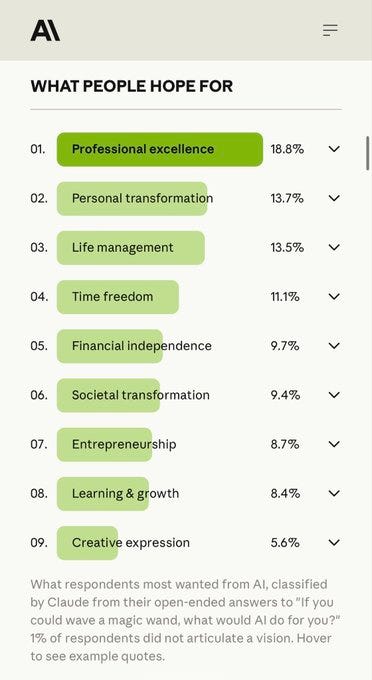
What people want from AI. We asked Claude to identify and categorize what each person most wanted from AI.
Source: Anthropic
The Hidden Cost of AI Anxiety: What Businesses Need to Know About This Workplace Stressor. Spring Health survey finds AI anxiety affects 24% of employees, worsening mental health, job security fears, and work-life stress.
Source: Spring HealthThe AI-driven workforce is here. How should your industry transform? World Economic Forum analysis shows AI creating a net gain of 78 million jobs by 2030, but industries must intentionally redesign roles and upskill workers to avoid disruption. Source: World Economic Forum
AI in the workplace is creating ‘friction or mistrust.’ MetLife report reveals 67% of HR leaders say AI is creating new points of friction and mistrust between employers and employees despite speed gains. Source: CNBC
Will AI Make the Workplace More Human? Gensler’s Global Workplace Survey 2026 shows AI is making physical offices more essential for human connection, not less, as hybrid work evolves. Source: Gensler
Why Gen AI Feels So Threatening to Workers. Harvard Business Review explains how generative AI threatens employees’ sense of competence, autonomy, and belonging, creating widespread resistance. Source: Harvard Business Review
Why an AI-augmented workforce will still need you. Fast Company argues humans remain essential in an AI era, as only people can provide judgment, creativity, and ethical oversight. Source: Fast Company
AI Anxiety: Workers Lose Confidence in Job Security. 40% of workers fear long-term job loss due to AI, with 62% of negatively impacted employees reporting burnout and reduced confidence. Source: Staffing Hub
‘Leadership vacuum’ prompts AI anxiety at work, report finds. Lack of clear leadership communication about AI increases employee anxiety; managers must address uncertainty through training and redesign. Source: HR Dive
Goldman finds no relationship between AI and productivity — but plenty of AI-nxiety. Goldman Sachs highlights corporate “AI-nxiety” where hype far outpaces actual productivity gains, increasing workforce uncertainty. Source: Fortune
Worried about AI? You should be, HR vets say. HR leaders express growing concern over the pace of AI change and its psychological toll on employees, urging proactive strategies. Source: HR Executive
AI Anxiety Deemed Top Business Risk in 2026. Vistra survey finds 50% of executives now rank AI implementation anxiety as their top business risk, surpassing economic slowdown concerns. Source: Supply & Demand Chain Executive
Developed in partnership with HR.com, AIX is a multimedia knowledge and engagement platform for experts, leaders, and HR peers to exchange experiences and seek guidance on cultivating mentally resilient, emotionally intelligent, and professionally adaptable workforces in an AI-augmented world. AI will increasingly touch every corner of the employee experience—from hiring to training, from task management to team dynamics. Whether its impact is positive or harmful depends largely on how HR prepares for it. The AIX platform (The AIX Files, The AIX Factor podcast, and the AIXonHR.com community) will play an important role in promoting employee well-being, workplace culture, and organisational readiness, the critical success factors in the age of AI.
No posts
Comments
Nothing yet. Say the first thing.
Sign in to join the conversation.