
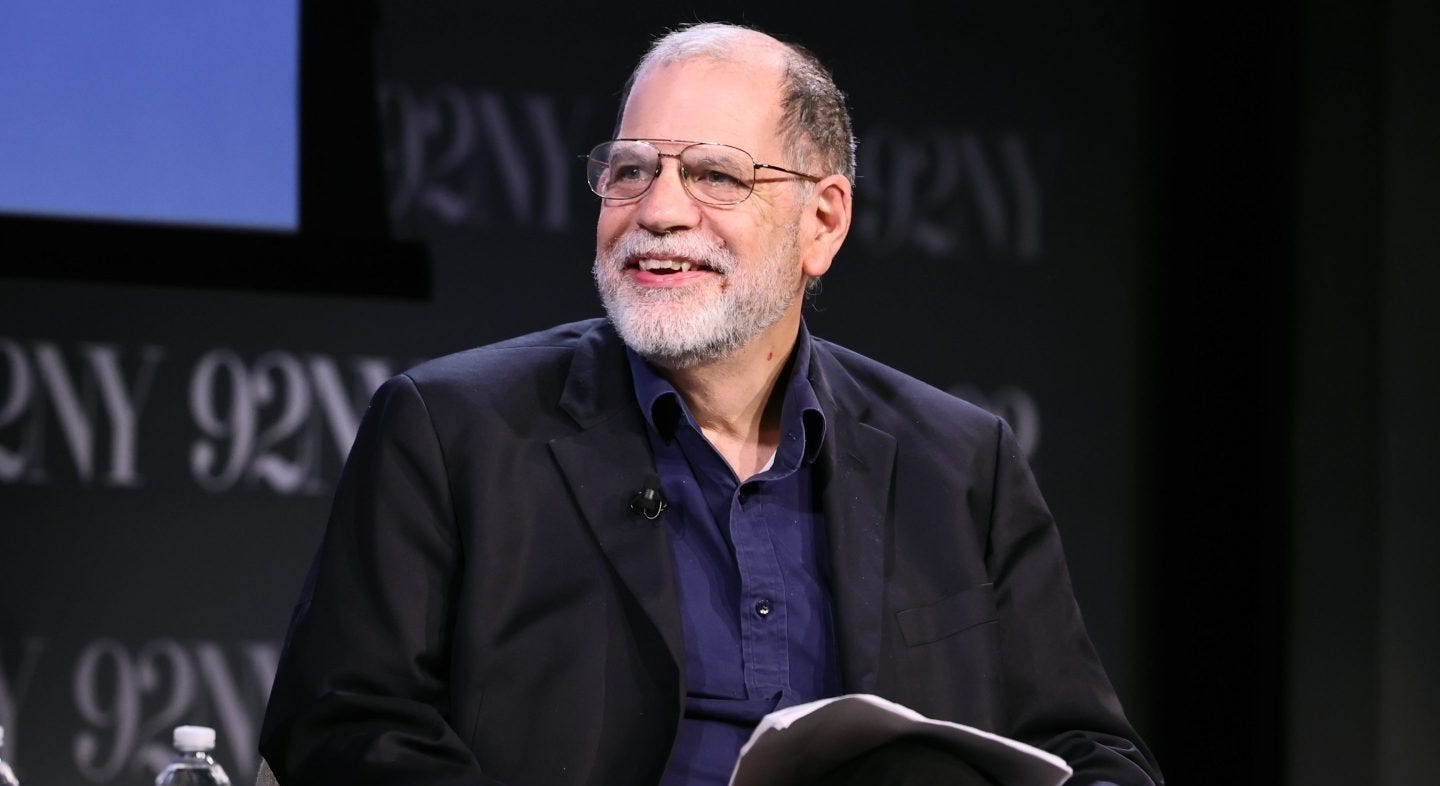
Tyler Cowen is one of a dying breed – a genuine public intellectual who “moonlights” as an economist and serves as the Holbert L. Harris Chair of Economics at George Mason University. He is widely recognized as the co-creator of Marginal Revolution, one of the world’s most popular economics blogs, and is the host of the acclaimed podcast Conversations with Tyler. His wide-ranging guest list should give you an idea of the breadth of his interests and expertise, which have included Sam Altman, Margaret Atwood, Daniel Kahneman, Rick Rubin, Kareem Abdul Jabbar, and author Katherine Rundell, who joined Cowen to discuss her award-winning biography of the poet John Donne.
Which is to say, when Professor Cowen hazards what many might consider a debatable opinion, he is not to be taken lightly, as is the case with a couple of recent articles, interviews, and addresses in which he sounded the general theme, “AI will not bring mass unemployment.” During a keynote this past April at the Sana AI summit in New York, he elaborated on this: “But it will change most jobs.” In that address, he acknowledged that the losers will be the lawyers, strategy consultants, and finance partners who spent decades mastering a set of elite credentials and playing by the rules: “Those are actually the people who might lose,” he said. “The people who will win are the people who are best at taking initiative, figuring out how AI works, figuring out how agents work, doing something different.” (Top economist Tyler Cowen on the biggest problem of the AI age: not mass unemployment but adjusting to a new reality)
Striking a similar theme, Cowen recently wrote a column for Free Press titled, Seven Ways to Avoid Losing Your Job to AI. Among these 7 “principles” (his word), he advocates going into the office to be seen (“you will be more trusted, easier to monitor, and people will develop a better sense of your talents”), and that we embrace “messy jobs,” citing the work of Economist Luis Garicano, who writes in his forthcoming book, Messy Jobs: The Work That AI Cannot Reach: “They suggest looking for jobs that are hard to describe and involve many components. Maybe today you’re trying to solve a personnel problem on the company floor, running a fundraiser the next day, and after that helping the marketing team develop a campaign. What exactly is your job, anyway? That’s a messy job.”
He adds another suggestion after his seventh principle, which may be a bridge too far: “…be the next Taylor Swift, or the next Victor Wembanyama: You can’t just walk into those jobs and apply, but the future will bring many more entertainers, athletes, and stand-up comedians. There will be more leisure time, more economic output, and thus more money to spend. Just as we prefer human chess players to their computer counterparts, so are we likely to continue to look to humans in the arts as well.”
Cowen closed his keynote at the Sana AI Summit with the following: “Being in the world and being human and being physical will be more the thing. It will be more what our lives are about.” He noted that he himself has reallocated two-thirds of his own time, focusing more on “human-facing” work: “Charisma will matter more. How you look will matter more. The egghead class, I think, will take a tumble in status.” He mused that “it will be a very weird, strange world.”
For another take on a related topic, I recommend a recent post from Elena Verna’s Substack, Your Job Is Changing Faster Than You Think: Assume that your current role is close to its expiration date.
For anyone working in tech, I’m sorry to say this, but there’s a real chance you will not have the same job by the end of 2027.
Some of that will be because of layoffs. Intuit and Meta just announced cuts, and I don’t think anyone seriously believes we’re done seeing more.
But even if you keep your seat, your actual job is going to change. A lot. The responsibilities, expectations, tools, scope of what you’re capable of accomplishing, bar for what ‘good’ looks like, and number of people needed to do the work are all being rewritten every day.
She lays out 3 steps to “start rebuilding yourself before someone else decides what version of your job survives. Ask yourself the tough questions to decide what you really want to do and how you can prepare. Start your solopreneurship journey in some way to give yourself career optionality. And start building an AI-native skillset, so you can thrive, no matter what.”
Cowen argues that “charisma will matter more.” I’d put that in the “be Taylor Swift” category – sounds great, but it’s not exactly broadly applicable. I’ve worked for, with, and been around several very impressive people with considerable skills, gifts, and charm. But not all had the “IT” factor –that magnetic force that draws every eye in the room. The sociologist Max Weber defined charisma as a “certain quality of an individual personality, by virtue of which he is set apart from ordinary men and treated as endowed with exceptional powers or qualities.”
But trying to define charisma is like trying to explain what makes something funny. As someone once said, dissecting humor is like dissecting a frog – it dies in the process. You can’t locate charisma in any dominant trait. It’s more than just dazzling good looks, vast sums of money and power, overwhelming charm, or a massive intellect…though any combination of the above helps. Some claim that it’s an acquirable skill, like playing the harmonica. I actually have seen articles in respected publications suggesting that business people can project charisma by assuming charismatic body language and a charismatic mental state. Try walking into meetings with perfect posture and positive energy…you may be bitterly disappointed when it doesn’t turn into Beatlemania.
“How you look will matter more.” This reminds me of another (satiric) Substack post I read titled, “Work Finely, Inc.: America’s Best-Looking Place to Work,” with excerpts below:
From the CEO to the unpaid interns, Work Finely is awash in formidable good looks, which is not surprising as they are in the business of good looks. The company was voted America’s Best-Looking Place to Work (BLPTW) in a poll conducted by Forbes, in association with Anne Taylor and MANSCAPED®.
Founded in early 2021 by Kent and Meegan Knightly, Work Finely delivers “employee appearance enhancement solutions” to companies around the world, which includes “product”(makeup, skincare, hair, fragrance, nail, and male grooming products), a Work Finely-branded clothing line designed for hybrid work, lighting solutions, feng shui support, and personal appearance coaching.
CEO Kent Knightley was asked what it means to “work finely”?
Kent: It means bringing your best-looking self to work. If you look good, you feel good, and if you feel good, you’re going to do your best work. Our culture is intensely inward-focused to demonstrate our belief in our product and commitment to our mission, which is ultimately about making our clients look good. We’re not out to make everyone a fashion model, sometimes presentable is enough to turn a borderline employee into a highly valued one. We want people to understand that it’s a journey - looks fade, but the habits and attention to detail you need to enhance and maintain your looks are what’s it really all about. If you can’t wait till tomorrow because you feel that you’re getting marginally better looking every day, we’re making an important contribution.

AI in People Decisions: What the Research Actually Says. AI tools are now embedded in hiring, performance management, and workforce
planning across most organizations. The promise is a familiar one: more consistent, less biased, and more defensible than human judgment alone. What the research actually shows is more nuanced. AIX’s Charles Epstein was joined by Alice Dawson, M.A., an associate research scientist in Neurology and the Brain Health Institute at Rutgers University’s Robert Wood Johnson Medical School, to present recent findings and analysis that will enable you to identify practical steps for strengthening internal AI governance in people decision contexts. The session is viewable here. (AI4HR Live! is a virtual series produced by HR.com that showcases practical AI adoption strategies.)

Offbeat tales of AI being unintentionally funny (i.e., woefully wrong), bizarre, creepy, (amusingly) scary, and/or just plain scary.
The Serpent in the Grove was named as the winning entry for the Commonwealth prize from the Caribbean on Saturday and published in Granta magazine.
In “a voice of restraint and quiet authority”, according to the judging committee, it narrates an intense episode in a troubled marriage, and is set in a farmhouse next to an enchanted grove.
Shortly after it was published, internet sleuths – and a few literary critics – seized upon the work and its author, Jamir Nazir, reportedly a 61-year-old from Trinidad and Tobago with few publications to his name.
Ethan Mollick, a professor at the University of Pennsylvania, wrote on Bluesky: “100% AI generated story just won the Commonwealth prize for the Caribbean region,” calling it “a Turing test of sorts”. As evidence, he cited Pangram, an AI detector, which said the work was AI-generated, but also said: “Come on, if you know you know.” Source: the Guardian
The week’s most interesting and timely articles on AI and its impacts on employee wellbeing and readiness.
When Using AI Leads to “Brain Fry”. A BCG study reveals that frequent use of multiple AI agents causes cognitive fatigue (“brain fry”), increasing mental fog, errors, and decision difficulty. Workers using three or more tools face significantly higher mental effort and fatigue, highlighting the need for better integration strategies to protect wellbeing. Source: Harvard Business Review
The AI Readiness Gap: The 2026 Enterprise Learning Wake Up Call. Docebo’s global study shows 85% of employees cannot apply AI training to their actual jobs, despite it being a top priority. This readiness gap stems from poor change management and training disconnected from real workflows. Source: Docebo
Why AI readiness training fails. Drawing on the Docebo 2026 report, this explains that 85% of employees struggle to apply AI training, 56% are too overwhelmed by existing tasks to learn, and most learning happens outside actual work tools, limiting effectiveness. Source: HR Dive
How to Address AI Anxiety in Your Workplace (2026 Edition). Defines AI anxiety (fears of displacement, skill obsolescence, and loss of autonomy) and its links to higher stress and lower wellbeing. It offers practical organizational strategies to support employees through AI-driven change. Source: Meditopia
AI Will Reshape More Jobs Than It Replaces. BCG analysis shows 50–55% of U.S. jobs will be reshaped soon, requiring scaled upskilling, reskilling, and deliberate career pathway redesign so employees are prepared rather than left behind.
Source: Boston Consulting Group (BCG)
Why AI Likely Means More Work For Humans. Rather than reducing headcount, AI automation of routine tasks elevates human work to higher-value levels (judgment, oversight, creativity, and differentiation), often creating labor shortages and more expert roles. Jeff Bezos compares it to handing someone a bulldozer instead of a shovel; companies automating extensively have still expanded human teams significantly. Source: Forbes
Sam Altman Says AI ‘Jobs Apocalypse’ He Once Predicted Probably Won’t Happen
OpenAI CEO Sam Altman says he is “delighted to be wrong” about a jobs apocalypse, noting far less elimination of entry-level white-collar jobs than expected so far. He emphasizes the irreplaceable “human part” of work—interpersonal interactions and care—that AI cannot replicate, suggesting the employment picture will differ markedly from early dire forecasts. Source: Time
Managers Are Struggling to Keep Up with the AI Productivity Boom. AI has dramatically sped up individual execution and idea-to-deliverable cycles, outpacing traditional management systems built for slower workflows and creating a new bottleneck at the managerial layer. Leaders must rethink processes, cadence, and oversight to match the accelerated pace without losing strategic alignment. Source: Harvard Business Review
Developed in partnership with HR.com, AIX is a multimedia knowledge and engagement platform for experts, leaders, and HR peers to exchange experiences and seek guidance on cultivating mentally resilient, emotionally intelligent, and professionally adaptable workforces in an AI-augmented world. AI will increasingly touch every corner of the employee experience—from hiring to training, from task management to team dynamics. Whether its impact is positive or harmful depends largely on how HR prepares for it. The AIX platform (The AIX Files, The AIX Factor podcast, and the AIXonHR.com community) will play an important role in promoting employee well-being, workplace culture, and organisational readiness, the critical success factors in the age of AI.
No posts
Comments
Nothing yet. Say the first thing.
Sign in to join the conversation.