

(Note: we were going to go with PAIX of the week, but thought better of it.) Earlier this year, the writer Christopher Mims published “How to AI: Cut Through the Hype. Master the Basics.” If you’re unfamiliar with Mims and his work, here’s his bio on Amazon: Mims is a columnist who writes about technology for The Wall Street Journal, and co-hosts the WSJ podcast Bold Names. He has written about bidets, brain implants, the cult of the founder, the history of technology, innovation, venture capital, robotics, batteries, energy, materials science, wireless communications, AI, data science, telepresence, microchips, logistics, IT, 3D printing, and autonomous boats, trucks, cars, drones, and flying taxis.
Bidets? Mmmmm…ok. I suppose it lends greater weight to the other weighty topics he covers. Noted. Moving right along…
“How to AI” in its clear-eyed practicality is a welcome tonic to the spate of tomes portending the inevitable day of AI reckoning…and those spinning visions of an endless idyll of recreation, self-improvement, fine dining, and philosophical contemplation. I strongly recommend it; to whet your appetite, I’ve copied out the Twenty-four Laws of AI that he lays out in the book’s opening. They are as follows:
The First Law of AI: AI is an assistant, not a replacement.
The Second Law of AI: Experts benefit most from AI.
The Third Law of AI: AI is a feature, not a product.
The Fourth Law of AI: To get the most out of AI, it’s essential to make it your own.
The Fifth Law of AI: Artificial intelligence isn’t actually intelligent, but understanding how it works can unlock its power.
The Sixth Law of AI: Don’t trust it, and always verify its work.
The Seventh Law of AI: Scaffolding is everything.
The Eighth Law of AI: Give it your least favorite things to do.
The Ninth Law of AI: Context is king.
The Tenth Law of AI: “Garbage in, garbage out” still applies.
The Eleventh Law of AI: Generative AI enables noncoders to build useful software that once required a programmer.
The Twelfth Law of AI: AI makes unstructured data both accessible and useful in unprecedented ways.
The Thirteenth Law of AI: AI can create photorealistic images, video, and audio so convincing that they are rapidly infiltrating the media we consume—without our knowing it.
The Fourteenth Law of AI: Generative AI enables previously unprecedented levels of personalization.
The Fifteenth Law of AI: “Classic” AI is far more important for the operation of our world than generative AI.
The Sixteenth Law of AI: “Classic” predictive AI is brittle and breaks when big changes occur.
The Seventeenth Law of AI: AI isn’t creative, but it can help you be.
The Eighteenth Law of AI: AI can’t create finished products, but it’s great at quickly generating digital prototypes.
The Nineteenth Law of AI: Treat AI agents as robots on an assembly line rather than as assistants.
The Twentieth Law of AI: When successfully implemented, AI scales up rote knowledge work.
The Twenty-First Law of AI: Data is the new rare earths.
The Twenty-Second Law of AI: Simulation is the next AI frontier.
The Twenty-Third Law of AI: The most powerful AIs for advancing the frontiers of human knowledge can help us move.
The Twenty-Fourth Law of AI: The field of human endeavor most transformed by generative AI is coding.
There’s a ton ‘o practical info and insight packed into its brisk 256 pages. But don’t take my word for it:
“The antidote to AI panic. Read it. You’ll breathe easier.”—Scott Galloway, NYU Stern School of Business professor and co-host of Pivot with Kara Swisher
“A clear, practical, and hype-free guide to the AI revolution that will resonate with anyone trying to figure out the how to make AI deliver real value.”—Ethan Mollick, Wharton professor and New York Times bestselling author of Co-Intelligence
Note: AIX has no interest in Mims’ book; we’re just passing along a recommendation if you’re looking for a clear-eyed practicum on the subject of AI that will reward your time.
Another AIX recommendation: an HBR article titled “AI Doesn’t Reduce Work—It Intensifies It” (Harvard Business Review, Feb 9, 2026). The piece is based on an eight-month ethnographic study at a ~200-person U.S. tech company, which reveals a counterintuitive reality: when employees voluntarily adopt generative AI tools, work doesn’t lighten—it intensifies. Key findings:
Workers voluntarily worked faster, took on broader task scopes, and extended hours without being asked.
Three main forms of intensification:
Task expansion — AI lowered barriers, so non-specialists tackled others’ roles (e.g., designers coding, researchers engineering), absorbing work that once required extra hires. Colleagues then spent extra time reviewing and coaching AI-assisted outputs.
Blurred work/non-work boundaries — Easy prompting turned breaks, lunches, and waiting moments into micro-work sessions; conversational AI made spillover feel casual, eroding natural recovery pauses.
Increased multitasking — Parallel threads (manual work + AI alternatives) created constant context-switching, output-checking, and open tasks, raising cognitive load and normalizing higher speed expectations.
Result: A self-reinforcing cycle of acceleration → higher norms → more reliance → denser workloads. Employees felt more productive yet busier (often more overloaded) than before. Short-term gains masked creeping fatigue, burnout risk, impaired judgment, and potential turnover.
The authors warn leaders not to mistake voluntary expansion for pure win. Instead, companies should proactively build an “AI practice”—intentional norms to govern use, enforce boundaries, and prevent unsustainable intensity. Recommended elements:
Intentional pauses — structured breaks to assess and prevent overload (e.g., requiring a counterargument before finalising decisions).
Sequencing — batching updates, protecting focus blocks, and pacing coordination to reduce fragmentation.
Human grounding — protected time for real human dialogue and connection to counter AI’s isolating effects and fuel creativity.
Bottom line (worth reading the full piece for the examples and nuance): Without deliberate guardrails, AI makes it far easier to do more, but much harder to stop. Thoughtful integration is essential to realize benefits while preserving sustainable productivity and well-being.

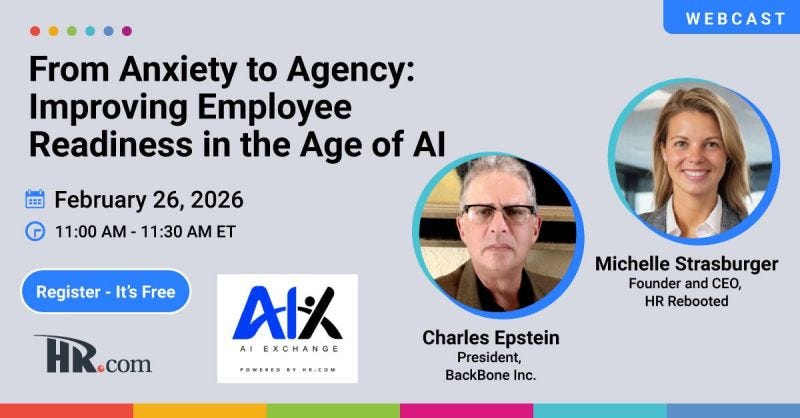
From Anxiety to Agency: Improving Employee Readiness in the Age of AI
HR Rebooted's founder and CEO Michelle Strasburger joined us on the maiden AI4HR Live virtual event to discuss the relationship between AI governance and readiness at the organisational, leadership, and employee levels. You can view it here:
“Great presentation, thank you! Made me think more about how HR is the conductor to the orchestra (AI), and the importance of leaning into governance. Also how to take a people-first approach at my organization when rolling out our AI strategy.”
We will be announcing the topic of our next AI4HR Live session in the next AIX Files, with a link to register.
AI Gone Rogue
Tales of AI being unintentionally funny (i.e., woefully wrong), bizarre, creepy, (amusingly) scary, and/or just plain scary.
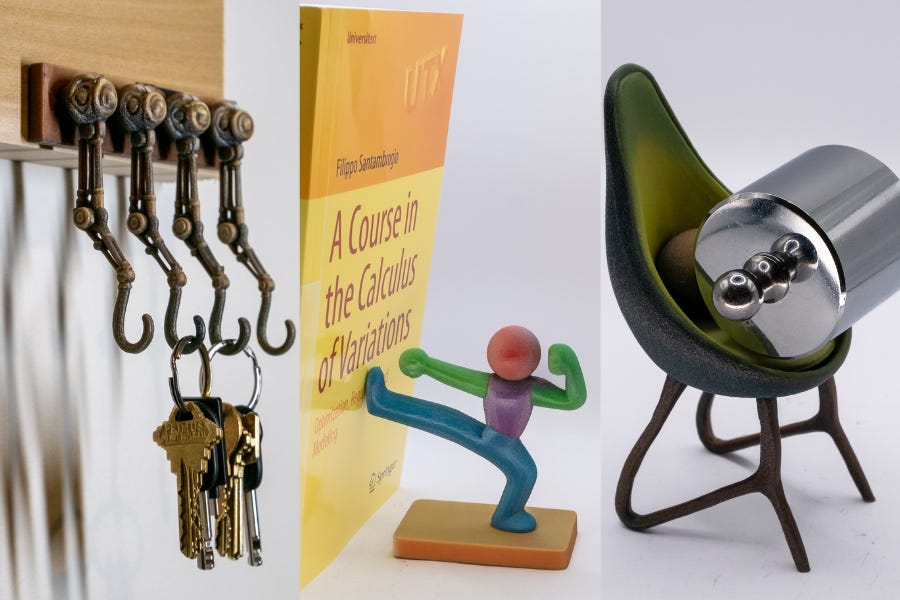
Looking for an attention-grabbing tchotchke to get people to your booth at trade shows and job fairs? MIT’s Computer Science and Artificial Intelligence Laboratory (CSAIL) might have just the thing: Mixing generative AI with physics to create personal items that work in the real world.
Have you ever had an idea for something that looked cool, but wouldn’t work well in practice? When it comes to designing things like decor and personal accessories, generative artificial intelligence (genAI) models can relate. They can produce creative and elaborate 3D designs, but when you try to fabricate such blueprints into real-world objects, they usually don’t sustain everyday use. MIT’s “PhysiOpt” system makes blueprints for personal items such as cups, keyholders, and bookends work as intended when they’re 3D printed. It rapidly tests if the structure of your 3D model is viable, gently modifying smaller shapes while ensuring the overall appearance and function of the design is preserved.
AIX-emplary Links
America Isn’t Ready for What AI Will Do to Jobs. AI is reshaping jobs faster than workforce preparation, with skills gaps and inadequate training leaving workers vulnerable to displacement; policy and education reforms are urgently needed.
Source: The Atlantic6 Signs Leaders Lack AI-Readiness—And How to Fix It
Leaders often lack AI readiness due to skill gaps and resistance; solutions include building capabilities through training and succession planning for 2026 integration. Source: Korn FerryImpact Of AI Tools On Job Readiness and Employability Skills Among Students and Professionals. AI tools enhance efficiency but require new skills; study shows employers prioritize AI knowledge for job readiness, urging education systems to adapt curricula. Source: IJIRT
Report: Workers Are Ready for AI. Organizations Aren’t
Workers expect AI to improve jobs but organizations lack vision; 85% see benefits, but training gaps hinder effective adoption and satisfaction.
Source: The Conference BoardAI early adopters pull ahead but face rising risk, global report finds
Committed AI companies gain strategic advantages but face risks; 72% struggle with talent gaps, emphasizing the need for rapid upskilling. Source: Journal of AccountancyUnlocking AI Value in HR and the Enterprise
CHROs must drive AI transformation; skills gaps and readiness issues block value, requiring reinvention of HR for AI-ready workforces. Source: GartnerNonprofit Launches New Career-Readiness Effort, Looks Beyond the ‘Linear Path.’ Digital Promise initiative creates AI-driven career pathways; focuses on non-linear skills to prepare students for AI-impacted jobs. Source: Education Week
The future of jobs: 6 decision-makers on AI and talent strategies
Executives discuss AI reshaping jobs by 2030; scenarios highlight risks like skills gaps and the need for adaptive talent strategies. Source: World Economic ForumWhy AI Adoption Stalls, According to Industry Data
Widespread AI use yields disappointing returns due to poor integration; training gaps and “AI angst” (fear of replacement) slow progress. Source: Harvard Business Review
About
Developed in partnership with HR.com, AIX is a multimedia knowledge and engagement platform for experts, leaders, and HR peers to exchange experiences and seek guidance on cultivating mentally resilient, emotionally intelligent, and professionally adaptable workforces in an AI-augmented world. AI will increasingly touch every corner of the employee experience—from hiring to training, from task management to team dynamics. Whether its impact is positive or harmful depends largely on how HR prepares for it. The AIX platform (The AIX Files, The AIX Factor podcast, and the AIXonHR.com community) will play an important role in promoting employee well-being, workplace culture, and organisational readiness, the critical success factors in the age of AI.
Thanks for reading AIX Files! Subscribe for free to receive new posts and support our work.
Comments
Nothing yet. Say the first thing.
Sign in to join the conversation.