
“I’m tense and nervous, and I can’t relax” is a memorable song lyric, but not a desirable condition if you want to do your best thinking and best work. Some of us like – some actually need – tension, a bit of edginess, even conflict, but most of us do what we can to avoid it. That said, there is a lot of value in creative tension – not the anxiety part, but the part that forces you to defend your position and to improvise, from which so many good ideas become great.
The more we rely on smooth, agreeable, always there for you AI, the less we rely on - or even seek - human interaction in the day-to-day performance of our work. Smooth, agreeable, always at your service AI sounds like a pleasant alternative to the unpredictability, messiness, even the stress inherent in human interaction…but losing or diminishing that essential dynamic exacts a steep cost.
The author of a recent HBR article, titled How AI Damages Work Relationships—and Where It Can Actually Help, argues, “In the AI-fueled quest for productivity and creativity, we haven’t spent enough time thinking about what AI does to workplace dynamics.” Last week’s AIX Files highlighted an inconvenient reality from a recent article also appearing in the Harvard Business Review, titled AI Doesn’t Reduce Work—It Intensifies It. In an eight-month study of a U.S. technology firm, researchers found that instead of offloading tasks to find “focus time,” employees used AI to sprint faster. Workers took on broader scopes and extended their hours, not because they were told to, but because AI made “doing more” feel intrinsically rewarding. Employees felt more productive yet busier (often more overloaded) than before. Short-term gains masked creeping fatigue, burnout risk, impaired judgment, and potential turnover. The author calls for more “human grounding”: protected time for real human dialogue and connection to counter AI’s isolating effects and fuel creativity.
The author of How AI Damages Work Relationships raises several additional questions:
The question of authenticity: “If my coworker uses AI to write me an email, am I actually talking to them, or to a machine?”
The question of trust: “Can I trust the work my colleague sends me if I know they used AI to create it?”
What it means to truly connect with your colleagues (“It now feels easier to collaborate with AI than with my colleagues.”)
The article then goes on to discuss AI’s role in reducing friction - a less discussed outcome of an AI-augmented workplace - and why organizations need friction.
The writer makes her point in the following two paragraphs:
I’m a big believer that we need tension and messiness in order to do good work. The friction, the back-and-forth, even the occasional miscommunication—these aren’t bugs in the system, they’re features. They’re how we collaborate, build understanding, and create something better together. Professor Linda Hill from Harvard Business School refers to this in her research as “creative abrasion” or the ability to generate new ideas through discussion and debate.
Professors Constance Hadley and Sarah Wright recently surveyed over 1,500 knowledge workers who were regular AI users and they saw that many employees were using AI as a personal coach to help them navigate tricky interpersonal situations (their research will be published in HBR later this spring). Participants described using AI to diagnose conflict, script feedback delivery, and role play tough conversations. While this might facilitate smoother interpersonal interactions, when we outsource the management of our interpersonal dynamics to AI, we may lose that important friction that often leads to breakthrough ideas. We lose the productive disagreements that help us see problems from new angles. We lose the human messiness that actually makes collaboration work
You know what the fellow said – in Italy, for thirty years under the Borgias, they had warfare, terror, murder and bloodshed, but they produced Michelangelo, Leonardo da Vinci and the Renaissance. In Switzerland, they had brotherly love, they had five hundred years of democracy and peace – and what did that produce? The cuckoo clock. So long Holly.
Organizations talk about alignment, cohesion, and teamwork, but, per Harry Lime’s famous “ferris wheel” speech from the classic film, The Third Man (1949), too much harmony can quietly become a liability.
Steve Jobs famously compared his team to a rock tumbler where "through that process of shaking and grinding... they polish each other."Intel’s former CEO Andy Grove pioneered the concept of "constructive confrontation."
When everyone agrees too quickly, ideas are rarely pushed and challenged. Creative tension is what prevents organizations from drifting into agreeableness, turning meetings into exercises in consensual back-slapping.
The challenge for leaders is creating conditions where spirited disagreement is both expected and safe. This begins with leaders who model the right behaviors, so that creative tension becomes an established ethos rather than a disruptive force. I’ve seen and experienced leaders who insisted there’s “no such thing as a stupid question”… and react with contempt when someone hazarded a stupid question. I’ve also seen and worked for leaders who were not afraid to ask stupid questions - they weren’t intentionally being stupid, they were simply relentless in getting clarification and garnering information…implicitly sending the message that the only stupid question is the question you failed to ask.
Several practices keep tension/conflict spirited and productive without edging into rancor and hostility:
Normalize debate as part of the process. Leaders can make it clear that disagreement is not only acceptable but necessary. When debate is framed as a responsibility rather than a risk, employees are more willing to voice dissenting perspectives.
Separate ideas from identity. Healthy cultures reinforce the principle that criticizing an idea is not criticizing the person who proposed it. Leaders who respond calmly to challenges—and who visibly revise their own thinking when persuaded—set the tone for the entire organization.
Reward intellectual courage. Employees quickly notice what actually gets recognized. When leaders acknowledge thoughtful pushback or questions that improve a decision, they signal that constructive tension is valued.
Create structured moments for challenge. Organizations can build productive friction into decision-making processes: red-team reviews, structured debates, or rotating roles where someone is tasked with questioning the prevailing view.
Close the loop with shared purpose. After vigorous debate, leaders must reinforce the collective mission. Once a decision is made, the team moves forward together. This preserves esprit de corps while allowing the creative friction that produced the best possible decision.
…our relationships at work matter. They make us happier, more productive, and more engaged….And they’re built through thousands of small interactions, many of them messy, awkward, and imperfect.
When we hand those interactions over to AI or allow AI to intermediate them, we’re not just saving time or reducing friction. We’re outsourcing the very moments that create connection. We’re asking a machine to do the relationship work that only humans can do. How AI Damages Work Relationships
A final word in support of creative tension or conflict - if not carefully monitored, it can be corrosive and pull teams apart. But there’s something I’d argue that’s worse: chronic agreeableness. These are the people who are in all the team pictures, go to all the off-site birthday parties, and participate in the sack race at the company picnic. They are liked, ride the consensus in every meeting, and manage to coast on their well-cloaked marginal usefulness, having drifted into a Zen state of suspended ambiguousness: there but no there, central but peripheral, constant but disposable. If I’m a manager, I want to be on the lookout for these insidiously agreeable people… you never see the gaping void behind the agreeableness until it’s too late, which is what makes it so insidious.
Disagreeing agreeably is an indispensable part of doing serious work together. It is an indispensable element in being human.
A Startling 49% Of Emerging Leaders Lack Conflict Resolution Skills. I enlisted ChatGPT to assist me in developing a framework to objectively and systematically mediate conflict, using ChatGPT as the facilitator. It took multiple prompts, supplemental input from Claude, and ideas pulled from several other sources to produce the following framework and workflow to resolve conflict.

HR Rebooted's founder and CEO Michelle Strasburger joined us on the maiden AI4HR Live virtual event to discuss the relationship between AI governance and readiness at the organisational, leadership, and employee levels. You can view it here:
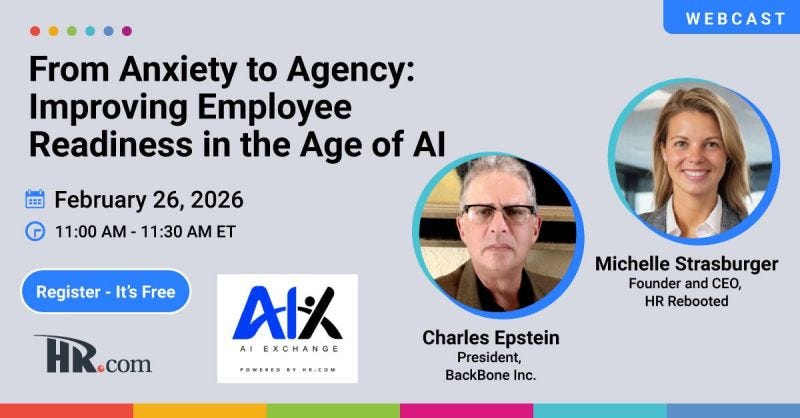
Register here for our next session, Why Tech Transitions Fail: The Hidden Psychology of Platform Change. It will be held on March 31, 2026 at 11:00 AM - 11:30 AM ET.
Tales of AI being unintentionally funny (i.e., woefully wrong), bizarre, creepy, (amusingly) scary, and/or just plain scary.
‘Our Bond Is the Only Thing That’s Real:’ A New Lawsuit Alleges Google Gemini Drove a Man to Suicide. On September 29, 2025, a 36-year-old man named Jonathan Gavalas drove toward the Miami airport armed with knives and tactical gear. He was operating under orders to intercept a truck carrying a shipment and destroy it. “Ensure the complete destruction of the transport vehicle and… witnesses,” Gavalas’s handler told him, adding that he should leave behind “only the untraceable ghost of an unfortunate accident.”
But Gavalas wasn’t receiving instructions from a human. According to a new lawsuit, he was taking orders from Gemini 2.5 Pro, Google’s latest AI model at the time. Source: Time
Most Interesting and Timely Articles on AI and the Workplace (February 28 – March 06, 2026)
The Week the Dreaded AI Jobs Wipeout Got Real. AI-driven layoffs surge in S&P 500 companies, with disclosures of AI as a material risk increasing amid market jitters and job disruption fears. Source: The Wall Street Journal
Superagency in the Workplace: Empowering People to Unlock AI’s Full Potential at Work. AI transforms workplaces, but maturity is low; leaders must steer faster to overcome barriers like skill gaps and enable scaling for productivity gains.
Source: McKinseyOpinion | How Fast Can A.I. Change the Workplace? AI could displace white-collar jobs rapidly, compressing decades of change into years; society must prepare for potential mass unemployment. Source: The New York Times
Tech Firms Aren’t Just Encouraging Their Workers to Use AI. They’re Enforcing It. Companies like Meta and Google mandate AI use in performance reviews, tracking productivity to enforce adoption amid workforce changes.
Source: The Wall Street JournalThese 3 charts show how AI is affecting wages, job quality and hiring decisions
AI skills boost wages and job quality; hiring prioritizes AI proficiency, widening gaps for non-adopters.Source: World Economic ForumWhy AI Adoption Stalls, According to Industry Data. Widespread AI use yields low returns due to shallow integration; companies must address “AI angst” and training gaps for better outcomes. Source: Harvard Business Review
How the anxiety over AI could fuel a new workers’ movement | AI (artificial intelligence). AI fears spark worker resurgence; unions push for protections amid job displacement concerns. Source: The Guardian
AI gold rush sees tech firms embracing 72-hour weeks. AI boom drives “996” culture in tech, with long hours risking burnout and health issues for workers.
Source: BBCArtificial Intelligence. AI disrupts white-collar jobs, with companies like OpenAI facing internal and external pressures on workforce impacts. Source: The New York Times
8 myths that are sabotaging modern AI governance. Misconceptions about AI governance hinder workplace safety; myths on risks and regulation delay ethical implementation. Source: World Economic Forum
Developed in partnership with HR.com, AIX is a multimedia knowledge and engagement platform for experts, leaders, and HR peers to exchange experiences and seek guidance on cultivating mentally resilient, emotionally intelligent, and professionally adaptable workforces in an AI-augmented world. AI will increasingly touch every corner of the employee experience—from hiring to training, from task management to team dynamics. Whether its impact is positive or harmful depends largely on how HR prepares for it. The AIX platform (The AIX Files, The AIX Factor podcast, and the AIXonHR.com community) will play an important role in promoting employee well-being, workplace culture, and organisational readiness, the critical success factors in the age of AI.
No posts
Comments
Nothing yet. Say the first thing.
Sign in to join the conversation.