
Ready to supercharge your classroom with some AI magic? This week, we're diving headfirst into the latest experiments and insights educators are exploring right now. From turning boring syllabi into engaging podcasts to AI tutors reading students' minds (literally!), we've got stories, research, and implementations that'll spark your imagination and have your students wondering, "What's next?"
Here is an overview of today’s newsletter:
Exploring AI Use Cases in the Classroom
Interview with a Master’s Student – How AI helps students catch up on learning
Key Findings from a Study on AI Mentors for Student Projects
The Latest on AI and Academic Cheating
Roll Up Your Sleeves: The Practical AI Toolkit for Busy Educators
Whether you're new to the space or already experimenting with tools, our next webinar will equip you with practical, people-centered strategies to implement AI with confidence and care. Join internationally renowned educator and innovation leader Rebecca Bultsma (Chief Innovation Officer, Amplify & Elevate Innovation; co-host, AmpED to 11 Podcast) as she shares actionable ways to transform instruction, streamline administrative tasks, and personalize learning—no technical background required.

You’ll walk away with:
Step-by-step processes for using AI in your daily workflow
Real-world examples of AI-enhanced lesson planning, assessment, and feedback
Ethical frameworks for responsible AI adoption in schools
Perfect for K–12 educators, school leaders, and anyone eager to make AI approachable and impactful in the classroom.
This LinkedIn tutorial by Darren Coxen highlights a simple yet powerful strategy for educators to create study guides and practice quizzes. By leveraging Google’s NotebookLM, educators can convert syllabus units into podcasts, transform transcripts into study notes with Gamma, and generate quizzes with Quizizz.

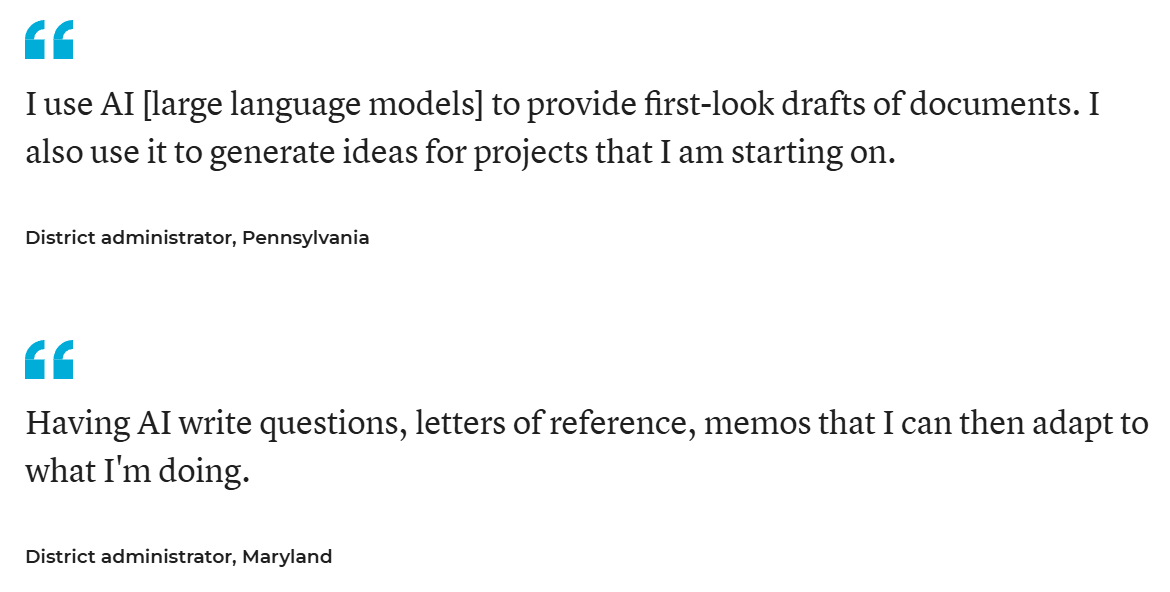
Check out EdWeek’s article, “How District Leaders Use AI to Save Time, Help Teachers, and More”, where they share how 22 district leaders are leveraging AI to streamline administrative tasks, enhance brainstorming, and more.
This blog post shares 8 universities and schools transforming education with the help of Google AI. It explores specific use cases in K-12 and higher education, showcasing how campuses integrate AI in the classroom to assist students with data analysis, engage in debates, and more.

A group at Stanford University Human-Centered Artificial Intelligence (HAI) shares their findings in the article, “AI Helps Math Teachers Build Better "Scaffolds" where they explored how AI could support middle school math teachers in creating stronger scaffolds for their students. Their study used AI to generate warm-up problems that activate prior knowledge. Ultimately, the AI-generated warmups modeled after real teachers' lessons were rated higher than those created by humans, highlighting AI’s potential to enhance the learning experience.


In this podcast episode of Class Disrupted, Diane Tavenner and Michael B. Horn interview Siya Raj Purohit, a leader of education initiatives at OpenAI. They discuss ChatGPT’s potential to transform education, with Purohit sharing her experiences and advocating for its role in personalizing learning and serving as a mentor. She also emphasizes the importance of preventing teacher burnout and improving classroom interactions.
On February 4, 2025, 150 children across the UK gathered at the Children’s AI Summit, organized by The Alan Turing Institute in partnership with Queen Mary University of London, to discuss how generative AI impacts their lives. The children’s insights were compiled into a manifesto titled, “The Children's Manifesto for the Future of AI”, available in both a 2-page summary and a 29-page detailed report, where they emphasized the need for AI to enhance education, well-being, scientific research, and more.
The University of Sydney has put together a comprehensive site, titled AI for Educators, to share resources on various topics such as Generative AI in Assessment, How to Use GenAI in Teaching, and more.

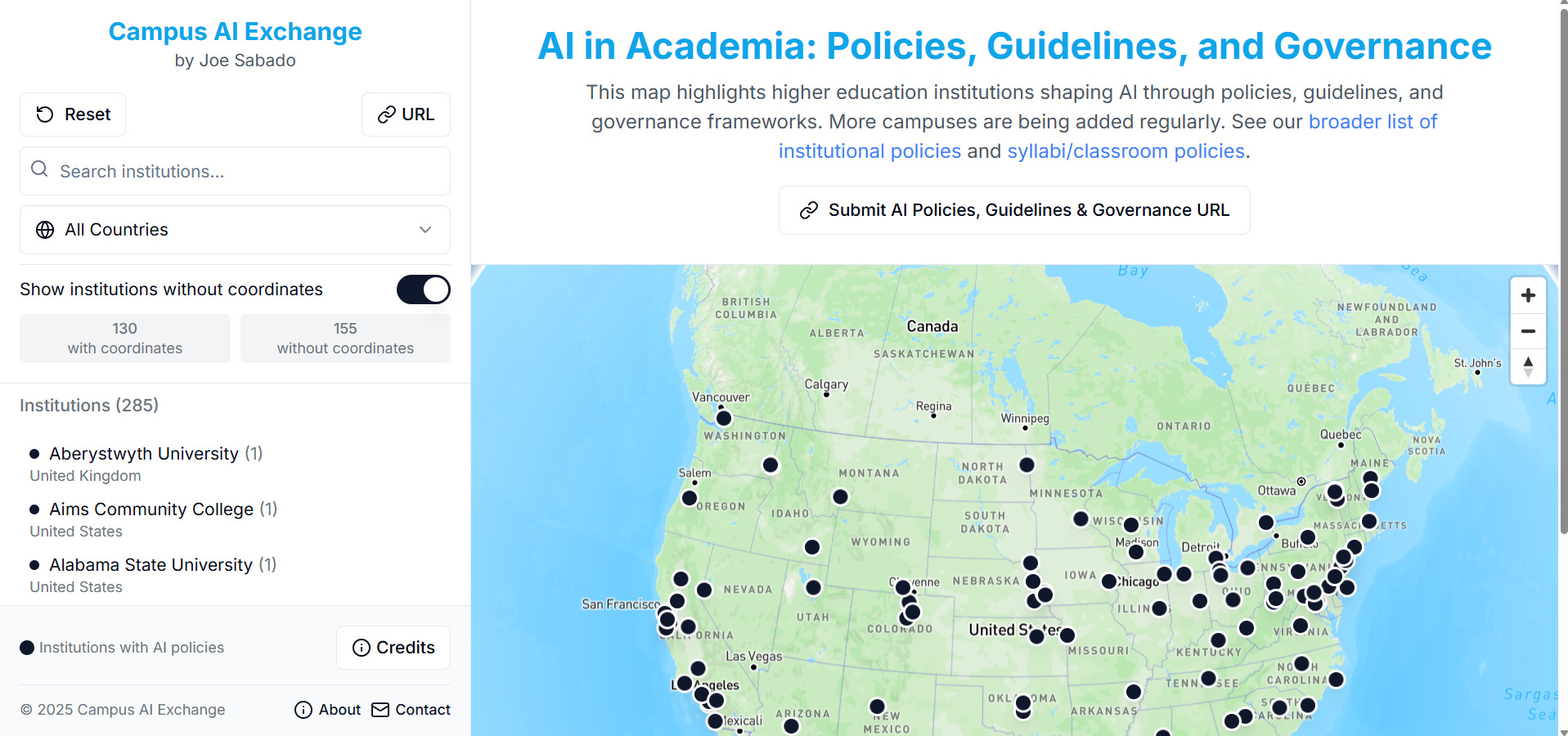
This Higher Education AI Policies and Guidelines interactive map, created by Joe Sabado, provides links to Generative AI policy in various institutions around the world. This can be a helpful resource to learn about and get inspired from AI policies from other institutions.

Classroom-Ready Resources About AI For Teaching (CRAFT) at Stanford, provides free resources to high school educators who teach students to question and explore AI. Their resource database is multidisciplinary and offers valuable lessons on topics like verifying an AI model’s responses. There are also tutorial pages for activities like building a chatbot that can help educators spark AI development in high school classrooms.



This week, we had a chance to interview Roberto Huie, a first-year master’s student studying Applied Computer Science at Columbus State University. In the following, we present select highlights from these conversations, which have been slightly edited for enhanced clarity and precision:
Q: In what ways have you used AI in your education?
I don't want to date myself, but I'm a little further removed from my full-time undergraduate education. As I'm getting back into that learning mindset, AI has really accelerated the process of picking up things I've forgotten or need to relearn. For example, if I'm working on an assignment and realize I don't remember how to do something, I can easily prompt, "Hey, teach me some of the most important concepts of this topic." It's been really helpful in getting me back up to speed in my education.
Q: What are some concerns you have about AI?
I think AI dependency is something worth thinking about. Over-reliance on AI can erode fundamental critical thinking and decision-making skills, which are skills that are crucial for us as humans. There's a real risk that we could become too dependent on it, which is something to be mindful of.
We also don’t want AI to replace human interaction. People still need to communicate effectively and think for themselves, so ensuring that balance is really important.
Another concern is the environmental impact. I read an article a couple of months ago that mentioned a ChatGPT prompt can consume around ten times more energy than a typical Google search. As AI adoption continues to grow, we have to consider what that means for our energy resources and the environment.
Lastly, misinformation and manipulation are major concerns. We've seen the rise of deepfake technology and how language models can produce biased or misleading content if trained on bad data. That’s worrying because people often put a lot of trust in these systems and the information they provide.
Q: How do you see education changing in the next 10 to 20 years?
It's hard to say for certain, but I think it's still under review as institutions are approaching AI integration at different paces. Some institutions are fully embracing it, finding creative ways to engage faculty and students. Others seem to be taking a more cautious approach, figuring out how best to adapt to the changing environment. I believe we'll eventually see some form of standardization, whether that’s through governance, compliance, or regulation at the institutional, state, or federal level. I imagine this steady state will emerge over the next 5 to 10 years, which will shape future changes.
I also think we'll see a shift toward more personalized learning paths. I wouldn’t say the one-size-fits-all model will completely disappear, but education will likely become more tailored to individual needs. A big part of this will be driven by AI-driven analytics and insights. As the technology becomes more accessible, tools like virtual tutors, simulations, and augmented reality will become much more common.
On a practical level, I think AI will increasingly automate administrative tasks, which is something we're already starting to see. For example, my mother-in-law is a professor, and she spends a lot of time managing grades. AI can help automate that, giving educators more time to focus on teaching, mentoring, and being creative.
MIT Media Lab
NeuroChat: A Neuroadaptive AI Chatbot for Customizing Learning Experiences ↗️
A team of researchers at the MIT Media Lab has been developing NeuroChat, a new type of AI tutor designed to make learning more engaging and personalized. Unlike regular AI chatbots, NeuroChat uses a wearable EEG headband to monitor a learner's brain activity and understand their real-time engagement levels. This engagement information is then used to tell a generative AI model (specifically GPT-4) how to adjust its responses, such as changing the complexity or style of explanations.
Here’s what they learned:
NeuroChat significantly increased how engaged learners were, both in terms of their brain activity and their own reports.
Increased engagement with NeuroChat, however, did not lead to immediate improvements in test scores, suggesting that more research is needed to understand how to best translate engagement into learning gains.
Learners have diverse preferences for interaction styles with AI tutors, with some favoring NeuroChat's more human-like approach and others preferring the factual style of a standard LLM.
NeuroChat represents an advancement in neuroadaptive learning by moving from pre-scripted content to the dynamic generation of personalized learning content based on real-time cognitive feedback.
Baradari, D., Kosmyna, N., Petrov, O., Kaplun, R., & Maes, P. (2025). NeuroChat: A neuroadaptive AI chatbot for customizing learning experiences. arXiv. https://arxiv.org/abs/2503.07599Carnegie Mellon University
AI Mentors for Student Projects: Spotting Early Issues in Computer Science Proposals ↗️
Researchers at CMU developed a software system to help educators spot early issues in student computer science project proposals for project-based learning. In an initial study, 36 online student participants used the system to create project proposals for interactive web applications or video games by filling out a structured online form. The system also gathered information on their aptitude and experience. Afterward, two educators and GPT-4o independently evaluated the quality of these proposals using a detailed rubric, and the agreement between their ratings was analyzed.
Here’s what they learned:
GPT-4o's ratings of project proposal quality showed promising agreement with educator ratings, suggesting the potential for LLMs to scale the automatic grading of these proposal
Students generally had a positive perception of the AI mentor system. A large majority of the participants (88.8%) indicated they would want to use the system in the future to help them choose skills and technologies to learn more about. An even higher percentage (91.6%) expressed interest in using the system in the future to design project ideas that would motivate them to learn more.
Students who reported having less technical experience in the intended project topic tended to submit project proposals that were rated as lower in quality. This finding, supported by the educators' independent evaluations, suggests that prior experience in computer science plays a role in the initial quality of project proposals in a project-based learning context.
Aher, G., Schmucker, R., Mitchell, T., & Lipton, Z. C. (2025). AI mentors for student projects: Spotting early issues in computer science proposals. arXiv. https://arxiv.org/abs/2503.05782Wall Street Journal
There’s a Good Chance Your Kid Uses AI to Cheat ↗️
Key takeaways:
Nearly 40% of middle and high school students who use AI do so without their teachers' permission to complete assignments, and this figure rises to nearly half for college students who use AI.
Educators are struggling to address this, as AI companies offer little direct help in preventing cheating. One representative from OpenAI stated, "OpenAI did not invent cheating. People who want to cheat will find a way".
While some AI detection tools exist, they are not always accurate, with instances of both false positives and false negatives.
Some teachers are implementing innovative solutions like requiring handwritten first drafts in class with technology prohibited, which has led to students taking more time and producing more authentic writing.
The widespread use of AI in education presents a "gigantic public experiment" with limited research on its academic merits and pitfalls, raising concerns about students' preparedness for college and the workforce and the value of traditional assessments like essays
Business Insider
China's capital city is making AI education mandatory, even for elementary schoolers ↗️
Key takeaways:
Schools in Beijing will be required to provide at least eight hours of AI instruction each academic year starting this fall.
Elementary school students will engage in hands-on courses to build foundational AI understanding, while middle schoolers will learn to apply AI in their schoolwork and daily lives. High school students will concentrate on enhancing AI applications and innovation.
Beijing's initiative aims to establish a "teacher-student-machine" learning model and incorporate AI ethics. Schools have the option to teach AI as a separate subject or integrate it into existing science and information technology courses.
Beijing's move to make AI education compulsory aligns with China's broader efforts to advance in the AI race, as evidenced by the global attention received by its homegrown AI startups like DeepSeek.
And that’s a wrap for this week’s newsletter! If you enjoyed our newsletter and found it helpful, please consider sharing this free resource with your colleagues, educators, administrators, and more.
No posts
Comments
Nothing yet. Say the first thing.
Sign in to join the conversation.