
Quick challenge: Take a second and think about how much you’ve spent in the past year on ads, funnel tools, and conversion hacks. Ballpark it.
Now... imagine getting better results while cutting that spend way down.
In this issue, I’m going to introduce the Trust Funnel and break down the core idea behind it - why the old way is falling flat, what’s actually working now, and how you can tell if your trust-building game is on point. You’ll also find out which of the seven “trust vehicles” clicks best with your business.
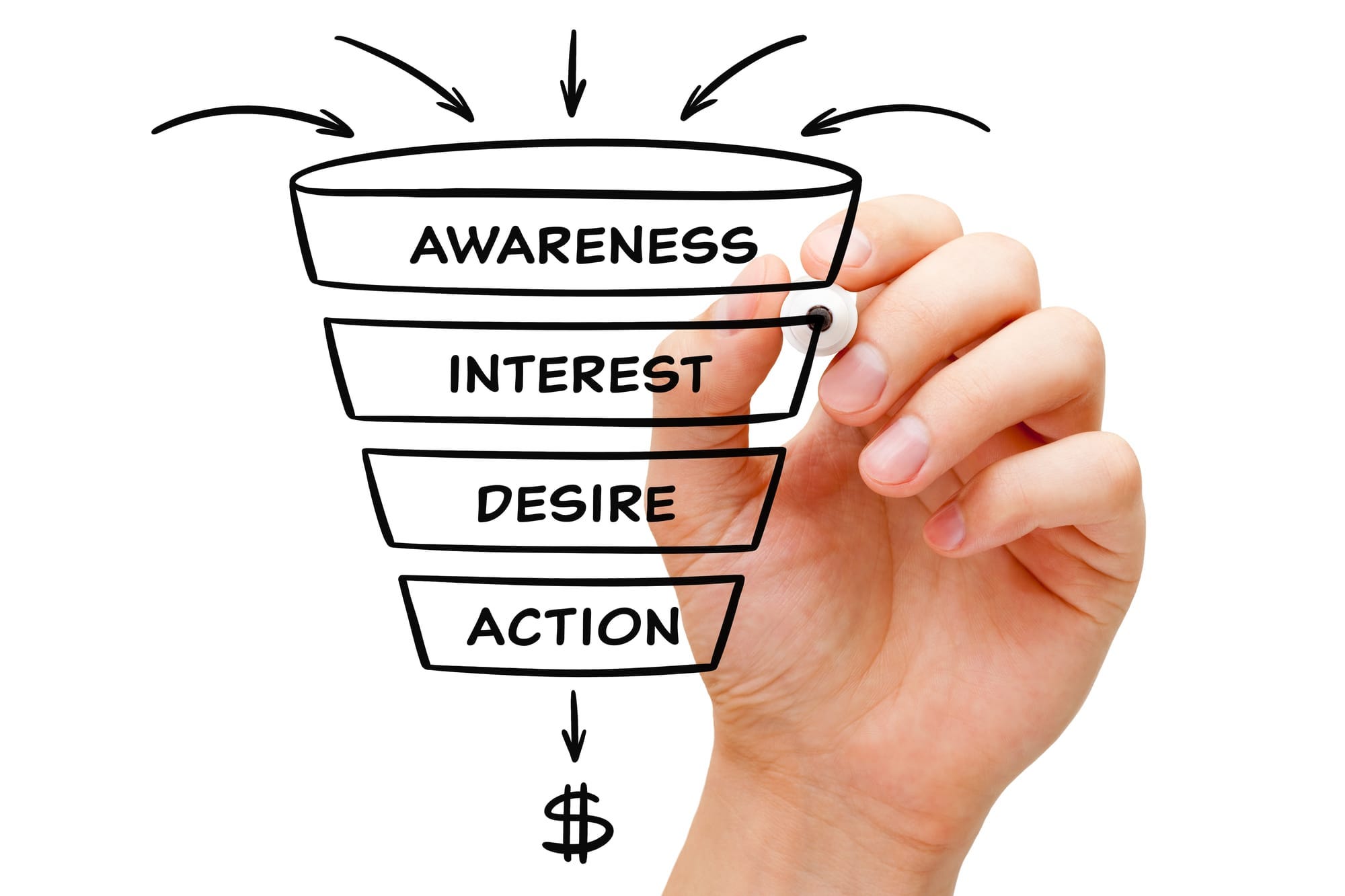
What if all that funnel advice you’ve been following - the split tests, the complex sequences, the endless upsells - is actually doing more harm than good?
Here’s the reality: we’re not in an information shortage anymore. We’re in a trust shortage.
Back in the day, a decent product and a clean pitch could carry you. Now? Everyone’s got access to reviews, tutorials, and competitor options in seconds. They’re not asking “Is this product good?” They’re asking, “Can I trust this person?”
And it’s showing in the numbers. Companies are spending more on funnel optimization than ever... and seeing worse results.
The tactics aren’t broken – the mindset is. Traditional funnels treat people like data points in a system. But people aren’t systems. They’re scanning for credibility, safety, and sincerity long before they care about your limited-time offer.
That’s the real shift: trust comes first now. And if you don’t have it, nothing else matters.
Traditional funnels are clunky. They create pressure - for both sides. Buyers feel boxed in, pushed along some preset path. Sellers end up sounding robotic, chasing metrics instead of actually connecting.
And the metric most funnels obsess over? Conversions.
Which is wild, because that number means almost nothing if people don’t stick around. If they don’t trust you, they’ll bail the second the transaction’s over. That’s why so many businesses feel like they’re working harder, spending more, and still not getting anywhere.
It’s not about needing better funnels. It’s about rethinking the whole thing.
The brands that are crushing it right now aren’t the ones with slick automations and 43-step sequences. They’re the ones that feel real. Human. Relatable. They’ve figured out how to build trust at scale - and when people trust you, conversions take care of themselves.
So instead of asking “How do we boost conversions?” the better question is: “How do we become the most trusted voice in our space?”
That question changes everything.
Your content changes. Your emails change. The way you handle sales calls changes. Suddenly, you're not squeezing people through a funnel - you’re showing up as someone worth listening to.
The old playbook is broken because it was built for a world that doesn’t exist anymore. One where the marketer had the power, and the buyer had questions. Now the buyer has all the power - and what they’re really asking is, “Can I believe you?”
If the answer is yes, you're in. If not, you’re just another tab they closed.
Let’s flip it. Instead of obsessing over how to squeeze more conversions out of your funnel, ask yourself this:
What if I became so trusted that people just bought from me naturally?
That’s the heart of the Trust Funnel. It flips the whole sales funnel concept on its head. Instead of pushing people through a sequence to get to the sale, you focus on actually earning their trust. Genuinely. Consistently. And when you do that well, the sale doesn’t need to be forced - it just happens.
Now, for years, marketers have been told: "More complexity equals more results." Add more steps. More automations. More branching logic. Personalize every micro-action. But here’s the twist: what if that extra complexity is actually hurting you?
The Trust Funnel doesn’t care about all those fancy mechanics. It’s built on a way simpler idea: focus on your first interaction and make every touchpoint after that feel like a natural next step - not a manipulation. No pressure tactics. No weird urgency triggers. Just real value, shared with real people.
Think of every interaction as making a little deposit into what I call your “Trust Bank.” Not because you’re setting up for a sale, but because you’re building something that matters: a connection.
This shift changes everything. The old model runs on scarcity - “capture the lead,” “convert the customer,” “close the sale.” That kind of language? It sets up a win-lose dynamic. You win, they lose. And that’s just not how people want to buy anymore.
Trust Funnels come from a whole different place. The goal isn’t to get someone to say yes. It’s to get them to feel safe. Informed. Understood. Like you’re both on the same side.
And the results? They stack. Traditional marketing hits a ceiling - the more saturated things get, the less effective it becomes. But trust-based marketing compounds over time. Each piece of value you put out there builds on the last one. And eventually, that flywheel starts spinning on its own.
Here’s what makes it work:
Consistency: Show up. Regularly. Don’t ghost your audience or only show up when you’re selling something.
Transparency: Don’t hide the flaws. Be honest about what you offer, what you don’t, and why you do things the way you do.
Value First: Give more than you take. Share useful stuff, answer questions, solve problems - without always asking for something in return.
And yeah, this approach might feel slower out of the gate. You’re not dangling discounts or stacking countdown timers. But in the long run? It outperforms. Big time.
People stick around. They refer you. They trust you enough to buy again without needing a funnel full of “limited time” urgency.
And here's a nice bonus: it’s actually way less complicated. You don’t need all those tech-heavy workflows and split-test funnels. When you're focused on trust instead of tricks, marketing gets simpler. Way simpler.
So if you’re tired of chasing short-term gains and wondering why your funnel keeps underperforming, maybe the funnel isn’t broken. Maybe it just doesn’t fit how people buy anymore.
Try leading with trust. You’ll spend less energy convincing and more time connecting. And once the relationship’s strong enough, the sale’s just a natural side effect.
No push. No pressure. Just people buying from someone they believe in.
Here’s a question most marketers never stop to ask: Are the tools you’re using to build trust actually slowing you down?
We’ve already talked about how trust needs to come before the sale. But there’s a crucial piece most folks miss: not all channels build trust at the same speed. Some are basically in a Prius on a steep hill. Others? Full throttle.
This is what I call the Speed of Trust Spectrum.
It’s not just about personal preference. Your brain literally processes trust differently depending on how you're getting the info. Different channels trigger different parts of your brain - some go deep fast, others barely scratch the surface.
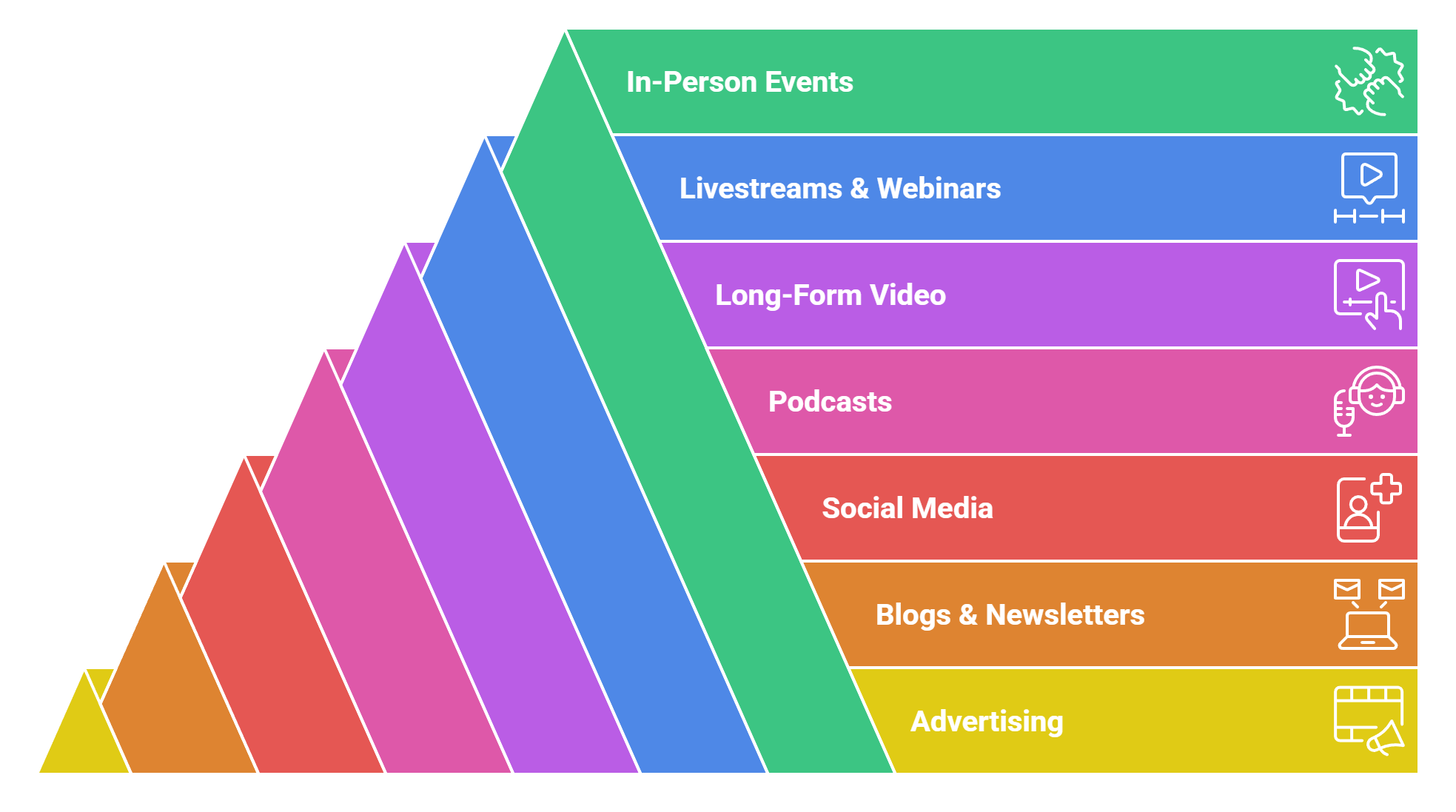
Let’s walk through it from slowest to fastest:
1. Advertising (The Slow Lane)
We spend a ton on ads, but when it comes to trust? They're sluggish. Ads are short, interruptive, and usually get ignored unless they hit just right. There’s no real context, no back-and-forth, no depth. It’s like trying to build a relationship by shouting your name across a crowded room.
2. Blogs & Newsletters
A little faster. You’ve got room to stretch out, share your thoughts, show you know your stuff. Writing gives readers time to think and absorb, which is good - but it’s still a one-way street. Helpful? Yes. Quick trust builder? Not really.
3. Social Media
This is the middle ground. You’re showing up regularly, maybe responding to comments, sharing bits of your day. It’s more personal, and because it’s frequent, it builds familiarity faster than a blog post ever could. But depth is still limited.
4. Podcasts (Now We’re Moving)
Here’s where things speed up. When someone hears your voice in their ears for 30, 60, 90 minutes? They start to feel like they know you. Even if you’ve never met. It’s personal, it’s intimate, and it builds those “I trust this person” feelings way faster than written content ever could.
5. Long-Form Video
Add a face to the voice, and now you’ve got facial expressions, tone, body language - all those little things our brains use to figure out if someone’s trustworthy. Watching someone talk to you feels way more real than reading a tweet.
6. Livestreams & Webinars
This kicks things up even more. It’s live. You’re there. You’re answering questions in real time. There’s no script, no fancy edits. That kind of spontaneity is gold for trust. People see you thinking on your feet, reacting in the moment - it’s about as transparent as it gets without being in the same room.
7. In-Person Events (Top of the Trust Food Chain)
Nothing beats face-to-face. All your senses are involved. You shake hands, share a laugh, make eye contact. It takes minutes to build trust in person that might take months online. If you want to make a lasting impression, this is it.
Because too many people are putting all their time and money into the slowest trust channels... and then wondering why their audience isn’t converting. It's not always about what you're saying. Sometimes it's about how you’re delivering it.
This doesn’t mean ditch every low-speed channel. But it does mean you should think strategically. Where do you shine? Maybe you’re a natural on camera. Maybe you’ve got the kind of voice people could listen to for hours. Maybe you're magnetic in a room full of people. Use that.
The key is understanding your Trust Velocity - how fast your content builds actual relationships, not just clicks or impressions. Because high-quality trust leads to high-quality conversions. Every time.
Bottom line: if trust is your foundation (and it should be), then the way you build it matters just as much as the message itself.
Understanding how trust works is great. But knowing why something matters doesn’t do much unless you’ve got a plan for putting it into action.
After analyzing hundreds of trust-first marketing strategies, one thing stood out: the businesses that really saw results didn’t just choose the right channels. They had a system. A way to turn trust from a nice idea into a real asset that moved the needle.
Here’s the uncomfortable bit: most people know trust is important... but they treat it like a vibe instead of a strategy. They bounce from platform to platform, chasing clicks and trends, instead of showing up consistently where their audience actually is. They throw content at the wall and hope something sticks.
That gap between knowing and doing? That’s where most trust-based efforts fall apart.
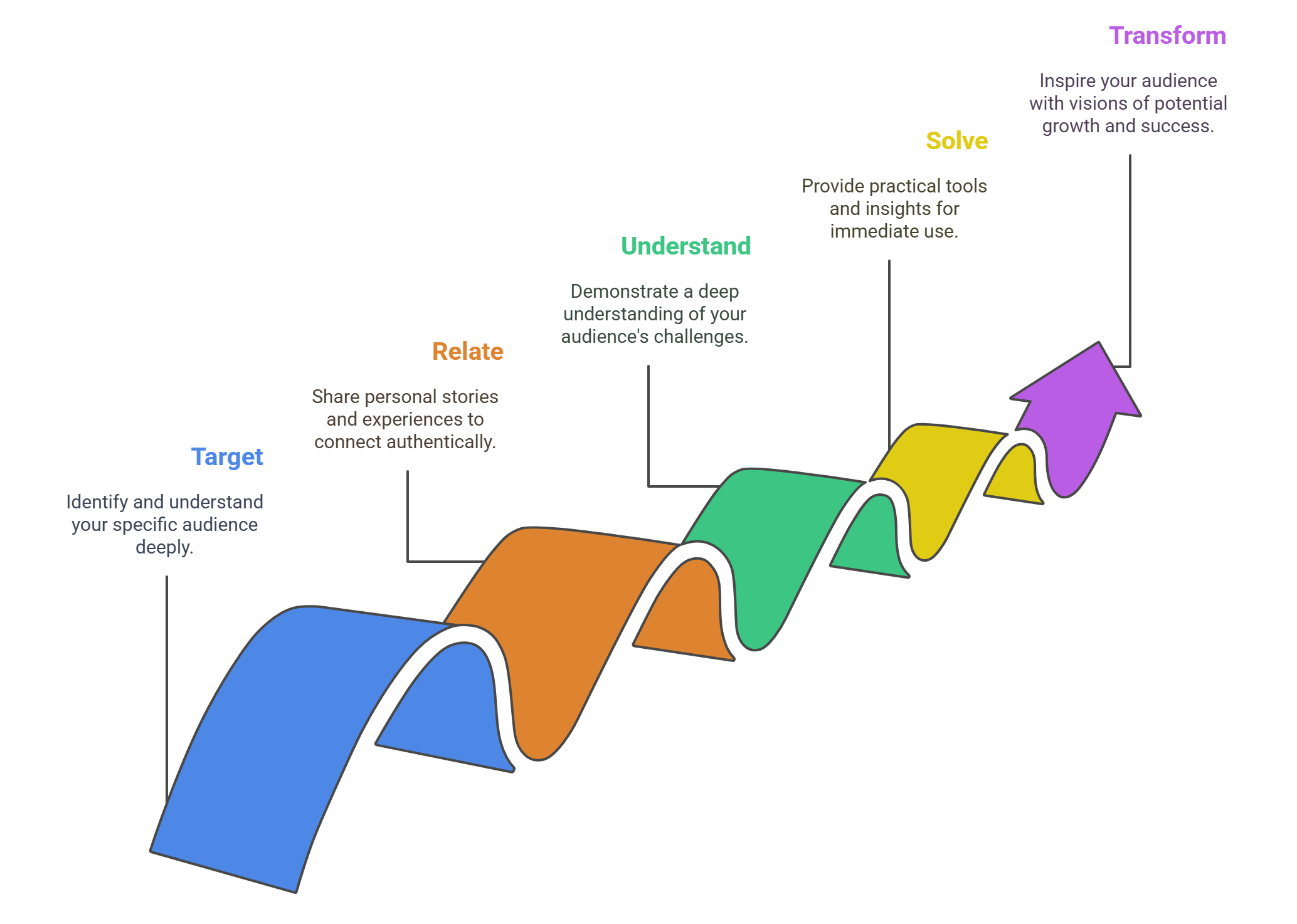
That’s why I put together the TRUST Method - a dead-simple framework to help you go from theory to practice, without getting buried in busywork.
Let’s break it down:
T = Target
Who are you actually trying to build trust with? And no, “entrepreneurs” or “busy moms” isn’t enough. You need to know what keeps them up at night. What they’re dreaming about. What words they use to describe their struggles. When you understand their world that deeply, your content starts feeling like a personal message instead of a generic broadcast.
R = Relate
Drop the expert mask. People don’t connect with perfection - they connect with real stories, real messiness, real wins and losses. Share the moments you struggled, especially if they mirror what your audience is going through now. That’s how you bridge the gap.
U = Understand
Show them you get it - not just at surface level, but better than they do. When someone reads or hears your content and thinks, “Wow, this person just described my situation better than I could,” that’s a trust builder. That’s when they start leaning in.
S = Solve
Now give them something they can use. Not vague advice. Not fluff. Real tools or insights they can apply right now. It doesn’t have to fix everything - just give them a win they can feel. That little momentum gain? It’s gold.
T = Transform
Finally, show them what’s possible. Give them a picture of what life could look like if they stick with the path you’re laying out. Use transformation stories, client wins, personal shifts. Help them see themselves in that future.
Simple: play to your strengths and pick the vehicle that fits your audience and your business. If you’re a coach or consultant, maybe it’s live workshops or webinars where your energy comes through. If you sell physical products, maybe it’s tutorial-style video that shows the value right away.
Whatever you choose, track it. Build out what I call a Trust Asset Inventory - a live doc where you list every piece of content you create, and tag it based on which part of the TRUST method it supports. Over time, you’ll start to see patterns: which pieces spark engagement, which ones lead to conversions, which ones people share. That’s your signal to double down.
For example: say you do a podcast episode about a challenge your audience faces, and it blows up. Cool - now turn that into a blog post, a social media clip, maybe even a webinar. You’re not starting over every time. You’re building on the trust you’ve already earned.
And that’s the real beauty of this approach: it’s slow and steady in a world that’s obsessed with viral spikes. While everyone else is scrambling for attention, you’re building a foundation that actually lasts.
It’s like the difference between trying to win the lottery vs. building a retirement account. One’s a quick hit (if you’re lucky). The other? Predictable. Sustainable. And way more valuable in the long run.
We all know that trust takes time. It’s slow. It’s earned. But here’s the tension: we’re now in a world where AI touches nearly every corner of marketing. So how do you keep things human when so much of the process is getting automated?
Here’s the thing: AI isn’t the problem. The real issue is how people are using it.
Most businesses treat AI like a shortcut. They let it crank out content, handle replies, run campaigns - all in the name of efficiency. But in doing that, they strip out the very thing that makes people want to buy in the first place: the human touch.
Yeah, their marketing can work in the short term. But since it feels flat and robotic, trust dilutes, impact diminishes and you’re left with a soulless husk of a message. It may sound or look great, yet your target audience will no longer believe you and will naturally turn toward competitors who have earned their trust.
But what if AI could actually help build trust instead of destroying it?
That’s the idea behind something I call the Trust-Tech Matrix. It’s a dead-simple way to look at your marketing and ask better questions. Not, “What can we automate?” but: “Where can tech actually help us feel more human?”
High-trust moments (like replying to an emotional customer message)? Keep that human.
Low-trust, high-friction stuff (like scheduling, tagging, follow-ups)? Automate that all day long.
But the real magic? It’s in the middle zone. That sweet spot where AI isn’t replacing you, it’s backing you up - making your human efforts more personal, more relevant, and more impactful.
Here’s what that looks like in the wild:
Instead of using AI to blast generic email sequences, use it to find patterns in your customer behavior when interacting with your products/services. Then write personalized emails that feel like you actually know them.
Let AI flag which customers are dropping off early - then send a thoughtful message that hits exactly where they’re stuck.
Use it to analyze recurring pain points from calls or support tickets, and shape your next piece of content around those exact issues.
You’re not outsourcing the relationship. You’re using AI to inform it. That’s the shift.
And here’s something that might surprise you:
People don’t hate AI. What they hate is being tricked by it.
They don’t mind if you use AI to help with that first response... as long as they know a real person’s still involved when it matters. Transparency actually builds trust. Trying to pass off robot responses as “personal” backfires.
So tell people how you're using tech. Be clear about the handoff points between AI and your team. Customers aren’t expecting perfection - they’re just looking for honesty.
Let AI crunch the data. Let humans tell the story.
The best combo? Use tech to spot the patterns and filter relevant information. Then bring in real stories, real transformation, real connection. Let AI handle the grunt work, and you focus on making the message feel like it came from someone who actually cares.
The more data you collect, the more relevant your communication gets. The more relevant your communication, the more people engage. And every time they engage, you learn more. It’s a feedback loop - but one that’s powered by actual trust, not just clicks and opens.
So don’t ditch AI. Just use it better.
Use it to support your voice, not replace it. Use it to get closer to your audience, not hide behind automation. That’s how you build trust at scale - without losing what makes your business human in the first place.
Let tech do the heavy lifting. But keep the soul.
And here’s the twist that throws most people off: the minute you stop obsessing over making the sale and start showing up to build real relationships - that’s when the sales start rolling in.
Like Simon Sinek said, “People don’t buy what you do; they buy why you do it.” That’s not just a nice quote for your Instagram feed. It’s the reason authenticity has quietly become the most powerful marketing strategy out there.
Trust is weird like that. Most assets lose value the more you use them. Not trust. The more you invest in it, the more it grows. It compounds. And eventually, it does the heavy lifting for you.
You don’t need some hyper-complicated tech stack or manipulative funnel wizardry. Pick one channel that feels natural to you. Maybe it’s your voice. Maybe it’s video. Maybe it’s writing. Whatever it is, show up consistently and deliver real value for 90 days. No pitch-fests. No gimmicks. Just help.
And when you do make an ask, don’t overthink it. You don’t need the perfect pitch. You just need a clear, honest invitation that gives people a reason to lean in a little closer.
Because at the end of the day, trust isn’t a trick. It’s not a tactic. It’s the foundation for a business that actually lasts - one that supports you, serves them, and doesn’t burn out after a few wins.
Start with trust. Everything else gets easier from there.
If this issue helped you rethink trust, funnels, or how you're using AI in your business - don’t keep it to yourself.
💡 Restack this.
💡 Send it to a friend who's stuck in funnel fatigue.
💡 Hit reply and tell me - what’s one shift you’re making after reading this?
If you’re a Substack publisher and think our readers would vibe with each other, let’s team up. My inbox is open - let’s chat.
Until next time: stay sharp, stay human, and remember - people buy trust, not tactics. See you in the next one.
No posts
Comments
Nothing yet. Say the first thing.
Sign in to join the conversation.