
Today I am away from land in the lovely Arabian sea thinking about what comes next. No breakfast just a beautiful view though I much prefer it from the land side.

There is a rite of passage every company would go through after they hit a level of size or value. You outgrow your spreadsheets and google drive, bring in consultants, and implement a big central system to become the single source of truth. We call this digital transformation and it promises the world but ask anyone and it has gone on for years, cost millions and even take some people back a step or two.
AI and agents are quietly removing the need or requirement for this large scale and complex transformation. The business that never built the monolith may now be the one best placed to win.
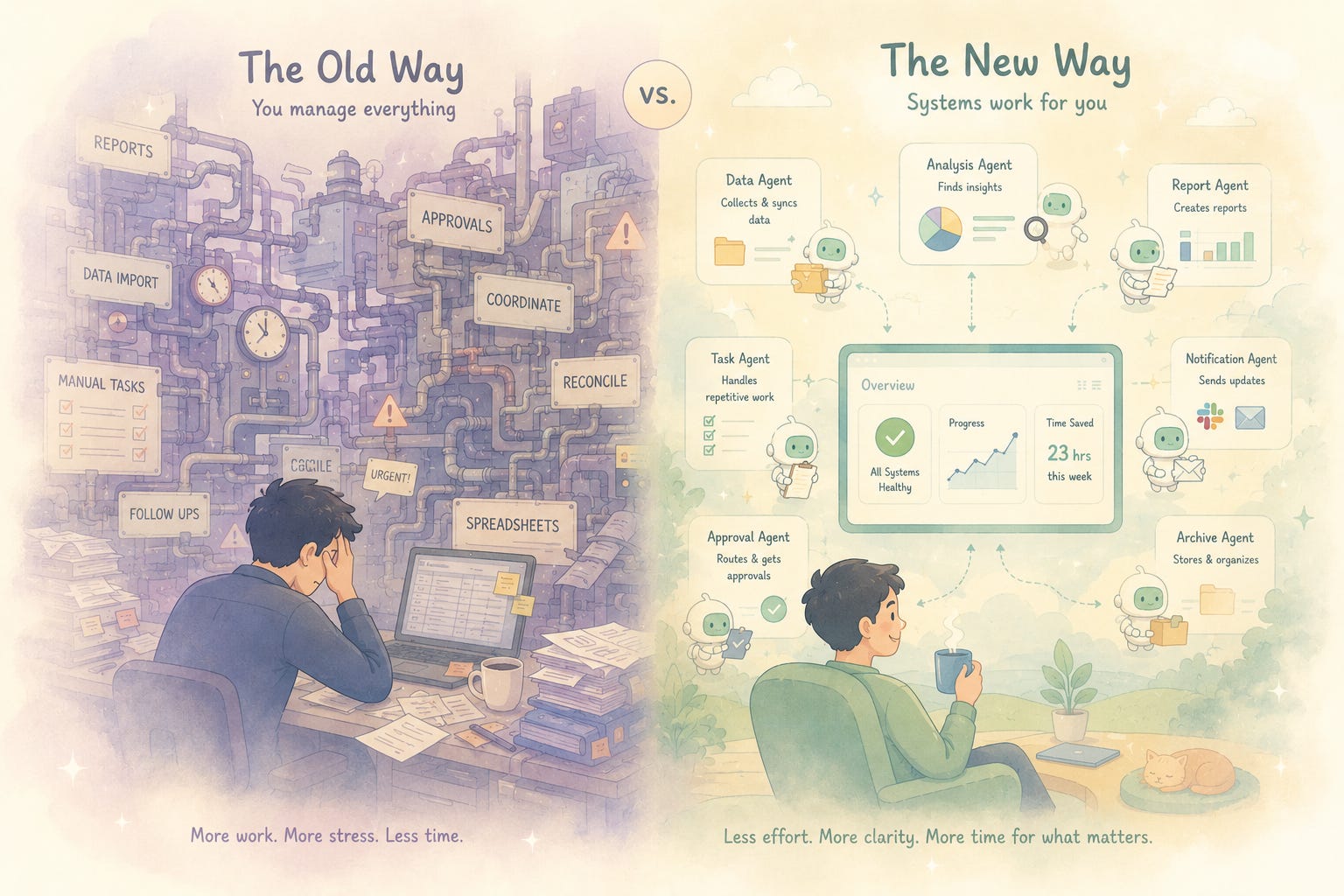
I spoke to someone this week who has just bought a company for x tens of millions, great team and great business out of central Europe but almost entirely running on Excel and digital post-it notes. Not metaphorically. Actual spreadsheets, a shared drive that one or two people fully understands, and a digital wall covered in coloured squares that quietly serve as the projects board, the CRM was another spreadsheet.
It worked for them but now their new owner is a thousands miles away and wants visibility.
For decades there has been a well-worn path out of the spreadsheet era. You start scrappy, with whatever tools are to hand. You grow. The scrappiness that once made you fast starts making you fragile. And at a certain size, the accepted cure is consolidation: a large, central enterprise platform that holds everything, so that there is one place where the truth lives.
This was not a fashion. It solved a real problem. The reason a growing business felt like chaos was that its tools did not talk to each other. Sales lived in one place, finance in another, operations in a third, and the only thing connecting them was a human copying numbers between systems and hoping they got it right. The big central platform was the answer to that fragmentation. It existed to stop the systems from disagreeing with each other.
The single source of truth was, underneath all the strategy language, a sync solution.
So companies paid for it, and they paid dearly. Not just the licences, but the eighteen-month implementation, the consultants, the customisation, the retraining of everyone who had done it the old way, and the slow process around a platform that was now too expensive and too central to ever rip out. You did it because the alternative, staying fragmented, was worse. That was the deal.
Here is the question worth sitting with. What happens to that deal when the fragmentation problem can be solved another way?
For most of the twentieth century, connecting a country meant copper. Landlines, millions of miles of cable, strung and buried and maintained over decades. It was simply the cost of having a phone network, and wealthy nations paid it first because they could.
Then mobile arrived, and large parts of the developing world did something the West could not. They skipped the copper entirely. No landlines, straight to mobile, then to mobile money and mobile internet. People were running businesses off a phone in places that never had a wire in the wall, while plenty of richer countries were still tethered to infrastructure built around one.
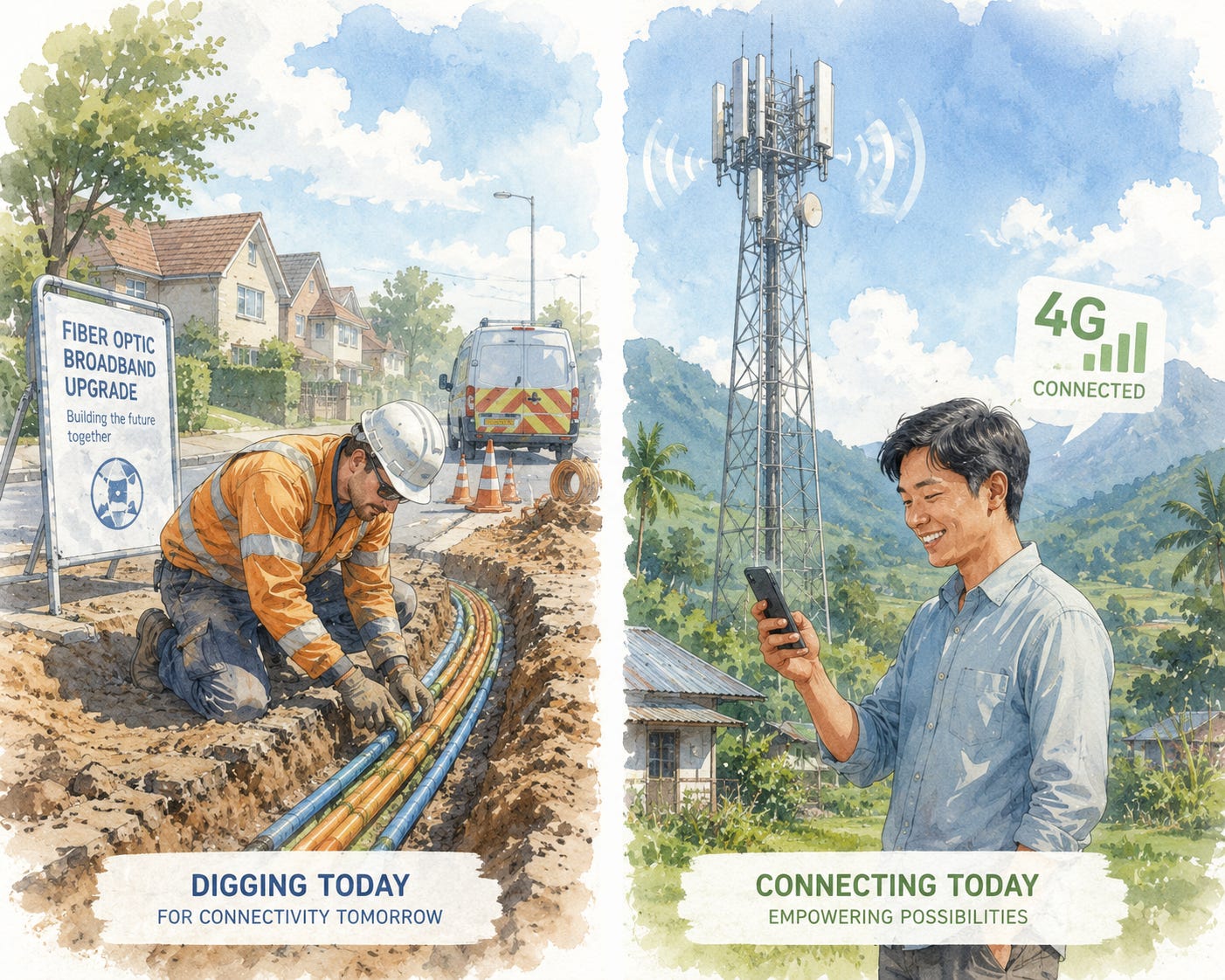
The lesson is precise, and it is not that being behind is good. The leapfrog happened because those economies had no installed base to defend. No sunk cost in copper to honour, no workforce trained on the old way, no politics around protecting what already existed. They could adopt the new thing in its purest form, because nothing was in the way.
Now hold that next to the company with the post-it wall. They never bought the copper. And the question facing them is no longer “which monolith do we install.” It is something their consultants have not quite caught up to yet: do they need the monolith at all?
This is where things get interesting, because two separate shifts are arriving together, and each one chips away at the reason the central system existed.
The first is that the sync problem is being solved from a different direction. The whole justification for pulling everything into one platform was that best-in-class tools could not talk to each other, so you traded excellence for integration and accepted a mediocre all-in-one because at least it agreed with itself. Agents and a quietly important piece of plumbing called MCP, the Model Context Protocol, are changing that. MCP gives AI a common way to reach into the tools you already use, read from them, and act between them. The connective tissue that used to require a monolith, or an army of people copying numbers between systems, is increasingly something intelligence can provide on top.
I wrote recently about Figma rolling back features from their MCP server once developers could reach the product through agents and stopped needing as many subscription seats. The same force that erodes a platform’s seat count also erodes the case for consolidation. If your tools can be made to agree with each other from above, you no longer have to surrender your best tools to get them to agree.
The second shift is that you can now have software built to fit, on demand. I have written before about what I call PSoD, Personalised Software on Demand, software that fits like a tailored suit because it was described into existence rather than bought off a shelf. The cost of creating a sharp, specific tool for one workflow has collapsed from a developer, a designer, a sprint, and a budget down to a morning of conversation with an AI. Not for everything. You are not going to describe your way to your own Figma over breakfast. But for the precise internal workflow that the post-it wall was standing in for? That is exactly where on-demand software now lives. I am using a PSoD right now to write this article, built specifically for this purpose. It is awesome.
Put those two together and the growing company suddenly has a fork in the road it never used to have.
The old road had one lane: outgrow the spreadsheets, buy the monolith, become the single source of truth, spend the years and the money. The new road has at least two more lanes running alongside it.
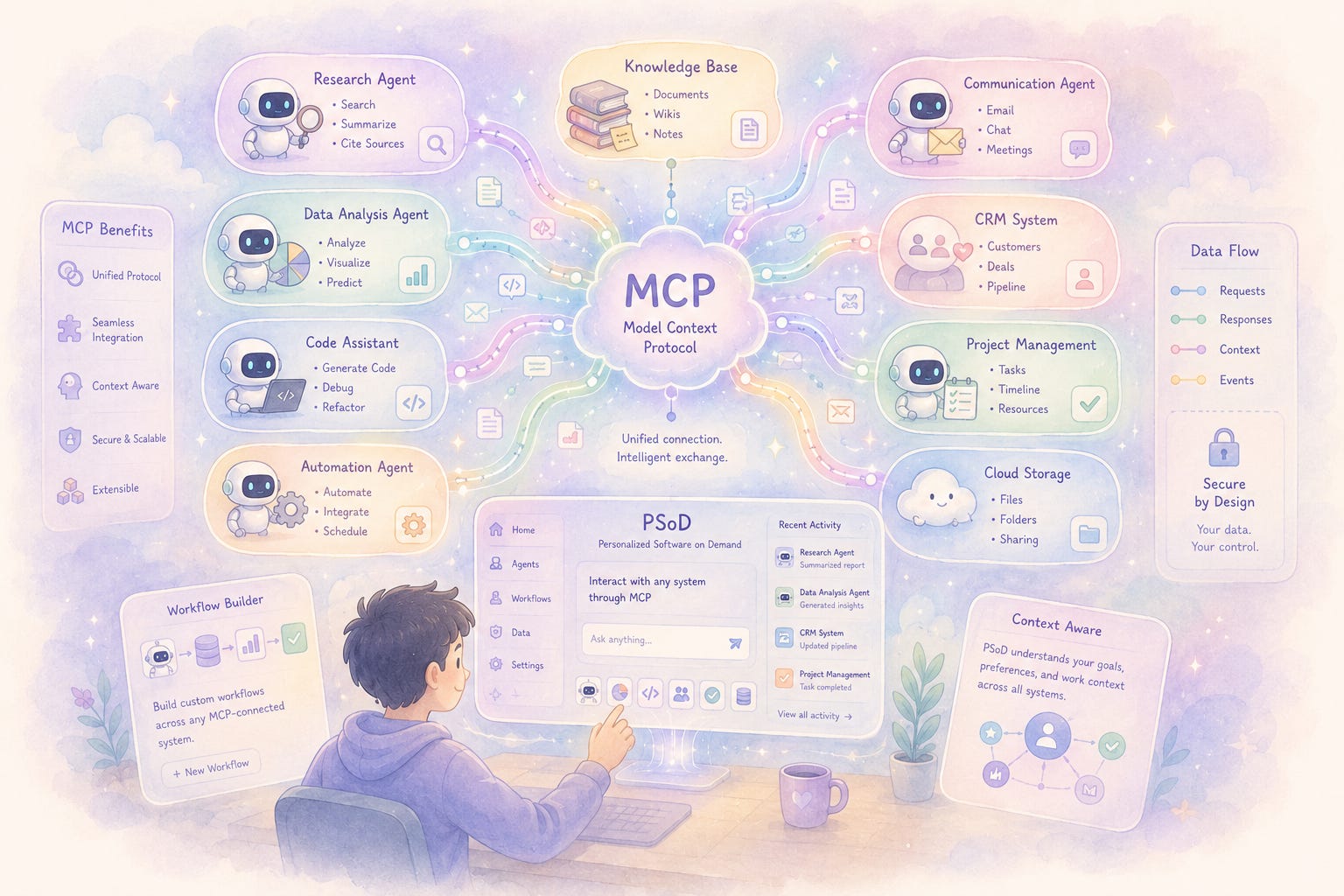
The first new lane is best-in-class, stitched by agents. Instead of one platform that does ten jobs adequately, you keep the ten tools that each do their job brilliantly, and you let agents and MCP handle the synchronisation that used to be the monolith’s entire reason for being. You get excellence in every layer and the integration on top, rather than buying mediocrity everywhere to guarantee the integration underneath.
The second new lane is to build the parts that are truly yours. For the workflows that are specific to how your business actually works, the ones no off-the-shelf product ever fits cleanly, you generate your own software on demand. It fits exactly because it was made for you, and it costs a fraction of what bespoke development used to.
Most real businesses will end up somewhere across all three lanes rather than purely in one. The point is not that the enterprise platform is dead. For some organisations, in some regulated and deeply complex situations, the monolith is still the right answer. The point is that for the first time, skipping it is a serious, defensible option rather than a sign that you never grew up.
So why does this matter for who wins? Because it quietly reverses who is carrying the weight.

Picture two companies in the same market. One is our post-it business, scrappy, behind, still running on spreadsheets. The other is a competitor who, three years ago, did everything right by the old playbook. They brought in the consultants. They implemented the big central platform. They spent the year and a half and the small fortune, and they wired their entire operation tightly around it. By every conventional measure, they are ahead.
But look at what each can do next. The post-it company can adopt a new best-in-class tool this quarter and have agents connect it to the rest in days, because there is almost nothing to undo. They can generate a bespoke internal tool for their oddest workflow over a couple of days/weeks. They are light, and lightness has just become valuable in a way it never was before.
The competitor cannot move like that. Every change has to go through the platform. New tools have to be justified against the system they already paid for and built their processes around. The very investment that made them look grown-up is now the thing they have to drag through every decision. They did not do anything wrong.
They simply bought a lot of copper right before the mobile networks turned on.
This is the other side of something I have argued before, that the next competitive advantage is increasingly internal, built rather than bought. The less you consolidated into someone else’s platform, the less you have to unpick now. Legacy stops being a quiet asset on the balance sheet and starts being a literal weight, and the organisations furthest behind are, for once, the ones with the least of it.
If budget and consolidation are fading as the deciding factors, something has to replace them. I think it is three things, and none can be bought in a single purchase order.
Adaptability, meaning the real ability to change how you work without an eighteen-month programme attached. Learning speed, meaning how fast you can try a tool, see what happened, and adjust, because in a fast-moving space the rate at which you learn compounds far harder than the size of any one-off investment. And the capability of your people, because none of this runs itself. The gap between a workforce that can describe the software it needs and stitch its own tools together, and one that waits to be handed a platform, is about to become the widest gap in business.
Now imagine this. In the old world, you would back the well-funded, fully-implemented competitor every time. In a world where the advantage is adaptability and learning speed, the company that never built the monolith is no longer the underdog. It might be the favourite. That is the leapfrog. Not catching up by spending your way down the same road.
Skipping the road entirely.
None of this is permission to sit still and feel clever about being behind. A head start is worth nothing if you do not run with it. If you are the founder with the post-it wall, here is where I would point you.
Do not reach for the monolith by reflex. When the consultants say “you need one central system,” ask the question underneath it: what is the single source of truth actually for? Usually the honest answer is “so our tools stop disagreeing.” If that is the real problem, ask whether agents and MCP can now solve the disagreeing without the consolidation.
Start from the friction, not the platform. Find the specific place where things slip through the cracks, the duplicated quote, the four spreadsheets behind one question, and aim AI squarely at that. Solve the actual pain before buying a system that promises to solve all pain.
I have seen this implemented first hand and once you break down the existing business process you can see where the cracks are and how they can quickly and easily be fixed.
Keep your best tools and connect them, rather than trading them away for one that does everything adequately. And for the workflows that are genuinely yours, the ones the post-it wall was really standing in for, build them. On demand, tailored, owned.
Above all, invest in your people before your platform. The capability that compounds is internal. A licence is bought once. A team that can describe, build, and stitch keeps getting more valuable. I have said before that AI adoption is far more a leadership and people problem than a technology one, and nowhere is that more true than at this fork.
So here is what I keep turning over. The single source of truth was never really the goal. It was a workaround for a world where systems could not talk to each other. We turned a sync problem into a strategy, an expensive rite of passage, a sign that a company had grown up. And now the underlying problem is starting to be solved another way.
Which makes me wonder how many other things we treat as “growing up” are really just legacy we have not noticed we no longer need. How much of what consultants still sell as maturity is actually copper, laid out of habit, right as the mobile networks come on.
The future may belong less to the organisations that built the most, and more to the ones light enough to leap clean over the past while everyone else is still deciding which monolith to buy. No pressure to anyone who signed the Oracle contract last quarter. But it might be worth asking which parts of that system are an asset, and which are just a wire in the wall you no longer need.
Comments
Nothing yet. Say the first thing.
Sign in to join the conversation.