
I was explaining something over Sunday roast last week and watched the exact moment it landed.
We were talking about someone’s job, a fairly senior operations role, lots of moving parts, the kind of work people describe as “you can’t really automate it, there’s too much judgement.”
Then, in the air, I drew two lines with my finger. The first was their job as it runs today. The second was their job as it will run in three years. He went quiet, and then, like slow motion, you could see it click.
For decades we have built workflows as human-to-human chains with technology bolted between the steps, and lately we have sprinkled AI into those technology steps. The real shift, though, is to flip the whole thing: to move to a world where workflows are AI-to-AI, not human-to-human, and to design only for the few places a human gate genuinely earns its keep.
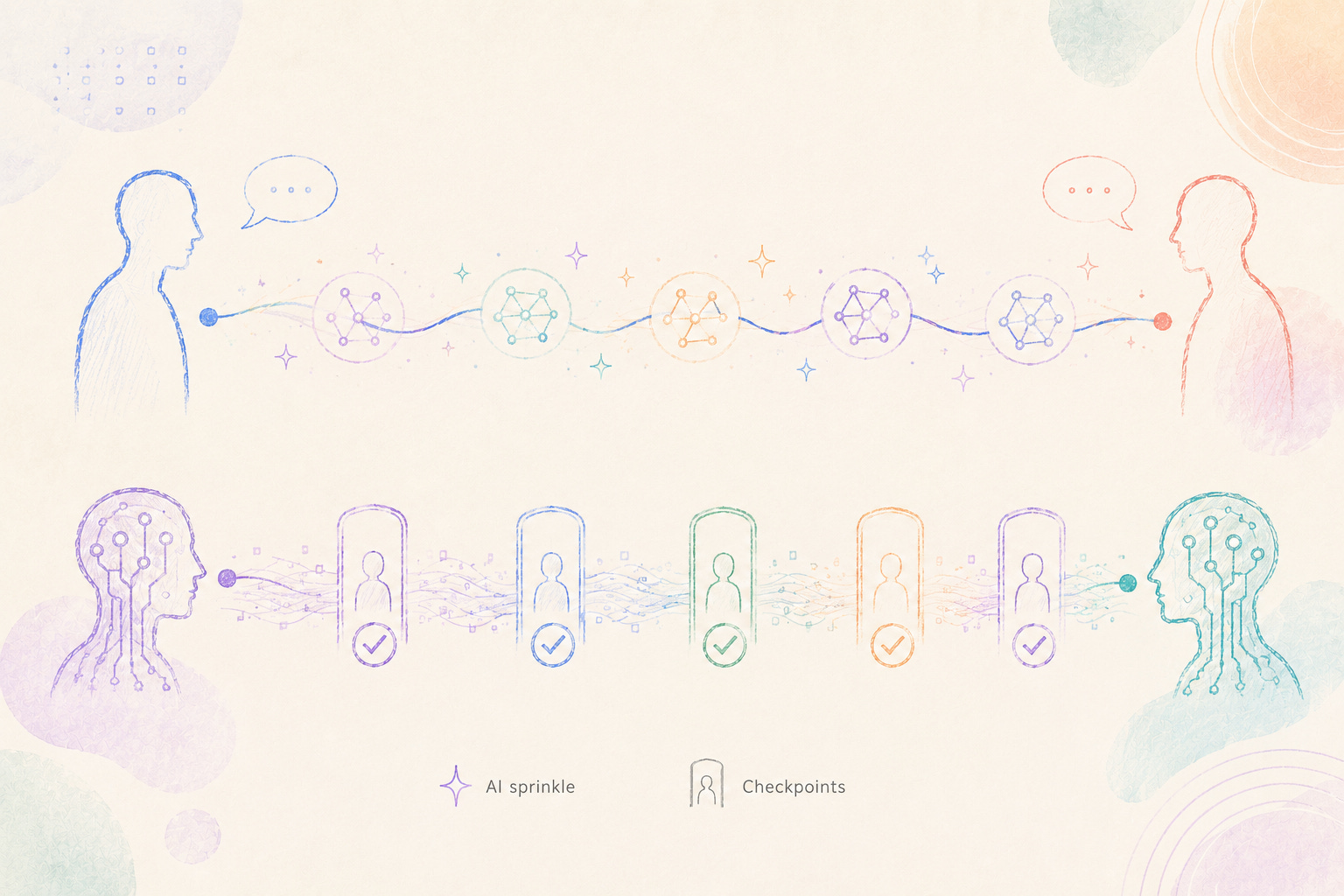
Most of today’s job descriptions are about to become gate definitions.
Pick almost any role and underneath the title, it is a workflow. A repeatable sequence of steps that turns some input into some output. The marketing manager turns a brief into a campaign. The analyst turns raw numbers into a recommendation. The recruiter turns a vacancy into a hire. We dress these up as identities, but they behave like processes.
Today that process has a very particular shape. It runs:
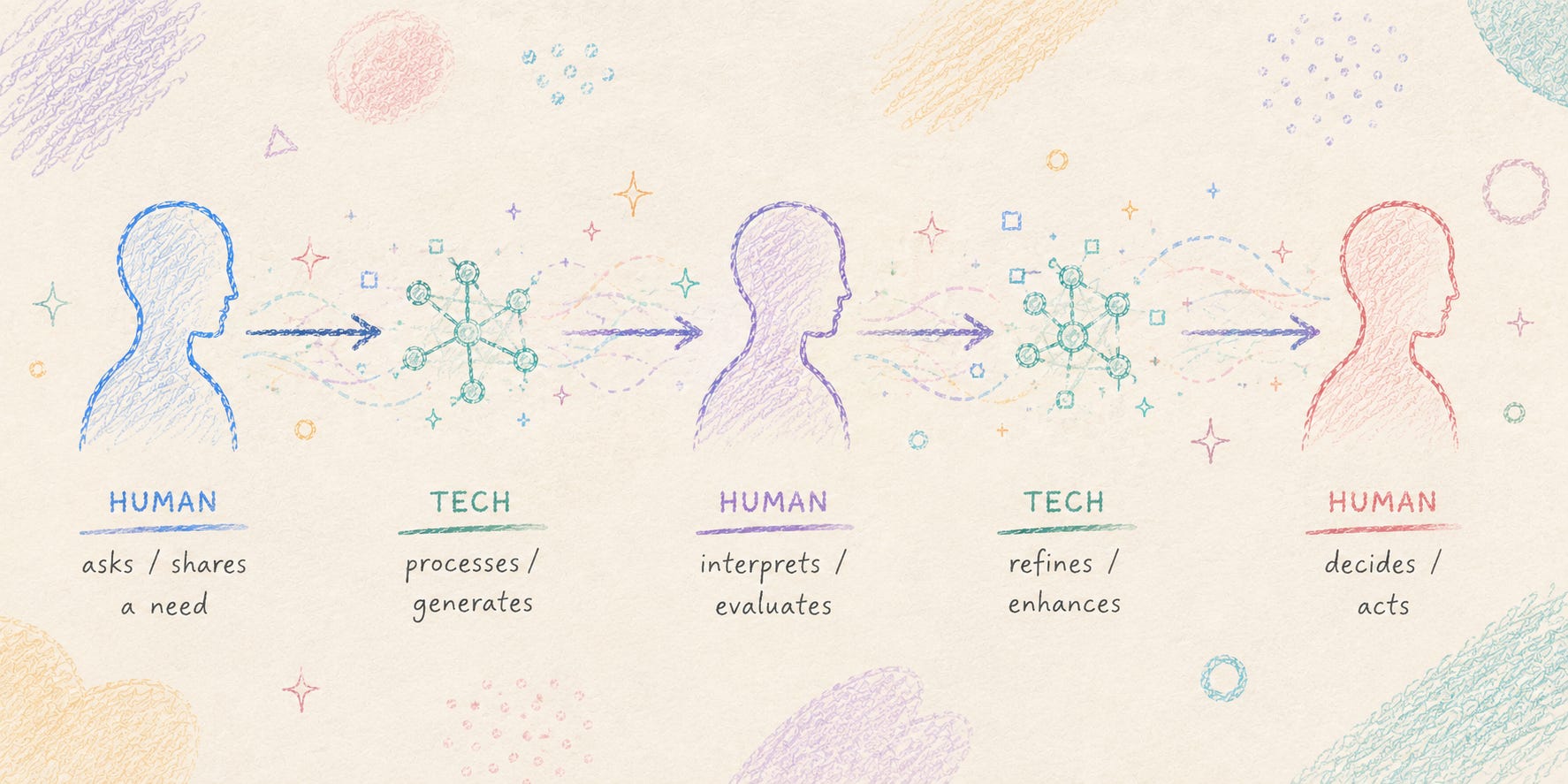
A person does a bit of thinking, hands it to a tool, the tool spits something back, another person picks it up, passes it to another tool, and so on down the line. The humans are the engine. The technology is the plumbing between them. Email, spreadsheets, a CRM, a project board. None of it does the work. It just carries the work between the people who do.
In the last two years something changed, the start of an evolution, even if a slow one. We have taken that human-to-tech-to-human chain, looked at the tech bits between the human steps, and started to sprinkle a little AI on top. A smarter autocomplete in the email step. A summariser in the document step. A draft generator in the deck step. The chain is still the same. We have just made the plumbing slightly cleverer.
I wrote a while back about the first lift, the easy ten to fifteen percent productivity bump that almost anyone gets from a good day of AI training. This is the mechanism behind that bump. You are sprinkling AI into the gaps of a workflow whose shape nobody has questioned.
It is real,
it is useful,
but it is nowhere near the actual prize.
We have been adding AI to the plumbing and calling it transformation.
Now the second line.
Instead of starting with the human chain and decorating the gaps, you start from the opposite assumption. You assume the whole thing runs AI-to-AI by default, end to end, and then you ask a single, much sharper question: where does a human actually need to step in?
The shape inverts to something like:
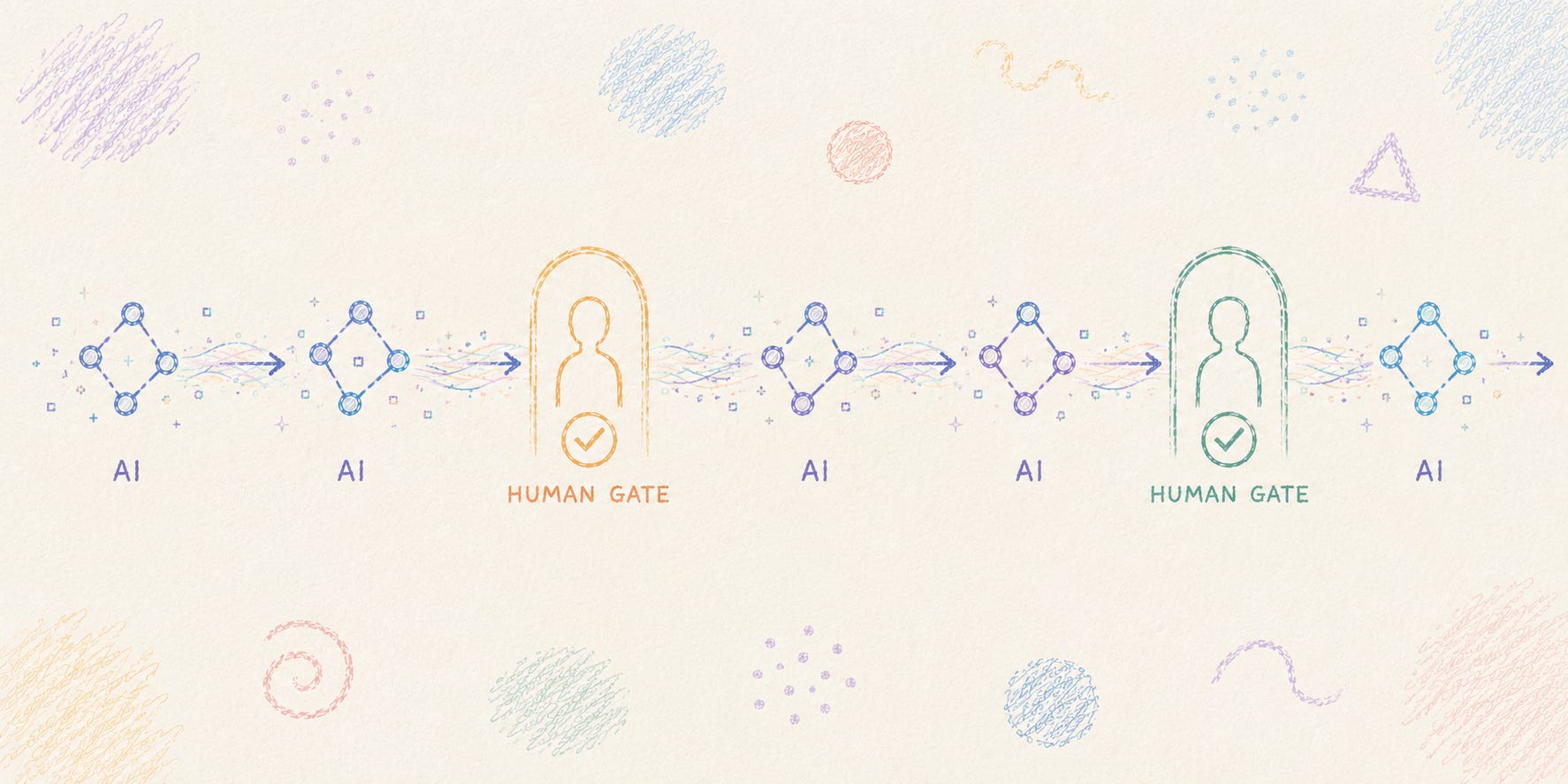
The AI is no longer the sprinkle. The AI is the chain. The humans are no longer the engine. They are the gates. A handful of deliberate checkpoints where a person looks at what the machine produced, applies judgement, and either waves it through or sends it back.
This is a genuinely different design posture, and I think the difference runs deeper than it first looks. In the first shape, the question was “where can AI help the people?” In the second, the question is “where do the people actually need to be?” One treats AI as an assistant to a human process. The other treats the human as a checkpoint in an AI process. They produce completely different systems, even when the underlying task is exactly the same.
The wrong instinct is to put a gate wherever the work feels important, or wherever it feels uncomfortable to let go. That feeling is almost never about the work. It is about us. It is the discomfort of watching something we used to do by hand happen without us.
A gate earns its place for one of a small number of honest reasons:
Irreversibility. The step does something that is genuinely hard to undo. Money leaves the building. A contract is signed. A message goes to a customer and can’t be unsent. You gate the door you can’t reopen.
Accountability. Someone has to be able to stand behind this decision, by law, by regulation, or because a human will rightly want another human to own it. A diagnosis. A hiring rejection. A safety call. The gate is there so there is a name attached.
Genuine ambiguity. The situation sits outside anything the system can be trusted to weigh. Real novelty, real conflict between values, the kind of judgement that isn’t a harder version of a known problem but a different kind of problem altogether.
Taste, where taste is the product. Sometimes the whole point is that a specific human’s judgement is the value. Not a proxy for it. The thing itself.
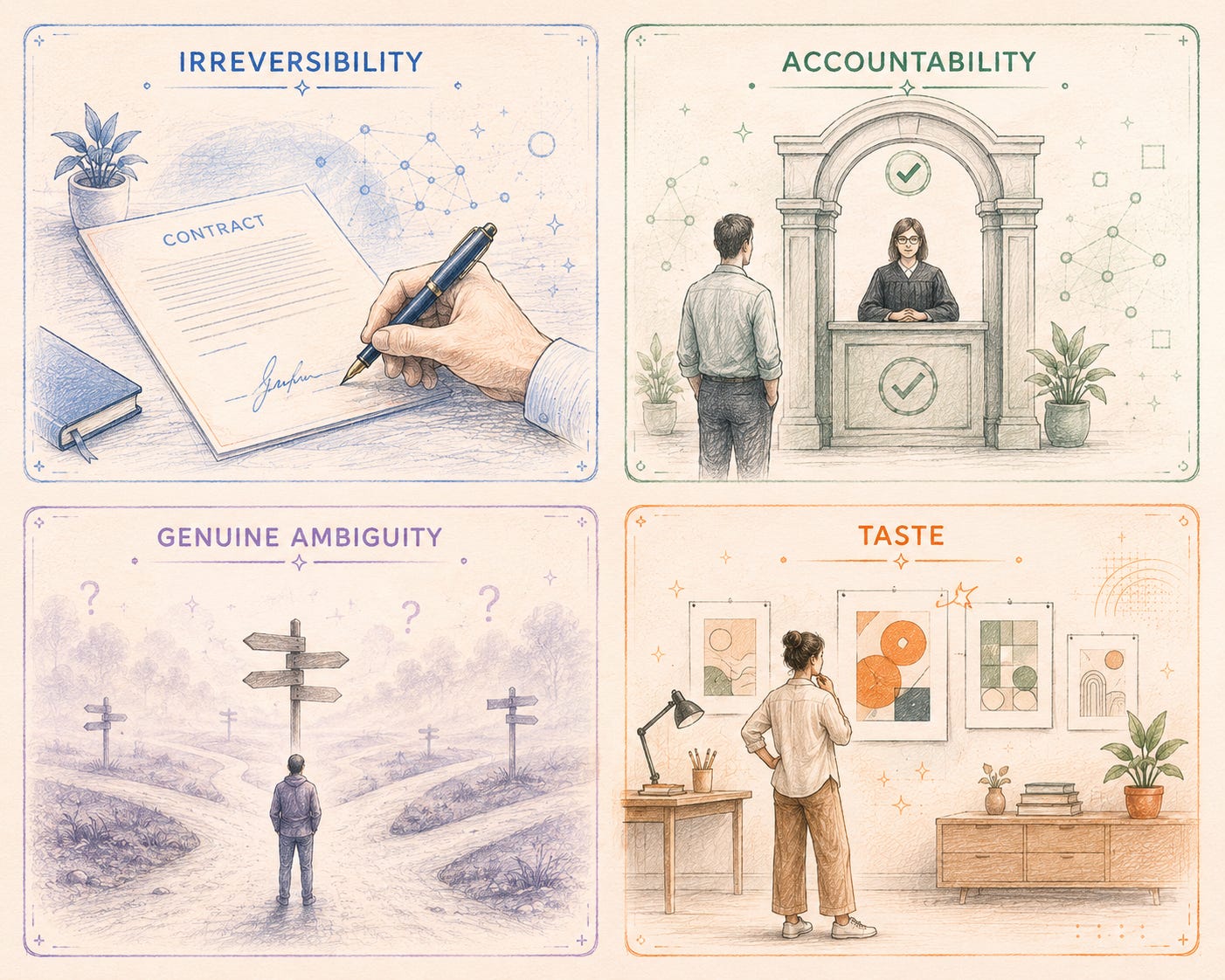
Notice what isn’t on that list. “Because I’ve always done it.” “Because it’s my job.” “Because it would feel strange not to.” Most of the steps we instinctively want to gate fail all four tests. They feel human because we have only ever seen them done by humans, which is a fact about our history, not about the work.
The design question is no longer where the AI helper goes. It is where the human gate genuinely earns its place.
For the next five years, assume that any end-to-end process you currently treat as “obviously human” can be run as all-AI. Not as a prediction that it will be, but as a design assumption you reason from. Start there, and work backwards to the gates.
This feels reckless until you try it, because the moment you adopt it as a working assumption, you are forced to do the honest accounting you were avoiding. You can no longer hide behind “this whole role needs a person.” You have to point at the specific steps and say this one, because it’s irreversible, and this one, because someone has to be accountable, and the other six, well, the other six were only human because nobody had asked the question yet.
This is going to be the hardest part of the transformation, because it hits us in the soul. I did this myself eighteen months ago, when I accepted that I would never write code again. Before that, I was always saying, “I need to do X, I need to do Y.” After that decision, it became: AI can do it all, so where do I align myself in the process?
I am not saying the humans disappear. I am saying the humans move. They stop being the thing that does every step and become the thing that owns the few steps that genuinely need owning. That is not a smaller job. In many cases it is a much bigger one, because the person at the gate is now accountable for the output of an entire automated chain rather than for their own little segment of it. It connects directly to the idea of a HALO, a human running a stack of agents around an outcome. The HALO is just a person who has worked out where their gates are and let the machine have the rest.
Because it changes what a job is, and almost nobody has updated their language for it yet.
A job description today is a list of activities. Manage this, produce that, coordinate the other. It describes a human running a chain of steps. Read one with the flip in mind and most of those activities are not the job at all. They are the steps that are about to be absorbed by the machine. The actual job, the part worth writing down, is the gates. The judgement calls. The places where this specific person’s accountability, taste, or wisdom is the reason the chain is trusted to run at all.
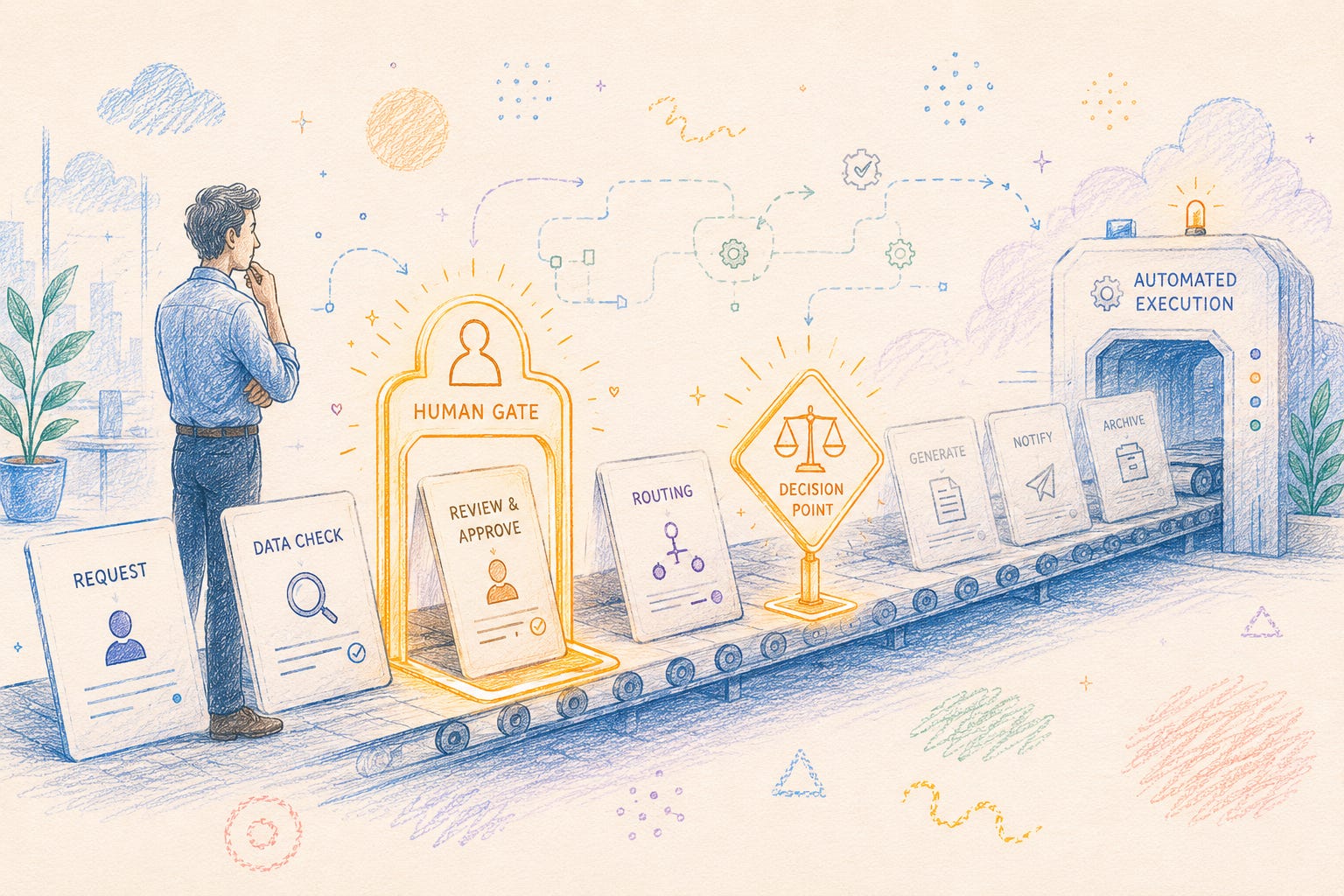
So here is the question I would leave you with. If you took your own role, assumed the whole thing could run AI-to-AI tomorrow, and were only allowed to keep the steps where a human gate truly earns its place, how long would the list be? And, more uncomfortably, is that short list the thing you are actually best at, or just the thing you happen to spend the least time on today?
I think we are about to watch job descriptions quietly rewrite themselves. Not in a dramatic, everyone-fired way, but in the slow way these things actually happen. A role gets redesigned around its gates. Then the next one. Then someone notices that the org chart has stopped describing who does the work and started describing who is accountable for which gates in which automated chains.
The people who get ahead of this won’t be the ones who sprinkled the most AI onto their old workflow. They’ll be the ones who were honest, early, about which parts of their work were ever really theirs to hold. That is an uncomfortable audit to run on yourself. It is also, I suspect, the single most useful thing you can do with a quiet morning and a fresh cup of coffee.
Because most of today’s job descriptions are about to become gate definitions. The only real question is whether you write yours, or wait for someone else to.
Comments
Nothing yet. Say the first thing.
Sign in to join the conversation.