
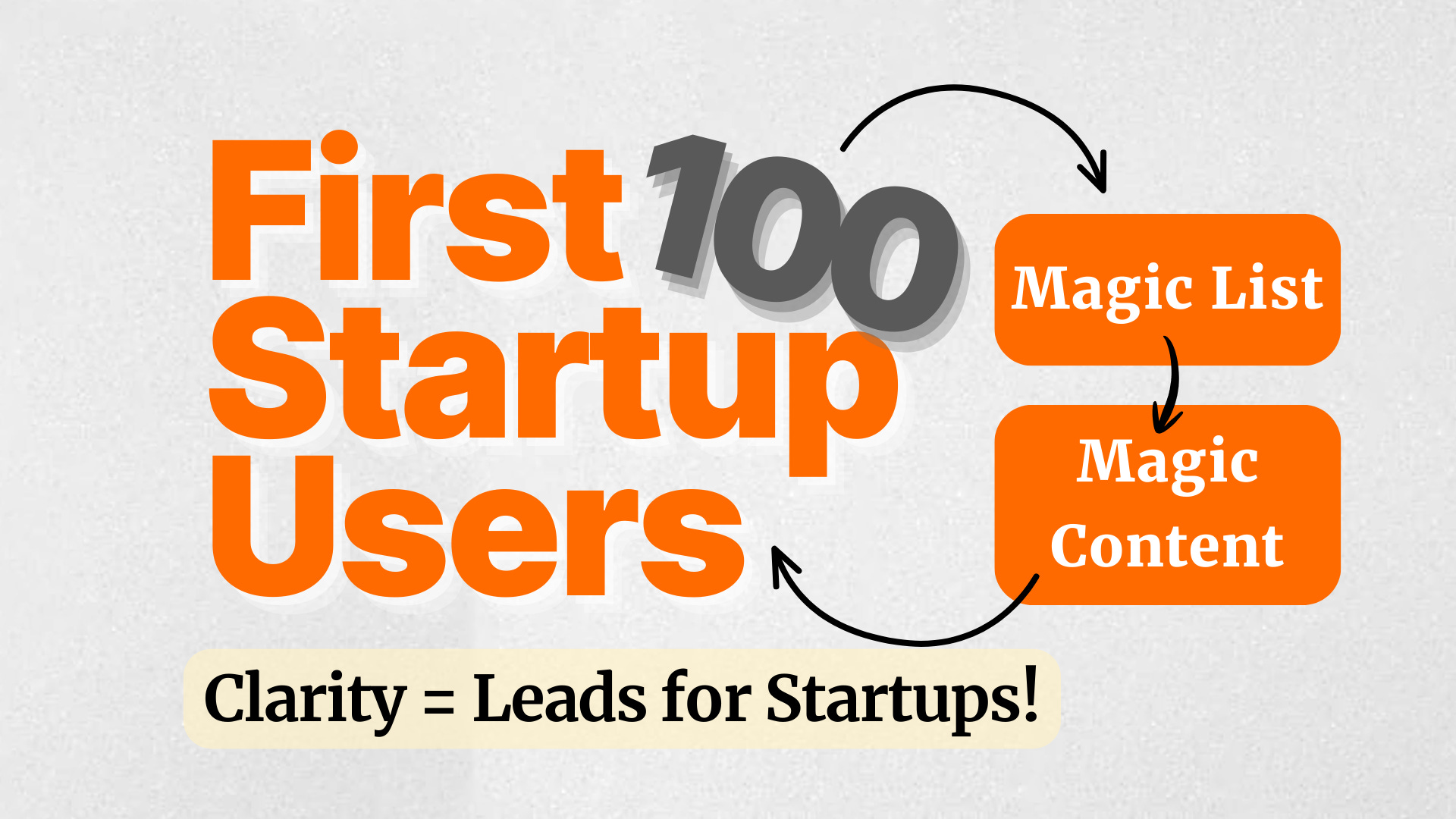
When you are starting-upꜛ, getting your first 100 leads is a burr in your sock – small but incredibly irritating!
The grind is not a problem if you know what you are doing.
The discomfort sneaks in when you can’t get any leads, and also don’t know what the heck you are doing.
Different Gurus 🥴 Different Platforms 😵💫 Different Algorithms 🫠
It all adds up to the confusion.
It’s fair to say the hardest job of a founder is indeed, marketing. Marketing that works.
Nowadays, we hear so much cliche on the internet, that it made real marketing advice totally meaningless. But i want you to forget all that for 2 minutes, and focus.
There are 4 basic steps in every successful lead generation campaign.
The problem? The level of clarity you have on each of these steps can totally make, or break your results.
“Know Your Customer!”
It's the worn-out advice that’s been echoed so many times it’s lost all impact. Everyone's heard it, but no one listens to it. And that’s the very thing holding you back from making real progress.
Knowing your ICP (Ideal Customer Profile) is necessary, but it’s just the first step.
→ Here is a Customer Research prompt for you!
You are a founder; you need results – fast results. Knowledge is the first step. It’s absolutely necessary, but only works when you turn it into action.
The second step after knowing your customers, is having an actual list of your potential customers.
✅ Get that list! ☝
You might ask, but how? Now we’re talking!
Now we’re turning knowledge into → action, and hopefully actions into → results.
It’s time to turn your ICP into a real list. There are different ways to build a lead list and engage with them.
One of the best ways for an online business to make their lead list – specially early leads – is online databases. Tools like:
Apollo
Clay
Zoominfo
These tools allow you to filter leads based on your ideal customer profile (ICP) and, for a reasonable price, you can start gathering high-quality leads.
The added benefit? These platforms often come with built-in engagement features, so you can initiate conversations directly, saving you time and effort.
Another way that works especially well on LinkedIn is the power of searching and scraping. There are many tools and chrome extensions designed to streamline this process, like:
Scrapin
Waalaxy
Taplio
✅ You install these tools → search for the relevant leads and positions you are targeting → then they generate a list of contacts ready for connection and engagement.
If you’re a B2B service provider, there’s a great chance companies are already in need of your services.
✅ You can easily identify them by searching job lists.
If you are a Game Designer, for example, and gaming companies are posting Game Designer job offers online, that’s a clear signal that they are already in the market and could be your perfect lead.
This means they’re not only looking for talent – they’re looking for solutions. And that’s where your service steps in!
As obvious as it is, finding platforms and communities where your customers spend time and engaging with them is an absolute no-brainer.
➡ It’s a numbers game.
Join discussions, answer questions, and build relationships.
But remember, it's like dating – you don’t want to seem creepy or pushy! Engage in a way that feels natural and helpful.
The 4 methods above are the best low-budget, fast ways early to gather your list of leads.
But what happens next? How do you convert these leads into long-term customers?
I don’t suggest you just cold message, or email them and tell about your offers.
The value of these leads will determine how much effort you should put on researching and approaching them.
Because they are your first 100 customers, their value is already high. So you need to provide so much value upfront to make it really difficult for them to ignore your approach.
A lead magnet is a targeted piece of content that solves a very specific pain-point for your potential customers.
Think of it as a little nugget of value you give away in exchange for their attention and trust. Some examples include:
✅ A PDF checklist
✅ A custom website audit
✅ A landing page with a free tool or software
✅ An insightful piece of information that speaks to their immediate problem
But here's where most people get it wrong: Your lead magnet should not be a generic, one-size-fits-all solution.
It has to speak directly to your ideal customer’s pain points and offer a glimpse of the transformation they can achieve by working with you.

Think about it, If you hand someone a bandaid that barely fits, are they going to trust you with their surgery? Absolutely not. But if you give them the perfect fit, they'll feel confident in your ability to solve their bigger problem.

So you’ve delivered the lead magnet and they’re engaged. Now, let’s guide them towards becoming a customer. Here’s how to make that happen:
✅ Provide Immediate Value →
Once they’ve grabbed your lead magnet, don’t go straight into the hard sell. Instead, follow up with something extra, something useful.
➡ Example:“Glad you downloaded the checklist! Here’s another tip to make it even more powerful…”
✅ Engage with Personalization →
Make your follow-up feel personal. If they’ve shown interest in a specific part of your content, mention it. This shows you’re paying attention.
➡ Example:“I saw you were looking into [specific pain-point]. Here’s how others have tackled this and what worked for them…”
✅ Invite, Don’t Push →
Now that you’ve provided value and shown you care, gently invite them to take the next step. No hard pitch, just a simple, low-pressure ask.
➡ Example:“If you’re interested in learning more, let’s jump on a quick 15-minute call to discuss how we can help you…”
This simple, human-centered approach moves your lead from passive to engaged, without feeling like a pushy sales pitch.
You’ve done it.
You’ve built the list → found the leads → and started connecting.
It’s not about doing more – it’s about doing the right things.
The key is clarity, not complexity.
Stop overcomplicating your process and focus on what works.
Instead of overthinking where to find leads, you now have a clear roadmap:
✅ Use low-budget tools
✅ Engage where your leads are already hanging out
✅ Make lead capture easy!
The moment you stop waiting for leads and start actively finding them, everything shifts.
Now, here’s the real magic: Your first 100 leads are more than just numbers – they’re the foundation of your entire business.
They’re not just customers; they’re your advocates, your early supporters, your first real proof that this works. Once you get those first 100 leads, everything starts to snowball.
PS: There are other lead generations methods such as Content Marketing and Paid Ads. My focus on this article was on the super practical, low-budget, but immediate strategies for early-stage startup founders.
What’s your go-to strategy for generating your first 100 customers? Share with us in comments 👇
No posts
Comments
Nothing yet. Say the first thing.
Sign in to join the conversation.