
OpenAI published ten AI-generated advances in mathematics and theoretical computer science. An internal version of its next major model, Astra, produced results across sphere packing, coding theory, quantum games, lattice problems, and more, then helped formalize the proofs in Lean so researchers can inspect them. Read more
Google DeepMind open-sourced WeatherNext models that improve cyclone forecasting. The team says WeatherNext Cyclones gives forecasters about an extra day of useful warning for storm track, intensity, and wind structure, which can matter when cities are preparing for hurricanes and typhoons. Read more
Alibaba released Qwen3.8-Max, its strongest Qwen model so far. The model is aimed at coding and long agentic work, and Alibaba says it will return to an open-weight release strategy so developers can run and adapt a frontier-scale Chinese model. Read more
Meta is positioning Muse Spark as a serious coding and agentic AI model for developers. The latest Muse Spark 1.2 highlights faster coding workflows, multimodal reasoning, long context, and lower-latency agent work through Meta's model API. Read more
Do you prefer to watch instead of read? Check out this video covering the top AI news this week:
Stanford scientists used a DNA-trained AI model to design 16 working bacteria-infecting viruses. The study points to useful phage therapies for antibiotic-resistant bacteria, but it also raises biosecurity questions because AI can now help design functional genetic systems not found in nature. Read more
Xiaomi open-sourced Xiaomi-Robotics-1, a large robot foundation model. It was trained on more than 100,000 hours of real-world manipulation trajectories and is designed to help robots handle unseen environments, new objects, and new tasks with only a small amount of extra demonstration data. Read more
Tencent Hunyuan introduced Hunyuan3D-Buffalo 1.0 for 3D generation, understanding, and editing. The system connects language, 3D representations, and generative modules so one model can answer questions about 3D objects, generate assets from prompts, edit meshes, and break objects into parts. Read more
Alibaba's Tongyi Lab showed Wan-Animate-2 for real-time character animation. It can drive a character directly from reference video, preserve identity better, control camera viewpoint with text, and has a Lite version aimed at live avatars and streaming hosts. Read more
Run the best AI video model, MiniMax H3, with a flexible pay-as-you-go subscription. Upgrade your videos from 768P to sharp 2K quality for just $0.05 per second, and use Prompt Expansion to make your prompts more accurate, cut down on trial-and-error, and get better results at $3.60 per M tokens. Try it today!
BigBang is a new model project built around self-evolving synthetic tasks. The team says it post-trained a Qwen3.6-35B-A3B model using a generator-critic loop that creates verifiable frontier research tasks, reaching performance between much larger DeepSeek V4 systems. Read more
LongHorizon-Harness is a new framework for agents that need to work across long tasks. Instead of letting one agent keep an ever-growing memory, it splits work into manager, executor, and auditor roles so only independently checked facts guide the next step. Read more
Multi-Agent-CAD turns text prompts into CAD models with a structured multi-agent pipeline. The project splits planning, geometry design, code generation, and repair into separate stages, cutting token use sharply while keeping strong feature pass rates on mechanical-part benchmarks. Read more
Alibaba DAMO released ClinFusion for medical multimodal AI. It combines 2D and 3D medical image understanding, report generation, instruction following, and text medical tasks, with open 8B and 32B checkpoints for researchers to test. Read more
Rei Labs introduced Adapt-1 Preview as a test-time learning research system. Instead of relying on a fixed pretrained model, Adapt-1 is designed to update from scored feedback while preserving task rules, evidence provenance, and inspectable decision state. Read more
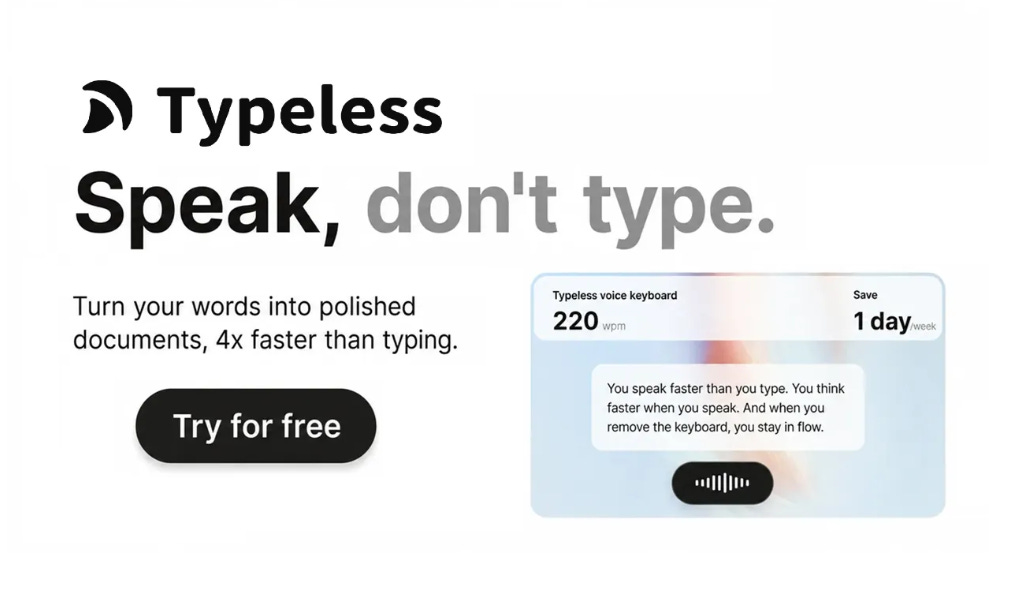
Typeless is an intelligent AI voice dictation tool designed to turn your speech into polished, well-structured text in real time. It automatically cleans up your speech by removing filler words like "um," fixing mid-sentence corrections, and formatting lists across various apps and devices. Try it for free today!
LeapTalk is a real-time talking-head generation method that claims up to 200 FPS on one H200 GPU. It distills a diffusion-style teacher into a one-step streaming model, trying to keep identity stable and lips synced over long videos. Read more
SymphonyGen is a research system for controllable orchestral music generation. It uses a harmony skeleton like a short score, then generates full multi-track orchestration while trying to reduce unwanted dissonance and preserve musical structure. Read more
VocalRender turns composer-style scores directly into expressive singing audio. Instead of requiring hand-made phoneme timing, it reads lyrics, MIDI pitches, note values, and tempo, then generates singing with pitch, timbre, and prosody details. Read more
TRACE released code for active scene reconstruction in robotics. Its planner tries to move a camera toward useful surface regions instead of repeatedly scanning the same geometry, helping robots build better 3D maps under a time budget. Read more

Meet Fish Audio, the most expressive AI voice model. Core features include text-to-speech, instant voice cloning, and a library of over 2 million voices. Create natural, emotionally rich AI voices built for your workflows. Try it for free.
Comments
Nothing yet. Say the first thing.
Sign in to join the conversation.