
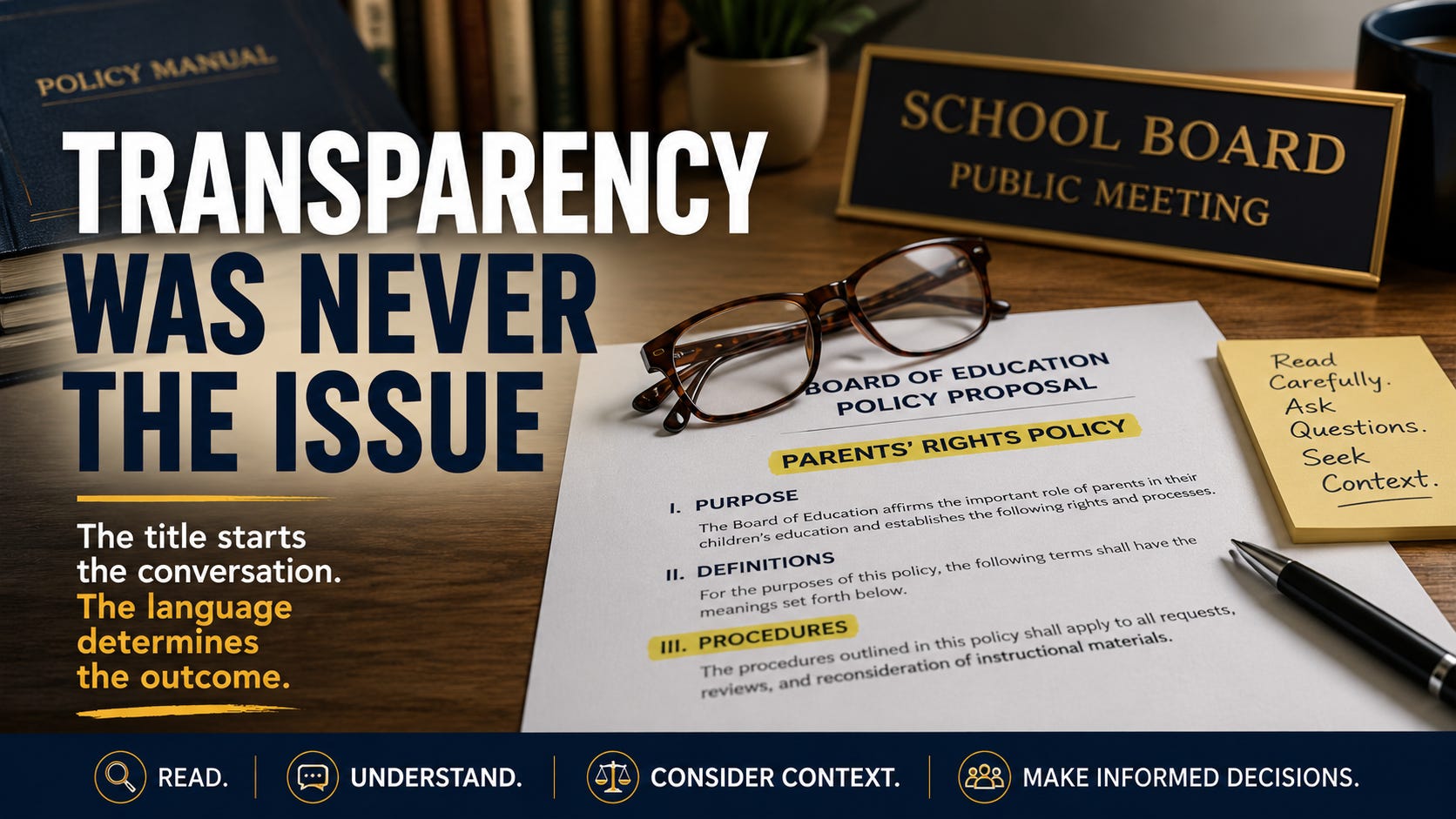
Every few weeks, another school district makes headlines for considering or adopting a Parents’ Rights policy. Supporters often describe these proposals as restoring parental rights, while critics warn they could lead to censorship or restrict access to books and instructional materials. Before long, the conversation becomes polarized, with each side arguing over what the policy is intended to accomplish.
As both a school librarian and a former elected member of a board of education, I read these policies a little differently.
For three years, I served on my board’s policy committee, where I saw firsthand what happens before a policy ever reaches a board agenda. I watched policies move through multiple drafts as board members, administrators, and attorneys debated the meaning of individual words and phrases. I also experienced the other side of the process as the librarian responsible for implementing those same policies once they were adopted.
Every meeting reinforced something that has stayed with me ever since: policies are not written for the day they are adopted. They are written for the situations that may arise years later—for the day a complaint is filed, a book is challenged, a parent raises a concern, or a board is asked to make a difficult decision.
That experience changed the way I read school policy. The title of a policy often tells you very little; the language tells you everything.
That is why I have been paying close attention to the growing number of Parents’ Rights policies appearing in school districts across New Jersey and around the country. One recent example comes from Kinnelon, New Jersey, where the board adopted a Parents’ Rights policy after months of public discussion. While much of the public attention focused on a handful of provisions, the policy itself addressed a much broader range of topics.
Kinnelon is not unique. It is simply one example of a broader trend that school districts across the country are beginning to navigate. Some of these policies largely organize existing district practices into a single document, while others introduce new procedures, redefine responsibilities, or shift decision-making authority in meaningful ways.
That is why I believe we need to slow down before reacting. As I have watched these proposals spread, I keep coming back to one conclusion: Transparency was never the issue.
That statement may surprise some readers because transparency has become one of the central talking points surrounding these policies. The implication is often that schools have been keeping information from parents or making important decisions without their knowledge.
In most public school districts, parents have long had the right to ask questions about what their children are learning. They have been able to review curriculum, inspect library materials, search online library catalogs where available, speak with teachers, principals, and librarians, attend board meetings, review board policies, request alternative reading assignments for their own child, and challenge instructional or library materials through established district reconsideration procedures.
None of those rights are new.
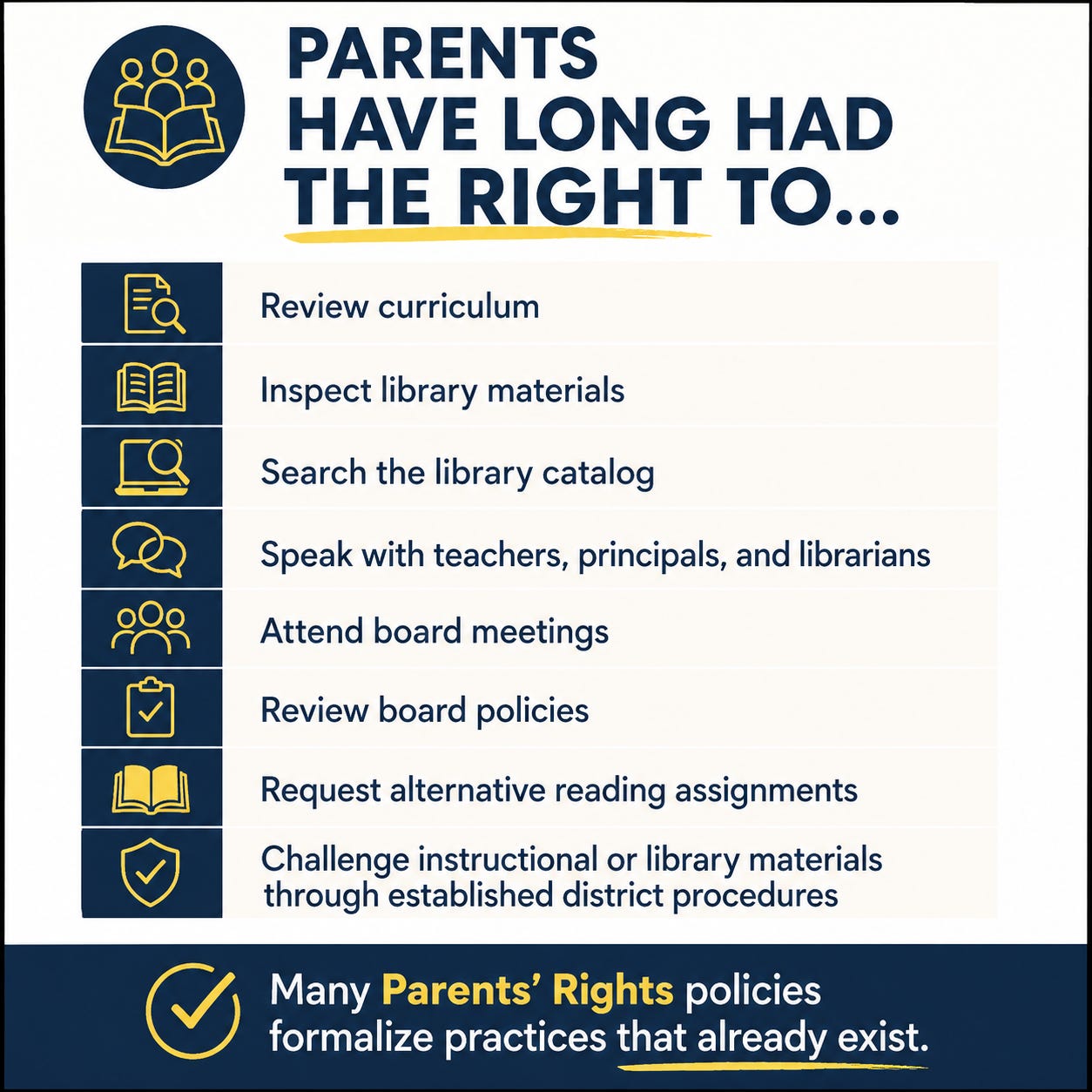
That does not mean every Parents’ Rights policy is unnecessary. Some districts may simply organize existing practices into a single policy, while others create new procedures or shift decision-making authority in ways that deserve careful attention.
That’s where I think the conversation should begin.
What’s Actually New?
One of the first questions I ask whenever I read one of these proposals is surprisingly simple: What’s actually new?
If you’ve been following the headlines, you might assume these policies create an entirely new set of rights for parents. In many districts, that isn’t the case. Some policies simply bring together practices that have existed for years, while others clarify procedures that were previously spread across multiple board policies or administrative regulations. Still others do much more.
They may change who has the authority to make decisions, establish new notification requirements, alter reconsideration procedures, redefine responsibilities, or create entirely new processes. Those differences matter.
When I served on my board’s policy committee, we rarely spent much time discussing a policy’s title. Instead, we focused on how the policy would actually work: who has the authority to act, who reviews a complaint, what happens if someone disagrees with the decision, and whether that decision can be appealed. Those were the questions that mattered because they were the ones that eventually affected students, families, educators, and administrators.
Titles make headlines, but procedures determine outcomes. That is why I encourage people to read beyond the summary or social media posts and compare a proposed policy with the policies already in place. Ask what language has been added, what language has been removed, and what authority has changed. Those answers often reveal far more than the title ever could.
Where Transparency Ends
One phrase appears in many of these proposals: Parents have the right to inspect library books or library materials.
At first glance, that statement seems straightforward, and in fact, I believe most librarians, educators, and parents would agree with it. Parents should know what materials are available to their children. They should be able to ask questions, understand how books are selected, and make informed decisions about what is appropriate for their own child. That is what transparency looks like
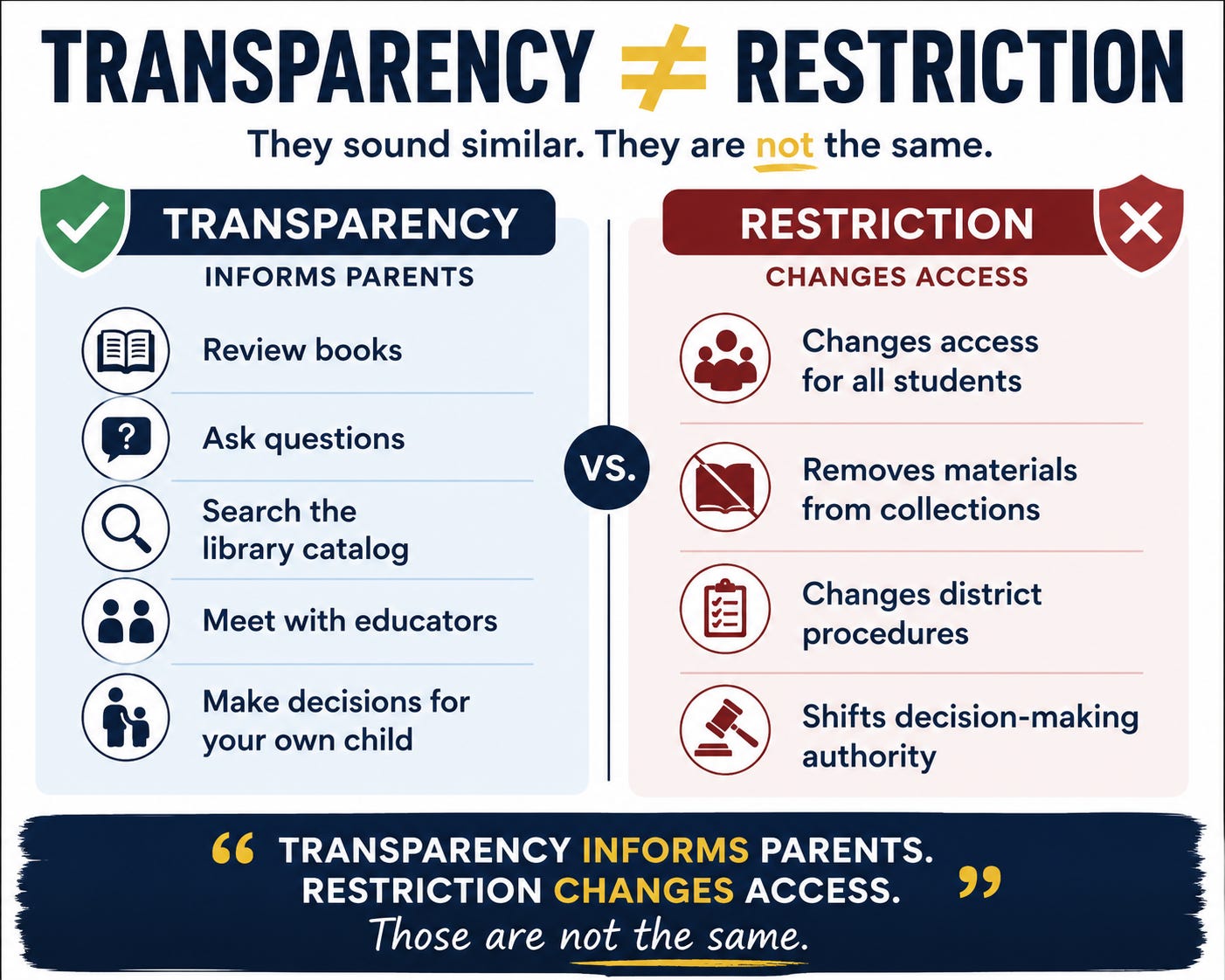
.Transparency gives parents information and builds trust. It has always been an important part of the relationship between schools and families. But transparency is not the same as restriction, and that distinction is where many of these conversations begin to change.
There is an important difference between a parent deciding that a particular book is not appropriate for their own child and a policy that allows one family’s objection to determine what remains available to every student in a school. Good policy should protect both parental involvement and every student’s right to learn, and those goals are not mutually exclusive.
Parents have every right to guide their own children’s reading, and most school districts already provide ways to request an alternative title, discuss concerns with educators, or ask that a particular student not have access to a specific resource. They have not traditionally had the authority to determine what every other family’s children may read, and that is a different question entirely.
School library collections are developed through board-approved collection development policies. Librarians consider curriculum, educational relevance, age appropriateness, professional reviews, student interests, and the needs of an entire school community. The goal is not to build a collection that reflects one family’s preferences, but to build a collection that supports learning for all students.
That is why transparency and restriction should never be treated as though they are interchangeable. They are not, and understanding where one ends and the other begins is essential to understanding what these policies actually change. What Serving on a Policy Committee Taught Me
One of the greatest lessons I learned while serving on my board’s policy committee is that policy is cumulative. School districts rarely make sweeping changes through a single policy. Instead, they make a series of revisions over time, with one policy updating parental notification procedures, another revising curriculum review, and another changing how instructional or library materials are reconsidered. Viewed individually, each revision may appear relatively small, but together they can significantly reshape how a district operates.
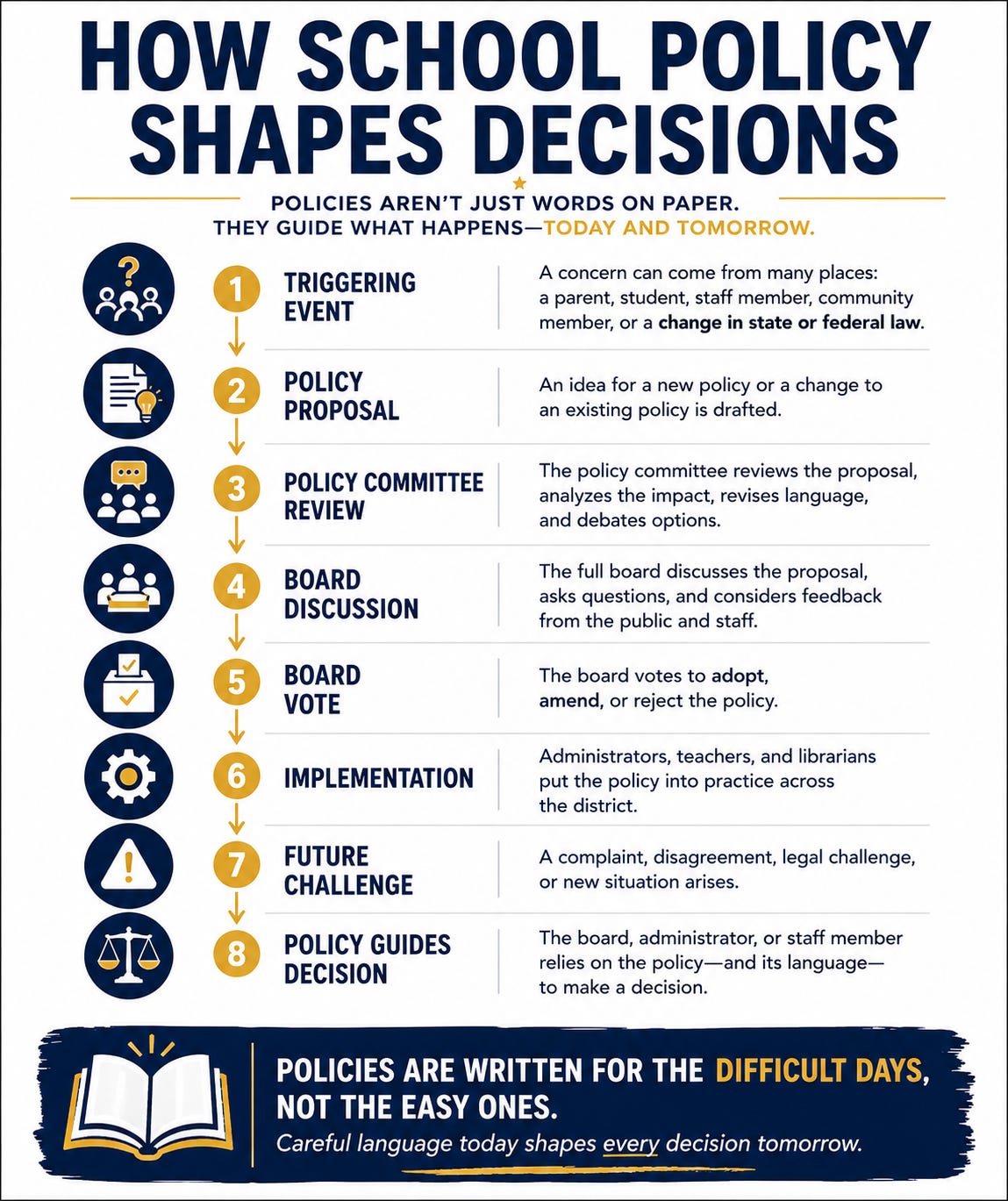
That is one reason I encourage people not to evaluate a policy in isolation. Compare it with the policies your district already has in place, and ask what language has been added or removed, whether authority has shifted, and whether timelines, procedures, or responsibilities have changed. Those comparisons often reveal far more than a headline or a social media post ever could.
Another lesson I learned is that policies often affect people who had no role in writing them. Teachers implement them, principals interpret them, librarians answer questions about them, administrators apply them, and boards revisit them when new situations arise. By the time a policy reaches the people responsible for carrying it out, the discussion about its language is usually over.
That is why understanding policy before controversy arises is so important. It allows educators, families, and community members to participate in informed discussions while changes are still being considered rather than after they have already been adopted.
The longer I served on the policy committee, the more I realized that the title of a policy was almost never the most important part. The real work happened in the definitions, the procedures, and the details that many people never read. That is where authority is assigned, responsibilities are defined, and future decisions are often shaped.
Why State Law Matters
Another reason these conversations can become confusing is that local board policies do not exist on their own. Every school district operates within state and federal law, and those legal frameworks are not the same across the country.
Some states, including New Jersey, have adopted Freedom to Read protections that establish how challenges to library materials are reviewed and recognize the role of professionally developed collection policies. Other states have adopted different approaches that give local districts broader discretion or establish different procedures for reviewing materials. That means two school districts can adopt policies with nearly identical language while operating under very different legal requirements.
Understanding your state’s legal framework is just as important as understanding your local board policy. It is also why comparing headlines from different states can be misleading, since a policy that has one effect in New Jersey may operate very differently somewhere else because the underlying legal framework is different.
That is another reason I encourage people to read carefully, understand the context, and resist drawing conclusions based solely on a policy’s title or a headline summarizing it. Policy does not exist in a vacuum; it works alongside state law, existing board policies, administrative regulations, and long-established district procedures. Understanding how those pieces fit together is often the key to understanding what a policy actually does.
The recent Parents’ Rights policy adopted in Kinnelon is one example of why I believe this conversation deserves more attention.
Like many similar proposals across the country, the policy generated significant public debate, with supporters and critics quickly focusing on specific provisions while much of the broader policy received far less discussion. That pattern is becoming increasingly common, as policies are often reduced to a single issue, a single quote, or a single headline, even though the language that ultimately guides a district’s decisions is found in the policy itself.
Kinnelon is not unique. School boards across New Jersey and across the country are considering similar proposals, some of which simply organize existing district practices into one document, while others introduce new procedures or shift decision-making authority in meaningful ways.
The point is not that every Parents’ Rights policy is the same, but that none of them should be evaluated by title alone, and every proposal deserves to be read on its own merits
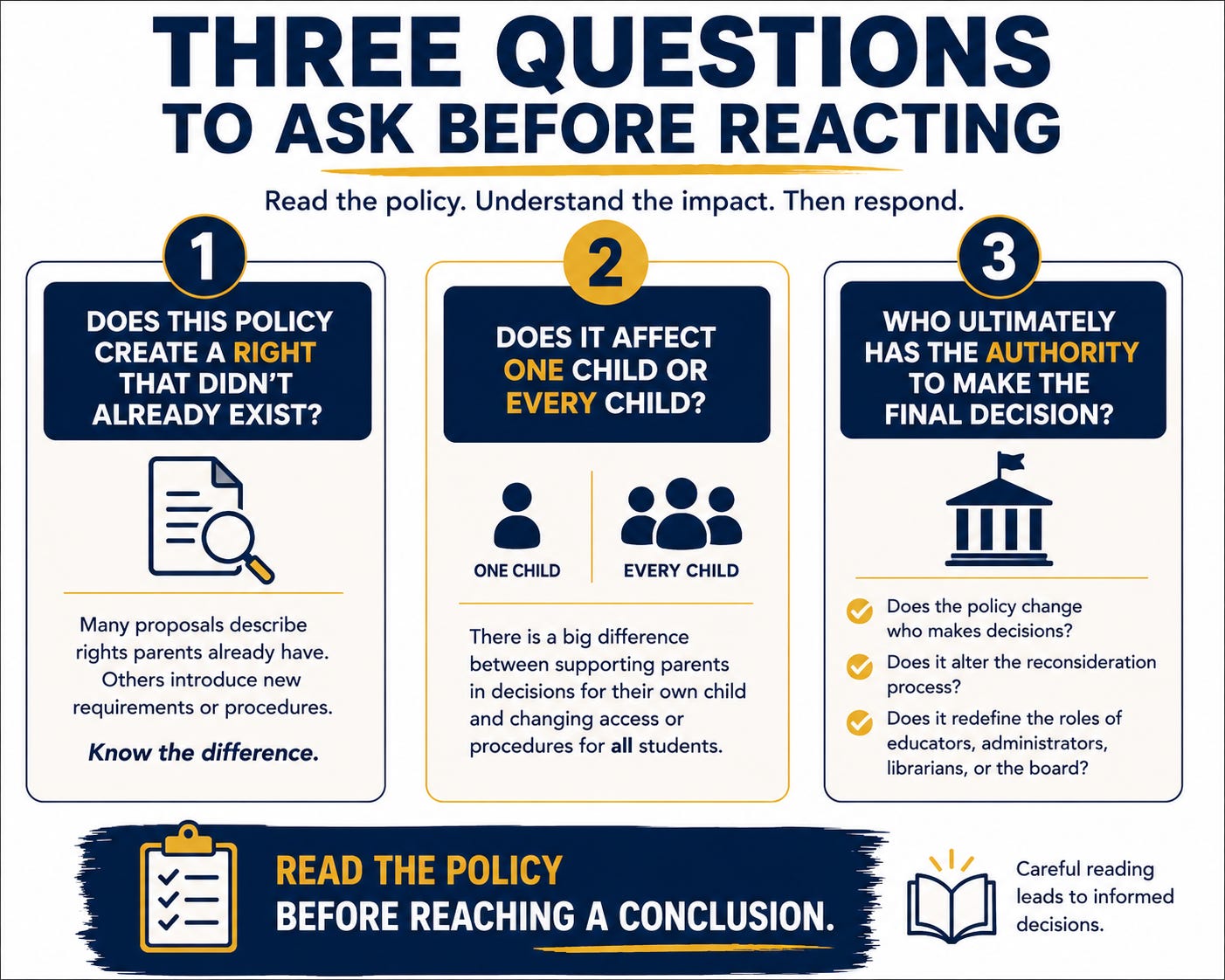
Three Questions Everyone Should Ask
Whether you are a parent, educator, librarian, administrator, school board member, or community member, I believe every proposed policy should begin with three simple questions.
Does this policy create a right that did not already exist?
Many proposals describe rights that parents have exercised for years, while others introduce new requirements or procedures, and understanding that distinction is the first step in evaluating any policy.
Does this policy affect only a parent’s own child, or does it affect every student?
There is an important difference between supporting parents in making decisions for their own children and changing access or procedures for an entire school community.
Who ultimately has the authority to make the final decision?
Does the policy change who makes decisions, alter the reconsideration process, or redefine the roles of educators, administrators, librarians, or the board of education? Those three questions move the conversation beyond slogans and toward understanding.
Read the Policy
One of the most valuable lessons I have learned, both as a librarian and as a former board member, is that careful reading matters.
Every day, educators teach students to evaluate sources, question assumptions, seek context, and read beyond the headline before reaching a conclusion, and school policy deserves that same level of careful reading.
The next time your district considers a Parents’ Rights policy, don’t stop with the headline, the social media posts, or the talking points. Read the proposal, compare it with your district’s existing policies, and ask what has changed and what has stayed the same, as well as who now has the authority to make decisions and how those decisions affect not only one child, but every child.
The question isn’t whether a policy sounds reasonable; the question is what authority it creates, what responsibility it changes, and what happens when the first real challenge arrives, because those answers are rarely found in the title and are instead found in the language, since the title starts the conversation, but the language determines the outcome.
Comments
Nothing yet. Say the first thing.
Sign in to join the conversation.