
Related Reading
If you’ve been following my recent articles, you’ll know this isn’t the first time I’ve written about legislation moving through Congress. Earlier this year, I examined H.R. 7661, H.R. 2616, and H.R. 8705 because I believed educators deserved to understand what those proposals could mean for public schools before they became political talking points.
Unfortunately, here we are again.
Why I’m Writing About This
What if I told you Congress has introduced four different education bills in just a few months that could affect what students read, what teachers teach, and what librarians can provide, yet most educators haven’t heard about any of them?
That’s exactly why I’m writing this article.
If you’re a school librarian, classroom teacher, administrator, or school board member, chances are you’ve spent the summer preparing for another school year. You’re thinking about lesson plans, schedules, budgets, staffing shortages, artificial intelligence, and the dozens of other challenges educators juggle every August. You’re probably not checking Congress.gov every morning to see what education bills were introduced the day before.
Neither was I.
Back in May, one bill caught my attention because it dealt directly with school libraries. I assumed it would be a one-time article explaining legislation that most educators hadn’t seen. Instead, another bill followed. Then another. Now Senate Bill 4925 has arrived, and I find myself asking a question I didn’t expect to ask just a few months ago.
At what point do we stop treating these as isolated proposals and begin recognizing them as part of a much larger conversation about public education?
I don’t think that question is political.
I think it’s professional.
As educators, we have a responsibility to understand proposals that could change how we teach, what our students can access, and how we make decisions inside our schools. We don’t have to agree with one another about every piece of legislation. In fact, thoughtful people rarely do. But we should at least know the conversation is happening before someone else decides the outcome for us.
That’s why Senate Bill 4925 matters.
Understanding Senate Bill 4925
Before we talk about why I’m concerned, let’s start with the bill itself.
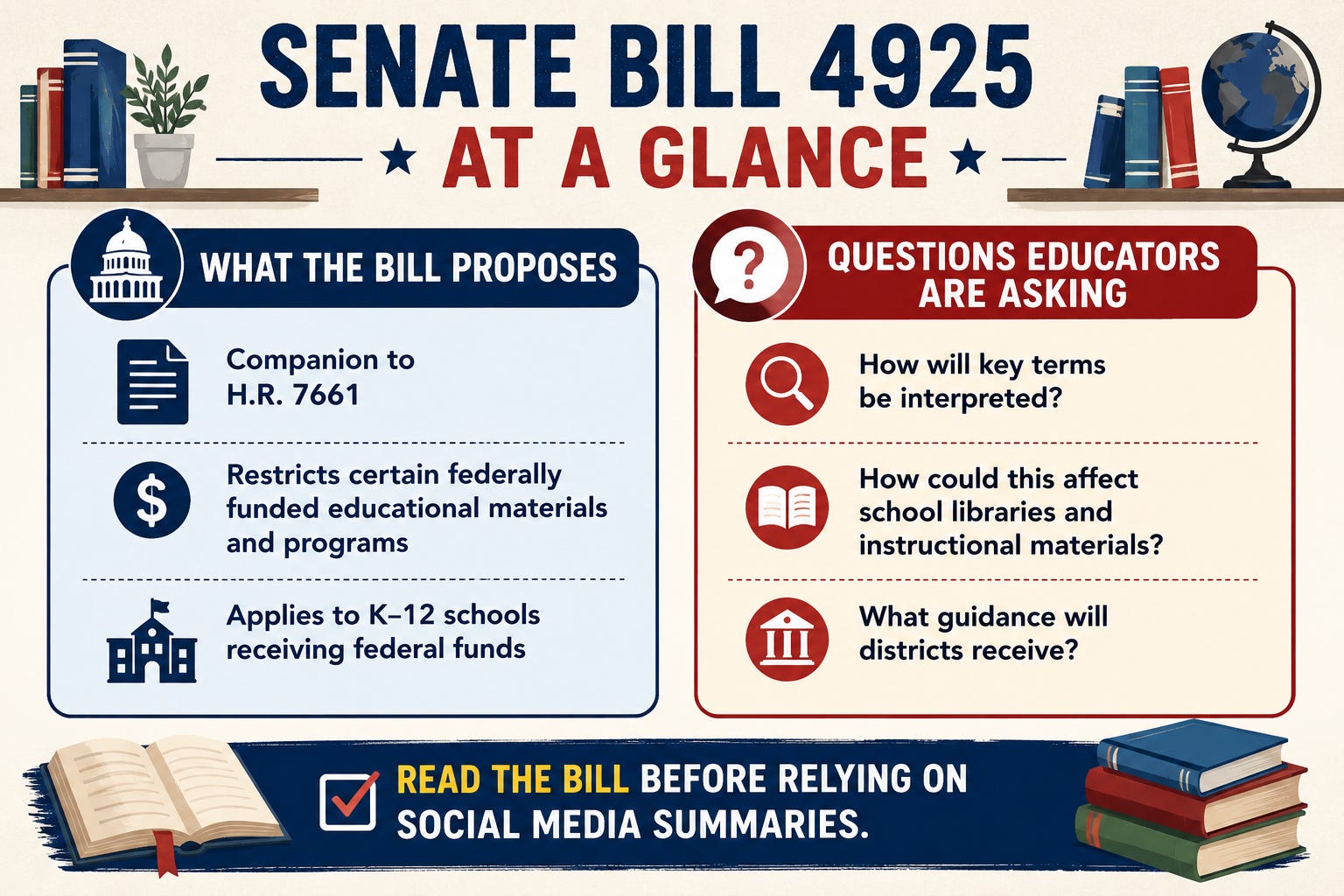
Senate Bill 4925 is the Senate companion to H.R. 7661, the Stop the Sexualization of Children Act. In simple terms, it would prohibit schools receiving certain federal education funds from using those funds for materials or programs that the legislation defines as “sexually oriented.” Like the House version, the bill also includes exceptions for science instruction, major world religions, certain classic works of literature, and other educational contexts specifically identified within the legislation.
If you’ve only seen the bill discussed on social media, you’ve probably encountered one of two very different narratives.
Supporters argue the legislation is about protecting children from age-inappropriate material and ensuring federal education dollars are used responsibly. Critics argue that the bill’s language is broad enough that districts could struggle to determine exactly what materials are covered, leading schools to remove or avoid books and instructional resources that the law may not explicitly prohibit.
That difference matters.
One of the things I tell students all the time is that when two groups describe the same document in dramatically different ways, it’s usually a sign that you should read the original source yourself. I think educators should take that same approach here. Read the bill. Read reporting from multiple perspectives. Compare what different organizations emphasize. Ask what questions remain unanswered.
Those are information literacy skills.
They’re also citizenship skills.
Why This Bill Should Be on Every Librarian’s Radar
On its own, Senate Bill 4925 would be worth paying attention to because of the potential implications for school libraries and instructional materials.
What concerns me, however, is not simply the existence of another education bill.
It’s the context in which this bill has appeared.
This is now the fourth federal education bill I’ve written about in just a few months. The others addressed different issues, including library materials, student identity, and history education. Each generated its own headlines and its own political debate. Each was presented as though it were a separate conversation.
I don’t think they are separate conversations anymore.
Taken together, these proposals suggest a broader effort to influence what public schools teach, what resources libraries provide, and how educators make professional decisions. Whether that effort is viewed as necessary reform or federal overreach depends on your perspective. Regardless of where you stand politically, I believe educators should recognize that these proposals are no longer isolated events.
At some point, four bills stop looking like coincidence.
They start looking like a legislative direction.
As a librarian, that’s the part that keeps my attention.
We teach students to recognize patterns in history, literature, science, and media. We ask them to compare multiple sources before reaching conclusions. We encourage them to look beyond a single event and ask what larger trends might be developing.
I think it’s time educators did the same thing.
Why I’m Concerned
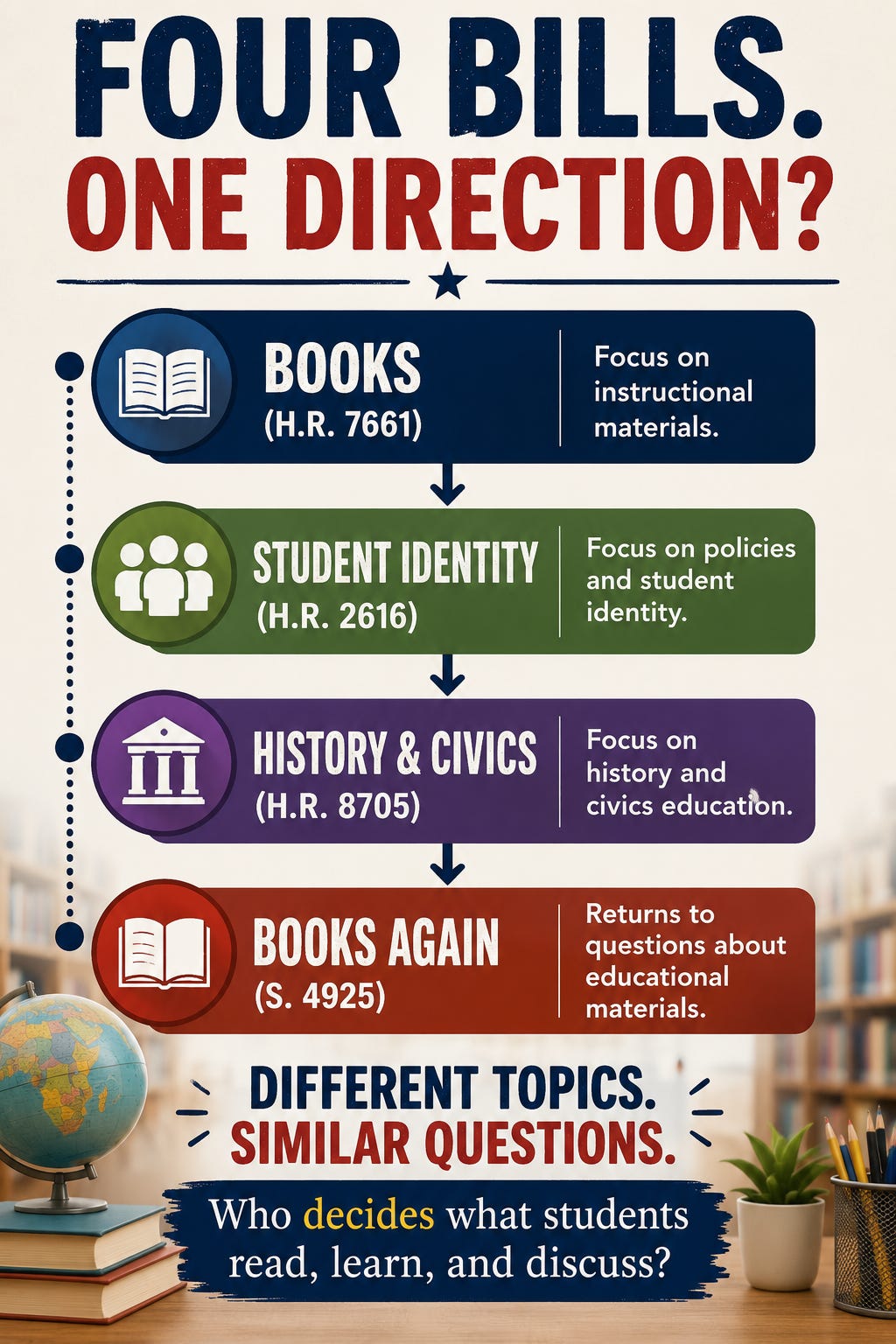
After writing about four federal education bills in just a few months, my concern isn’t really about any single proposal. It’s about what happens when you step back and look at all four together. H.R. 7661 focused on books and instructional materials. H.R. 2616 expanded the conversation to student identity, parental notification, and school policies. H.R. 8705 shifted the focus to civics and history education. Now Senate Bill 4925 returns to books once again. Looking at those bills individually, it’s easy to see separate political debates. Looking at them together, however, I see repeated attempts to influence decisions that have traditionally been made by educators, librarians, curriculum specialists, and local school districts.
That should matter regardless of where you fall politically.
I’ve served on a board of education, and today I work as both a district library coordinator and a practicing school librarian. Those experiences have reinforced something I believe deeply. Decisions about curriculum, instructional materials, and library collections are rarely simple. They require balancing state standards, professional expertise, community expectations, legal requirements, educational research, and, most importantly, the needs of students. Those conversations are often challenging, but they are also local because the needs of one community are not always identical to the needs of another.
What concerns me about this series of bills is that they increasingly move those conversations away from local educators and toward Washington. Whether someone believes that’s the right direction or the wrong one is a legitimate political debate. My concern is that many educators don’t even realize the debate is happening. If we aren’t paying attention while these proposals are being discussed, we lose the opportunity to share our expertise before decisions are made that could affect every public school in the country.
The Chilling Effect Doesn’t Require a Law
One of the biggest misconceptions about legislation is that nothing changes unless a bill becomes law. In reality, schools often begin responding long before a final vote is taken. Administrators ask attorneys for guidance. Curriculum committees review instructional materials. Publishers begin watching what districts are requesting. Professional organizations issue statements. Teachers start asking whether a lesson could become controversial, and librarians begin thinking carefully about purchasing decisions, displays, programming, and recommendations.
I’ve watched this happen repeatedly over the past several years. During debates over book challenges, curriculum changes, and state legislation, I’ve seen educators become more cautious long before new rules were finalized. That’s a completely understandable response. Most educators aren’t trying to make political statements. They’re trying to do what’s best for students while avoiding unnecessary conflict for their schools and communities.
The problem is that caution can change student access even when no law explicitly requires it.
A district delays purchasing a title until there is more legal clarity. A teacher decides to replace a lesson because it feels safer than defending it. A librarian postpones a display tied to a current event because no one wants to become the next national headline. None of those decisions necessarily result from a legal mandate. They happen because uncertainty influences professional judgment, and uncertainty can be just as powerful as legislation itself.
That’s what concerns me most about Senate Bill 4925 and the three bills that came before it. Even if they never become law, they can still influence how schools think about curriculum, collections, and instructional materials. When enough uncertainty exists, districts often become more conservative in their decision-making because the perceived risk of controversy outweighs the educational value of standing firm.
Why Librarians Should Be Paying Attention
School librarians occupy a unique position in education because our work touches every grade level, every department, and every subject. We help develop collections, collaborate on curriculum, teach research and information literacy, support classroom instruction, and answer questions from students, teachers, administrators, and families. That perspective allows us to notice changes that may not be immediately visible to others.
When teachers begin asking whether a book is still appropriate for a lesson, we hear those questions. When publishers quietly revise descriptions of new titles or districts begin reconsidering purchasing decisions, we notice those trends. When administrators ask how other schools are responding to new legislation, librarians are often part of those conversations because we are responsible for many of the resources at the center of the debate.
That’s one of the reasons I’ve continued writing about these bills.
Not because I enjoy reading legislation. Not because I think every proposal will become law. I keep writing because I know how quickly uncertainty can reshape schools. By the time many educators hear about legislation like Senate Bill 4925, advocacy organizations have already mobilized, school boards have started asking questions, and districts have begun reviewing policies. I don’t want librarians to be among the last people learning about legislation that could affect their collections, their programming, and their professional judgment.
This Is Bigger Than Books
Although Senate Bill 4925 focuses on educational materials, I don’t believe the larger issue is really about books. It’s about professional trust. Do we trust trained educators to select materials that support state standards, meet the needs of their students, and follow established collection development policies? Or do we increasingly rely on federal legislation to define those boundaries?
That’s a conversation worth having, and thoughtful people will disagree about the answer. What concerns me is that many of the people with the most expertise, including teachers, librarians, curriculum directors, and school leaders, are often missing from the public conversation. These bills will affect our work, yet too often we hear about them only after the debate has already been framed by political organizations or social media.
That’s exactly why I’m writing this article. I don’t expect everyone to agree with my concerns. I do hope more educators start paying attention because these conversations are happening whether we participate in them or not. If we believe our professional experience has value, then we have a responsibility to make our voices part of that conversation before someone else decides what public education should look like.
What Librarians Can Do Right Now
One of the things I appreciate most about librarians is that we’re problem solvers. When a student can’t find reliable information, we teach them how to search more effectively. When a teacher needs new resources, we help identify them. When communities begin asking difficult questions, we don’t stop doing our jobs. We lean into our professional expertise.
I think this moment calls for that same approach.
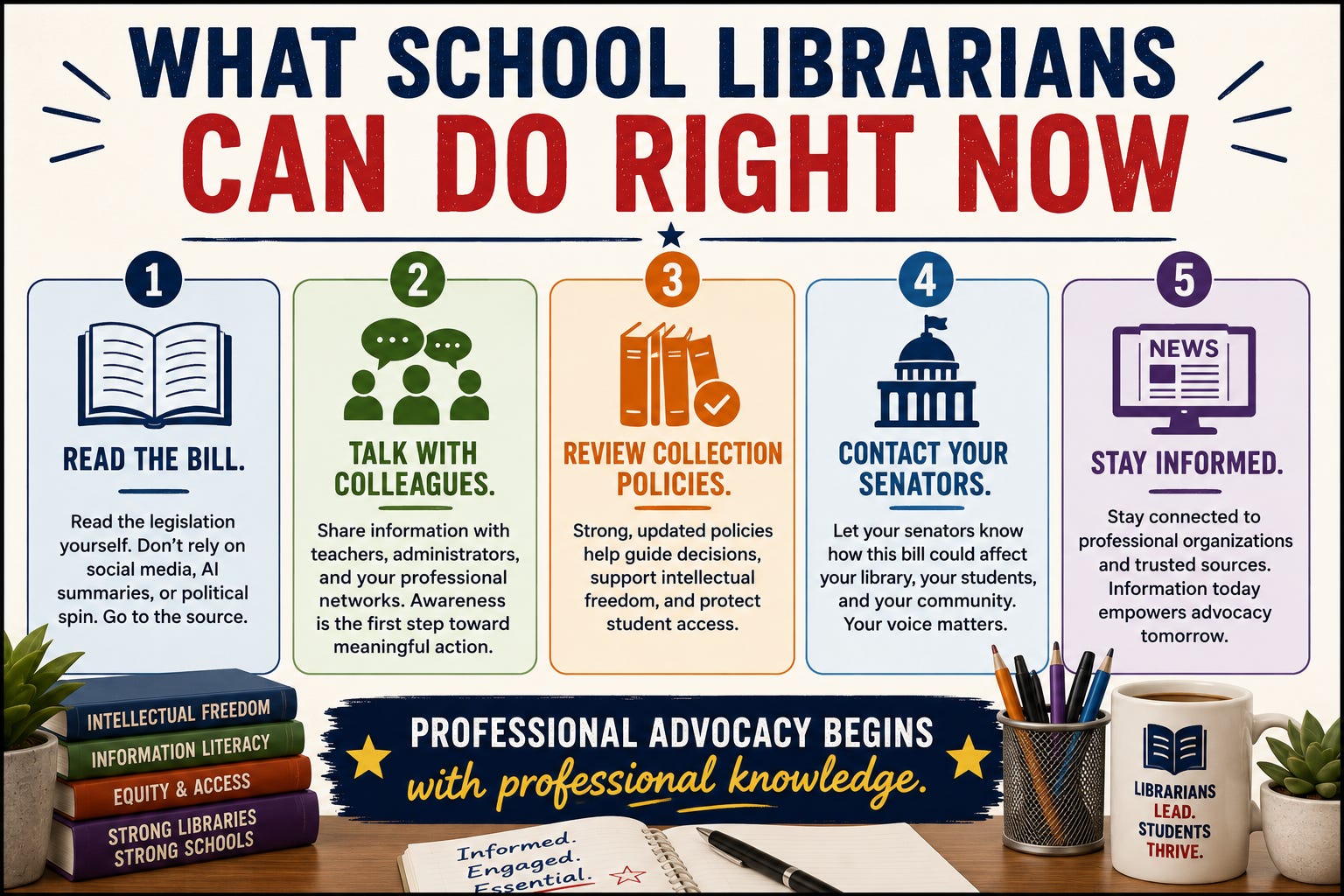
The first step is simple. Read the bill yourself. Whether you ultimately support it or oppose it, don’t let social media, AI-generated summaries, or political organizations become your only source of information. Read the legislation. Read reporting from multiple perspectives. Compare what different organizations are saying. That’s exactly the process we teach students every day, and it’s one we should model ourselves.
The second step is to start talking about it. Share information with your colleagues, administrators, and professional networks. In my experience, many educators still haven’t heard about Senate Bill 4925, just as many hadn’t heard about H.R. 7661, H.R. 2616, or H.R. 8705 until well after they had been introduced. Awareness is the first step toward meaningful participation, and we can’t contribute to conversations we don’t know are happening.
Third, take time to review your district’s collection development and reconsideration policies. Strong policies, developed before controversy arises, provide a framework for making thoughtful professional decisions. They also remind communities that library collections are built through established educational processes, not political trends or social media campaigns. If your policies haven’t been reviewed in several years, now may be a good time to revisit them with your administration.
Fourth, stay connected to your state and national professional organizations. Groups such as the American Association of School Librarians, the American Library Association, EveryLibrary, PEN America, the National Coalition Against Censorship, and your state library association regularly monitor legislation, provide analysis, and offer practical guidance for educators. No one should feel like they have to navigate these issues alone.
Finally, if you have concerns about Senate Bill 4925, contact your senators while the bill is still under consideration. Too often, educators wait until legislation is close to becoming law before speaking up. By then, many of the key conversations have already taken place. Lawmakers need to hear from the people who work with students every day. Explain how the bill could affect your library, your classrooms, and your community. Personal stories from educators are often far more powerful than form letters because they illustrate the real-world consequences of policy decisions.
Why This Matters Even If the Bill Never Becomes Law
One of the biggest lessons I’ve learned over the past several months is that legislation matters long before it becomes law.
The introduction of a bill often changes the conversation. School boards begin asking questions. Administrators review policies. Publishers pay attention to what districts are requesting. Advocacy organizations mobilize. Professional associations issue guidance. News organizations frame the debate. By the time Congress casts a final vote, schools may have already spent months responding to the possibility of change.
That’s why I don’t think educators can afford to wait until legislation reaches the evening news.
Paying attention early doesn’t mean assuming every bill will become law. It doesn’t mean panicking every time Congress introduces new legislation. It simply means recognizing that informed professionals should understand proposals that could affect their work before someone else defines the conversation for them.
As school librarians, we teach students that good citizenship begins with informed participation. We encourage them to seek primary sources, compare perspectives, ask thoughtful questions, and evaluate evidence before forming opinions. Those same principles apply here. Whether we’re talking about artificial intelligence, media literacy, elections, or education policy, informed participation is one of the most important skills we can model.
Final Thoughts
When I wrote about H.R. 7661 back in May, I assumed I was explaining one bill that educators should know about. I never expected to spend the next several months writing about three more federal education proposals. Looking back now, I’m grateful I did because reading them together changed how I think about what’s happening in public education.
I don’t know whether Senate Bill 4925 will become law. I don’t know whether every proposal I’ve written about will move forward. Congress will ultimately decide that.
What I do know is that educators can’t afford to ignore legislation simply because it hasn’t become tomorrow’s headline.
Public education is shaped by more than the laws that pass. It is shaped by the conversations we have while those laws are still being debated. It is shaped by whether educators bring their professional expertise to those conversations or leave them to others. It is shaped by whether librarians continue advocating for intellectual freedom, strong collection development policies, and students’ right to access diverse ideas and reliable information.
That’s why I wrote this article.
Not to tell you what to think.
Not to tell you which political party to support.
But to encourage you to pay attention, read the legislation for yourself, and make your voice heard while there is still time to influence the conversation.
I’ve spent my career teaching students to ask better questions, evaluate evidence, and seek out primary sources before reaching conclusions. I think this is one of those moments when we should follow our own advice.
The conversation about Senate Bill 4925 is already happening.
My hope is that school librarians will help lead it, rather than discovering it after the decisions have already been made.
Learn More
Read the legislation
Additional Reading
Comments
Nothing yet. Say the first thing.
Sign in to join the conversation.