
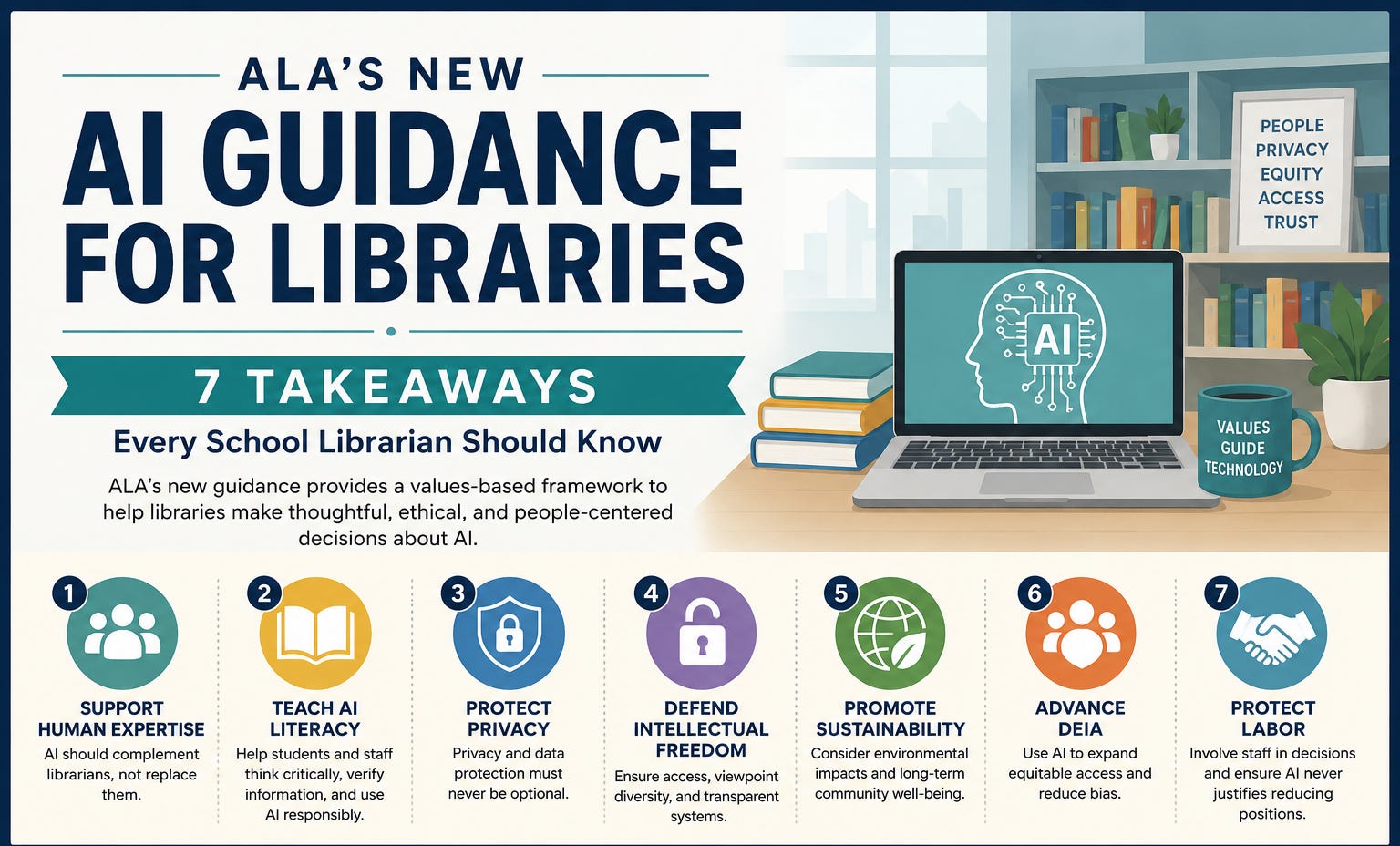
Editor’s Note: There was some confusion regarding the images included in this article. In my haste to publish, I inadvertently omitted the captions explaining that the images were created with the assistance of AI using the ALA Guidance on the Use of Artificial Intelligence in Libraries as the source material.
I have also updated images to remove an element that could have unintentionally suggested it was created by the American Library Association. That was not my intention, and I regret any confusion this may have caused.
Artificial intelligence has moved far beyond experimentation. It is now embedded in library databases, discovery systems, research platforms, productivity software, educational technology, and many of the tools our students and teachers use every day. In many cases, librarians are already interacting with AI whether they intentionally adopted it or not. That reality makes one question increasingly important: How do libraries use AI without compromising the professional values that have guided our work for generations?
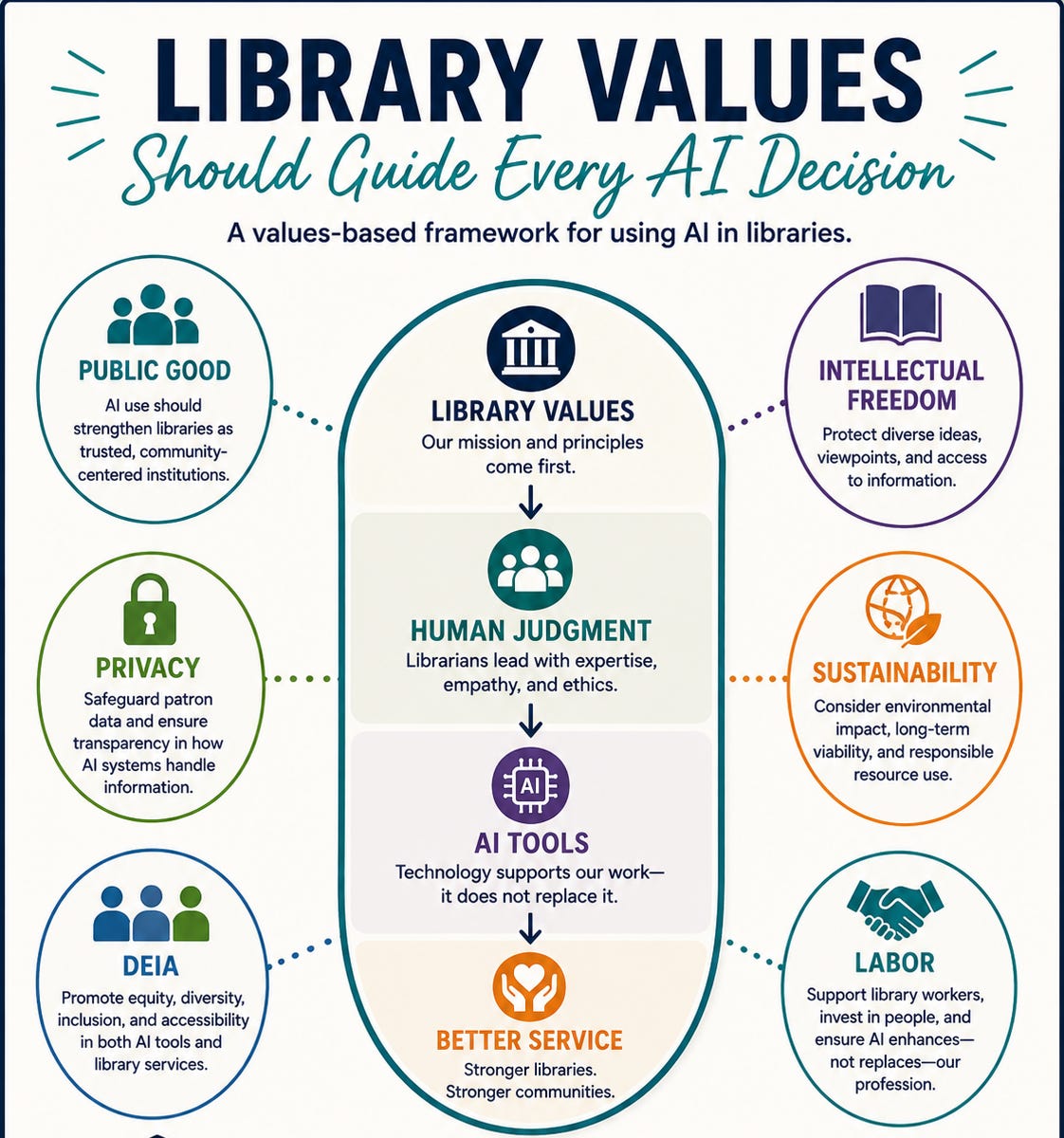
This month, the American Library Association released its final Guidance on the Use of Artificial Intelligence in Libraries, a comprehensive framework designed to help libraries develop local AI policies, evaluate AI-enabled products, and make thoughtful decisions about when AI should, and should not, be used. Rather than recommending specific products, the document asks libraries to evaluate every AI decision through the lens of public service, intellectual freedom, privacy, sustainability, equity, labor, and community trust.
For school librarians, this guidance arrives at exactly the right time. Districts are purchasing AI-powered products at an unprecedented pace. Vendors are rapidly adding AI features to existing platforms. Teachers are experimenting with generative AI in their classrooms. Students are using AI for research, studying, and writing. Yet many schools still lack clear policies that explain how these tools should be evaluated or used responsibly.
That is where this document stands out.
Instead of asking, “How can libraries use more AI?” it asks a far better question.
“How can libraries use AI while remaining true to the values that define librarianship?”
That shift in thinking may be the document’s greatest strength.
AI Should Support Librarians, Not Replace Them
One of the strongest themes running throughout ALA’s guidance is that artificial intelligence should strengthen library work, not diminish it. The document repeatedly returns to a simple principle: AI is a tool that should support professional judgment, never replace it. Human expertise remains essential, and librarians remain accountable for the decisions that affect their communities.
That distinction matters because much of the public conversation around AI focuses on efficiency. Companies promise to automate routine tasks, save time, and increase productivity. Those benefits can be real, but libraries have always measured success differently. Our work is built on relationships, trust, professional ethics, and the ability to understand the unique needs of every community we serve. Those qualities cannot be automated.
The guidance makes this point directly. It states that AI should complement rather than replace human intelligence, reasoning, deliberation, and critical thinking. It also emphasizes that patrons and library workers should always have access to human assistance and that library staff must have the authority to question or override AI recommendations that appear inaccurate or unreasonable. Perhaps most importantly, the document explicitly states that libraries should not use AI to justify staff reductions or replace professional judgment.
For school librarians, this recommendation feels especially timely.
Across the country, districts are facing budget pressures while vendors increasingly market AI as a way to do more with fewer people. It is easy to imagine decision-makers asking whether AI can answer reference questions, create instructional materials, recommend books, or teach research skills. The technology may assist with portions of those tasks, but assistance is not the same as expertise.
A school librarian does far more than retrieve information. We teach students how to evaluate sources, recognize bias, ask better questions, and navigate increasingly complex information environments. We collaborate with classroom teachers, recommend books that connect with individual readers, protect student privacy, and build collections that reflect our communities. Those responsibilities require empathy, context, professional judgment, and relationships that develop over time. They cannot be reduced to an algorithm.
I also appreciate that the guidance reframes efficiency. Rather than suggesting that time saved through AI should reduce staffing, ALA recommends using those gains to improve working conditions, strengthen services, and expand support for communities. That is a fundamentally different vision of how AI should be integrated into libraries. Technology should give librarians more time to do the work that only librarians can do, not become a justification for eliminating the very expertise that makes libraries valuable.
As school librarians, we should welcome tools that reduce repetitive administrative work, improve accessibility, or streamline routine workflows. We should also be willing to say no when technology begins replacing the human relationships and professional judgment that define our profession. One of the most important messages in ALA’s guidance is that adopting AI is never the goal. Strengthening library service is the goal, and AI should only be used when it helps us accomplish that mission.
AI Literacy Is Officially Library Work
If there is one section that made me smile, it was the one devoted to AI literacy.
For years, school librarians have been helping students evaluate information, question sources, identify misinformation, protect their privacy, and think critically about what they read online. Those responsibilities have not disappeared because AI entered the picture. If anything, they have become even more important.
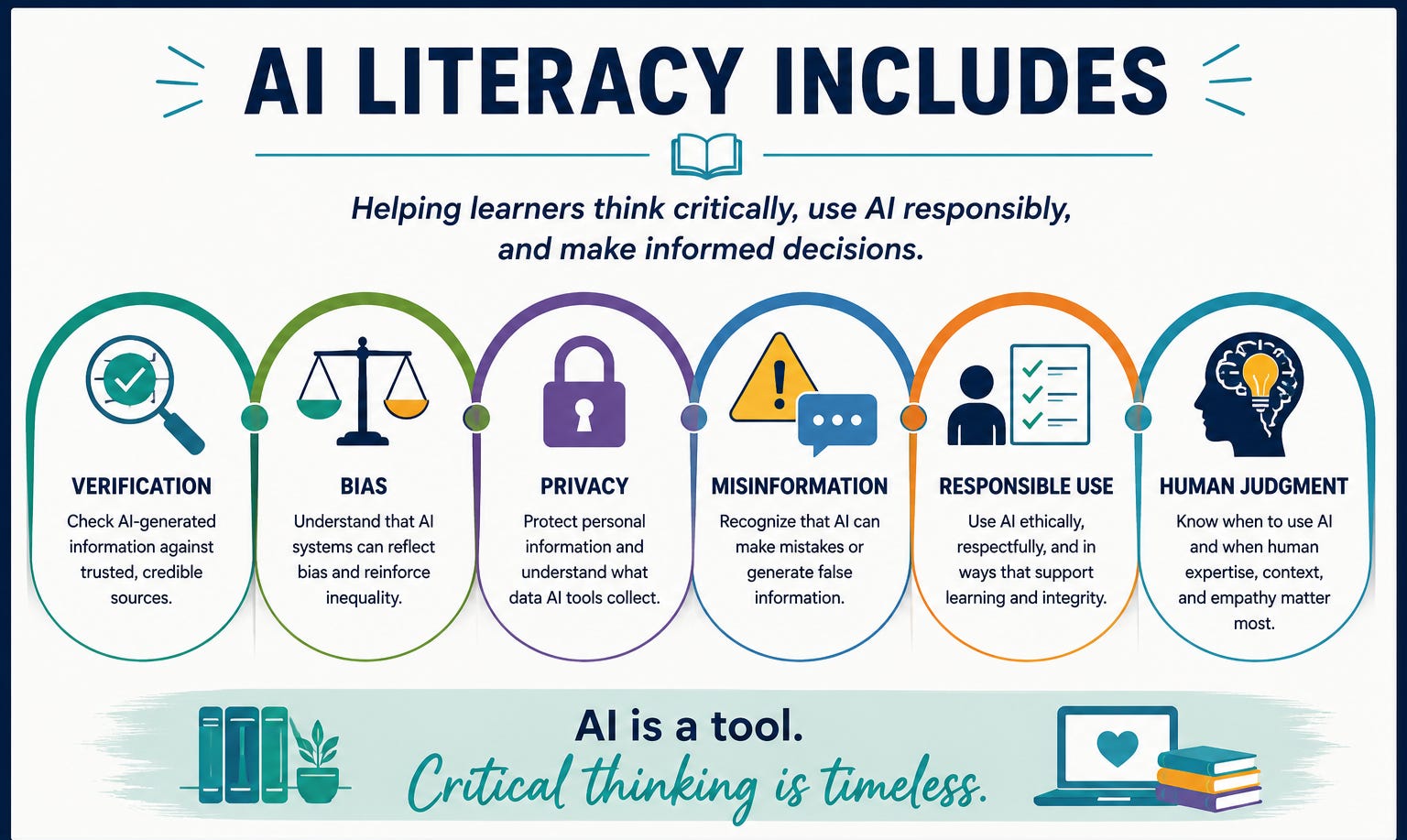
The guidance recognizes that reality. Rather than treating AI literacy as a technology initiative, ALA places it squarely within the library’s educational mission. The document recommends teaching patrons, students, staff, and community members how AI works, where it appears in everyday life, what benefits it offers, what risks it creates, and how to verify AI-generated information. Just as importantly, it encourages libraries to teach these skills without shaming people who are curious about AI, already using it, skeptical of it, or trying to avoid it altogether.
I appreciate that approach because it reflects what effective instruction has always looked like. Our job has never been to tell students what to think about a technology. Our job is to help them become informed, thoughtful, and responsible users of information.
That means AI literacy is not a lesson about prompt writing.
It is a lesson about judgment.
Students need to know when AI can be a useful brainstorming partner and when it is likely to produce inaccurate or incomplete information. They need to recognize that confident language is not the same as evidence. They need to understand that AI systems can reflect bias, fabricate sources, omit important perspectives, and produce different answers to the same question. Those are information literacy skills, and librarians have been teaching them for decades.
The guidance also encourages librarians to incorporate AI into reference conversations by helping patrons ask better questions, compare AI responses with trusted sources, and verify information before accepting it as fact. That recommendation closely mirrors what many school librarians are already doing. AI should not become a shortcut around research. Instead, it should become another opportunity to teach students how knowledge is created, evaluated, and communicated.
One phrase in particular stood out to me. The guidance recommends approaching AI literacy through a harm-reduction lens. That means acknowledging both the opportunities and the risks. Instead of presenting AI as either something to embrace uncritically or something to fear entirely, librarians can help students make informed decisions based on context, purpose, and evidence.
I have often said that AI literacy is simply information literacy for an AI-powered world. Reading this guidance reinforced that belief. The skills we have always taught remain the foundation. The tools may have changed, but our mission has not. Our responsibility is still to help learners become thoughtful consumers and creators of information, regardless of whether that information comes from a book, a website, a database, or an AI chatbot.
Privacy Cannot Be an Afterthought
If there is one section that school librarians should read carefully, it is the guidance on privacy.
Privacy has always been one of the profession’s defining values. Long before generative AI, librarians understood that what people read, search, borrow, and ask at the reference desk should remain confidential. AI has not changed that responsibility. It has made it more complicated.
Many AI systems improve by collecting prompts, analyzing user behavior, storing conversations, or using interactions to refine future models. That reality means librarians can no longer evaluate a product based solely on what it does. We also have to understand what it collects, where the data goes, who has access to it, and whether it is retained after the interaction ends.
The guidance recommends that every library carefully evaluate AI-enabled products before they are adopted. That includes asking whether AI features can be disabled, whether prompts are logged, whether data is used to train future models, how long information is retained, and whether libraries can request that data be deleted. It also recommends explaining these practices to patrons in clear, understandable language rather than hiding them in lengthy privacy policies.
For school librarians, these recommendations are especially important because we work with students whose privacy is protected by federal law. The guidance specifically references both the Family Educational Rights and Privacy Act (FERPA) and the Children’s Online Privacy Protection Act (COPPA), reminding school librarians that AI decisions must be evaluated alongside district policies and student privacy requirements. It also recognizes a reality many of us know well: school librarians are often expected to evaluate new technologies without dedicated technology or legal support.
One recommendation deserves particular attention. The guidance advises libraries not to enter personally identifiable information, borrowing histories, reading histories, reference interactions, account information, staff records, or other nonpublic information into AI systems unless those systems have been formally reviewed and approved for that specific purpose. If a library cannot determine how an AI system collects, stores, shares, or uses data, the guidance recommends delaying, limiting, or refusing its use.
That is an important reminder in today’s educational environment. It is easy to become excited about a new AI feature that promises to save time. But convenience should never outweigh a student’s right to privacy. Before using any AI tool, librarians should ask a simple question: What happens to the information after I press submit?
I also appreciate that the guidance places responsibility where it belongs. Protecting privacy is not solely the responsibility of the individual librarian. Libraries should establish local policies, conduct regular privacy reviews, evaluate vendors, and ensure staff receive ongoing professional development about responsible AI use. Privacy is not a one-time checklist completed during procurement. It is an ongoing commitment that must evolve as AI tools and vendor practices continue to change.
Perhaps the most valuable lesson from this section is that responsible AI adoption begins long before anyone writes a prompt. It begins by asking difficult questions about data, transparency, and accountability. If a vendor cannot answer those questions clearly, that uncertainty is itself valuable information. Sometimes the most responsible decision a library can make is to wait until those answers are available.
Intellectual Freedom Still Matters in an AI World
One of the most thought-provoking sections of ALA’s guidance focuses on intellectual freedom. While libraries have long defended the freedom to read and access information, AI introduces new challenges that are far less visible than traditional censorship. Instead of a book being removed from a shelf, an algorithm might quietly influence what users discover, what appears first in search results, or which perspectives receive greater visibility. Those decisions can shape what people read without them ever realizing it.
That is why the guidance emphasizes transparency. If AI is influencing discovery, recommendations, or other public-facing services, libraries should understand how those systems work and be prepared to explain them to their communities. When possible, users should be able to choose non-AI alternatives, and libraries should ask vendors difficult questions about how recommendation systems rank information, personalize results, or moderate content.
For school librarians, these recommendations deserve careful attention. Students increasingly begin their research with AI-powered search tools that summarize information instead of presenting a range of sources. Library vendors are introducing AI features into databases, discovery platforms, and research tools at a rapid pace. While these features may improve efficiency, they also have the potential to influence what students see first, what information is emphasized, and what perspectives may be overlooked.
This is not a new concern. Librarians have always understood that the way information is organized influences what people discover. AI simply changes the scale and complexity of that challenge. Instead of evaluating a subject heading or search algorithm, we may now be evaluating a large language model or recommendation engine that makes thousands of decisions behind the scenes.
The guidance encourages libraries to review AI-enhanced discovery systems on a regular basis, looking for patterns that reduce visibility for particular viewpoints, communities, languages, or topics. It also recommends preserving transparent, non-personalized ways for patrons to explore collections, such as subject browsing or traditional search, alongside AI-enhanced features. Those recommendations recognize that intellectual freedom is not only about protecting access to information. It is also about protecting how people find that information.
I was also encouraged to see ALA address an issue that often receives too little attention in discussions about AI. The guidance reminds libraries that AI outputs should never be treated as authoritative. They should be viewed as drafts that require human review, especially when accuracy, context, or community sensitivity matters. That recommendation reflects a core principle of librarianship. Information should be questioned, verified, and placed into context before it is trusted.
For school librarians, this reinforces the role we have always played. We are not simply helping students locate information. We are teaching them to understand how information reaches them in the first place. In an AI-powered information ecosystem, that work becomes even more important. Students need to ask not only, “Is this information accurate?” but also, “Why did this system show me this answer instead of another one?”
That may become one of the defining information literacy questions of the AI era.
The Conversation We Need to Have About Labor
Of all the sections in ALA’s guidance, the one that surprised me most was the discussion of labor.
Most conversations about AI in education focus on productivity. We hear about saving time, automating repetitive tasks, and improving efficiency. Those are legitimate goals, but they often overlook a much larger question.
What happens to the profession when AI begins performing work that once required human expertise?
ALA does not avoid that question. Instead, it addresses it directly.
The guidance warns that AI and automation have been used in many industries to justify restructuring, reducing jobs, shifting workloads, and devaluing professional expertise. It argues that libraries should evaluate AI not only by what it can do, but by how it affects workers, public service, and the future of librarianship.
That is an important shift in the conversation.
For years, many discussions about AI have assumed that if a task can be automated, it should be automated. Libraries have traditionally approached technology differently. The question has never been whether technology can replace people. The question has always been whether technology improves service while preserving the human relationships that make libraries successful.
The guidance makes that philosophy explicit. It states that libraries should not replace reference services, readers’ advisory, instruction, or community support with AI systems. It also emphasizes that work requiring empathy, professional judgment, and subject expertise should remain human-led. Those recommendations recognize something every librarian understands. Our value is not simply in answering questions. Our value is in understanding the person asking them.
I was equally encouraged to see the guidance recommend that library workers be included in decisions about AI adoption. Too often, technology decisions are made for librarians rather than with librarians. The people who understand daily workflows, community needs, and the practical realities of library service should have a meaningful voice in deciding where AI belongs and where it does not.
There is another point in this section that deserves more attention.
ALA recommends that any efficiency gained through AI should be reinvested in people. That means improving working conditions, strengthening services, expanding staffing capacity, and providing paid professional development instead of using automation to justify fewer positions or increased workloads. In other words, AI should make librarians more effective, not more expendable.
For school librarians, this conversation feels especially relevant.
Across the country, many school libraries are already operating with reduced staffing, shared positions, or no certified librarian at all. At the same time, AI companies are marketing products that promise to answer research questions, recommend books, generate lesson materials, and assist students independently. While these tools may have legitimate educational value, they should never become an excuse to reduce professional staffing or diminish the instructional role of the school librarian.
Technology has always changed the way libraries work. Card catalogs gave way to online catalogs. Print indexes became digital databases. Search engines transformed how people find information. Through each of those changes, librarians adapted because our expertise was never tied to a particular tool. It was tied to helping people learn, think critically, and access trustworthy information.
The same principle applies to AI.
The future of librarianship should not be measured by how much human work we eliminate. It should be measured by how effectively technology allows librarians to spend more time doing the work that only people can do: teaching, mentoring, advocating, building relationships, and strengthening our communities.
That may be one of the most important messages in ALA’s entire guidance document.
The Bigger Picture: This Is a Blueprint for Local AI Policies
As I finished reading the guidance, I realized something important.
This is not a document that tells libraries to adopt AI.
It is not a document that tells libraries to avoid AI.
It is a document that teaches libraries how to make good decisions.
That distinction matters.
For the past two years, I have spoken with librarians across the country who are looking for direction. Some work in districts where AI has already been integrated into classroom instruction. Others have been told not to use AI at all. Many are somewhere in the middle, trying to balance innovation with legitimate concerns about privacy, intellectual freedom, accuracy, and equity.
What has often been missing is a common framework for making those decisions.
This guidance helps fill that gap.
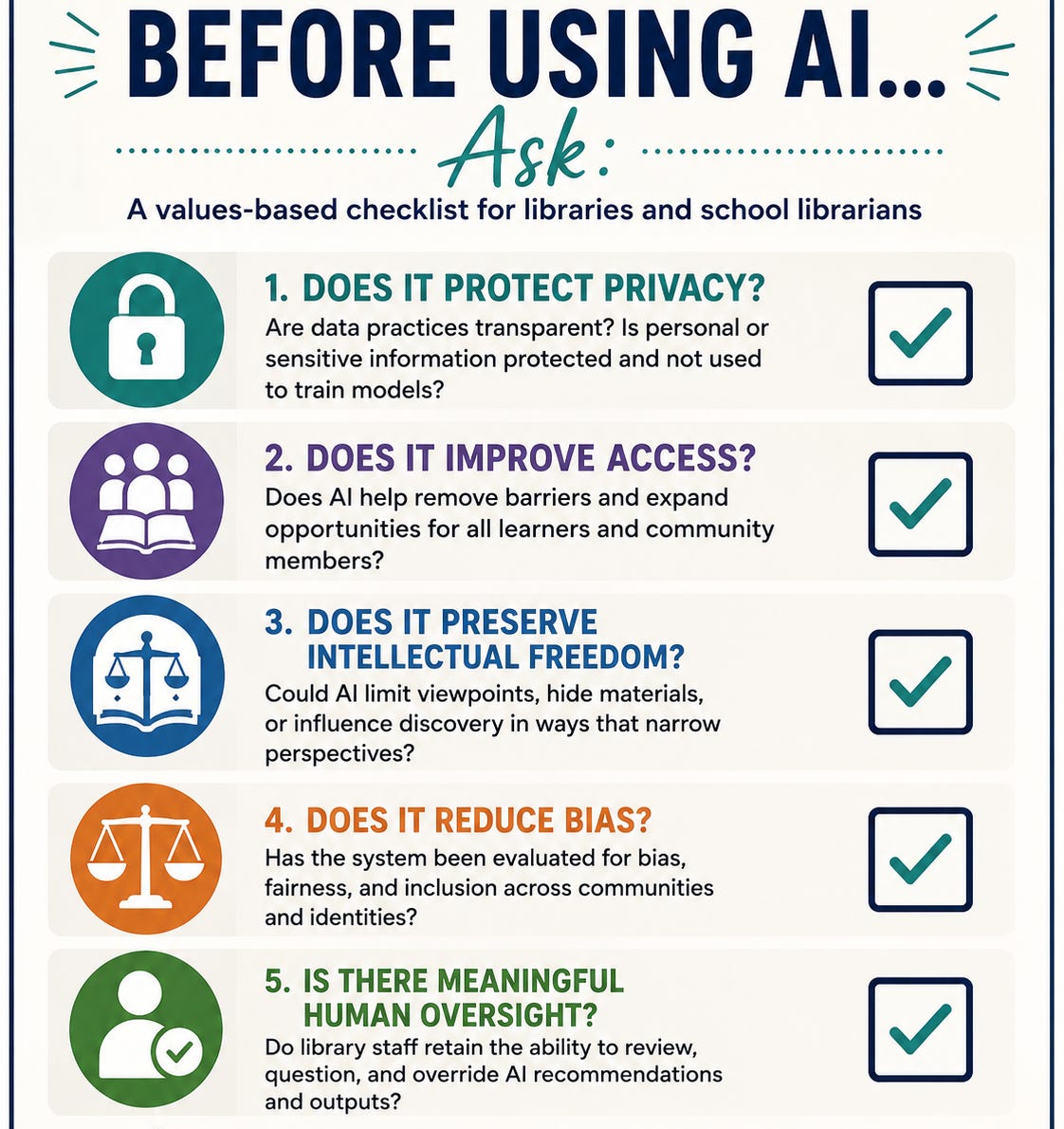
Rather than focusing on individual AI products, ALA encourages libraries to ask broader questions. Does this tool improve service? Does it protect patron privacy? Does it preserve intellectual freedom? Does it strengthen accessibility? Does it support library workers instead of replacing them? Those are the kinds of questions that remain relevant even as today’s AI tools are replaced by tomorrow’s.
I also appreciate that the guidance acknowledges something many librarians have experienced firsthand. Sometimes the most responsible decision is not to adopt a technology.
We often assume that innovation means saying yes to every new tool. The guidance reminds us that declining to adopt an AI product can be just as thoughtful and professional as implementing one. If a vendor cannot adequately explain how a system handles patron data, if transparency is lacking, or if a product conflicts with the library’s mission and values, choosing not to use it is a legitimate professional decision.
That perspective is refreshing.
Technology should not determine library policy.
Library policy should determine how technology is used.
For school librarians, this is an opportunity to lead.
Many districts are still developing AI policies, and those conversations often center on classroom use, plagiarism, or teacher productivity. Libraries bring a broader perspective. We think about information access, privacy, intellectual freedom, media literacy, equitable access, vendor practices, and long-term stewardship of information. Those are conversations every district needs to have as AI becomes more deeply integrated into education.
In many ways, librarians are uniquely prepared for this moment. We have always helped people navigate new information technologies. We guided students through the rise of the internet, search engines, social media, smartphones, and digital databases. Artificial intelligence is another major shift, but our mission remains remarkably consistent. We help people ask better questions, evaluate information carefully, protect their privacy, and make informed decisions.
That is why I believe this document will have lasting value.
Specific AI platforms will change. Vendors will introduce new features. New laws and regulations will emerge. But a decision-making framework grounded in library values is far more durable than any individual technology.
The best AI policy is not one that predicts the future.
It is one that remains useful no matter what the future brings.
Final Thoughts
The American Library Association’s Guidance on the Use of Artificial Intelligence in Libraries is more than a policy document. It is a statement about what libraries stand for in an era of rapid technological change.
Throughout its pages, one message appears again and again. AI should serve people, not the other way around. Every decision about artificial intelligence should begin with the values that have guided libraries for generations: intellectual freedom, privacy, equitable access, professional expertise, transparency, and public trust. Technology may evolve, but those principles remain constant.
For school librarians, I encourage you to read the guidance, share it with your administrators, and use it as the foundation for conversations in your own district. Whether your school is just beginning to explore AI or already has AI integrated into instruction and library services, this document provides a thoughtful framework for asking the right questions before making important decisions.
Libraries have always been places where people learn to navigate change with curiosity, wisdom, and critical thinking.
Artificial intelligence does not change that mission.
If anything, it makes that mission more important than ever.
Comments
Nothing yet. Say the first thing.
Sign in to join the conversation.