
Who should control AI?
When an elected government demands “all lawful purposes” and a company refuses on ethical grounds, whose decision should prevail?
Should there be clear legal frameworks defining when AI vendors may refuse government or military uses, rather than leaving this to ad hoc confrontation and executive retaliation?
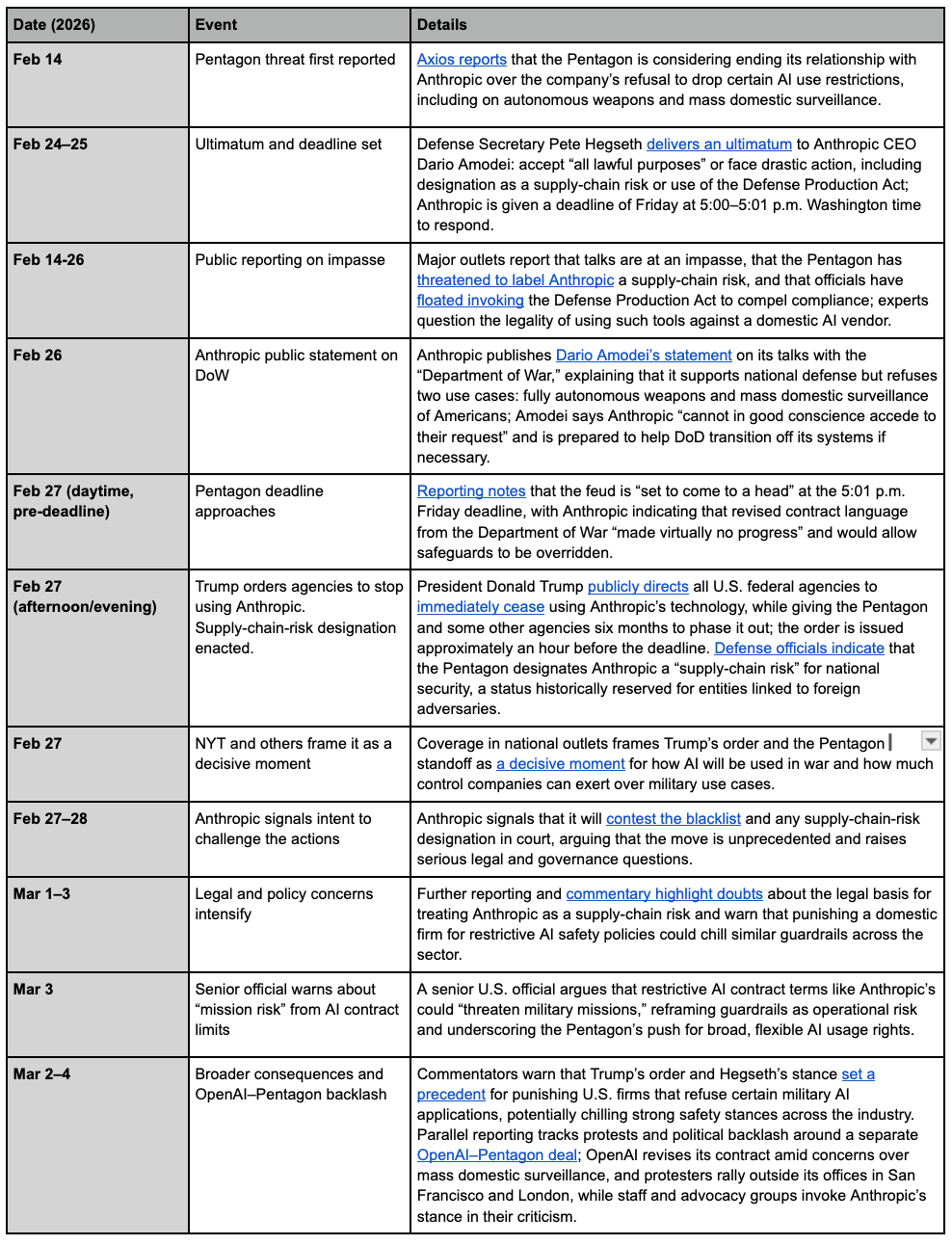
How far can states punish dissenting AI firms?
Is it legitimate for a government to blacklist a domestic company across the entire federal system and label it a “supply‑chain risk” primarily because it refused to relax safety safeguards, a tool historically reserved for foreign adversaries?
What legal and institutional checks should exist to prevent national‑security designations from being used as political or ideological weapons against firms that set stricter safety policies than the state wants?
What guardrails on military AI?
Should there be binding national or international rules on autonomous weapons (e.g., requiring meaningful human control) and on AI‑enabled mass domestic surveillance, or should each government decide unilaterally what is “lawful”?
If some labs keep “red lines” (no fully autonomous weapons, no mass domestic surveillance) while others agree to “any lawful use,” does that simply shift dangerous work to less cautious actors, and how should policy respond to that substitution effect?
How do we prevent a race to the bottom among AI labs?
Trump’s ban and the supply‑chain‑risk label may signal to other labs that strong contractual guardrails can trigger existential commercial retaliation; will this push firms to weaken safeguards to stay eligible for government and defense business?
Should there be industry‑wide or regulatory baselines for minimum safety constraints (e.g., on targeting, surveillance, disinformation), so that responsible labs are not competitively disadvantaged for saying “no”?
What protections do citizens have against AI‑enabled state power?
If governments can compel or pressure AI vendors to support mass domestic surveillance and lethal autonomous operations, what new rights, oversight structures, or transparency duties are needed to protect citizens from abuse?
How should courts, legislatures, and independent oversight bodies handle cases where a company’s refusal to support certain state uses is framed as “threatening military missions,” but civil liberties and human rights concerns point the other way?
What global precedent is being set?
Will other governments copy the U.S. approach using procurement power and security designations to force alignment, or instead move toward negotiated standards and treaties on military AI use, seeing this episode as a cautionary tale?
How will this precedent influence emerging global norms: will “ethical refusal” by labs become a recognized and protected practice, or will states converge on expectations that vendors must support “all lawful purposes” once under contract?
For Hong Kong government and regulators
Hong Kong is rapidly scaling up AI use across departments, but has not yet articulated clear red lines around policing, or mass‑surveillance uses of advanced models.
The Anthropic case exposes how quickly “responsible AI” can collide with security and law enforcement priorities, so HK policymakers need to decide early: Do they want explicit protections (e.g., limits on fully autonomous lethal uses, bulk facial recognition, etc) or a broad “all lawful uses” doctrine by default?
For Hong Kong‑based AI labs and startups
If HK wants to host serious frontier or near‑frontier labs (via the new Hong Kong AI Research and Development Institute and related funding), firms will face the same basic question: Will they adopt Anthropic‑style “conscience clauses”, or take a different approach regarding safety and regarding government collaboration.
The U.S. move to label Anthropic a “supply‑chain risk” for refusing certain uses shows how security frameworks and safety-minded companies can come into conflict, which is directly relevant for HK firms that may straddle U.S., Chinese, and regional markets and be exposed to multiple security regimes at once.
For financial, legal and corporate stakeholders
Hong Kong is a financing hub for Chinese and global tech; investors now have to treat military‑AI and surveillance exposure as a material governance and regulatory risk, not just a PR issue, when backing labs that sell into defence, law enforcement, or ‘smart city’ contracts.
The Anthropic dispute is likely to shape contract and compliance practice: HK‑based counsel working on government or cross‑border AI deals will need to think much harder about clauses on permissible uses, supply‑chain‑risk designations, export controls.
For universities and research institutes
HK universities and the new Hong Kong Artificial Intelligence Research and Development Institute are positioning themselves at the cutting edge of AI research; this episode strengthens the case for explicit institutional policies on military collaborations, dual‑use research.
It also highlights a teaching gap: local AI and law/policy curricula will need to grapple with questions of control, national security law, and cross‑border ethical conflicts, because future HK‑trained engineers may end up working in exactly these contested spaces.
For civil society
As the HK government pushes wider and responsible use of AI and expands AI‑driven public‑sector transformation, there is an urgency for NGOs, professional bodies, and associations to define what “responsible” actually excludes.
No posts
Comments
Nothing yet. Say the first thing.
Sign in to join the conversation.