
While writer Evan Armstrong asks, “why isn’t there any software that can make us cry?”, founder Los Mayers has been beating the rest of us to the punch, building apps that make us laugh.
His love for technology began with the promise of an iPod Touch after tutoring class; his video-making days started with Vines at his grandma’s house; and the first time he opened the App Store as a kid, he knew he wanted to ship an app one day. He’s now shipped a bunch.
Alongside Marc Müller, Los is one half of the founding duo of Danger Testing, the collective behind a series of viral apps including Link Bouquet, Vandalize Friend, and MyBrainRot, which blur the line between product, joke, and cultural commentary. In their own words: friends making apps.
At first glance, Danger Testing’s releases can look like fleeting internet moments: funny, timely, built to be shared and then replaced by the next thing. But if you laugh once and move on, you’re missing the point. While most apps on our phones have been built for utility or to keep us hooked, Danger Testing instead asks: what happens when software is treated as a medium for self-expression?
In downtown Manhattan, with FiDi in the window and Chinatown bustling below, we talked about software as culture, where new talent is coming from, and what happens when apps become a way to learn about yourself, connect with others, and maybe even make a living from your point of view.
Is your media training complete? Nope. So, you’ll get the real stuff.
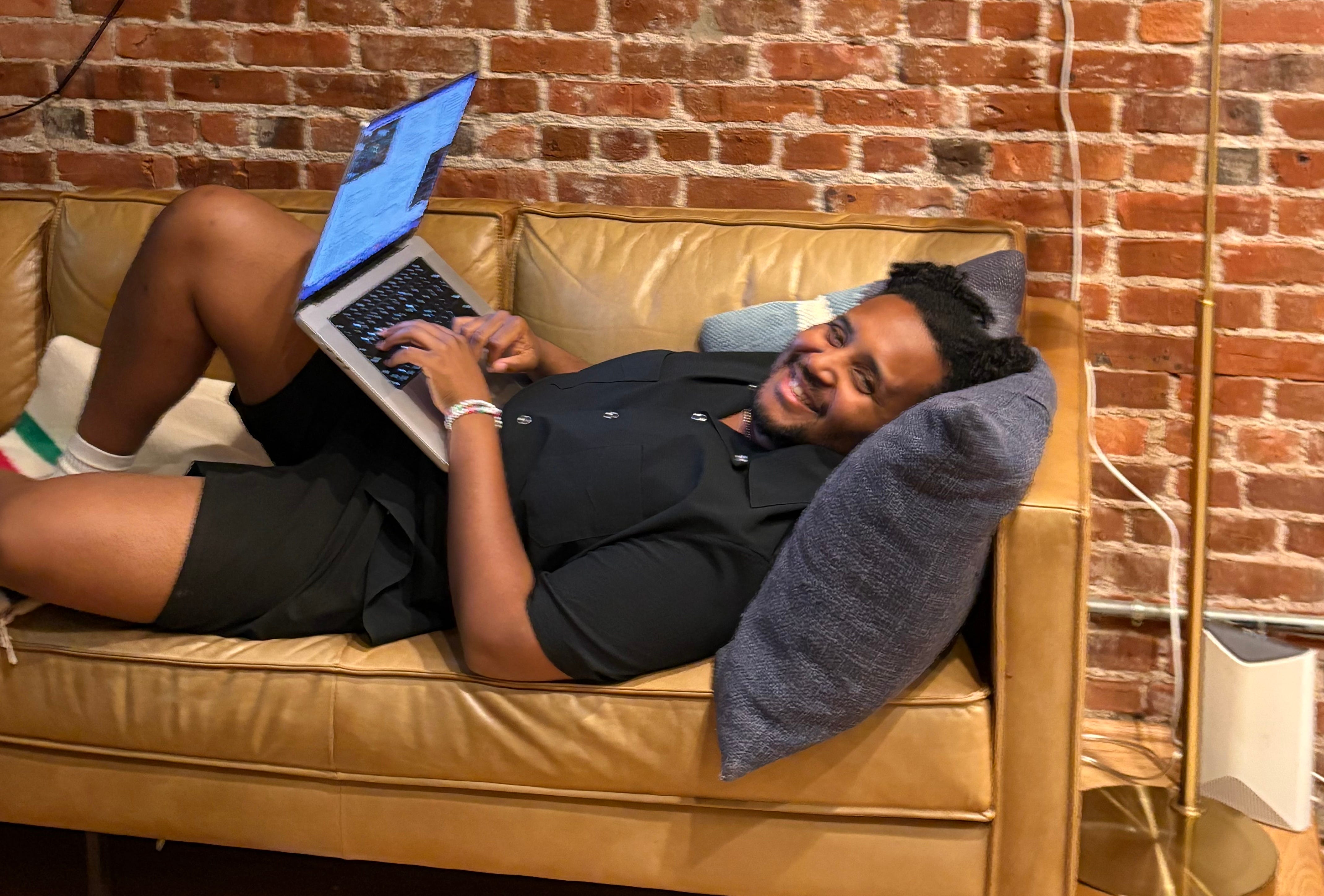
What media do you consume in a normal week?
I consume a lot of Twitter and YouTube. When I was in Berlin, I watched a lot of movies, which were deeply inspiring. I saw Eyes Wide Shut, Groundhog Day. And I saw... What’s that movie? You know, that movie with Heath Ledger in high school?
Where they sing “I love you baaaaaaby”?
Yeah, yeah, yeah. 10 things I Hate About You. I also watched Synecdoche, New York. I watched Tár. I watched Babylon.
Did you do anything else in Berlin outside of watching films?
I was extremely sick with a stomach virus of my own doing in the first week. But in the midst of my brain fog, watching those movies informed videos that we dropped at Danger Testing.
What did one of them spark?
There’s this one part of Groundhog Day, where he asks a question: what if there’s no tomorrow, what if there are no consequences? And he speaks about all the shit that’s annoying him in the world, and says, “I’m not gonna live by their rules anymore”.
So, I exported that, chopped up the audio, and combined it with this rap beat from this rapper, 2Slimey. He makes music that really hurts your ears. We used his instrumental, then we spliced in Carly talking about the parts of the tech scene that she doesn’t like: “You have to be retentive, everything has to be monetized”. Then we ended it with: “I’m not gonna live by those rules”, and it showed all these crazy app demos. Someone who’s been watching my videos for a long time said it was his second favorite video of mine ever. So I was sick. It was sick.
Are you reading anything at the moment?
The Philosophy of Andy Warhol (From A to B & Back Again). Marc reads much more than me.
Are you inspired by trends or just captivated by culture as it’s happening?
I’m really Warholian in the sense that I’m so captivated by media. I’m not ever trying to see what trend I can follow. It’s more like: who the hell is Clavicular, what is he saying? Or someone says something funny, and that curiosity turns into an app.
Danger Testing has its own aesthetic. How has it evolved?
It’s been a journey, honestly. When we first started Danger Testing, I was making videos that people loved. And then I spent less and less time making videos like that to try and do the videos that “made sense”. For example, spending time on UGC or spending time on long form interviews, where I sit down in front of a camera, and I talk about the apps that we did. And I realized neither of those things felt authentic to me. I wasn’t having fun doing it. I wasn’t having fun making it. And it was all scripted. I ended up crashing out and coming back to the types of videos I made originally. It all feels gritty—filmed with a camcorder, or a random iPhone, or some random military equipment, and then you overlay the code with the app, because this is not an app, this is your life. Software is no longer strictly utility. You can find who you are as a person by expressing yourself through the medium of software.
Do you think roughness makes something feel more personal? What feels more real: polish, or something less refined?
That’s interesting. I don’t have a real take on that. I think that’s a good question. There’s a video we posted that I didn’t expect to blow up. But I think a lot of the stuff that we’re doing bridges these two different worlds: software engineers, consumer app people, and the world that Marc and I both come from, which is streetwear and rappers. It kind of looks like an ASAP Rocky video, except you’re not in the studio making a song, you’re making an app. I think it spoke to an audience that’s not being spoken to right now. There are some people that don’t want to just work on paywalls all day. There are some people that do. They make a ton of money, and they should. These are also my friends. But it was just something so unpolished – I spent 40 minutes max on it. I did not think it was ready when I put it out, you know?
Are there any sources that you repeatedly go to for inspiration?
Hmm. I don’t think so. But I do think that I live such a cool life, honestly. I’m inspired by all of my friends, or I have a life experience that informs an app, like Girl Hinge, which is inspired by my dating experience, and seeing the other side. And then I have apps like this achievement one that I’m making now, which is like playing a new Pokemon game. I asked myself: why do I only get achievements when I play Pokemon? Why don’t I get it when I make a new tweet or watch a YouTube video or write something on Substack.
We should all be doing more, apparently.
I don’t know. I think we’re doing enough. We should be – we can all be – more chill.
What can software express that another medium can’t?
All mediums are so good at doing what they do. What speaks to me and to other artists, and feels completely untapped, is that software is the first form of scriptwriting that extends beyond a fixed cast of characters. With say theatre, for example, you might have a cast as small as 10 or as big as 100. But that’s about it. You sort of have to sit in the crowd and wish that that was you. With software, you can empower anyone in the world to become part of your cast.
I think there’s a reaction this generation is having to this world where a lot of businesses have benefited from the fact they can try and make you feel like you’re Kim K for a day, which is essentially Instagram. It’s like, “if we can give you 1% of that dopamine rush every month, it hooks you in longer for us to show you ads”. And what’s interesting about our model is that monetization is not linked to screen time. All attention is not treated equally in this future we’re talking about.
If you spend seven minutes in an app that feels like you’re zooming Timothy Chalamet, exploring his desktop, controlling parts of the experience and then posting it on your story, that could be more valuable than watching a seventy minute video about him. That’s a super rudimentary version of what the medium could provide, but if you’re a creator that puts out stuff like that every month, they might pay that creator, similar to Patreon, the same amount of money as they would pay Netflix or YouTube Premium. Those 7 minutes could be worth more than a 70 minute video.
What’s the spectrum of what a creative app can be? Is it a stage, a game, a world?
It’s unknown to me what apps people are going to make out there. We try to experiment across a wide range. Some apps are about you like MyBrainRot, which is like TikTok, but it’s just your camera roll and your videos with captions on it. Then there’s ones that we’ve done, like for our friend Tony, for you to view him try and bike from Tokyo to Osaka. The app is strictly about him. There’s no way for you to feel like you’re part of that. But experiencing it is so much more immersive and creative than watching him post it on Instagram, with a like button and a comments button underneath it, and stories above it. The app creates its own world around a person and is artistically interesting even though it wasn’t designed by a UI/UX designer. It was designed by a graffiti artist.
If the AppStar future comes true there’ll be just as many creative apps making a statement - in the same way that you have a viral tweet - as there are apps that are informative or just for utility. Anything that feels like you, that carries your point of view, is more important than anything. If there’s something you feel strongly about, or even if something embarrasses you, and you express that through software, those are the moments that actually connect you through the screen. It’s not just sharing content, but it’s putting the labor of love into building something, and having other people connect with it.
How do you know when a cultural signal is worth turning into an app?
I never asked myself, “Is this trend gonna last? Or is this something that’s worth noticing?” You know Sam Levinson, the creator of Euphoria? This dude was just so obsessed with Gen Z culture, he would watch the YouTube videos that girls were making of putting on their makeup, or, unboxing. And, I mean, he’s not even using it. I have the same level of intrigue, that is so deep. I just have to express this, or I have a funny idea out of this. I never think, “this should blow up”. I’m not choosing the trend ‘cause it’ll blow up. I feel like a lot of the stuff I make should blow up just ‘cause I’m the funniest person alive.
Marc is interesting though because he’s done something I’ve never seen before. I’ve seen a lot of people go viral, and it’s all part of their process. It’s like if they keep doing it, they’ll eventually go viral. Marc did something this season that I’d never really seen before. We had a week where he was trying to figure out an app idea. He said, “We need something timely”. I pitched two or three ideas. And he said, “These ideas are good, but we need a banger this week”. We all came together. We said, okay, Valentine’s Day is coming up. We started pitching a bunch of Valentine’s ideas. And then we came up with Link Bouquet. It was the first time we knew it was gonna blow up before we posted it. And then it hit a million views, and it was the first time I’ve seen, personally, intending to make something blow up and then just doing it all in 72 hours.
What were the ingredients to Link Bouquet’s success?
It was timely, cultural, and funny. It’s not a bouquet of flowers, right? Because that would be timely and then that would just work in San Francisco. The reason it works in New York is because it’s not flowers, it’s Reels, and it’s Letterboxd, and it’s TikTok, and it’s Spotify. We have a creative director who’s choosing the flowers that actually make it look nice. And then she has her assistant that’s drawing a logo that’s a flower, but the petals are links. All this stuff is coming together. We’re all just in the chat. I was like, that looks wrong, this looks right. And then we’re throwing out things, and we wake up and overnight it has 2,000 likes, and I’m like, “We need to add email in the next 30 minutes”. We add it in, and after an hour, we have a thousand emails. That many visitors were happening in a row. It’s all collaborative. It’s the fact that we’re working with people that have never touched tech before. We’re working with people that were doing brand campaigns for Spotify, or, people that would typically work on making graphic designs for T-shirts, and we’re putting them on an app, and then we have the coolest app, ‘cause everyone’s contributing. You’re gonna hire someone for Meta to design your app? That world is dead. You’re done.
Where do you think the next great talent is coming from?
Baristas, bartenders…people that have stories to tell, people that are doing cool shit. There are no traditional designers on the team. We’ve got video game animators. They designed Kumo and it became one of our most viral apps. I think that’s why I’m so post-tech. What am I gonna learn in tech anymore? The best engineer, 90% of that person’s abilities are getting transferred to a T-shirt designer. And a T-shirt designer actually just went through a breakup, and is gonna make a fire app out of it to tell her story. The engineer’s never been in a relationship. No story to tell.
How important is humor to what you make? Is it something you actively think about and design for?
For Marc I would say it is not an intention. If you were to categorize artist apps the same way you’d categorize a movie or a song, I think Marc’s stuff leans more toward cultural commentary and I would say a lot of my stuff is comedy. But we’re so collaborative, it’s impossible for anything we put out to not be funny. We’re all touching it, we’re all dropping jokes. It’s part of our culture: we’re having so much fun.
Humor can be a tool to connect with people.
Yeah, yeah, yeah. 100%. If it doesn’t make me laugh, I don’t put it out.
Also, everyone expects, because of our output, that we’re working the hardest in tech. But when you see some of the greatest inventions and revolutions that have happened in history, the people are doing all types of shit. They weren’t grinders, you know? Obviously, we’re working insanely hard, but we’ll spend three hours playing Mario Kart and still drop a banger app.
What would success look like for Danger Testing beyond virality?
There are so many metrics for success. As Jeremy Strong says, it’s always a receding line. There’s a version of me that already considers this a success. But success would also look like encouraging an entire generation of people that might be coming out of school, who might have studied computer science and feel like they can’t get an engineering job, or people that explored architecture or other artistic pursuits and feel like they can’t get a job, and can’t find their place in the world…to encourage a crossover of all of these different backgrounds, mediums and skill sets to create things that truly resonate with people through software as a medium. I think this can completely unlock a world of connectedness and monetization that has not been considered before.
There are different models to play around with: do you just straight up create a new type of creator – an AppStar – and that person gets subscribed to similar to a Twitch streamer or a Patreon person? And that person is paid to explore their life through software. That’s extremely exciting. If it looks more like everyone creating their own band or their own mini Warhol factory with their friends, e.g. a San Francisco engineer, a creative from Parsons, and a violinist, and they’re churning out things that people are following, and people are seeing them on tour. That’s extremely interesting. If it’s a barista who made a meme, and then made a keyboard app after making that meme for everyone to send to their friends and ends up making bank each month all of a sudden. These models didn’t exist before. Even the rap label to app label pipeline, where an artist that we sign drops a viral app for this huge K-pop group, and their fan base and community falling in love with it, and then Spotify coming to us, and asks, “Hey, can he drop those apps for us? Can we put him on retainer?” And then suddenly he’s getting paid for making a viral app about a band and to make as many as he wants. These careers, these business models did not even exist last year.
Those are a few different realities I could see being super successful for us. Many more people building, and much more cross-pollination and creativity while unlocking this new economy. People breaking out of the old pipeline and creating a body of work through apps. People will be able to see the through line through your work of who you are. If someone can drop apps in this way, make a living, and flourish in the world, that’s the closest thing to the new American dream I think we can have.
A lot of what you make is ephemeral. What long term principles sit underneath Danger Testing?
For us: screenshot moment, always. The moment that stops you in your tracks. The moment you want to screenshot it and send it to a friend. That’s important because it means the app is connecting someone to other people. The screenshot moment is also weirdly a validator to myself that this is a good app. Anything you make should give yourself a reaction. For me, it’s almost like comedy: does it make me chuckle?
I also think, truly, that apps are the engine that keep Danger Testing going. It’s not the videos or the content around the apps. The apps themselves are how we speak. We were already thinking about apps as a medium before AI made the vision easier to actualize.
Maybe this isn’t the answer as to why Danger Testing is durable, but for me, releasing software is how I learn about myself in the world. Depending on the app, it can be a way that I truly connect with people. Sometimes, if I’m talking to someone, I have no idea what to say. But the second I start talking about an app, I have a way to speak about my life, that is really, really uniquely close to me. I feel like I’m in such a flow state. I find it can be cathartic, exciting, funny…devastating. It lets me explore different parts of myself.
Building apps that make you feel something.
Exactly. A human feeling. That’s oftentimes humor for me. And if that humor is centered around you, it’s like, oh my gosh. In every app that has gone mega-viral for us, whether it’s Labubu, MyBrainRot, or Vandalize Friend…before thousands, or millions, of people laughed at it, I was always the first laugher. That’s a special moment because the second that it goes out there, it’s no longer yours. Then it belongs to everyone else, which is super fun.
So building stuff that’s true to you.
Yeah. Things that make you laugh. Things that make you feel something.
Thank you Los!
Thanks for reading AI Residency (AIR)! Subscribe for free to receive new posts.
Comments
Nothing yet. Say the first thing.
Sign in to join the conversation.