
Voice AI is becoming a core part of customer support, virtual assistants, and enterprise automation. But behind every natural conversation is a concept that developers should understand: the voice agent session.
A voice agent session represents a single conversation between a user and an AI assistant. Understanding how these sessions work makes it much easier to design scalable, reliable, and responsive voice applications.
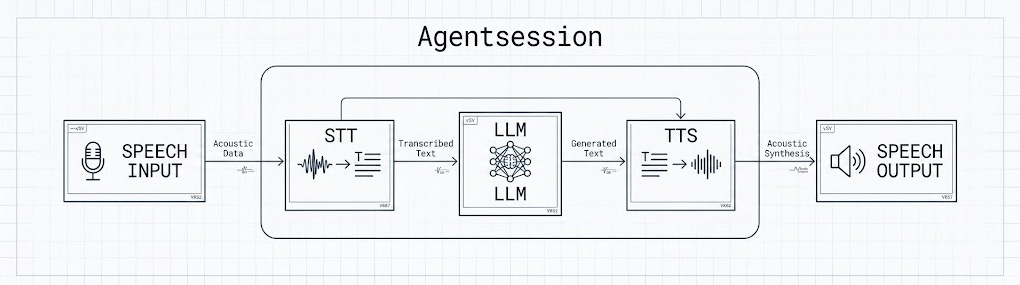
A voice agent session is a single interaction between a person and an AI assistant that communicates using speech.
Think of it like a phone call. The session begins when a user starts talking to the AI and ends when they disconnect, close the application, or the conversation is terminated.
Everything that happens during that conversation, including listening, understanding, reasoning, and responding, is managed within that session.
A voice conversation follows a continuous loop that repeats throughout the interaction:
The user speaks through a microphone or phone.
Speech is converted into text using Speech-to-Text (STT).
A Large Language Model (LLM) processes the text and decides how to respond.
The response is converted back into speech using Text-to-Speech (TTS).
The user hears the AI’s response.
This cycle happens repeatedly in real time, creating a conversation that feels natural rather than a sequence of separate API requests.
Most voice AI frameworks provide a session manager (sometimes called an AgentSession, ConversationSession, or similar) that coordinates the entire conversation.
The session manager is responsible for:
Managing the user’s conversation lifecycle
Receiving and processing audio streams
Coordinating STT, LLM, and TTS components
Maintaining conversation context
Tracking the current state of the interaction
Cleaning up resources when the conversation ends
Typically, every user conversation gets its own independent session. This keeps conversations isolated and prevents users from interfering with each other’s context.
A voice agent session generally moves through four simple phases.
The session begins when a user initiates a conversation by joining from a browser, mobile app, phone call, or another communication channel.
At this point, a new session is created specifically for that conversation.
Before the conversation begins, the system prepares everything needed for real-time interaction.
This usually includes:
Loading AI models
Connecting speech recognition
Initializing text-to-speech
Configuring prompts and conversation settings
Establishing audio streams
Once initialization is complete, the assistant is ready to respond.
This is where the actual interaction takes place.
The session continuously cycles through several states:
Listening – Waiting for the user to speak
Processing – Converting speech into text
Thinking – Generating a response using the AI model
Speaking – Playing the response back to the user
This loop continues until either the user or the application ends the conversation.
When the conversation finishes, the session is terminated.
The system:
Stops audio processing
Releases compute resources
Saves logs or conversation history (if required)
Cleans up temporary memory and connections
Proper session cleanup is important for scalability and efficient resource utilization.
Treating each conversation as its own session provides several advantages.
Isolation: Each user gets an independent conversation with separate context and memory.
Scalability: Thousands of conversations can run simultaneously because every session operates independently.
Observability: Developers can monitor latency, failures, token usage, interruptions, and conversation quality on a per-session basis.
Flexibility: Different AI models, prompts, or tools can be introduced during a conversation without disrupting the overall session.
Reliability: If one session encounters an issue, it does not affect other ongoing conversations.
A voice agent session is the foundation of every conversational AI system.
Rather than thinking of a voice assistant as one long-running application, it’s more accurate to think of it as a collection of independent conversations, each managed by its own session.
Once you understand this lifecycle, from session creation and initialization to conversation handling and cleanup, you’ll have a much clearer picture of how modern voice AI platforms deliver responsive, real-time interactions at scale.
Whether you’re building customer support bots, AI receptionists, healthcare assistants, or enterprise voice applications, designing around well-defined sessions is essential for creating reliable and scalable conversational experiences.
No posts
Comments
Nothing yet. Say the first thing.
Sign in to join the conversation.