
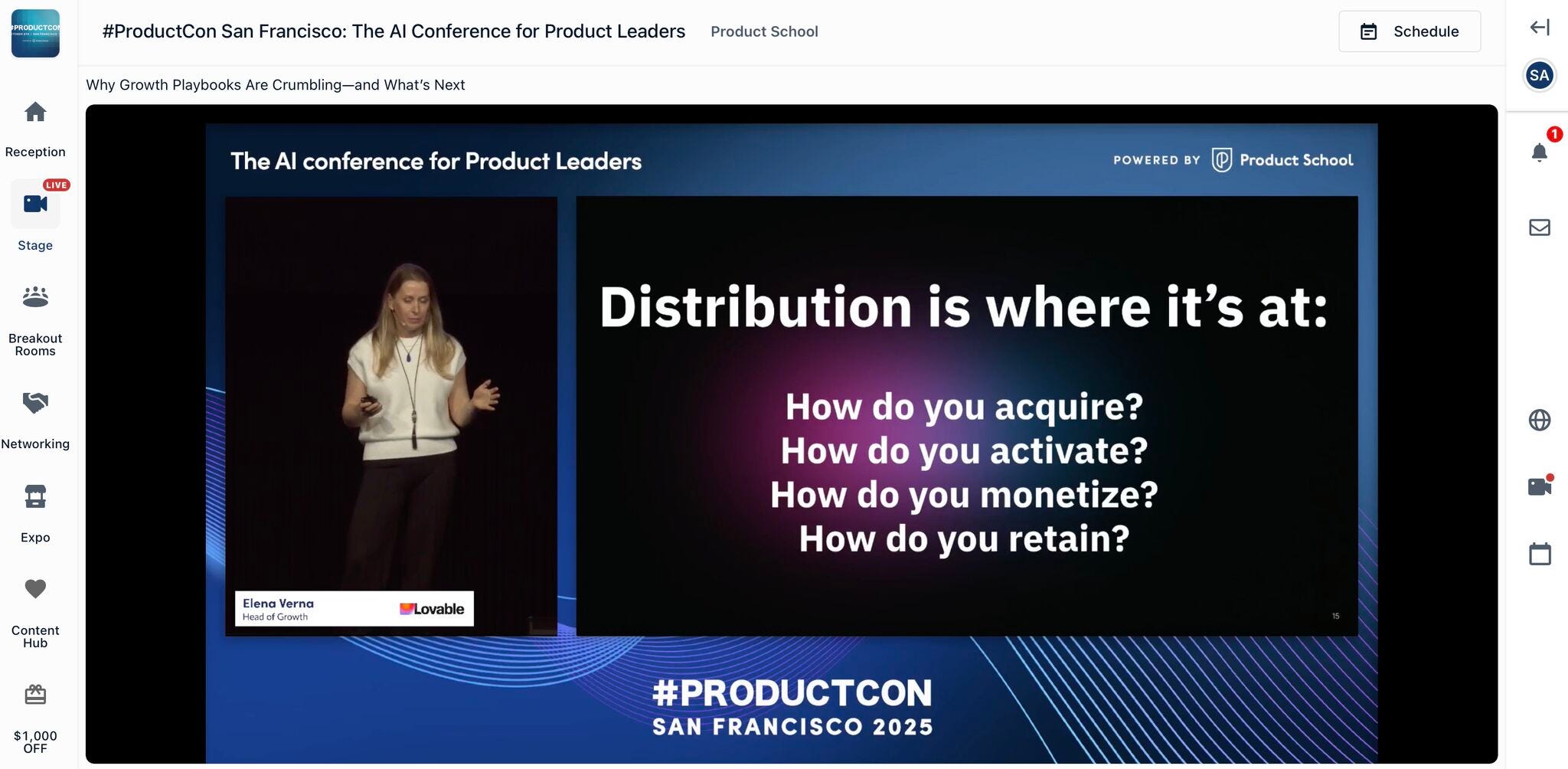
I attended #ProductCon (Online) yesterday, and one slide from Elena Verna really stuck with me.
It wasn’t about building faster or launching smarter.
It was about distribution, and how, in the Age of AI, that’s becoming the real challenge.
Just a few years ago, building a product or MVP took weeks or even months.
You needed engineers, designers, backend infrastructure, and plenty of patience.
Today, AI tools have completely changed that game.
With platforms like ChatGPT, Replit, Vercel, or Builder.ai, you can design, code, and deploy a working prototype in a day, sometimes even in a few hours.
Creation has become faster, cheaper, and more accessible than ever.
That’s a huge win for innovation.
But it also means one big thing:
When everyone can build, building stops being your advantage.
Think about this: if 1000 new apps or AI tools launch every day,
How does yours get noticed?
How will users find it, try it, and keep using it?
This is the new paradox of the AI era:
When building gets easier, distribution becomes the real moat.
You can have the smartest AI idea, but if no one knows about it, it doesn’t matter.
And even if they do, if you can’t keep them engaged, you’ll lose them just as quickly.
That’s why the conversation is shifting.
From “How fast can we build?”
to “How well can we distribute?”
Elena Verna explained distribution through four simple but powerful pillars, and they apply to every modern product team today.
Let’s unpack each one.
When thousands of new products launch every day, getting attention is a battle.
Your target users are already overwhelmed, inboxes full, feeds cluttered, and choices endless.
The question now is:
How do you stand out in a sea of sameness?
It’s not just about ads or SEO anymore.
It’s about building a clear story, brand, and trust.
Sometimes, a single viral moment or community endorsement can do more than a massive marketing budget.
Winning teams today are focusing less on volume and more on authentic connection.
Getting traffic is only step one.
The real magic happens when someone experiences your value quickly.
Think about the last time you signed up for a product and left within minutes because it was confusing or slow.
That’s where activation breaks.
The faster a user sees value, the “aha!” moment, the better your activation rate.
Clear onboarding, strong first-time experiences, and early wins make all the difference.
In a world of instant gratification, speed to value is everything.
With AI making it cheap to build, the real question becomes,
why would anyone pay for your product?
Monetization isn’t about pricing high or low, it’s about creating real, defensible value.
Free tools are everywhere, but users are happy to pay when you solve something deeply painful, save time, or drive real business impact.
In AI products, this often means going beyond a generic interface and offering workflow integration, trust, or fine-tuned results that free tools can’t match.
So, focus on value, not just features.
Retention is the new growth.
Why? Because switching costs are almost zero.
If your users lose interest or find a slightly better tool, they can move away instantly.
To retain users, you need to give them reasons to stay, consistent value, better experiences, and a sense of belonging.
That could be through community, personalization, or continuous improvement.
The goal isn’t just to keep users, it’s to keep them engaged.
As Product Managers, we’ve traditionally focused on what to build and how to build it.
But now, that’s not enough.
AI has leveled the playing field for building.
The next big differentiator is distribution mastery, knowing how to reach, activate, and retain users effectively.
It’s time we ask new questions in our product meetings:
How will users discover this?
What will make them stay?
How do we build distribution loops, not just product features?
Because the winners in the AI age won’t just be the ones who build fast,
They’ll be the ones who distribute smart.
No posts
Comments
Nothing yet. Say the first thing.
Sign in to join the conversation.