
When people think about AI performance, they usually think about which GPU they are using.
But here’s the real question:
When GPUs need to talk to each other, how do they do it—and how fast is each method?
Because in modern AI training, GPUs don’t work alone.
They constantly share data, sync results, and coordinate with each other.
And that communication layer?
That’s what actually unlocks performance.
Think of GPU communication like sending packages.
Some methods are slow but cheap. Others are fast but expensive.
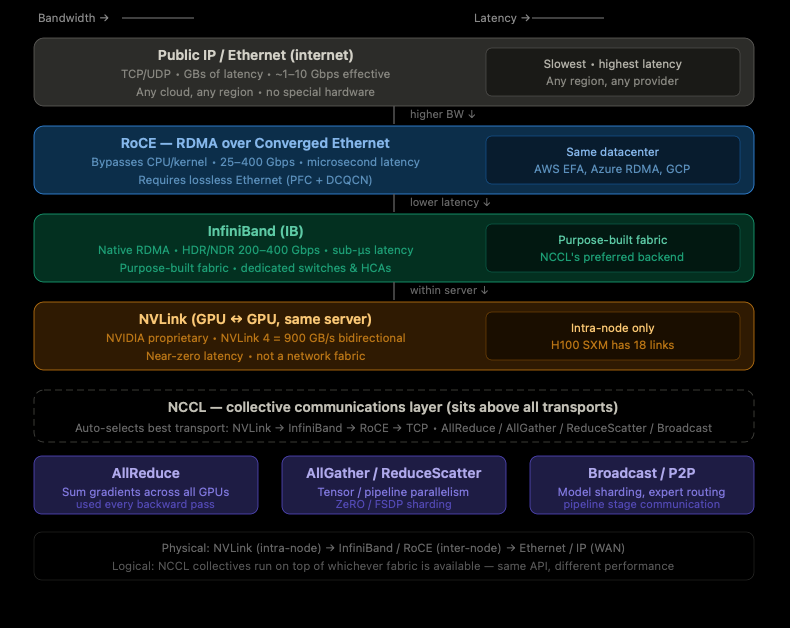
This is the regular internet
GPUs may be in different cities or data centers
Communication happens using TCP/IP
Result:
High latency
Slow data transfer
✔ Good for testing
Not suitable for serious AI training
Uses standard Ethernet, but smarter
Data goes directly from GPU memory to GPU memory (skips CPU)
Result:
~10–100× faster than public internet
Used in cloud services like AWS EFA and Azure RDMA
A dedicated network built for high-performance computing
Custom cables, switches, and optimized stack
Result:
Extremely low latency (sub-microsecond)
High throughput
This is what serious AI clusters use between servers
No external network at all
GPUs are connected directly inside the same machine
Result:
~900 GB/s bandwidth
~100× faster than InfiniBand
Limitation:
Only works within a single server
All of this complexity is handled by one powerful layer: NCCL.
Frameworks like PyTorch or JAX simply call NCCL
You write normal training code
NCCL automatically chooses the fastest communication path
Priority:
NVLink (same machine)
InfiniBand (across machines)
RoCE
Ethernet (last resort)
So you don’t have to think about networking—
NCCL optimizes it for you.
Every training step requires GPUs to sync data.
NCCL handles this using a few core operations:
AllReduce → Combine gradients from all GPUs and share results
AllGather / ReduceScatter → Used when the model is split across GPUs
Broadcast / P2P → Send data from one GPU to others
This happens after every backward pass
Most people focus on GPUs.
But the real performance unlock comes from:
How GPUs talk to each other
NVLink → fastest (inside a server)
InfiniBand / RoCE → fast (between servers)
Ethernet → fallback
If communication is slow, GPUs sit idle.
If communication is fast, GPUs stay busy.
And that’s what makes AI training truly scale
No posts
Comments
Nothing yet. Say the first thing.
Sign in to join the conversation.