
Josh and I were sitting around a couple of weeks ago, not working on anything in particular, when I just asked him out of curiosity:
When an agent runs in the real world and leaves a trace behind — who actually ends up owning that trace?
Neither of us had a good answer. We had opinions, which is a different thing and usually a worse one. And after about twenty minutes of going in circles, we did the one thing we’re actually good at, which is refusing to resolve an argument privately when we could get the smarter people to have it for us over dinner.
So we sent some emails and kickstarted our process .
* If you already know, skip ahead. If you don’t, this takes thirty seconds and it’s the whole ballgame.
When an AI agent does something real like refund a customer, file a support ticket, book the flight, write the pull request, it doesn’t just produce an outcome. It produces a record of how it got there. Every step it took. Every tool it called. Every dead end it wandered into, backed out of, and tried again from a different angle. The moment it misread the invoice. The moment it recovered.
That record is called a trace. Think of it as the flight recorder, except instead of only mattering after a crash, it matters most when things go right.
Here’s why anyone cares. That pile of traces is the single best training material that exists for making the next agent better.
Not synthetic data.
Not benchmarks.
Not some scraped corpus of the internet circa 2023.
Actual records of an agent doing actual work in an actual messy environment where the API times out and the customer is furious and the form has a field nobody documented.
Traces are how agents stop being a demo and start being an employee.
Feed the traces back in, and the agent improves at the specific job it’s doing. Feed them back in continuously, and you get what everyone in this industry has started calling the learning loop : the flywheel where the thing gets better because it’s being used, and gets better fastest where it’s being used most.
Which means the question Josh and I couldn’t answer wasn’t a legal trivia question.
Ownership of the trace is ownership of the loop. And ownership of the loop is, more or less, ownership of the future of the company.

Genuinely, pick a side. There are at least four defensible ones and they’re all held by serious people.
The enterprise says obviously we do — the agent ran on our data, in our systems, against our customers, and the reason it learned anything is that we had a hard problem worth learning from.
The agent company says obviously we do — it’s our model, our scaffolding, our orchestration, and you’re paying for the product precisely because it improves.
The infrastructure layer underneath says interesting debate, the traces are physically sitting in our storage.
And the model lab says lovely, all of you are downstream of weights we trained, so let’s talk about what “own” means.
Everybody is right. That’s the problem. When four parties all have a legitimate claim on the same asset and the asset happens to be the compounding one, you don’t get a clean answer, you get a decade of contracts.
So we figured, why guess. Why not do the thing we actually do best — research it, then put the right people in a room and let them answer it for us.

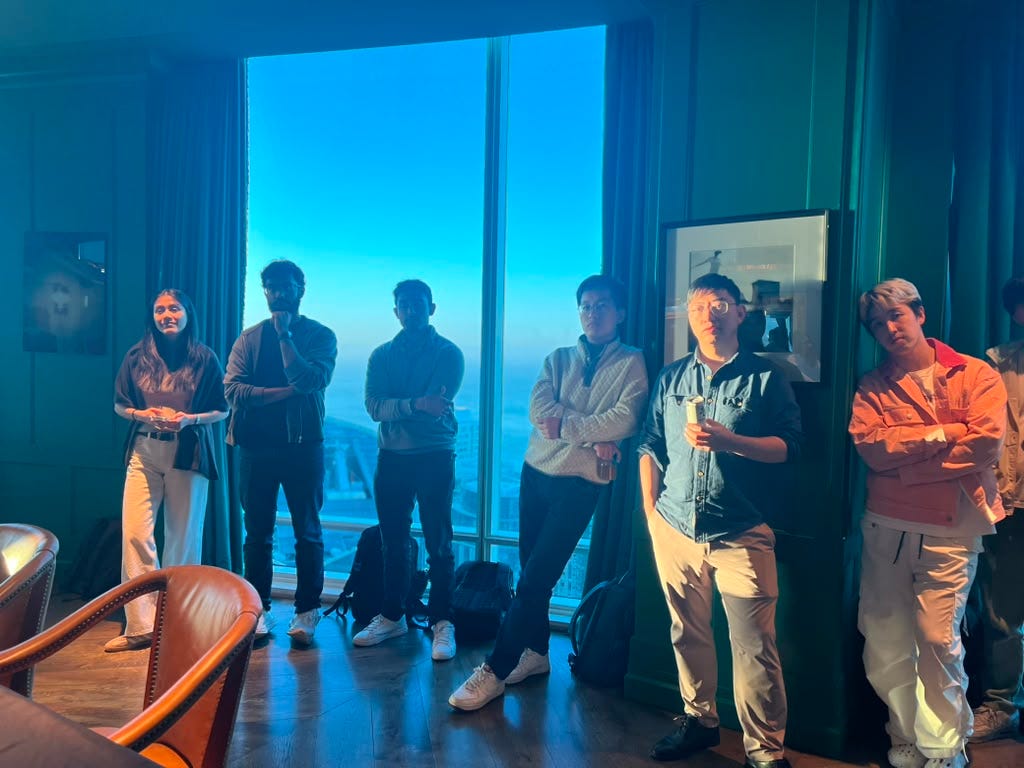
We had 24 of the most amazing people building the loop all in one room : Marco Casalaina, who runs Core AI products at Microsoft and owns Foundry’s Agent Optimizer. Tejas Dharamsi from LinkedIn, Sam Crowder from LangChain,.
Max Lu from Decagon Labs, whose company now runs something like 80% of production traffic on models they trained themselves . George Zhang, ex-Meta, who wrote OpenClaw.
We had founders, builders and investors from NVDIA, Bespoke Labs, Runta , HydraDB, Reflection AI, a16z, Radical, Altimeter and Emergence
Scott Fan of Paradigm, who is twenty-two and finished a Columbia BA and MS in three years, which I have decided not to think about.
We had Audrey Xu from Xiaohongshu, holding the only China-platform seat at the table. And we truly plan to integrate more international seats in our table.
While I was sitting across the table and listening to everyone I heard Guanlan Dai, who runs Runta, go first, his company customises the operating system the agent runs on, so every system call and network call passes through his layer. His claim wasn’t legal, it was structural. The lower you sit in the stack, the more you see.
Marco Casalaina, who runs Core AI products at Microsoft and before that ran AI at Salesforce, countered with the best analogy of the night.
Think about your CRM. Who owns your data? You do. But Salesforce is privy to things you’d never call theirs. He couldn’t open your leads. He could see that you’d created a custom field called hair colour, just not what was in it. And he could see your telemetry.
Landing: you own the telemetry, but you don’t necessarily own the data about yourself.
Then it got interesting.

Later in the evening I ended up in a corner with a researcher who trains models for a living, at a lab with enormous compute and a serious appetite for data. I asked what he actually needs right now.
He said: Not traces.
There are two ways to learn from a record of someone doing a task. Copy their steps — that’s supervised fine-tuning, and it’s fine if you want imitation. Or have the model attempt the task itself, thousands of times, and reward it when it wins. That’s reinforcement learning, that’s what everyone is excited about, and it requires the model to generate its own attempts.
On-policy, in the jargon. It learns from its own reasoning, not a transcript of someone else’s.
Which means he doesn’t want the messy middle. He wants the problem and the answer. The exact thing everyone at that table was arguing to own is the part he’d throw away, he was specifically dismissive about long-horizon agent traces.
So: an entire industry building moats around an asset, and the person who’d theoretically buy it shrugging in the corner. Not because traces are worthless. Because raw traces aren’t training data, they’re unconverted eval material.
This one started before the dinner officially began and I nearly missed it.
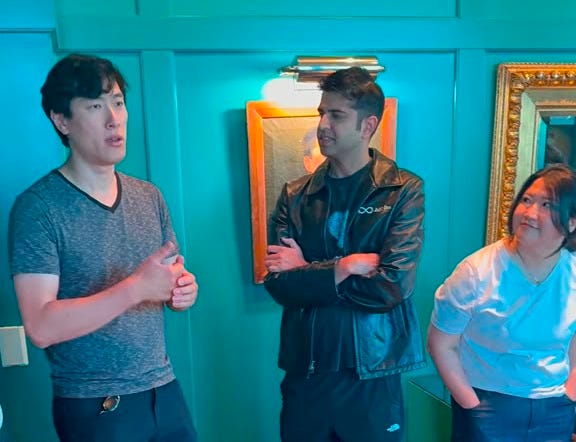
Marco was talking to Sam Crowder from LangChain about the shift everyone’s noticed — customers moving from static eval sets to defining their own tasks and verifiers and running their own RL. Sam sees it happening across LangSmith.
Normal enough.
Then Marco said the thing that made me put my drink down.
Everyone customising their own model breaks the economics of the cloud.
Follow the logic. Right now, a hyperscaler’s entire margin structure depends on the fact that we’re all using the same handful of models.
You use Sonnet, I use Sonnet, ten thousand companies use Sonnet, and the provider load-balances that demand across regions like water finding its level. That’s the scale play. That’s why inference is cheap enough to build on.
Now give every company its own post-trained model. Suddenly capacity has to be dedicated — carved out and reserved, not pooled. It isn’t multi-tenant anymore. The load balancing stops working. The economies of scale that made the whole thing viable quietly evaporate, one custom model at a time.
His phrase for it: locally optimal, globally suboptimal. Every individual company is making a perfectly rational decision. The aggregate is a problem.
What I liked about this is that it’s the opposite of the usual conference take.
“Everyone in that room was bullish on RL and post-training” — Mahesh Sathiamoorthy (Bespoke Labs)
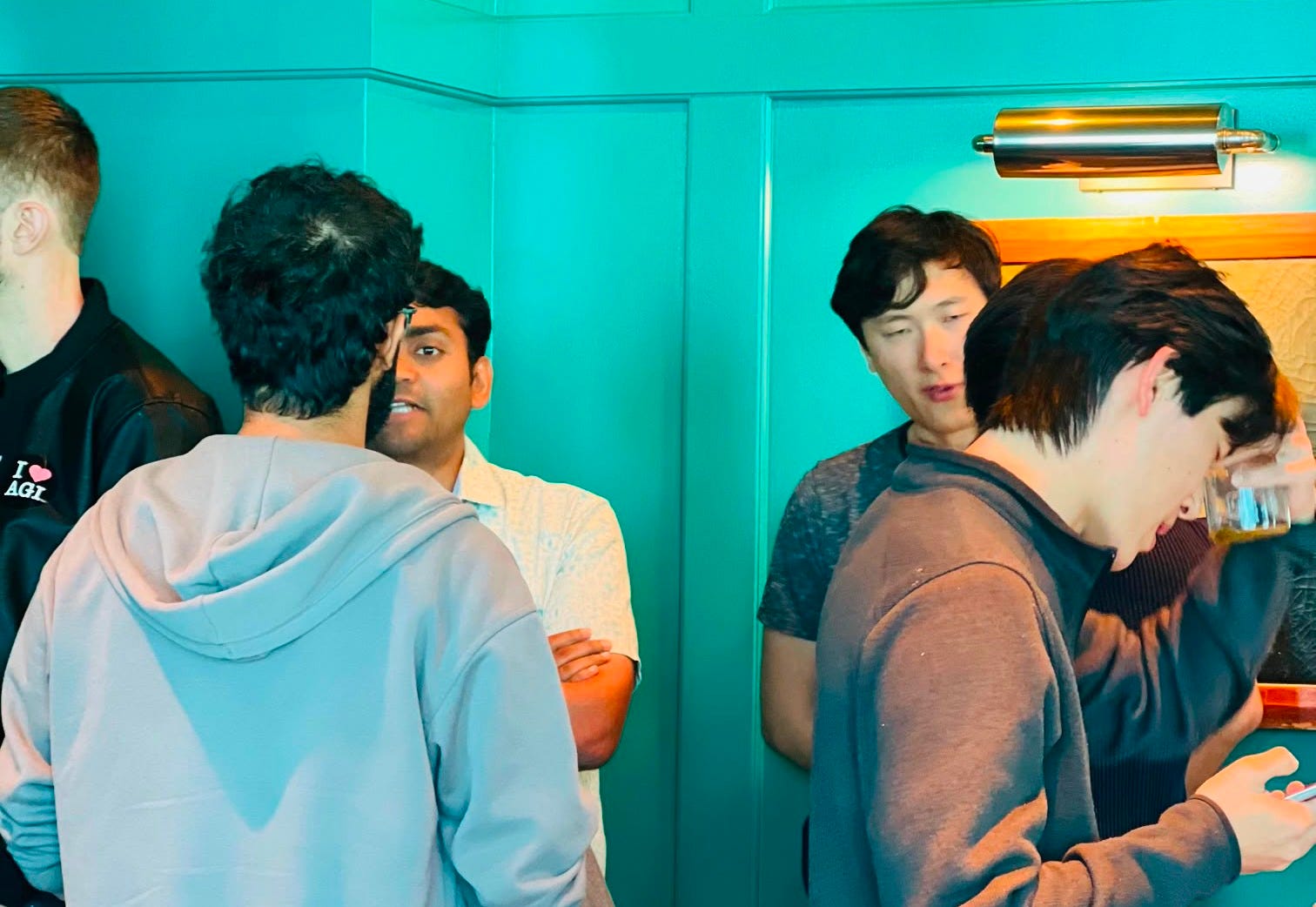
Max Lu does research at Decagon, which deploys AI agents into enterprises at scale, the kind of scale where the agent is talking to real customers without a human watching.
I asked him why the tail matters so much. Humans make mistakes constantly. Customer service is made of mistakes. Why is a small failure rate worth this much engineering?
His answer had two halves and the second one is the one that lodged.
First, the arithmetic. It’s easy enough to catch a problem that happens one percent of the time. The ones that end you happen at 0.01%. At a billion conversations, that’s not a rounding error, it’s a million failures, a million opportunities to get sued, a million chances to tell somebody the wrong thing about their medication. And you cannot find those in advance by reading logs. You find them by having already converted your logs into something that tests.
To which I pushed: humans make those mistakes too. He agreed. And then said, more or less, that it’s simply easier to blame the machine. Not because machines are worse.
Because before, you wouldn’t dig through the traces of a human.
The whole reason this argument exists, the reason we spent an evening arguing over who owns a trail of breadcrumbs is that machines produce a record and people don’t. Every bad call a human support agent has ever made evaporated the second the call ended. The agent’s version is there, timestamped, re-playable, subpoena-able, forever.
We didn’t build accountability into these systems on purpose. It fell out of the architecture. And now the entire industry is arguing about who gets to hold the receipts.
That’s the bit I’d love to hear you argue with. Because I don’t think we’ve decided yet whether that’s the best or the worst thing about the whole enterprise.
To many more gatherings and insights,
Team AI+
No posts
Comments
Nothing yet. Say the first thing.
Sign in to join the conversation.