
I spent forty minutes yesterday arguing with an AI about my own ad budget. It won.
Meta quietly handed Claude the keys to your ad account this year, and I’ve been letting it drive more than I’d like to admit. Not because I’m lazy (okay, partly because I’m lazy), but because the thing scored my last campaign a 42 and was, annoyingly, right about why.
Here’s what changed, what I’ve been doing with it, and the exact steps to set it up yourself.
Opportunity Score is Meta’s 0-100 health check on your campaign setup. It’s not a performance score. It’s a “how many of our best practices are you following” score. Meta scans your account, ranks unapplied recommendations by estimated impact, and tells you which ones are worth your time.
Here’s the catch nobody tells you upfront: a low score isn’t failure and a high score isn’t a guarantee. A campaign with tight, intentional targeting and strong ROAS can sit at 40 and be exactly right for what it’s doing. Meta itself has said advertisers who act on recommendations see a median 5-12% drop in cost per result, but that’s a correlation across millions of accounts, not a promise for yours.
Treat it as a structural audit, not a verdict. Use it to catch the stuff scale hides: a forgotten placement toggle, missing Conversions API setup, audiences so fragmented Meta’s AI never gets enough data to learn.
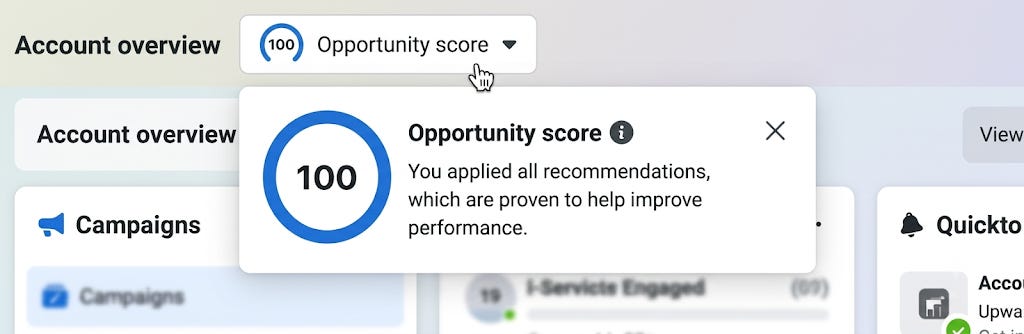
Most of the score is tied to Advantage+ adoption: audience, placements, budget. That’s not a coincidence. Meta’s machine learning needs room to move, and the score is really Meta asking “are you giving my AI enough flexibility to do its job.”
I’ll just stay off with an example about a product that I personally used Meta ads for and what were my steps. Say you’re launching a $199 cohort-based course. Here’s the sequence, start to finish.
Draft the offer with Claude first, not the ad. Give it your ICP, the course outcome, and pricing, and ask for three distinct angles: pain-first, outcome-first, and social proof-first. You want variety before you touch Ads Manager.
Set up the campaign as Advantage+ Sales, single ad set, Advantage+ audience on. For a $199 course, Meta’s reduced-event threshold for Purchase campaigns means you only need about 10 conversion events a week per ad set to exit the learning phase, not the old 50.
Check your Opportunity Score before you publish. Aim for 80+, but only apply recommendations that don’t fight your brand’s actual creative direction.
Generate 5+ creative variants with Claude, not 2. Advantage+ campaigns test combinations automatically, and creative diversity is the single biggest lever once targeting is on autopilot. Give Claude your brand voice and ask it to write hook, body, and caption sets per angle, formatted for 9:16 first since that’s roughly 90% of Meta inventory now.
Publish and do not touch it for 7 days. Every meaningful edit resets the learning phase. This is the hardest step and the one most people break. I usually just spend these days manifesting the results and hoping I get whatever I am expecting . At last all good things take time.
Come back with Claude connected to your account (below) and ask it to diagnose, not just report.
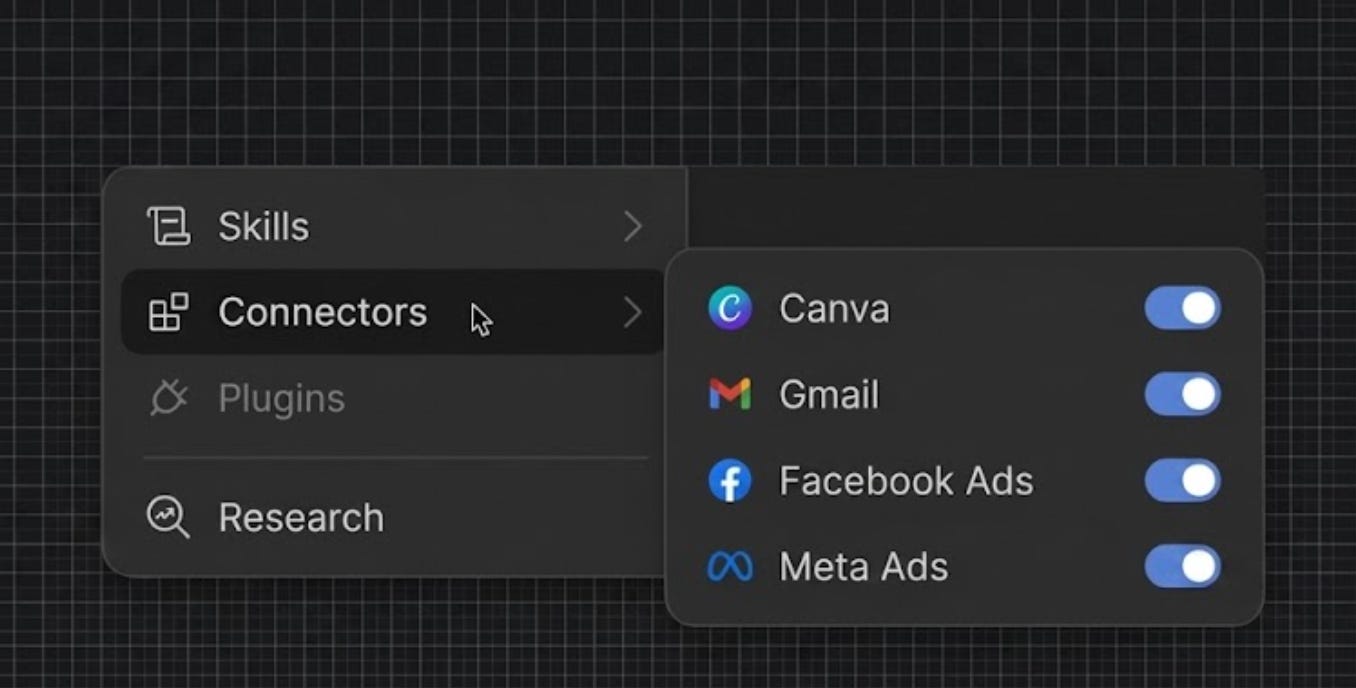
You don’t need to build one. Meta shipped an official MCP server in April, and it’s genuinely simple to wire up.
Server URL:
https://mcp.facebook.com/adsIn Claude, go to Settings → Connectors → Add custom connector, paste that URL, and authenticate through the standard Meta Business OAuth screen. Same login flow Shopify and Mailchimp use.
On Claude Desktop, you can instead edit
claude_desktop_config.jsondirectly and drop it into themcpServersblock:
{
  "mcpServers": {
    "meta-ads": {
      "url": "https://mcp.facebook.com/ads"
    }
  }
}
Fully quit Claude (Cmd-Q, not just closing the window) and reopen. You’ll see the connector show as active, and your first prompt can just be something like “show my top ad sets by spend over the last 7 days.”
Custom connectors need Claude Pro or Max, free tier doesn’t support them.
Meta exposes 29 tools across four buckets: performance reporting, campaign management, catalog management, and signal diagnostics, and every write action (new campaigns, budget changes, pauses) comes back to you for approval before it goes live, it won’t spend money without you saying yes.
And Meta is rolling this out per ad account, not per app, so some accounts still return
is_ads_mcp_enabled: falseeven after a clean OAuth.If that happens to you, third-party MCPs like Adzviser or Composio’s Meta Ads connector work as a stopgap and use the same underlying Marketing API.
The gap most people miss: connecting Claude to your ad account doesn’t make Claude a good media buyer, it just makes it a fast one. The good prompts are specific. I personally used some of these.
“Pull opportunity score and explain the top 3 recommendations in plain language, then tell me which ones conflict with a $199 course targeting working professionals.”
“Show ad sets with CPA more than 20% above target this week and tell me if it’s a creative fatigue problem or a targeting problem.”
“Draft 5 new creative variants for the ad set with the highest frequency, keeping the winning hook from last week.”
Claude reading your account is genuinely useful for diagnosis. It is still not the thing that decides your offer is good. That part is still you.
Honestly, this is how I’ve been running ads lately. It feels less like automation and more like having a slightly overeager intern who read every Meta best-practice doc overnight and a very fast analyst who never gets defensive when you tell them the recommendation is wrong. Neither one has taste. That part’s still yours, and honestly, thank god, because it’s the only part of this job I actually enjoy.
So no, AI isn’t running your ads for you in 2026. It’s just finally fast enough to stop being the bottleneck. Strategy and creative live in Claude, structure and delivery live in Meta’s AI, and somewhere in between, you get to be the person who actually knows the difference between a good ad and a technically-compliant one.
If you want to go deeper on the fundamentals underneath all this, Meta’s own Blueprint courses are free and genuinely well-maintained, start with “Understand Your Ad Auction and Delivery” before anything else. I started with that too and it genuinely helped me .I mean instead of scravaging through 1000 of “how to use meta ads” resources just stick to one that is posted by Meta itself . I can vouch for that being your friend /colleague/well wisher or just your host for this newsletter.
If you would like to know about other tools or want me to explore topics that interest you leave a comment down below or write to us personally at team@aiplus.dev.
No posts
Comments
Nothing yet. Say the first thing.
Sign in to join the conversation.