
I’m writing from Sydney, where I’m in town to present at SXSW Sydney. Glancing out over Sydney Harbour, I’m been thinking about the widening gap between two conversations about AI. One that’s fixated on bubbles, valuations, tech bros, and whether the economy is ready for a crash. The other, held by people building at the frontier, is exploring questions that can reshape business, society, and human agency.
Journalist Shakeel Hashim captured this split in his essay, “We’re All Behind the Curve,” reflecting on discussions at the Curve Conference, a forum where thinkers test disagreements and bridge toward solutions. After speaking there, he described a “very scary disconnect” between private conversations and the way the wider world talks about AI.
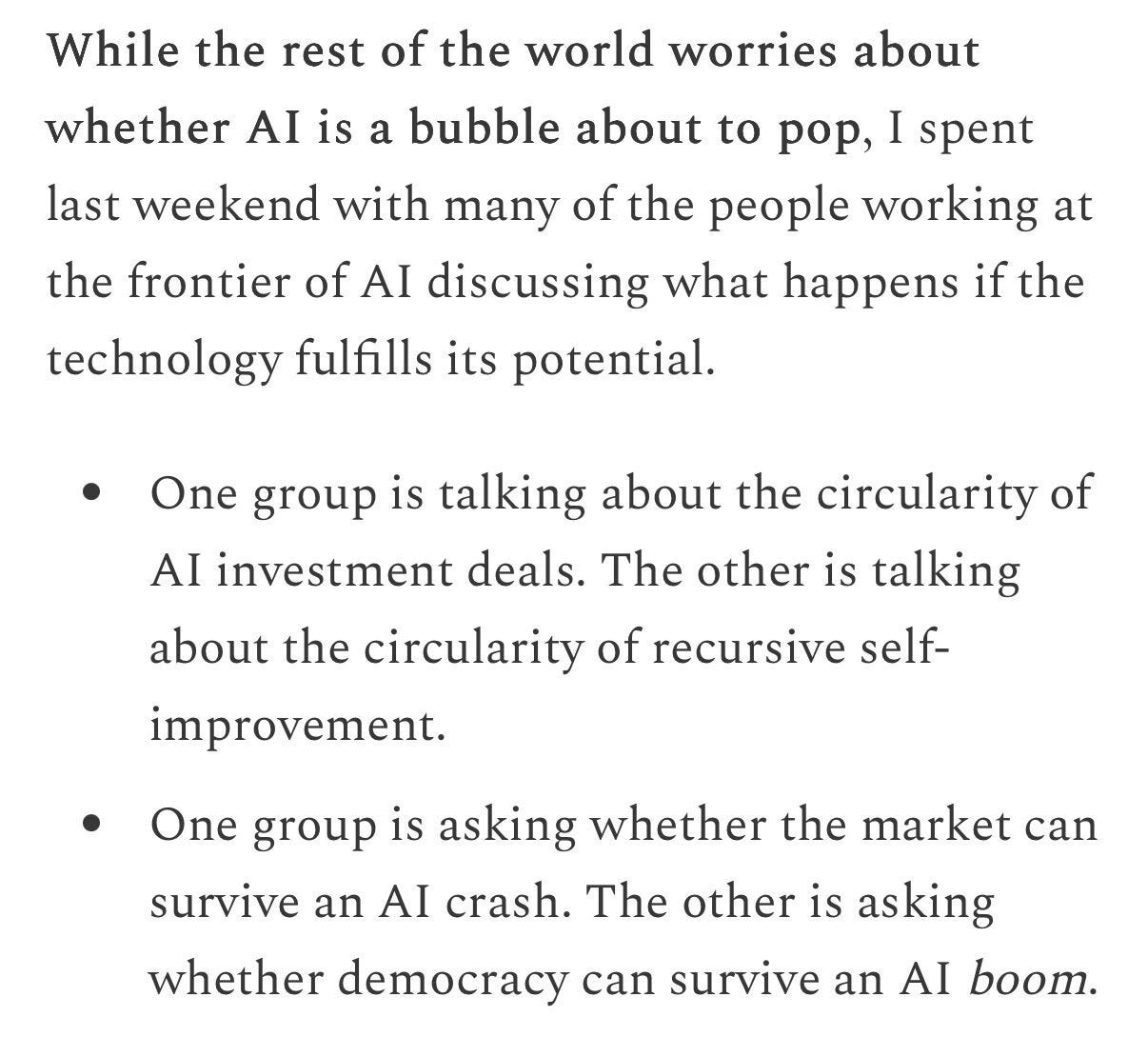
On one side, the market crowd is riding the Hype Cycle and worrying about circular capital flows, lofty multiples, and the potential for an AI-driven downturn. Understandable. Many leaders still carry the scar tissue of the last crisis, and fear makes for loud and reverberating headlines.
But the people working closest to the frontier are addressing fundamentally different questions, with direct implications for every enterprise:
How recursive self-improvement could compound capability in unexpected, and uncontrollable, ways.
Whether a culture war over AI “personhood” is inevitable, and what legal and ethical regimes might follow.
How advances in AI could destabilize geopolitics, including the risk of regime change shaped by information operations and automated persuasion.
Whether democratic institutions can withstand (or adapt to) the speed and scale of AI-mediated cognition.
Reshaping the conversation around human agency as agentic AI and autonomous enterprise workflows loom on the horizon.
Seen through that lens, obsessing over short-term market gyrations is a distraction. The real work is scenario design: mapping the waves of AI that will change how we work, who (or what) we employ, and how decisions are made when agentic, and eventually autonomous, systems sit inside our processes, products, and policies.
If your strategy is still anchored to “what phase of the Hype Cycle are we in?” you may already be behind. Leaders need to pivot from quarterly risk optics to first-principles questions:
Human agency in agentic enterprises: What remains uniquely human, and how do we protect and augment it?
Governance for non-human actors: What are our thresholds for AI personhood claims and responsibility?
Cognitive offloading and “AI slop”: How do we avoid atrophy of judgment, hallucinated feedback loops, and degraded information ecosystems?
Operational psych safety: What guardrails, red-teaming, and decision-review patterns keep autonomous workflows aligned with intent?
Democratic resilience: How do we design election, media, and institutional safeguards for an era of synthetic persuasion?
The future of human-AI work: How can we designwork charts that place humans in and above the loop in AI orchestration so that tasks are automated and human roles are elevated.
Crash or no crash, the downstream effects of these questions can eclipse anything we’ve faced. We are not spending nearly enough time exploring divergent futures or preparing for alternate trajectories. That is a strategic failure we can correct…now.
“Obsessing over the bubble is easy. Designing for agency and autonomy is the work.”
This is the moment for a mindshift, from hype management to horizon stewardship. Build scenario portfolios, run premortems on autonomy-enabled failures, rehearse recovery, and define your “lines you won’t cross” before you’re tempted to cross them. Create space for people with situational awareness outside your domain to inform your strategy, especially when it’s uncomfortable.
The market will keep doing what markets do. Our responsibility is to ensure that when the future arrives, and it will arrive faster than expected and from directions we didn’t plan for, we’ve done more than watch the headlines and scroll the feeds. We’ve done the thinking and the work.
Join me in mindshifting the conversation. Let’s design for agency, align for autonomy, and prepare institutions worthy of the capabilities we’re unleashing.
Thanks for reading AInsights! Subscribe for to receive new posts and support my work.
Comments
Nothing yet. Say the first thing.
Sign in to join the conversation.