
I reference hype cycles and adoption curves often because they help explain why two very different things can be true at once.
AI can be overhyped in the near term and still be underestimated in the long term (Amara’s Law). We can have extraordinary progress with an emerging tech, and at the same time, organizations still struggle to turn that progress into meaningful operational change. We can also have a small number of firms moving very quickly while the majority of the profession feels like it’s barely getting started.
That is exactly where firms appear to be right now.
The earliest adopters are moving beyond individual use cases and beginning to rethink workflows, staffing, pricing, and service delivery. The early majority is experimenting more seriously but still wants proven accounting-specific use cases, stronger governance, and evidence that the technology will work reliably. The late majority is waiting for AI to become a standard capability inside the platforms they already use and insist they don’t want to be a guinea pig. Then you have the laggards who are still hoping this will turn out to be another technology cycle they can wait out.
What makes this particularly difficult to see, is that all of these groups are using similar language. Firms at very different stages describe themselves as AI-forward, AI-enabled, or AI-native, even when the actual capabilities inside those firms bear very little resemblance to one another.
The profession is also not moving neatly along one adoption curve. Different service lines within the same firm may be at entirely different stages of implementation. A CAS team may be actively redesigning workflows while another part of the firm is still debating whether employees should be allowed to use ChatGPT. A few early adopters inside an organization can create the impression that the entire firm is further along than it actually is.
That is why we need a better way to assess progress than just asking whether a firm uses AI.
Rob Hamilton and Jeff Seibert provided what I found to be a useful framework for firm assessment in their new book, Zero Entry. By answering a set of questions, it surfaces where a firm is at across six different levels of AI maturity which I’ve displayed below, along with where I believe most firms are sitting today.
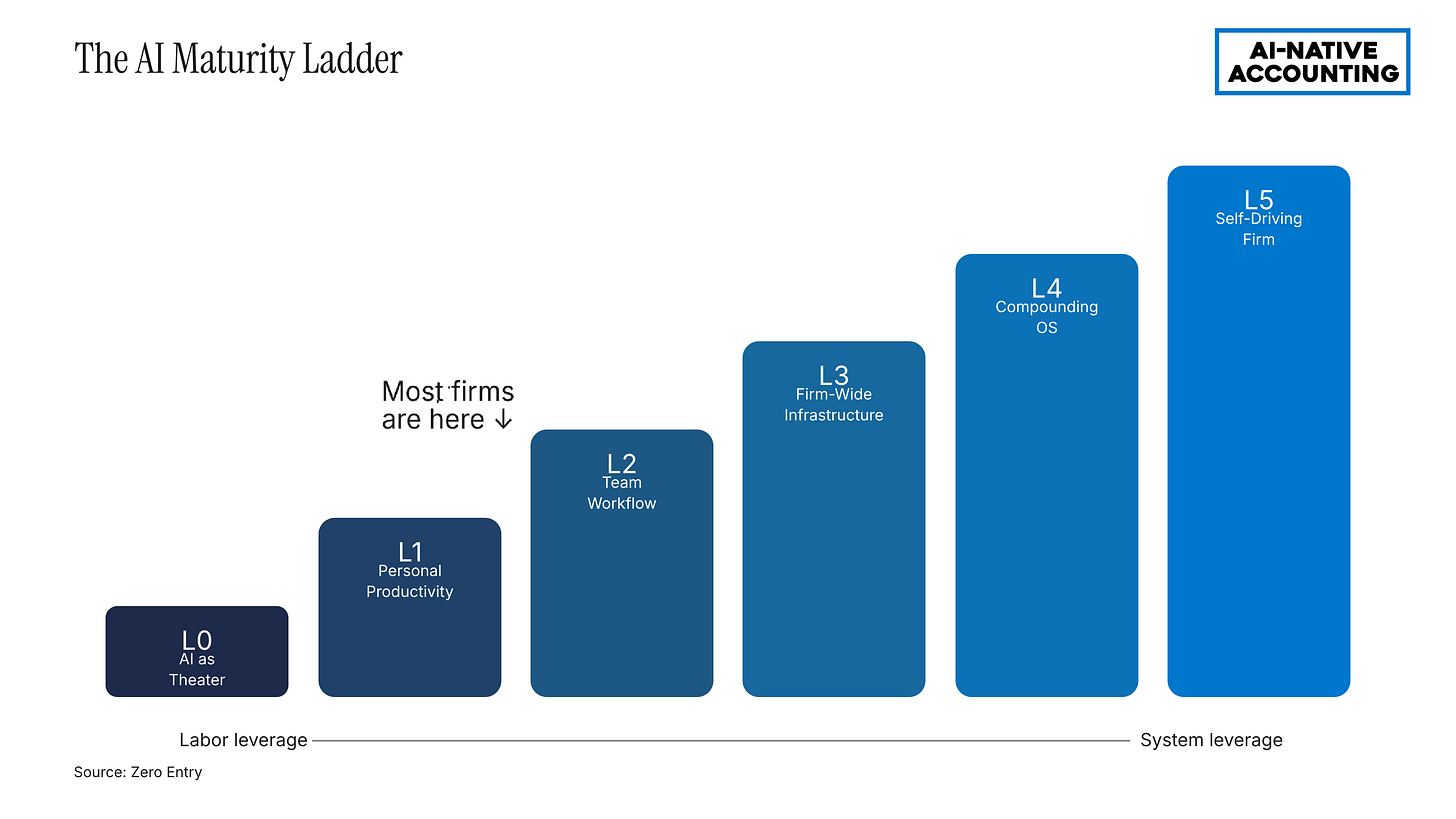
The majority of firm leaders that I speak with land at L1 or L2. Individuals are using AI for research, summaries, emails, and memos, and some teams have introduced AI into specific tax, audit, or CAS workflows. There is real value being created at both levels, but it is primarily personal or team-level productivity.
The underlying firm is largely unchanged.
The same people still move the work forward, the same management and review layers remain in place, and information still has to be moved and verified across disconnected systems. The firm may be producing work faster, but it is still operating through a model built around labor leverage. That distinction matters.
At the Foundation, we have defined an AI-native firm as one structured around automation-first operations, with roles built for strategy rather than process. I believe the term begins to apply around L3, when AI becomes part of the firm’s infrastructure rather than something used by an individual or isolated team.
L3 is also where the shift from labor leverage to system leverage begins. Instead of growth depending primarily on adding more people, the firm starts building systems that can perform work, retain knowledge, and improve across engagements.
Reaching that point requires more than moving through the normal stages of technology adoption. It requires firms to confront decisions they have been able to avoid while AI remained experimental.
So what’s holding firms back? Three challenges come up repeatedly in my conversations:
Pricing. Firms are still billing by the hour for work that AI can increasingly complete in a fraction of the time. Their economics are quietly punishing them for becoming more efficient. Firms cannot fully embrace automation while their business model continues to reward time spent.
Architecture. Most firms are adding AI to an already fragmented tech stack without asking where intelligence needs to live or how information will move across the entire client lifecycle. The ceiling on what AI can do is determined by the systems, data, and workflows underneath it - not by the number of AI tools the firm buys.
Change management. Firms are introducing AI as a technology initiative when it is really a workforce and operating-model change. Employees are being asked to experiment while worrying about accuracy, client risk, and what greater automation means for their own roles. At the same time, many leaders have not clearly explained what will change, what will remain human, or how people will be supported through the transition. Without trust, training, and permission to learn, adoption stays concentrated among a small group of enthusiasts and never becomes a firm-wide capability.
Now, don’t get me wrong – I do not believe every firm should be an early adopter. There are legitimate reasons to move carefully in a profession built on accuracy, trust, and accountability. But there is a difference between making a deliberate decision about where to sit on the adoption curve and simply assuming there will always be time to catch up.
Early adopters are not only getting access to the technology first - they are building the internal knowledge, redesigned workflows, governance practices, and client expectations that will allow them to move faster as the technology improves.
The most useful part of the maturity ladder is not the opportunity to claim a higher level. It is the ability to locate the firm honestly, understand what the next level requires, and decide whether the business model benefits by making those changes.
— Kacee Johnson, Executive Director
Barry Melancon spent decades leading the AICPA and broader accounting & finance profession to anticipate and prepare for change. Now, as Board Chairman at Baker Tilly International, he has a front-row seat to how firms around the world are responding to AI, rethinking their business models, and preparing for a future that will look very different in the years ahead.
In the latest episode of the AI Native Accounting Podcast, we explore:
→ Why the profession’s 100-year-old pyramid model is beginning to crack.
→ Why the biggest challenge is not learning how to use AI, it is developing business acumen fast enough to keep up.
→ Why the distinction Barry has emphasized throughout his career still matters: “It’s not an industry. It’s a profession.”
Two reports worth your time this month.
Schellman’s 2026 State of AI Governance survey put data behind something I hear in almost every governance conversation right now: 74% of enterprise leaders say they could pass an AI compliance audit today, but only 27% describe their governance as fully mature. That gap, between confidence and actual operational readiness, is where most organizations are quietly sitting, and it only gets more exposed as agentic AI moves into production.
Karbon’s Future of Client Trust in the Age of AI report is a useful companion to that one. It surfaces what’s happening with the clients – something every practitioner should have a keen pulse on. Clients rate their relationship with their accountant as highly as the deliverables themselves, and 81% said they’d find their accountant more valuable, not less, if AI freed up time for a monthly strategy call instead of a fee discount. If you’re trying to figure out where AI actually earns its keep with clients, it’s worth the read.
Comments
Nothing yet. Say the first thing.
Sign in to join the conversation.