
In a few different consulting engagements right now, I’m doing one-on-one AI coaching sessions with executive leaders.
I always ask them to bring something important and timely to work on.
A big decision. An important communication. A leadership conversation that keeps going sideways. A stuck initiative. A strategic opportunity that hasn’t been framed clearly enough to act on.
Then we open their custom AI Work Partner and begin with the part most people don’t ever share with their AI.
The earliest, messiest thinking.
I always ask them to dictate to AI. We speak about 3x faster than we type, and the extra words matter. When people talk, they include the hesitation, the side detail, the history, the tension, and the stakes.
Talking to AI is better than typing when you are doing strategic work.
A CEO told me last week that this was the hardest thing for her to get used to. Now she realizes that typing makes her shrink the topic, and talking expands the thinking.
And that’s the point: to think with your AI.
By the time most people open an AI chat, the most important thinking has already happened. They’ve already decided what kind of problem this is, what deliverable is needed, and what path they’re taking.
AI is being asked to help with a plan that it didn’t help shape.
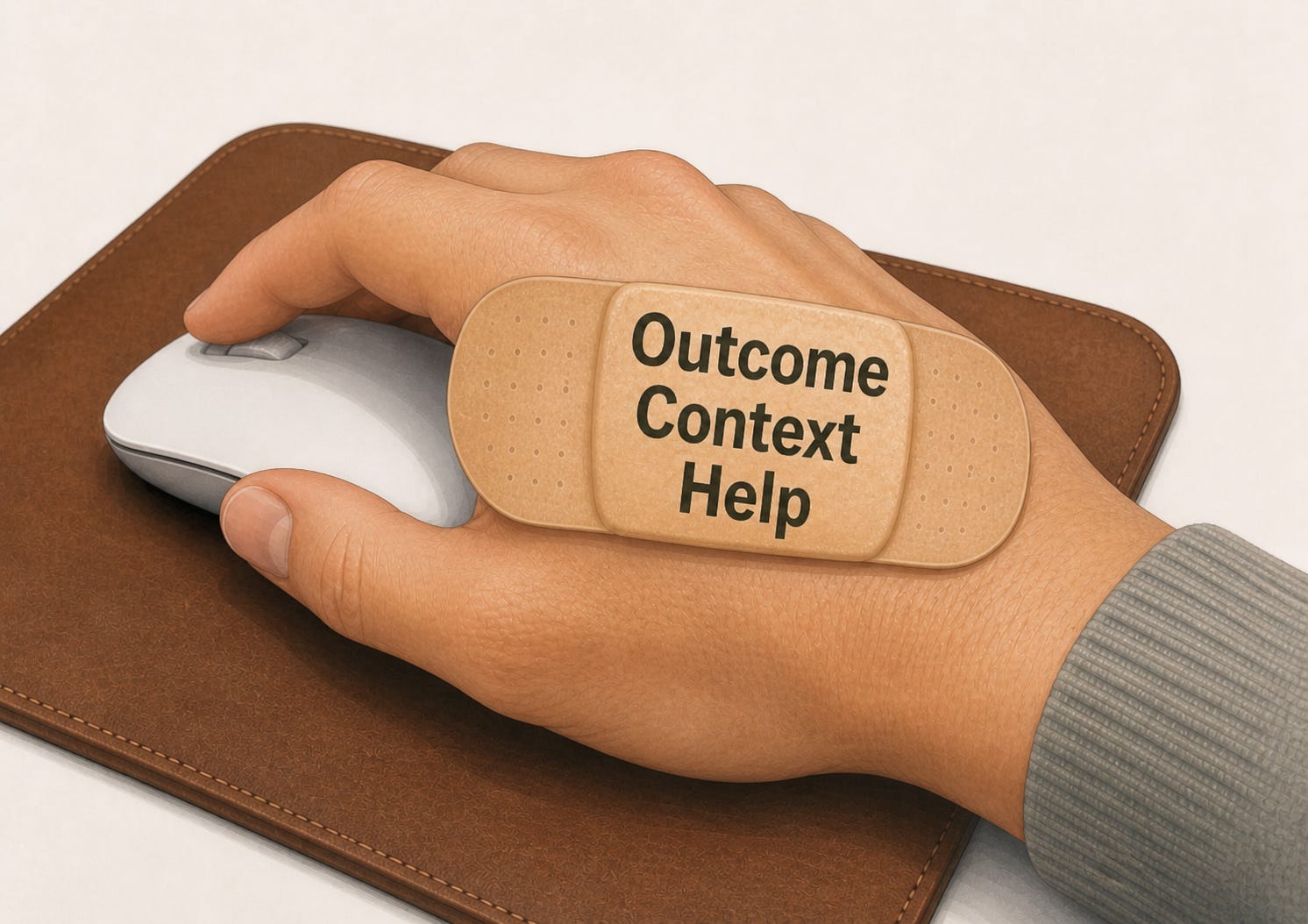
This is why I developed a prompting method called OuCH. It brings AI into strategic thinking before any tactical outputs.
OuCH has become one of the key practices in my upcoming book, Amplified Intelligence (AI) Mode.
And I called it “ouch” because you hurt yourself when you skip it.
OuCH stands for: Outcome, understanding Context, Help.
It’s your opening move for any important work. Dictated well, it’ll help you get maximum strategic value from AI.
The logic of using OuCH runs like this.
The human owns the Why. The outcome is the desired change, the highest goal, the vision, the standard. The thing you most want to happen.
Your custom AI Work Partner is there to help you determine the How. That means the strategy, sequence, tradeoffs, options. The strongest path for reaching your outcome.
After you determine the How, then the AI can help you execute the What. The email. The deck. The brief. The decision memo. The plan.
Most people start with the What. They jump straight to the deliverable.
OuCH pulls the opening move upstream, into the space where the strategy still has room to change.
Here’s how to do it.
The first part of OuCH is getting clear on the highest outcome.
Most people skip this without realizing it. They identify the object they want produced, not the change they want to create.
“Write an email to the board” is a deliverable. “Shift the board’s confidence in the recovery plan” is an outcome.
“Create an agenda” is a deliverable. “Get real alignment among six people who currently disagree” is an outcome.
“Draft a proposal” is a deliverable. “Win approval for the investment by addressing the CFO’s concerns about payback period” is an outcome.
The difference matters enormously.
When the outcome names the change that matters, everything downstream gets sharper. The AI stops being generic because the aim is not generic.
The second part is giving your AI enough information for effective thinking.
Context is the landscape of the situation. History. Constraints. Stakeholders. Prior attempts. Tradeoffs. Success criteria. Failure risks. Political dynamics. Emotional dynamics. Timing pressure. What must be avoided. What has already been tried and did not work.
Most people starve their AI of context and then blame the output for being shallow. The AI was never given the full terrain. It had no choice except to guess.
This is where dictation matters most.
When people type, they tend to summarize. When they speak, the real situation comes through. They mention the stakeholder they are worried about. They name the tension they were trying to avoid. They hear themselves say the part that was missing from the formal version.
Typing compresses. Speaking leaks the truth.
When you talk, the cost of sharing the full situation drops and the value of what the AI can do with it rises.
The third part is where the behavioral shift lives.
Most people ask for execution too early. The prompt jumps to “write the thing” before the optimal strategy has been determined.
A strong Help request moves upstream. The work is still fluid. The strategy can still change. The path can still improve.
Help me frame the real problem. Help me identify what I might be missing. Help me pressure-test the strongest paths. Help me surface the tradeoffs. Help me see second-order consequences. Help me determine the strongest approach before I create the output.
Or when in doubt: Ask me questions until you understand enough to help me reach the outcome.
That’s the moment the AI becomes a thinking partner. The request asks AI to examine the situation clearly before you commit to any particular thing.
An executive I was coaching recently had a complex policy standardization project in front of her. A consultant had sent a spreadsheet with initial findings.
With me watching, she opened a new AI chat and said: “Summarize this spreadsheet and prepare an executive brief with the key findings and risks...”
That’s when I interrupted her. Too tactical. Too small.
I reminded her to first name the desired outcome, and then describe the key context.
And she nailed it:
“I want to move from dozens of inconsistent local HR policies to a small number of standardized options that are practical, defensible, and aligned with our broader transformation. This work affects people, culture, cost, implementation complexity, and leadership confidence. Here’s the analysis we’ve received so far. Help me understand whether the path to standardization is realistic, where the biggest transition risks are, what questions I should ask the team, and what direction I should give next for the project.”
Same spreadsheet. Completely different conversation.
The tactical prompt asks AI to explain the artifact.
The strategic prompt asks AI to help solve the business problem the artifact exists to serve.
Now that knowledge and intelligence are abundant, the quality of direction becomes the decisive variable.
OuCH protects the strategic layer before the tactical layer takes over. It holds open the space where the most important thinking happens: what are we actually trying to accomplish, what’s really going on, and what would be the strongest way to approach this.
When leaders practice this opening move, the first exchange becomes far more useful because AI is helping with the real problem from the start.
Give it a try.
Take the most meaningful piece of work currently in front of you.
Something with stakes. A decision. A hard conversation. A proposal. A stuck project.
Open your custom AI Work Partner (please don’t use generic AI for anything important).
Click on the microphone and dictate three moves:
My desired outcome is...
The context is...
Help me...
Then keep working through the options until the strongest path to the outcome becomes clear.
The best work of your life may begin with the moment you stop thinking alone.
No posts
Comments
Nothing yet. Say the first thing.
Sign in to join the conversation.