
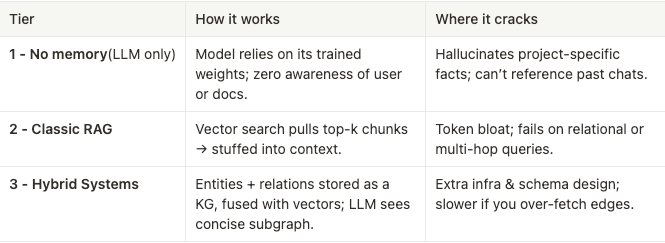
Last month we asked “What does memory actually mean in your stack?” The top replies clustered into three camps —no memory (just a base LLM), bolt-on RAG, or hybrid graph + vector systems.
The conversation included classical short-long term memory discussions.
This issue walks that ladder.
Let’s get the basics for our three clusters:
We distill all that chatter into four fresh, field-tested rules for shipping memory that actually works.
Hybrid tops the league tables
Two brand-new papers—Graph-R1 (ICML, 13 Jul) and Dynamic Local KG (ACL Findings, 30 Jul)—show that fusing a two-hop subgraph with the usual top-k vectors lifts exact-match by ≈10 points on HotPotQA and MuSiQue without enlarging the base model (source1, source2)
Speed is a feature—store smart, fetch smarter
AWS just rolled out S3 Vectors and an OpenSearch integration that holds billions of vectors yet still serves hits in ≈10 ms (source), while Qdrant Edge (30 Jul) brings sub-50 ms hybrid search to on-device workloads (source). If you’re running cognee, you can let every node hit the same bucket—no shared disks, no stale caches—so your memory layer scales line-rate with traffic instead of the slowest pod (source). With distributed processing on Modal, you get even faster results (source).
Great memory needs a good ontology
A SIGIR paper accepted 18 Jul shows sloppy edge labels sink multi-hop precision by 18 % on retail-QA tasks (source). From free resources you can draft a domain ontology (source), and Cognee’s graph layer will happily ingest it alongside your data and embeddings (source). Invest the few hours; good schemas outscore bigger embedding models every time.
Measure memory—not just answers
For unit tests, DeepEval (Confident AI) adds G-Eval and hallucination checks you can drop into CI (source) And when you need gold data, the GaRAGe benchmark (Findings ACL, 24 Jul) tags every grounding passage so you see exactly where your pipeline drifts. (source)
“Extending LLM Context Window with Adaptive Grouped Positional Encoding: A Training-Free Method” – (Xu et al., ACL 2025)
Introduces Adaptive Grouped Positional Encoding (AdaGroPE), a training-free, plug-and-play method to enhance long-context understanding in existing LLMs. Claims SOTA performance on certain tasks.
“MemAgent: Reshaping Long-Context LLM with Multi-Conv RL-based Memory Agent” (Yu et al., 3 Jul 2025)
RL-trained overwrite strategy glides from 32 k to 3.5 M-token QA with <5 % drop; proves segment reading really scales.
“Memory as a Service (MaaS): Rethinking Contextual Memory as Service-Oriented Modules for Collaborative Agents” (Li, 28 Jun 2025)
Position paper: treat memory as a network service for multi-agent cooperation—governance & privacy first.
Context engineering won’t fade.
In a debate, epreisz argued that without persistent memory you’re “rebuilding intelligence from scratch every session.” Denis_vo added that layering static context, dynamic session data and task prompts keeps his trading-agent on track.
Resource drop – The Era of Context Engineering.
HostShepherder9723 asked how to decide which snippets actually make it into the prompt; Short-Honeydew-7000 suggested sub-graph decomposition + matching as a quick win.
LongBench headache.
Cool_Photograph_8124 wondered if anyone has cracked LongBench-style datasets with AI memory. The consensus: GraphRAG variants look promising, but reproducible benchmarks are still thin on the ground.
“Where do you store memory?” poll.
Markdown-in-Git-commits was kongnico’s pick, while remotelspace is already running a vector + graph combo. Low-Rub-9454 likes plain Neo4j but “hybrid solutions like Cognee look promising.” separate_cod_9920 showed off a symbolic-memory DSL stored in Git, and ensprialrt shared a neat trick: teach the agent a folder hierarchy so it can “MCP-style fetch only what it needs.”
Net takeaway: the AIMemory subreddit is growing and has moved past “which prompt pack?” to hands-on choices about stores, schemas and benchmarks—exactly where AI-memory builders can shine.
cognee hosts office hours every Friday at 5 PM (CET) - join and ask your questions directly to the founder. You are invited.
One-metric challenge: you get to track one KPI to prove your context-engineered stack beats vanilla RAG. What metric is it, and how do you measure?
Reply on r/AIMemory or drop your take in Discord—top answer gets featured (and a little swag) next month.
Forward this newsletter to a friend still talking about context engineering.
Comments
Nothing yet. Say the first thing.
Sign in to join the conversation.