
TL;DR: Monica Goh from The SIA Brat Studio reimagined Miss Universe as a country branding exercise. I built the couture characters. We’re inviting you to generate yours, with a fillable prompt you can run in any image tool right now.
When Monica from The SIA Brat slid into my DMs with a collab idea, she described it as “Miss Universe but make it a country branding exercise.”
I closed my laptop. I walked around my apartment. I came back and typed: yes, obviously.
Because here’s the thing about Miss Universe that nobody in the branding world talks about: it’s the world’s most watched brand exercise. Every contestant wearing a gown is carrying a positioning statement, a personality type, and a visual identity her entire country either recognizes or argues about for years.
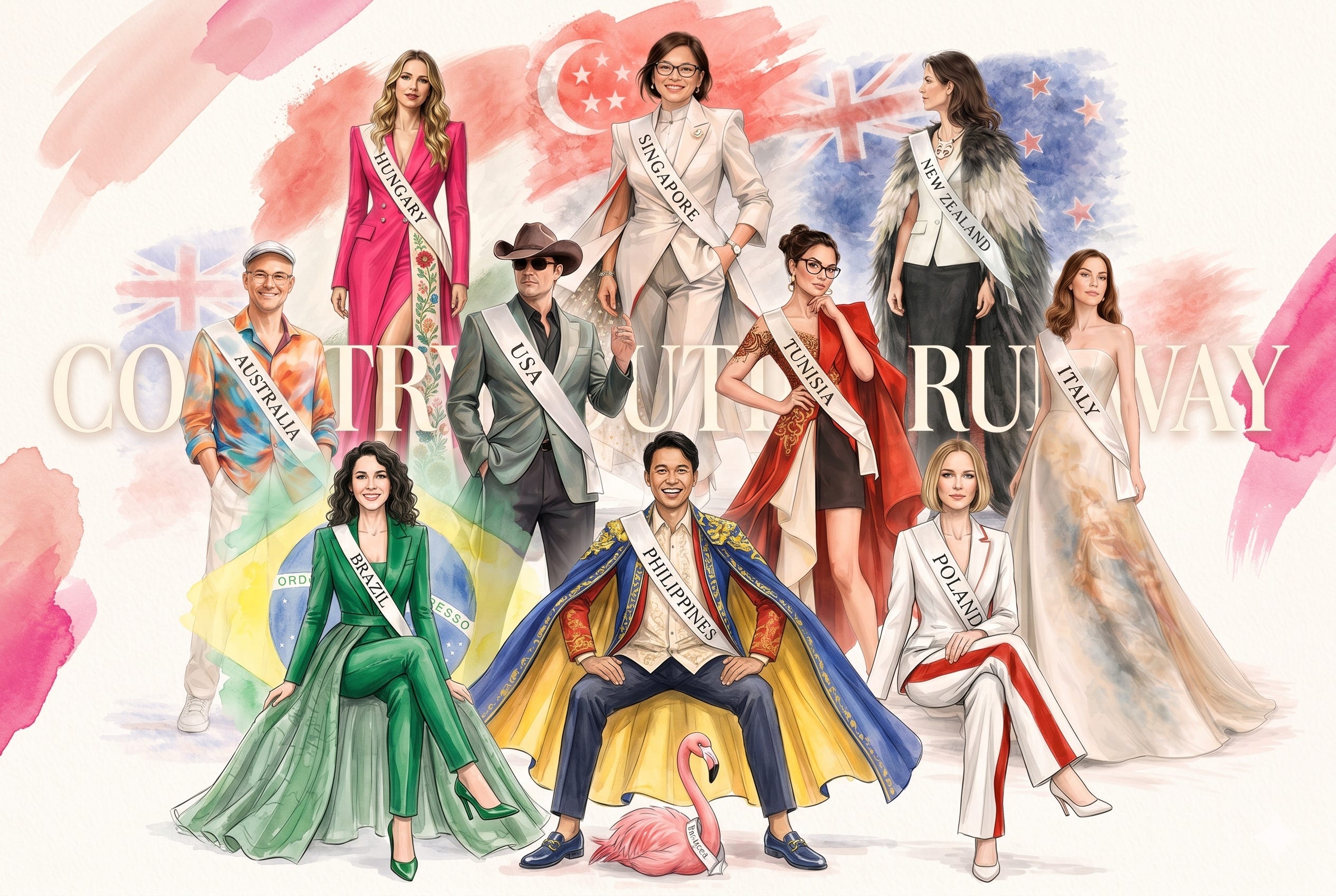
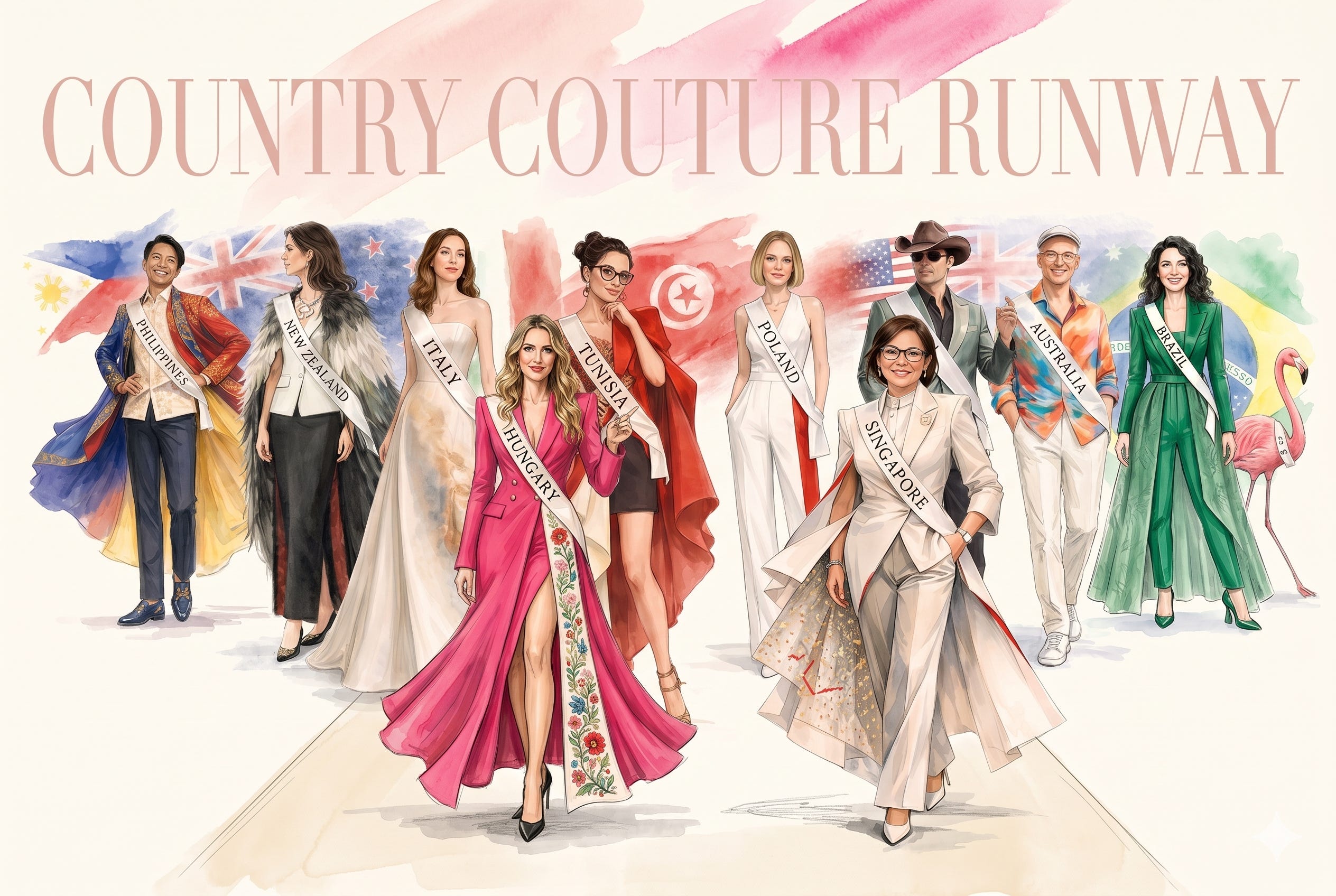
I made ten outfits for different Substack creators. Then I built you a prompt so you could make your own.
The full story of why this idea exists, and why it matters, is Monica Goh’s. I’ll hand it to her now.
Hey, I’m Pinkie. On this corner of the internet, we build your entire visual brand system using AI, one step at a time. If you’re new here: welcome. Honestly, this might be the best time to join. start here! 🩷🦩

Why we’re treating countries like brands (and why it actually works)
How personality archetypes translate into fashion illustration prompts
A free fillable prompt generator to create your own country couture character


Monica Goh: Today is April 25th. Supposedly, in Rhode Island, it’s “not too hot, not too cold. All you need is a light jacket.”
I quoted that in my Rhode Island collab with Stephanie Obodda three weeks ago and tried to move on. Except I didn’t move on. Because once Miss Congeniality is in your head, it stays there. One quote led to another. Another led to a rewatch. The rewatch led to a rabbit hole. And the rabbit hole led here.
Twenty-six years since Gracie Hart tripped onto that stage in a dress and gel-stiffened hair. And somehow it still has things to say.
I was five years old when Singapore hosted the Miss Universe pageant in 1987.
I don’t remember any of it. I was five. But my mother remembers. And years later, when she found out about my Miss Universe obsession, she told me something I have never quite gotten over.
She asked me if I wanted to audition to be a Little Sister.
Little Sisters were local girls paired with a Miss Universe contestant. They walked the stage together during the evening gown competition. They sang. They were, by any five-year-old’s measure, the luckiest girls in Singapore that week.
I said no.
The pageant came and went without me. Watch the video here.
I think about that five-year-old sometimes. Terrified of something she couldn’t name yet. Standing at the edge of something wonderful and stepping back.
She had no idea she would spend the next two decades glued to every Miss Universe final. Recording the pageant on VHS. Hunting down homemade DVDs of editions she’d missed. She’d even spend money buying homemade DVDs from other Miss Universe fans. An act that made her mother sigh and shake her head in disbelief.
Memorising winners and their answers like other kids memorised football scores? Easy peasy.
Miss Namibia, 1992. Michelle McLean. “I would speak to the children. Let them know that I’m there for them, because they are the foundation of every nation.”
Miss USA, 1997. Brook Mahealani Lee. “I would eat everything in the world. You do not understand. I will eat everything twice.”
That last one I still say out loud at least once a year. Usually near a buffet.
Here’s what Miss Congeniality understood that a lot of people didn’t, and still don’t.
The women in that pageant weren’t the joke. The joke was everyone who assumed they were.
Gracie Hart spends the first act of the film doing exactly what the critics do—rolling her eyes, muttering about bimbos, convinced that any woman who walks a stage in heels must have checked her intelligence in at the door. And then she meets them. Actually meets them. And they are funny and ambitious and competitive and kind and entirely capable of holding a conversation that doesn’t involve swimsuit wax.
“I used to be one of them,” she says at the end. “And then I came here and I realised that these women are smart, terrific people who are just trying to make a difference in the world.”
And then my brain did that thing it always does. It went local. I started thinking about the Singapore contestants I grew up watching. The ones I didn’t just watch—I rooted for. Like it mattered more than I admitted.
Eunice Olsen. I remember thinking: this one feels different.
Nuraliza Osman—seven languages. I didn’t even speak two properly at that age.
Cheryl Tay. Vet. Beauty and brains and a stethoscope. I thought: okay. This might finally be it.
Nothing. Not one of them cracked the Top 10.
We haven’t placed in the Top 10 since 1987. The year we hosted. The year five-year-old me said no.
I wonder sometimes if the problem was never the women. I used to think we just didn’t send the “right” one. But now I wonder if that was never the problem. Maybe the world just didn’t quite know what to do with Singapore yet. We knew who we were. I’m not sure they did.
Twenty-six years later, Miss Universe has changed more than Gracie Hart could have predicted. No upper age limit. Married women. Mothers. Transgender contestants. The stage that once had a very specific idea of who belonged on it has quietly, imperfectly, genuinely widened.
And the world they’re walking into has changed too.
When every contestant used to answer world peace and the audience laughed — I wonder if they’d laugh now. Looking at the state of things, world peace sounds less like a pageant cliché and more like something we’re all hoping someone, somewhere, is still working on.
And then there’s Jennifer Hawkins. Miss Universe 2004. Asked what era and gender she would choose to be born into, she said: a woman, now, in this modern era. Because women have freedom. Because we have a voice.
I agree with her. We have more say than ever before. And we still have a long way to go.
But I’d do her one better.
I’d like to be born today. Right now. In the hopes that by the time I grow up, women would have an even stronger position than we do at this moment. Not because now is enough. But because now is the foundation.
Jennifer Hawkins chose this era.
I’m betting on the next one.
Subscribe to Monica’s Substack page: The SIA Brat Studio —eclectic, opinionated, and curious—thinking out loud about travel, pop culture, family, and technology. This studio is for fellow eclectics who think in layers, connect dots across ideas and genres, and build beyond a single lane.
Here’s the thing I’ve always loved about Miss Universe that I’ve never quite known how to say.
It’s not really a beauty pageant. Or it’s not only a beauty pageant.
It’s a country showing up. Saying: here we are. Here is what we eat, what we wear, what we value, who we are when we put our best self forward. The evening gown isn’t just a dress. It’s a flag in fabric form. The national costume isn’t just a costume. It’s a story.
The Olympics, but with better outfits and more emotionally honest answers.
And once I saw it that way, I couldn’t unsee it.
Which is how I ended up in a conversation with Pinkie.
Pinkie runs AI Meets Girlboss on Substack. She is a branding expert who uses AI to build voice systems, visual identities, and couture looks that stop you mid-scroll. She’s also the person who will hand you the prompt at the end and say: now you try. She builds things that invite people in. It’s her whole philosophy.
But here’s the part that clicked for me. She doesn’t just make things look good. She figures out what something is before it even knows how to say it.
Personality types. Archetypes. All those frameworks I used to think were a bit… abstract. She uses them like a translator.
Like every brand is already speaking… just in a language we haven’t learned yet.
She’s done it for creators. She’s done it for companies. I wonder what she’d do with a country.
Because if Miss Universe is really about nations showing up as themselves—and I think it is—then every contestant isn’t just wearing a gown. She’s carrying a brand. A personality type. An archetype. Is Singapore the Sage? The Everyperson? The Ruler who pretends to be the Everyperson? Is France even capable of being anything other than the Lover? Is Japan the most INTJ country on earth?
And then I had a slightly unhinged thought.
What if you treated a country like a brand?
Not in a corporate way. Not in a tourism-board way. But in the way Pinkie sees things. As a personality.
Because if Miss Universe is really countries showing up as themselves, then every contestant isn’t just wearing a gown. She’s carrying a brand.
So I told her what I’d been thinking.
And she didn’t pause.
She just went: what if we actually did something with this?
Not a think piece. Not another observation. Something… participatory.
Her idea: reach out to writers from different countries. Ask them four questions. What’s your country famous for? What’s your favourite national dish? What’s the best season to visit, and what would you wear for a night out? Then take their answers and build a runway look from them. Not generic. Not stock photography. A look that comes directly from their answers. Their country. Their story. Their couture.
And maybe—just maybe—their brand archetype too.
I thought: yes, of course. It’s brilliant!
And then it hit me.
Oh.
This is my second chance. To represent Singapore on a global stage. To step onto the stage I was too terrified to step onto at five years old.
If I’m going to ask other people to be brave — I should go first.
I volunteered myself. Obviously.
I’m not so little anymore.
But I’m still a little nervous.

AI Meets Girlboss: The same instinct that made me turn 22 female AI writers into fashion illustrations made me say yes to this immediately. Countries are just brands with better catering.
So, how did we create the Country Couture Runway?
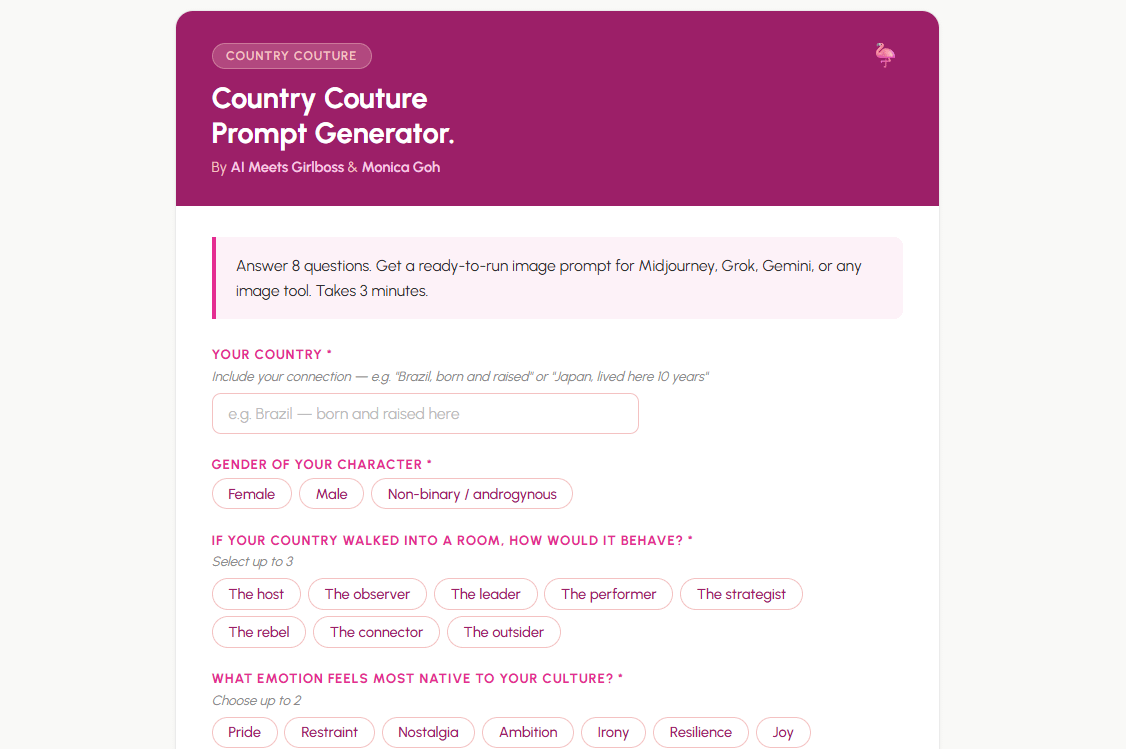
Every creator filled in the Country Couture Prompt Generator with their archetype, their values, their style rules, and — the part that made all the difference — their central tension. Those inputs were translated into fashion and thus the outfits emerged. The basis wasn’t stereotypes or flags, but the actual tensions, caharcteristics of the countries each creator represents.
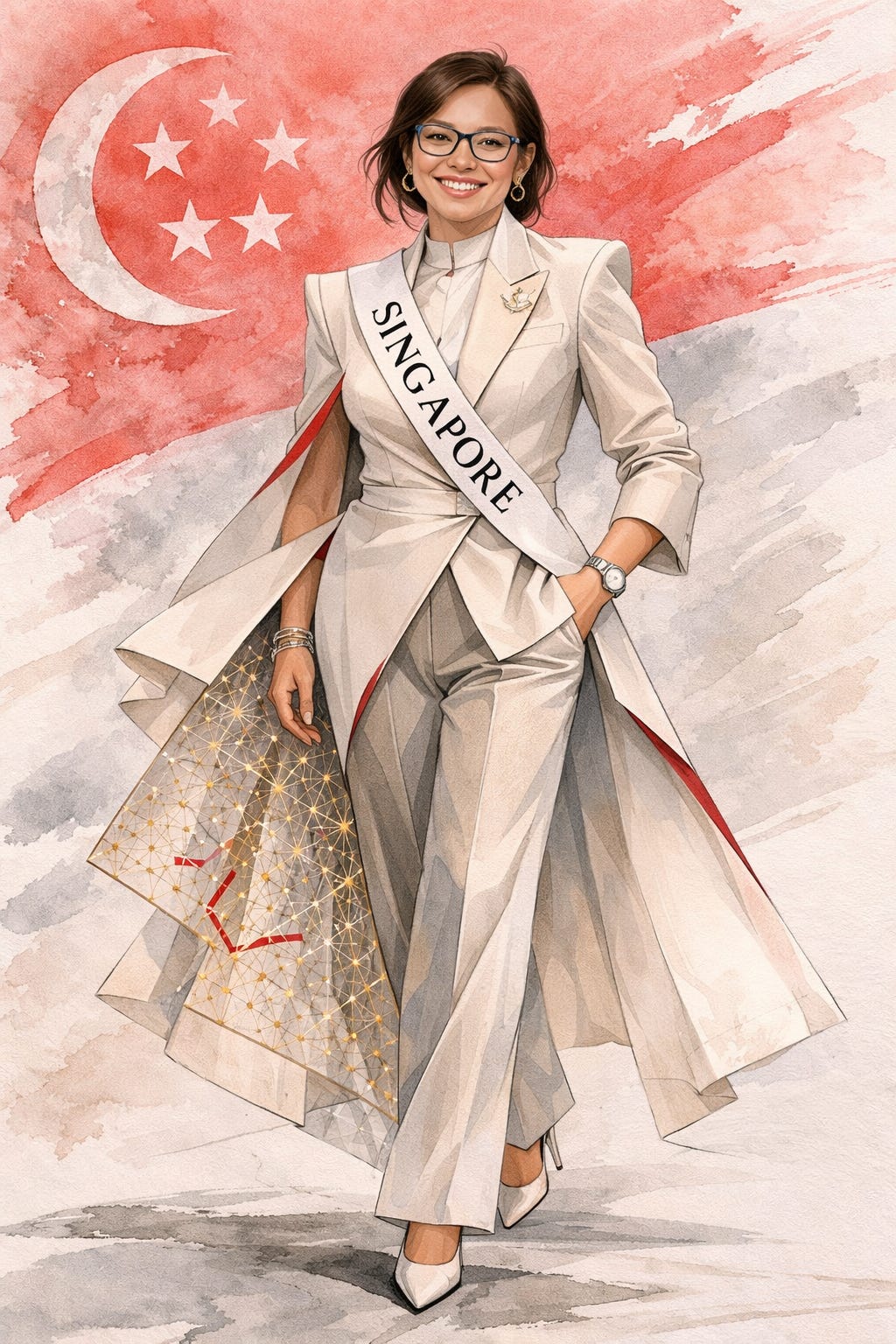
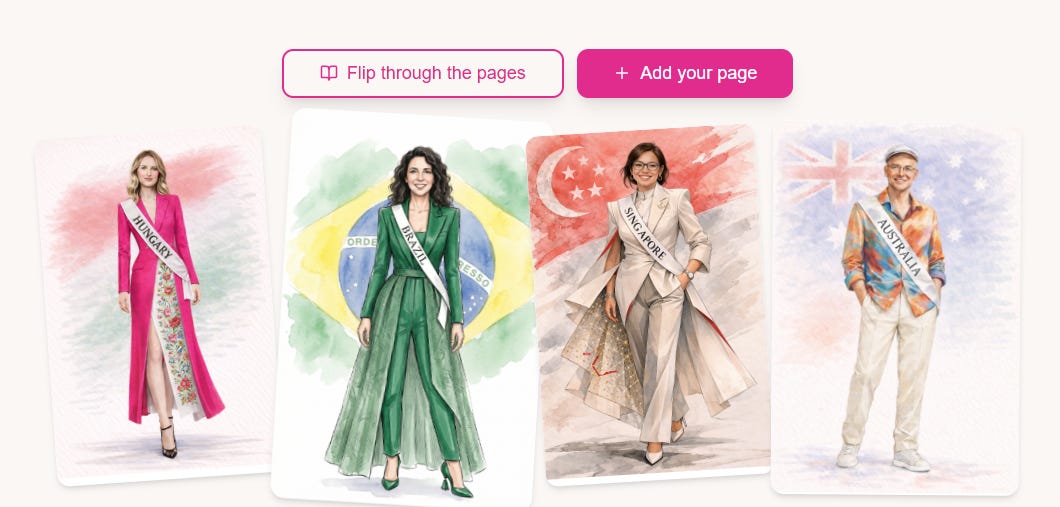
Singapore — Monica Goh. Host, Connector, Observer. Monica has lived almost her entire life in Singapore — a city-state that charted its own course, allied to no one, mistaken for many. A precisely tailored silhouette in clean lines and quiet neutrals reflects that discipline and ambition. Soft movement beneath the structure reveals a cosmopolitan connector at heart, confidently navigating the space between control and freedom.
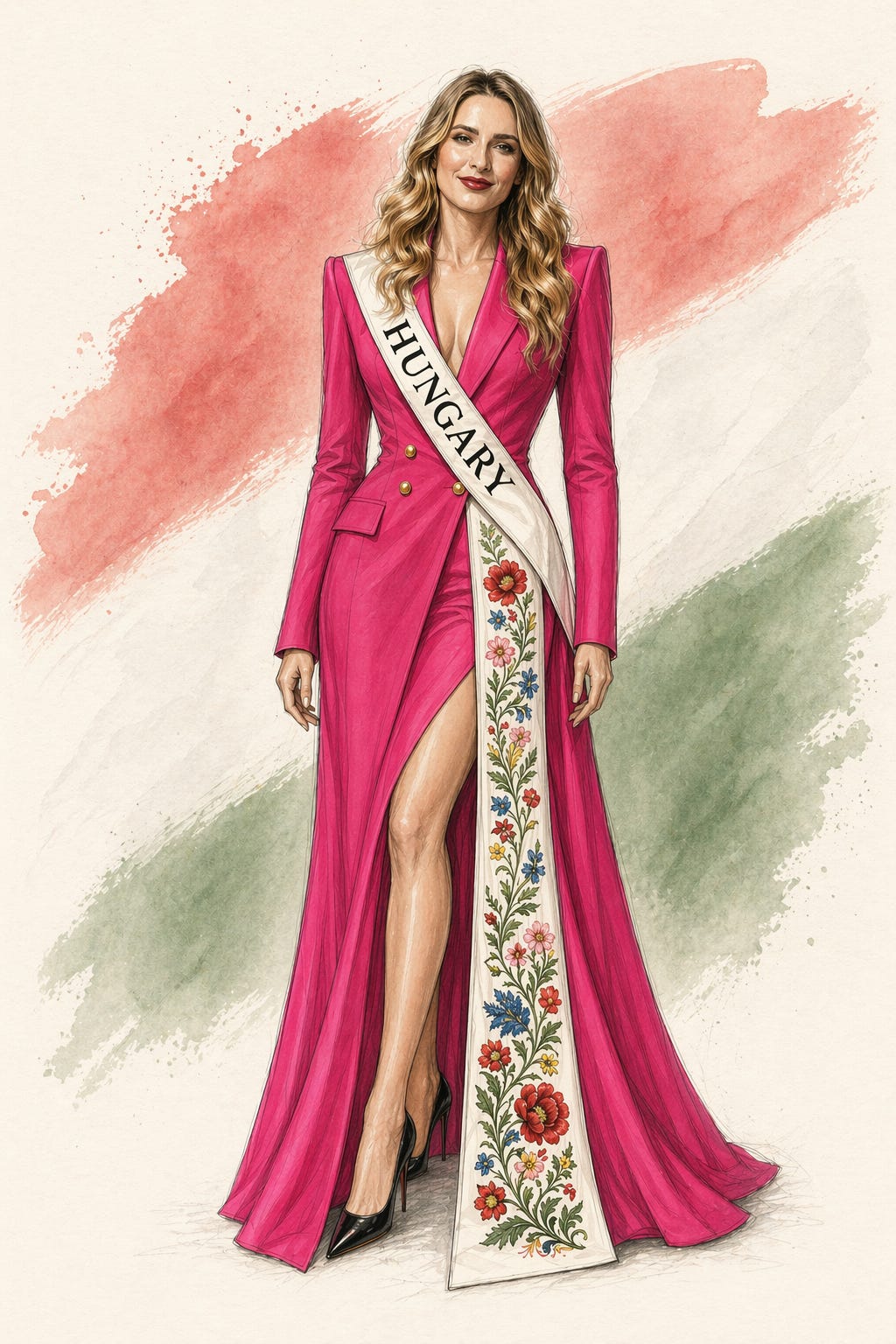
Hungary — AI Meets Girlboss. Rebel and Outsider. Born and raised in Budapest, never quite fitting the script. A sharply tailored silhouette speaks to years of resilience and restraint, while intricate folk embroidery underneath reveals the warmth and love for national belonging beneath the surface. Cut in vivid pink and opening at the stride, the look suggests a nation — and a person — stepping into a freer, brighter chapter.
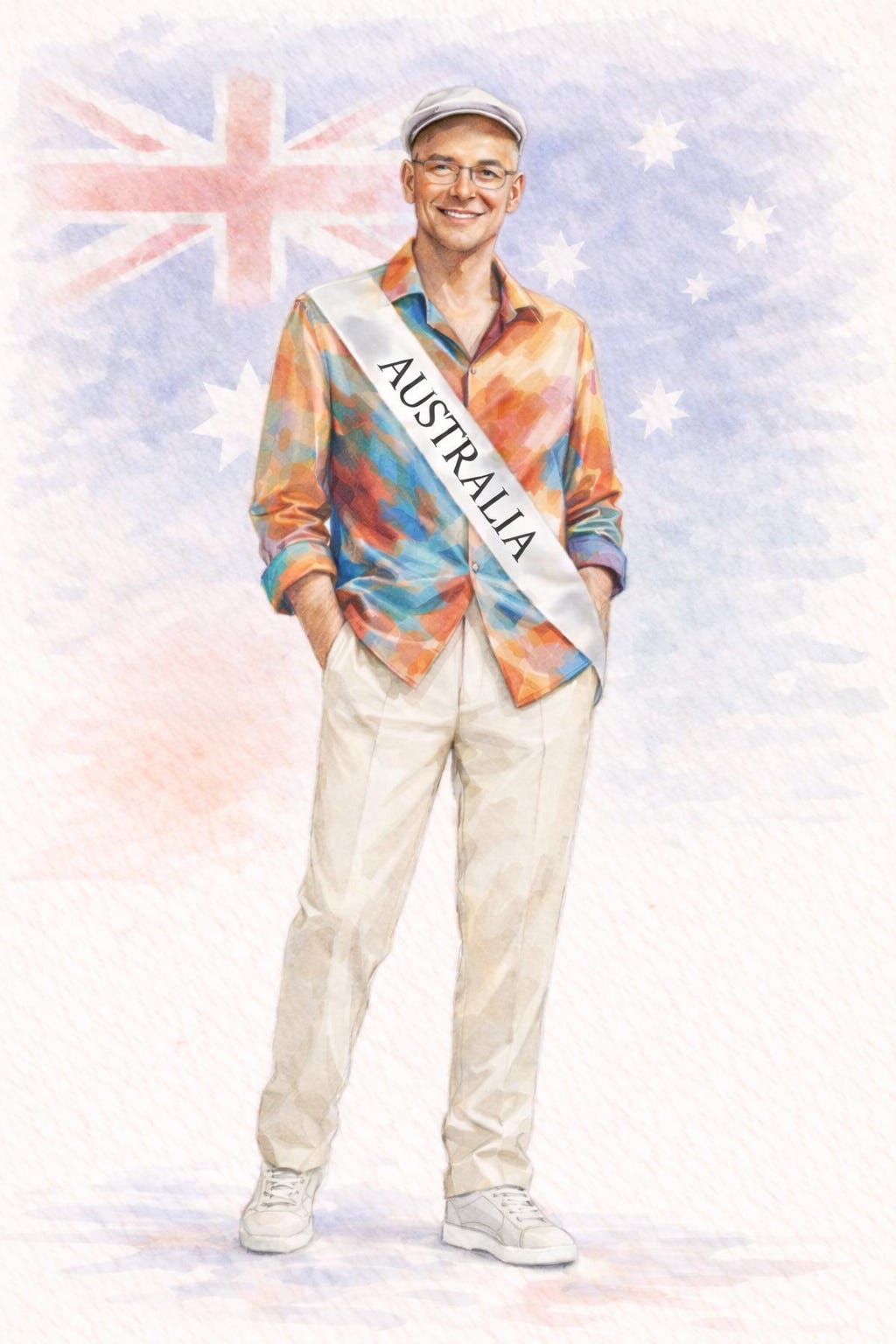
Australia — Mike Searles. Performer, Rebel, Connector. Born in Australia in 1958 and never left — which tells you something about the loyalty. A boldly painted open shirt worn with easy white trousers signals a country that leads with colour and warmth, with no patience for pretension. The relaxed silhouette carries genuine pride without performance.
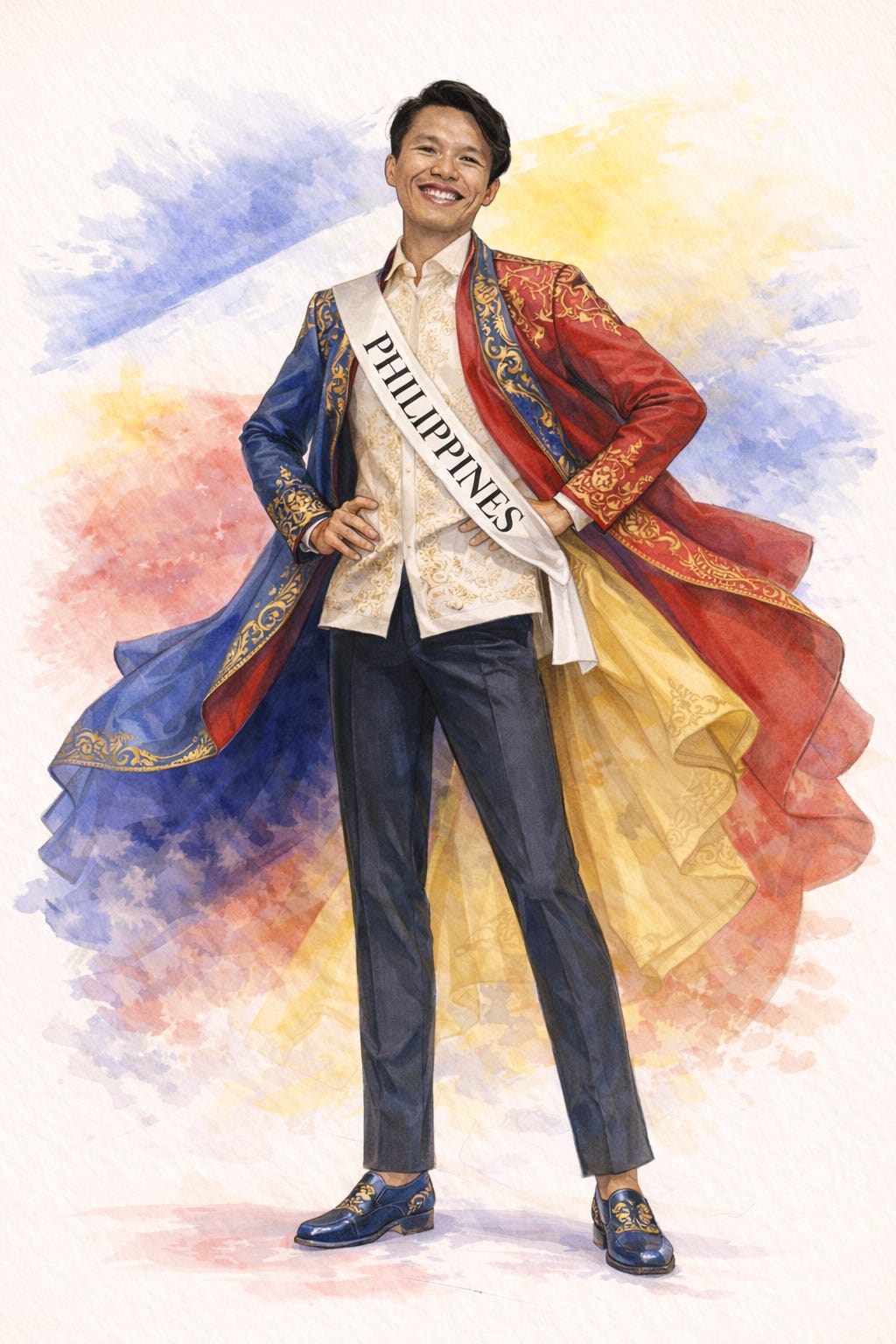
Philippines — James Presbitero. Host, Performer, Connector. Born and raised, carrying the full weight of it. A blazing cape in flag colours and a richly ornamental jacket arrive like a celebration that was decided long before the room was entered. The joy here isn't naivety — it's a position. "We are a hardened, jaded people who choose to be happy anyway." The outfit wears that choice on every surface.
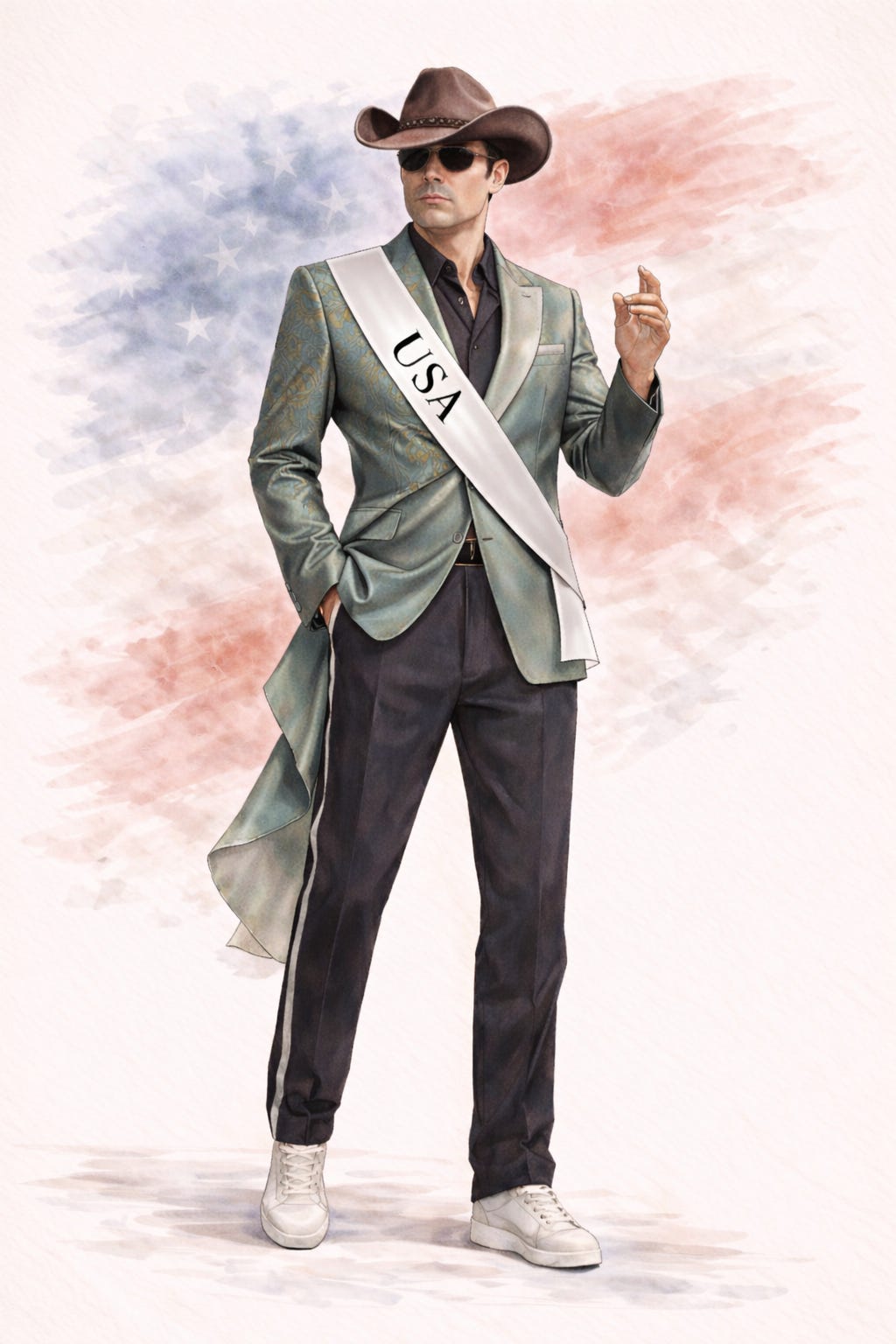
USA — Mack Collier. The Host. A Statue of Liberty-green tailcoat, slim dark trousers, white sneakers — America’s central contradiction dressed as one man. Grand in gesture, casual in exit. The romantic tailoring speaks to a country that still believes in its own mythology; the sneakers admit it doesn’t take itself too seriously. Tradition and innovation, sharing a collar.
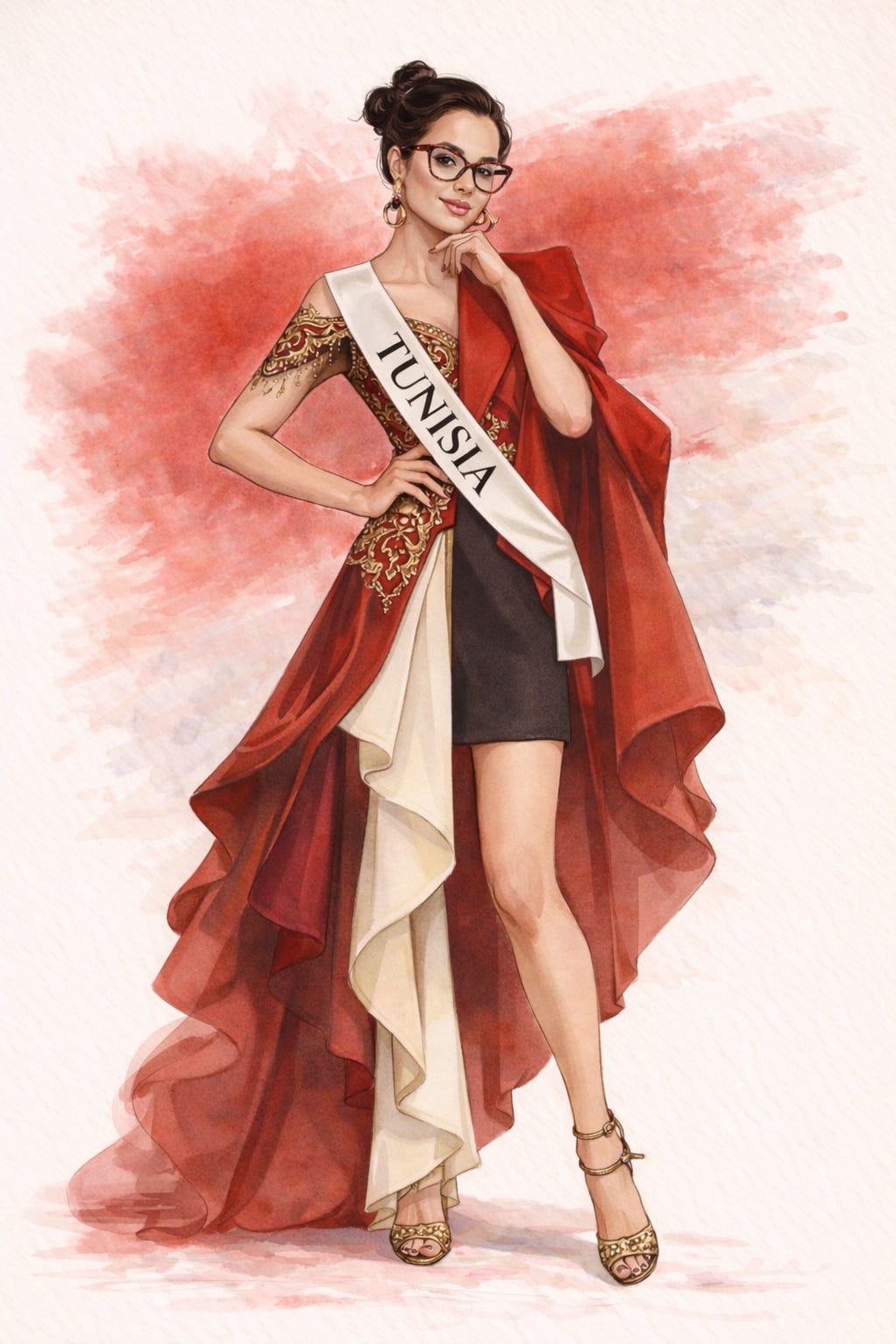
Tunisia — Traveling Amal. Host, Performer, Rebel. Born and shaped by Tunisia. A red cape thrown over a sharp, body-conscious base turns the room before a word is spoken. Heritage announces itself loudly, then steps aside for something entirely its own. Nothing minimal. Nothing apologetic. A country that has been underestimated long enough to know exactly how to walk into a room.
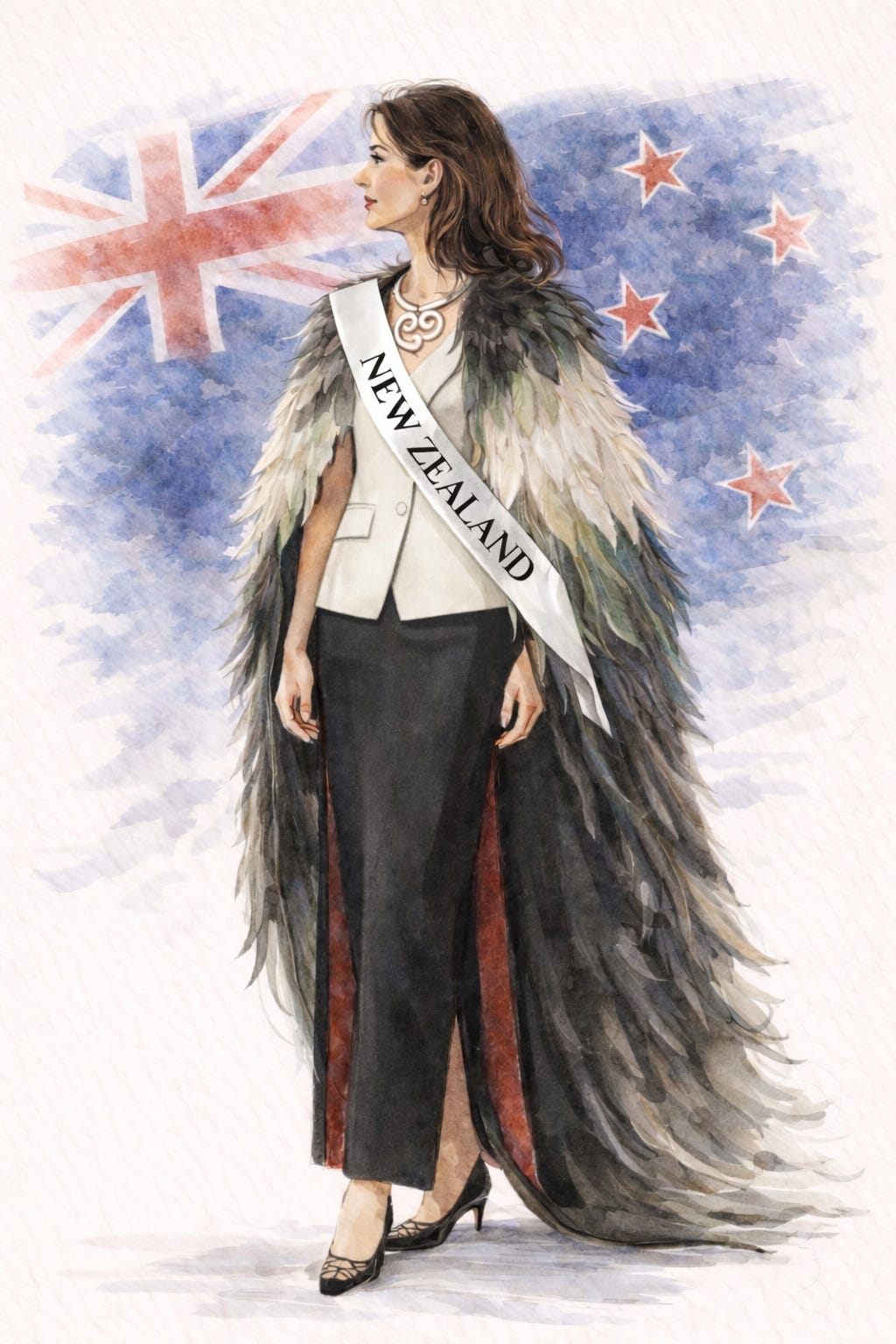
New Zealand — Dallas Payne. Host and Connector. Born here, European heritage, deeply aware of what that means on this land. A feather cloak worn over sharp tailoring holds the bicultural weight of a nation that opens every gathering with formality before it offers warmth. The bone carving at the throat is lineage, not decoration. The outfit honours Māori influence without crossing into appropriation — a distinction Dallas named clearly and we followed exactly.
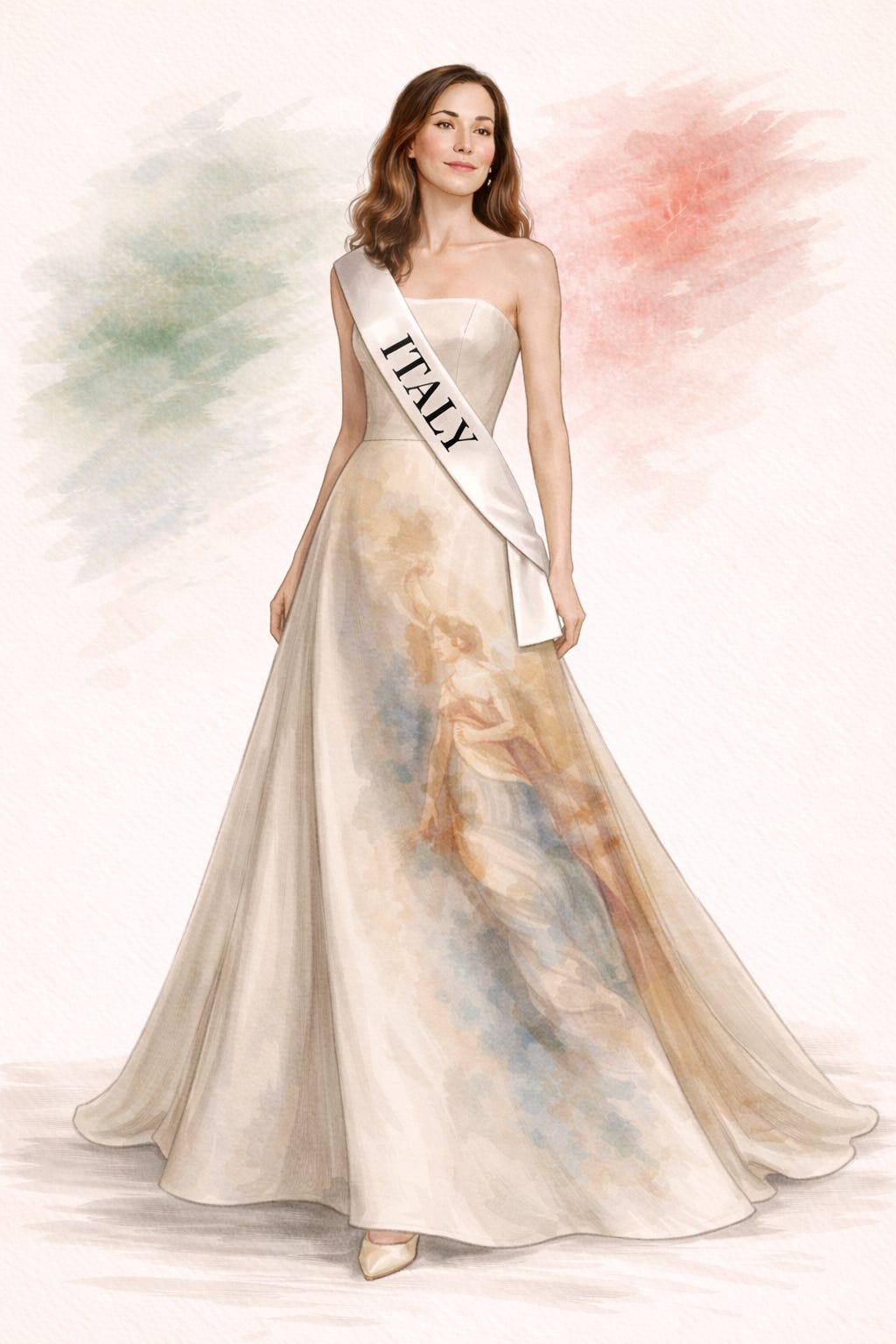
Italy — Cristina. Observer and Connector. Born and raised in Rome, which means growing up inside the argument. A floor-length gown rendered in the swirling forms of a Renaissance fresco — Michelangelo's palette pressed into a modern cut. "We only eat pasta — in reality our cuisine is varied." The same case, made in fabric: ancient on the surface, entirely alive underneath.
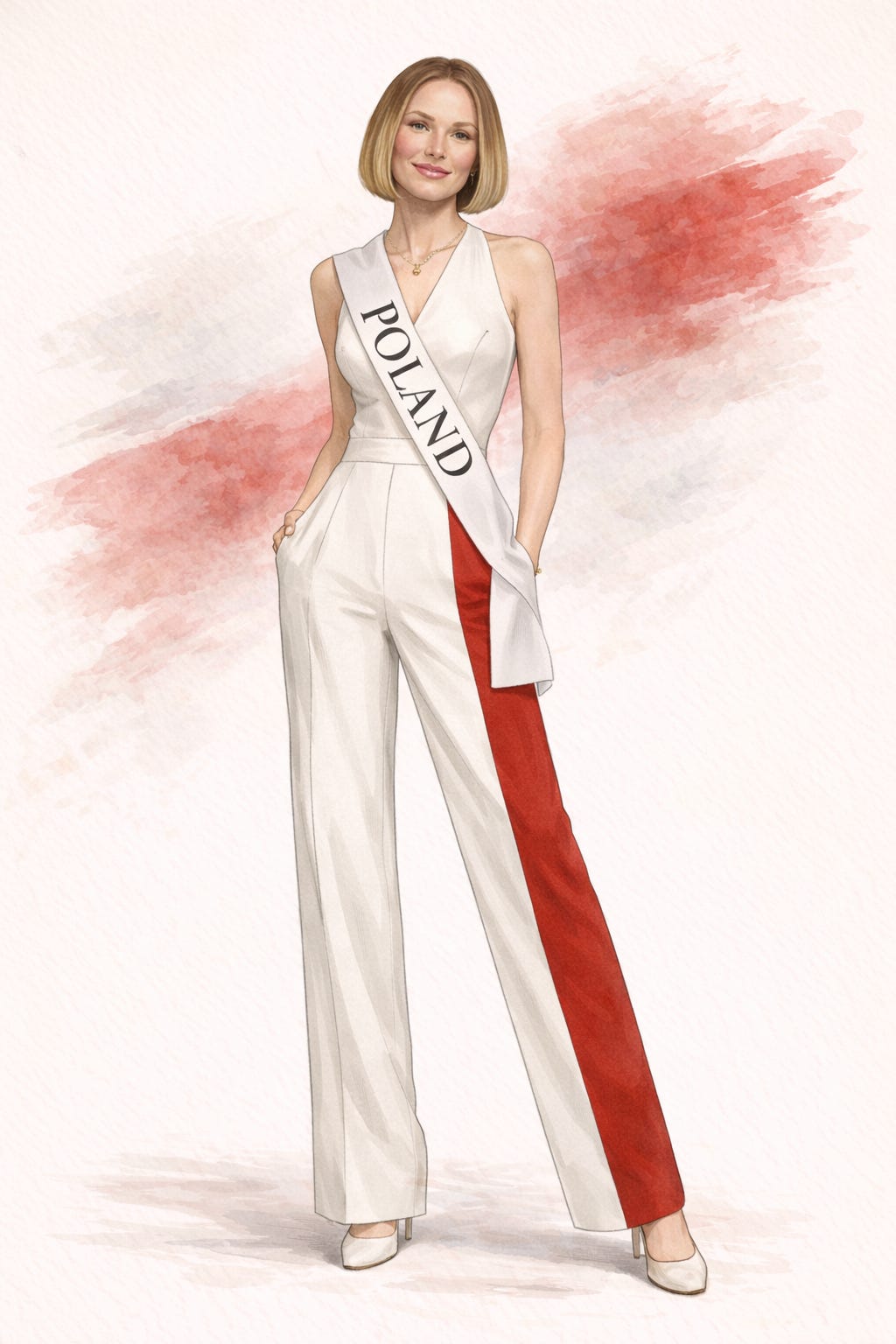
Poland — Anna | how to boss AI. Host, Observer, Strategist. Born in Poland, now living in the USA — holding both. A white suit with a single stroke of red: precise, intentional, nothing wasted. "We value transparency over guessing games." The tailoring makes the same argument. Ambition carried quietly, stability held in the spine.
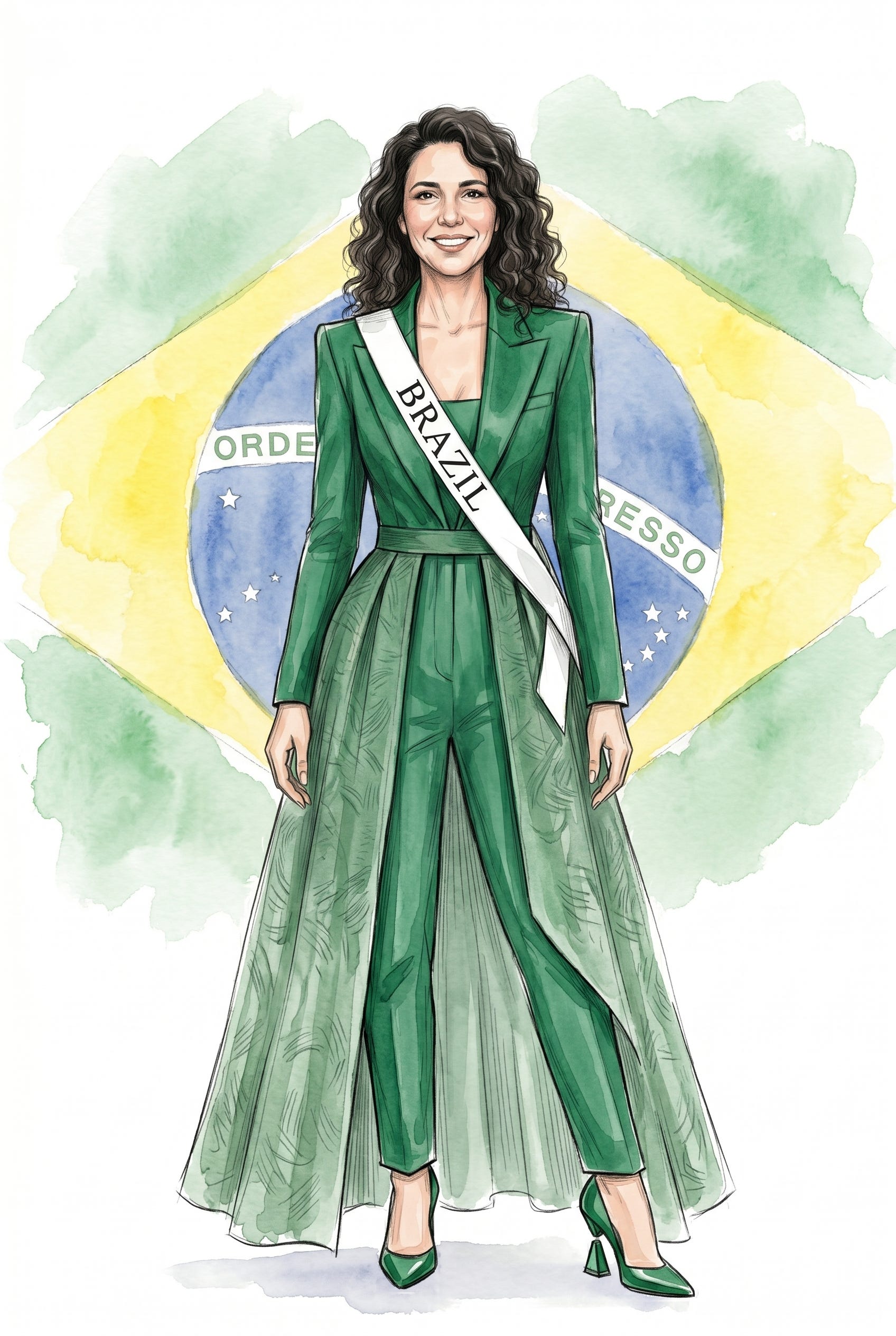
Brazil — Claire Machado. Host, Observer. A sharp green blazer-jumpsuit layered under a dramatic sheer overskirt, structured ambition on top, something fluid and alive beneath. A brain in constant overdrive, generating more ideas than can be executed, dressed accordingly: powerful, elegant, and entirely at home taking up space. Tradition holds the tailoring. The overskirt is where it gets interesting.

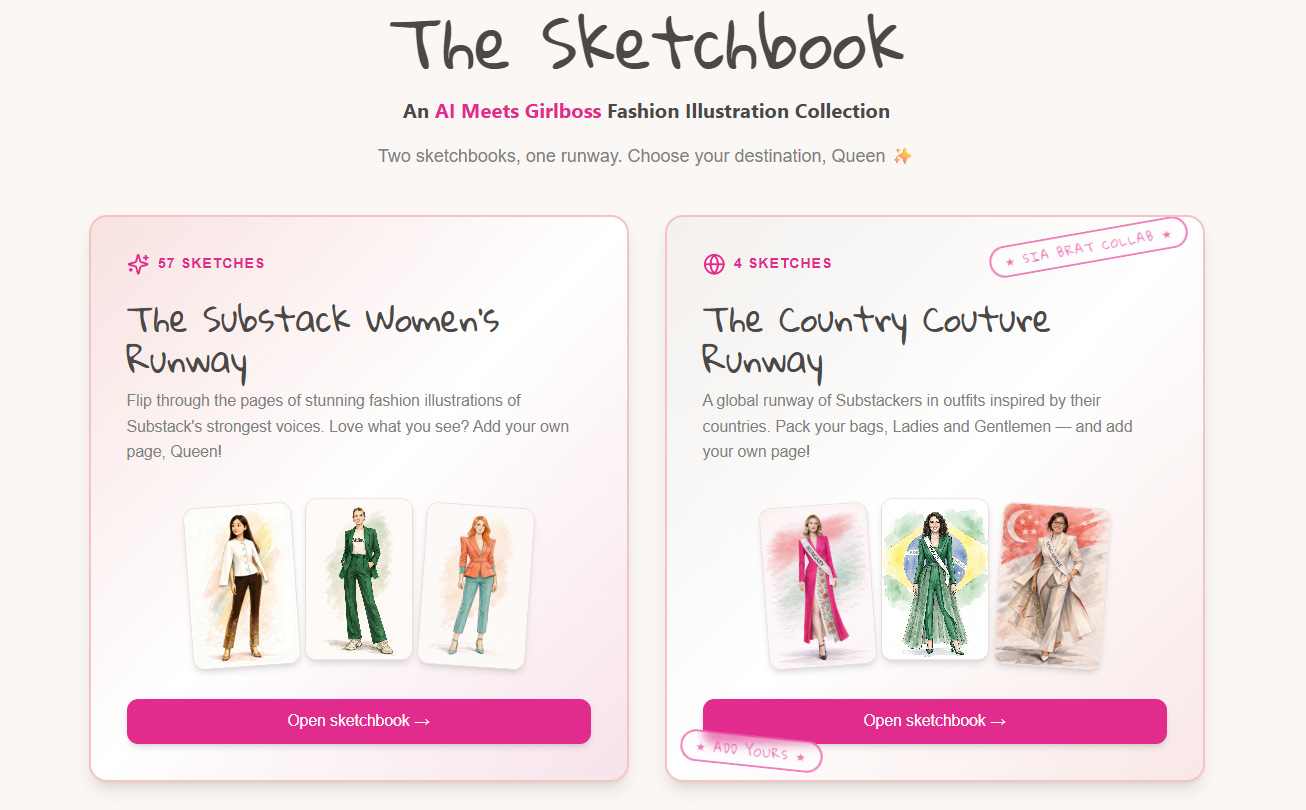
I vibe-coded a new page into the AI Meets Girlboss Sketchbook, called the Country Couture Runway — because after the Women’s Day Runway post, you asked for a thematic series, and I listened.
I recorded a full tutorial so you know exactly how this works — watch before you start.
Here’s the flow:
Go to the Country Couture Sketchbook and hit Add a Page
Open the prompt generator, answer 9 questions about your country’s personality, and copy your prompt
Take that prompt into your image tool (ChatGPT, Gemini, Grok) — attach a photo of yourself — and it will map your face onto the fashion illustration
Upload your finished page to the sketchbook
Everyone who contributes gets a shoutout in Notes — tagged and linked. And because we want the whole runway filled: 30% off an annual paid subscription for every page added. 🦩
Monica Goh: … it has been nearly forty years since we hosted Miss Universe.
1987. I was five. I said no to the stage.
We are not young anymore.
We have Jewel. We have Gardens by the Bay. We have a food culture that the world keeps showing up to eat and a multicultural vibe that the pageant, in its best moments, is actually trying to celebrate. We know how to put on a show. We know how to welcome the world.
I’m not saying we need to. I’m just saying — we could. And we’d be very, very good at it.
And I know the Little Sisters are no longer a thing, but maybe, just maybe, we could somehow incorporate them into the TV show. I was part of that world not too many years ago, I’m confident I can dream up some way to bring that back. And somewhere in Singapore, there is probably a five-year-old girl being asked if she wants to be part of something wonderful.
I hope she says yes.
So. April 25th.
Not too hot, not too cold.
All you need is a light jacket — or in Singapore’s case, a portable fan and the unshakeable confidence that our chili crab is better than anything you’ve had before.
Jennifer Hawkins chose this era. I’m betting on the next one. What about you?

Generate your character, run the prompt in your image tool of choice, and send me the result. Every submission that makes it into the sketchbook gets a shoutout in Notes — tagged, linked, and on the runway with the rest of us.
In the comments…
Drop your image in the comments or send it our way, tag us both in Notes — Monica is @thesiabrat and I’m @aimeetsgirlboss. The sketchbook is only as good as the community that fills it. 🦩
We want to see the whole runway.
And please subscribe to Monica Goh at The SIA Brat Studio as a thank you for coming up with this amazing idea!
Talk later, Girlbosses!
Monica, The SIA Brat & Pinkie 🩷

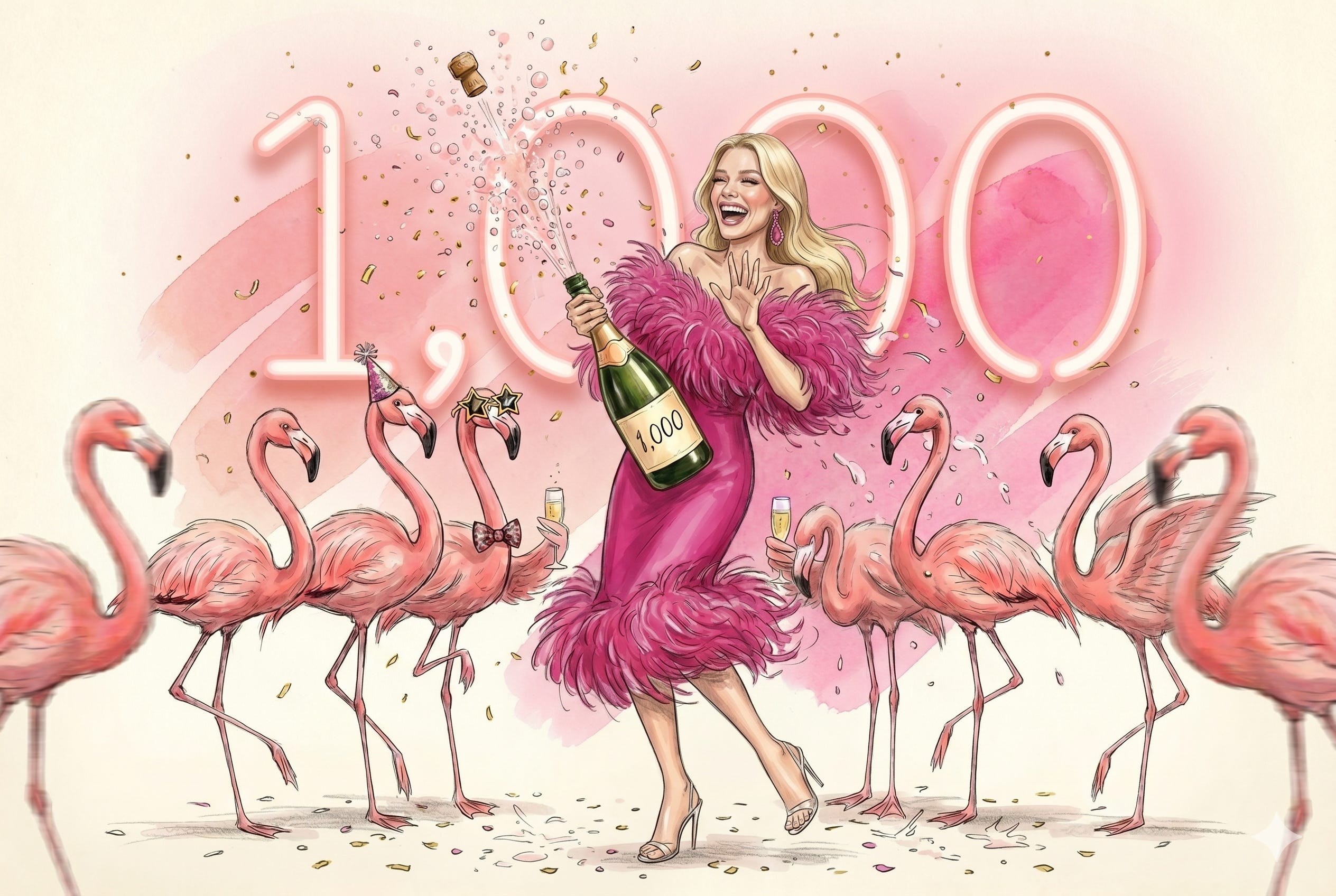
This week, AI Meets Girlboss crossed 1,000 followers, and I want to take a second to actually say that out loud and pinch myself. This community exists because you keep showing up, sharing, and building alongside me. Every post, every prompt, every sketchbook page… thank you!
I gave away three 100% off annual subscriptions to celebrate and the winners are:
🦩 New subscriber: Manuela Kouakou, MD-PhD
🦩 Post restacker: Eva, AI for Executives
🦩 Note restacker: Mack Collier
Congratulations to the winners and a warm welcome to the newest paid flamingos who joined this month: Donna, Christin, Stephanie Dianne, Kat, Nathalie Lethbridge, The Little Wins, 4 Degrees & Feelings: AI + Tea, Nina Restieri, j mikes, HannaD, Lee Hopkins
If today’s post made you think about your own visual brand, I am launching The Branding Flock, a 12-month visual brand program for Substack creators who are done guessing.
Full breakdown posts, real prompts, real outputs. Your color palette, your logo, your brand character, your content system — built step by step alongside the flock.
33% off closes after the first 100 seats. The discount lives inside your quiz result.
Comments
Nothing yet. Say the first thing.
Sign in to join the conversation.