
Standing on the TEDx stage yesterday was a surreal experience. I was deeply thankful for the opportunity to share a message I care about profoundly and equally aware of how urgent my message has become. Science communication should no longer be a bonus skill for scientists. It is essential, and it must be woven into how we train future scientists and physicians from the very beginning.
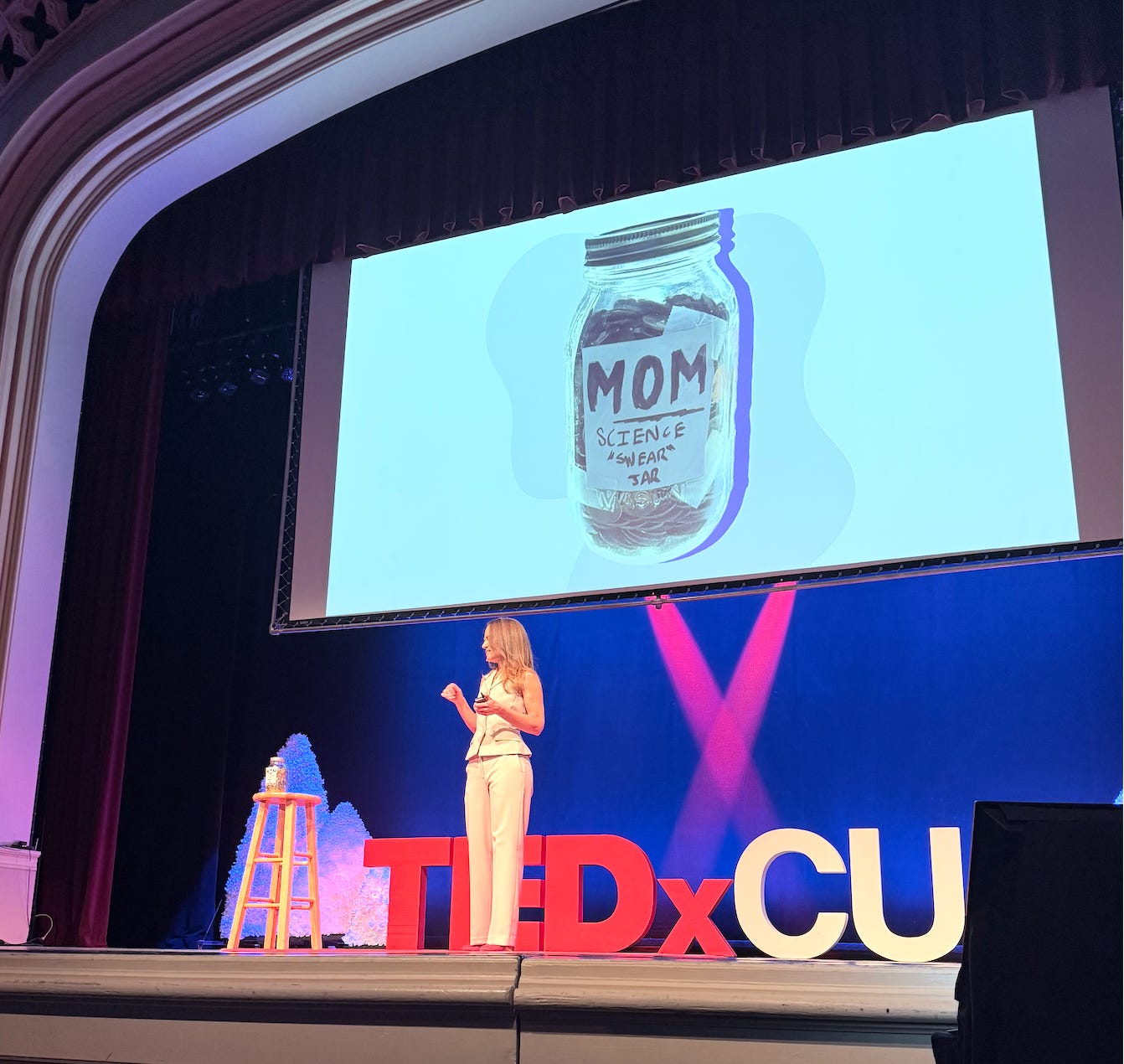
Part of the story I shared on the TEDxCU stage started 11 years ago when my daughter (at the age of 10) created a ‘science swear jar’ for me. The rule was simple: every time I started talking about science when no one asked, I had to put money in the jar - it filled up quickly! The joke, of course, is that scientists want to talk about science and often won’t stop talking about our science. Most of us are curious, passionate, and driven to share what we learn.
My ‘science swear jar’ also revealed something more serious: wanting to communicate doesn’t mean we know how to do it well.
As an immunologist and educator, I’ve spent years immersed in training programs that taught me how to think like a scientist - how to analyze data, write papers, and speak fluently in the technical language of immunology. What I didn’t learn through my 16 years of training was how to explain my work clearly to people outside my field. In fact, we’re inadvertently trained not to. The technical language or jargon becomes a badge of belonging, a signal of expertise, accuracy, and concise conversations. Over time we become very good at communicating only with one another in jargon that only we (in our specialized fields) understand.
That’s a big problem! Accuracy without clarity doesn’t build understanding or trust. Saying that vaccines “prime the adaptive immune system with an antigenic stimulus” is absolutely accurate but that means nothing to most people. On the other hand, explaining that vaccines safely train your immune system with a harmless version or piece of a pathogen (like the flu virus) so it’s ready and trained to fight the real infection is also accurate but easier to understand and connects science to lived experience.
The difference isn’t about oversimplifying - it’s about translating knowledge into meaning.
The consequences of failing to communicate with the public became painfully obvious during COVID. As evidence evolved and recommendations changed, the public questioned science more than ever. For the first time we - all os us - were living through the scientific process together. Unfortunately, no one in the scientific community explained that science is a process and that when recommendations change, it’s not because the process is broken, but because it was working exactly as intended.
During my TEDx talk, in an attempt to add clarity to the how the scientific process works through responding and updating to new evidence, I used a common item as an analogy - your GPS. Whenever our GPS reroutes us to the best possible route based on new traffic data, we all accept the update and are thankful for the new route. Science works the same way. Adaptability is a feature, now a flaw.
What the public should have heard from the scientific community was that revising conclusions in response to new data is one of science’s greatest strengths and that the process is working. Unfortunately, this message was not communicated in a way that landed with the public and without clear explanations for why the science was changing, misinformation (so much!) and confusion rushed in and eroded trust in science to an all-time low.
I’m so incredibly grateful to have had the opportunity to share my message on the TEDx stage. Science belongs to everyone, and communication is how knowledge becomes impact. If we trained scientists and physicians to communicate with the same intention that we train them to become scientists, we would change public understanding and build public trust.
I’m thankful, energized, and hopeful that this conversation continues.
Comments
Nothing yet. Say the first thing.
Sign in to join the conversation.