
On December 14, 2001, I defended my Ph.D. dissertation: “The Developmental Regulation of VH4.34-expressing B Lymphocytes. VH4.34 as an Experimental System for the Study of B cell Tolerance in Humans.”
The very beginning of my career in science is no different than my entire journey - it’s unusual. My research focused entirely on humans, not mice. This is ‘weird’ for an immunologist. Most immunologists use the traditional model system - the mouse - for most, if not all, of their experiments. I decided early on that I wanted to study the most important model system of all - the immune system within the human body. My thesis proposed that VH4.34-expressing B cells could serve as a model system for understanding B-cell tolerance in humans.
For 4.5 years, I worked seven days a week to unlock the story of VH3.34-expressing B cells. Most days I would start early in the morning (at lab by 7am) and most days I would work late into the night. I was driven by the timing of receiving human samples. If a precious human sample arrived at 2:00pm, that would be the starting point of my 12-hour protocol. It wasn’t unusual for me to eat breakfast, lunch and dinner at the lab. When I wasn’t isolating B cells from human tonsil tissue, blood, bone marrow, or spleen, I was writing up results or reading the literature to strategize my next steps. Most mornings I would wake remembering dreams where I had plotted my next set of experiments. Needless to say, I was obsessed with this project.
December 14, 2001, marked the culmination of my relentless curiosity, countless late nights in the lab, and endless experiments driven by one big question: How do human B cells learn tolerance? How do they learn to not react to the cells in our own body? Basically, how is autoimmunity - an immune response to our own tissues - averted?
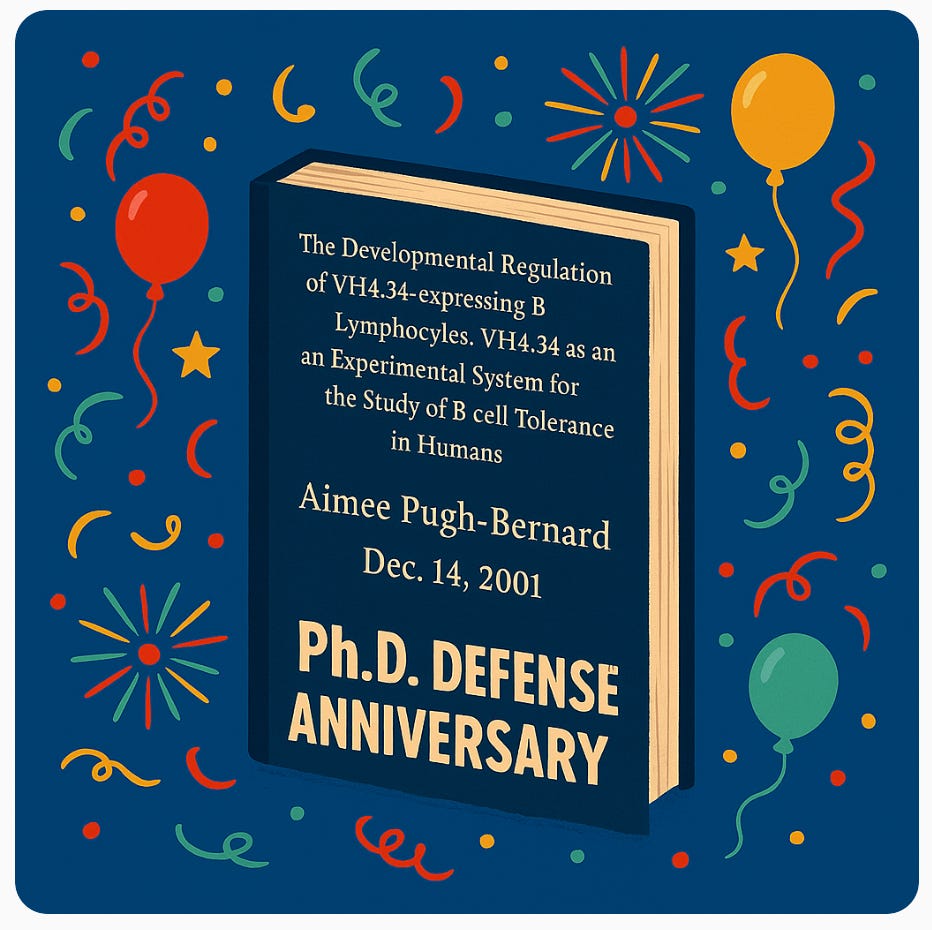
visual created by copilot with the prompt, “create a visual for an instagram post to celebrate the anniversary of my PhD defense. Make a dark blue book in the center of image surrounded by festive designs to convey a celebration.”
Yes, years of immunology research has allowed us to understand there is central tolerance in the primary lymphoid organs (e.g. bone marrow and thymus) where self-reactive B cells and T cells undergo negative selection (elimination by programmed cell death) if they react to bits of self-antigen being ‘shown’ to them as a test. We also know that there are layers of tolerance in the periphery, within areas called the peripheral lymphoid organs that include the blood, lymph nodes and spleen. Yes, we know all of this at a generic level but we (immunologists) never followed a specific cell through the human body to track what happens. That’s where my model system stepped in…
My work demonstrated that VH4.34-expressing B cells are a true model of human B-cell tolerance. In healthy individuals, they tend to be suppressed or kept out of the circulating B-cell repertoire and in most cases are not allowed to progress into or beyond the germinal center. These cells only seem to escape control in individuals prone to autoimmune disease, particularly those with Systemic Lupus Erythematosus (SLE). Evidence of this comes from analyzing autoantibodies from patients with lupus. The terminal or final phase of a B cells life is to become a plasma cell, which is basically an antibody factory. You can find VH4.34-encoded autoantibodies in roughly half of lupus patients. This suggest that VH4.34-expressing B cells are allowed to progress through development in individuals with lupus. This is not true for healthy individuals. VH4.34-expressing B cells seem to be kept in check and not allowed to progress to plasma cells in healthy individuals. There is clearly some layer of tolerance – something keeping these cells from progressing – in healthy individuals that is ‘broken’ in the immune system of individuals with the autoimmune disease lupus.
If you’re curious, you can read the full story here: https://pubmed.ncbi.nlm.nih.gov/11581307/
You can also read an extension of my work here: https://pubmed.ncbi.nlm.nih.gov/15034044/
Fast forward 24 years, and I’m still passionate about science and education but my pipettes and petri dishes have been replaced with lectures that inspire the next generation of scientists and healthcare professionals. Teaching future physicians, researchers, and educators is one of the most rewarding parts of my career. I strive to help them not only understand the complexities of immunology but also appreciate the curiosity and resilience that science demands.
Beyond the classroom, I’ve embraced science communication to share the impact of science with the broader public. Science doesn’t live in isolation. Science shapes our health, our policies, and our daily lives. Through community-based conversations, public talks, and digital platforms, I strive to make science accessible, engaging, and relevant. My goal as a science communicator is to bridge the gap between scientists and society, empowering people to make informed decisions and appreciate the impact of science to improve lives and the world around us.
Cheers to the journey, the relentless curiosity that gets us out of bed every day, and the resilience that science teaches us.
Comments
Nothing yet. Say the first thing.
Sign in to join the conversation.