

One of my favorite ways to learn AI is to watch how other people use it in their actual work.
You can learn the features of a new AI tool from a tutorial. But when someone walks through a process they use every week, you see the decisions behind how they use the tool—where they bring AI in, what they still do themselves, and which parts needed more system before the output became useful and closer to the quality bar we want.
I recently stumbled upon Alex Lieberman’s episode of How I AI with Claire Vo. Alex co-founded Morning Brew, and in the episode he demonstrated the content system he now uses at Tenex.
He calls it his Content Machine.
The system finds potential ideas in Alex’s company activity and recent posts from a handpicked list of X accounts, LinkedIn creators, and websites. Once he chooses one, an Interview Panel questions him to pull out stories, examples, opinions, and objections. Its six personas are modeled after Tim Ferriss, Joe Rogan, Barbara Walters, Howard Stern, Michael Barbaro, and Larry King.
The transcript becomes the raw material for a draft written with his voice files. A Writer’s Council then reviews it through personas modeled after Morgan Housel, Tim Urban, Greg Isenberg, David Perell, and Shaan Puri, plus an AI slop detector.
Alex makes the final edit, and the system proposes lessons he can choose to save for future drafts. And, there is even another step that adapts the finished piece for different platforms (X, LinkedIn, Threads, etc).
I already had versions of some of these ideas in my own writing process. I have my own voice guide. I sometimes ask AI to interview me, or I just brain-dump everything to AI and let it help me pick one idea that’s worthy of becoming the main argument. I also have separate editorial agents that review my drafts.
What I had never done was connect them into one clear sequence.
That was the part I kept thinking about after the episode. Alex had taken several things I was doing separately and turned them into a process where the output from one stage becomes the input for the next.
So I built a more compact version for myself that you can adapt as well.
A common AI writing process begins with rough notes, or by prompting the AI to write something for you.
If the output feels generic, we usually respond by changing the prompt. We add more style rules, provide another example of our writings, or ask the model to rewrite the vague sections to make it clearer.
Those fixes help when the problem is presentation, because they improve a draft you’ve already thought through. They matter much less when you still don’t know what to write in detail. You have a rough idea, but it’s still hard to pull the actual thoughts out of your head and onto the page.
A voice guide can tell AI that I prefer plain words, normal paragraphs, and a conversational tone. It cannot recover a story I never shared. It cannot explain why I believe something if I have not worked through the reason myself. When the source is missing, the model has to bridge the gap with a plausible guess. That’s what we call hallucination.
Alex’s workflow deals with that problem before drafting. The interview keeps asking questions until there is enough material to work with.
This interview process works especially well with voice-to-text. Alex uses Wispr Flow, and I can see why. When I answer out loud, I can brain-dump the story, correct myself halfway through a sentence, and keep talking until the point becomes clearer. The transcript captures much more than I would normally put into a polished prompt.
It’s like having a ghostwriter who is curious about your experiences and wants to sharpen your argument.
By the end of the interview, the model has a transcript filled with the writer’s answers. It has stories, examples, objections, and opinions to work for.
Then the review process brings in five separate subagents. One looks at the structure, another looks at the hook and retention, another focuses on the writing itself, another checks for generic AI patterns, and the final reviewer looks at the piece from the reader’s perspective.
After I make the final edit, the last process compares the first draft with the version I approved. It looks for the corrections I keep making and proposes the ones worth carrying into future drafts.
Once I looked at the process this way, I could see four different jobs:
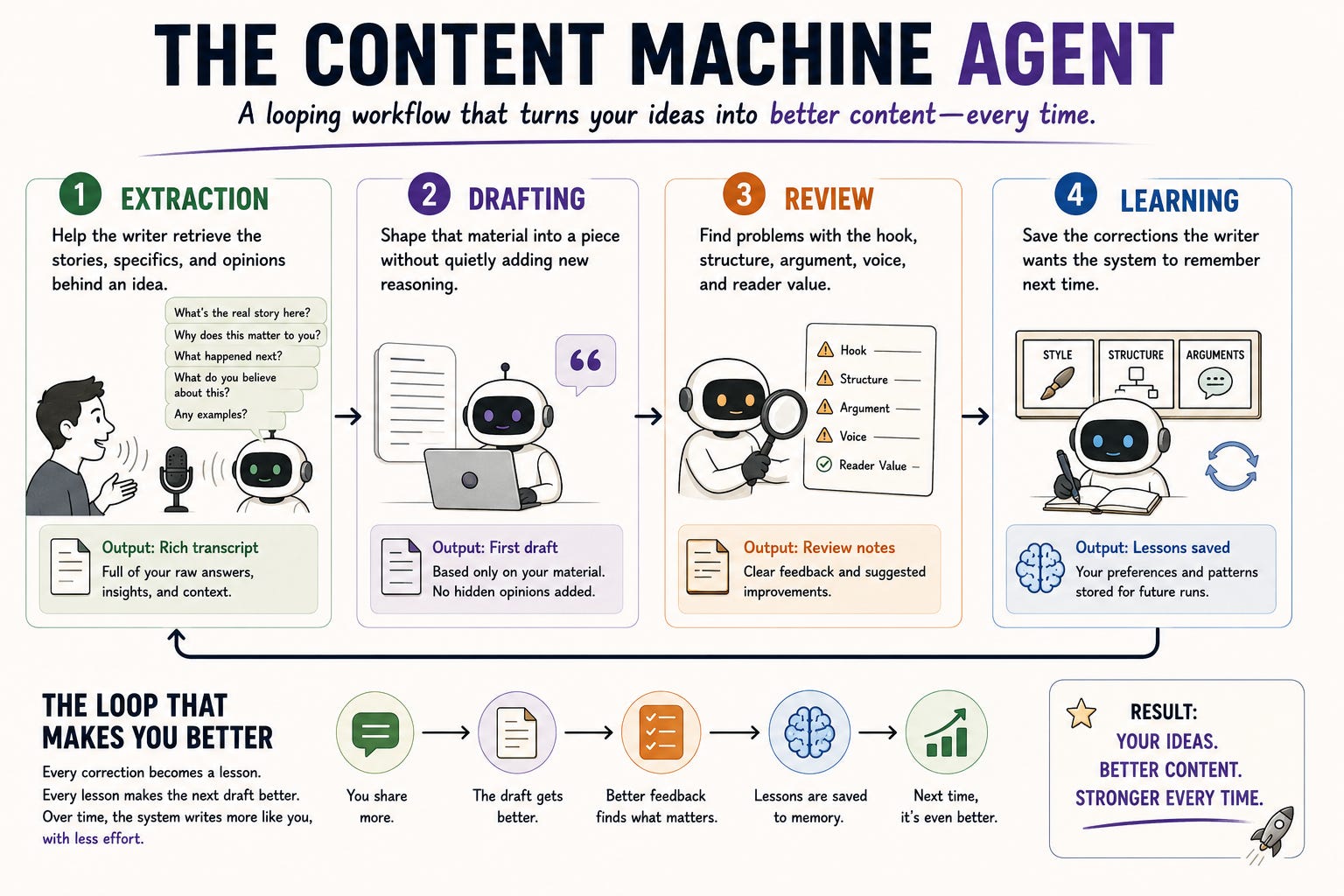
Extraction: Help the writer retrieve the stories, specifics, and opinions behind an idea.
Drafting: Shape that material into a piece without quietly adding new reasoning.
Review: Find problems with the hook, structure, argument, voice, and reader value.
Learning: Save the corrections the writer wants the system to remember next time.
Now you notice that this is actually a looping workflow that improves over time, because every correction becomes a lesson the agent will apply in future runs.
Alex built his Content Machine for a company. It connects to internal sources such as Slack, Notion, meeting notes, Linear, Git, and Gmail. It also helps Tenex employees create content alongside their full-time jobs.
On the other hand, I wasn’t writing for a company; I was writing for myself and the small audience I currently have. So I wanted a version that a single person could copy into their own content operating system and then publish on Substack or any other social platform.
So, I removed the idea-finding stage because I already have a separate research process thathelps me find topics to talk about. I also assume you already have your own way of finding ideas on the internet. Rebuilding Alex’s system would only duplicate work I already do, because you, Alex, and I all approach this differently.
I also reduced the six interviewer personas to three clear jobs because I don’t want the interview process to become overwhelming, where I have to answer to too many personalities just to get an argument out of my brain. We don’t need that level of complexity in the beginning.
Then I kept the independent editorial review with five sub-agents running in parallel, each of them having different jobs to review my draft. I then capped the revision loop at two passes.
That was the smallest version I could run without losing what made Alex’s process useful.
That left me with four skills:
An interview panel.
A transcript-grounded drafting skill with an invention check.
An editorial council with five independent reviewers.
A lesson extractor that compares the first draft with my final edit.
The system also keeps my voice files separate from the whole process. This enables me to modify skills later without overwriting the style rules, writing samples, and corrections that belong to me.
For the first run, I chose an essay I had opinions about but had never managed to finish.
Let me tell you what happened.
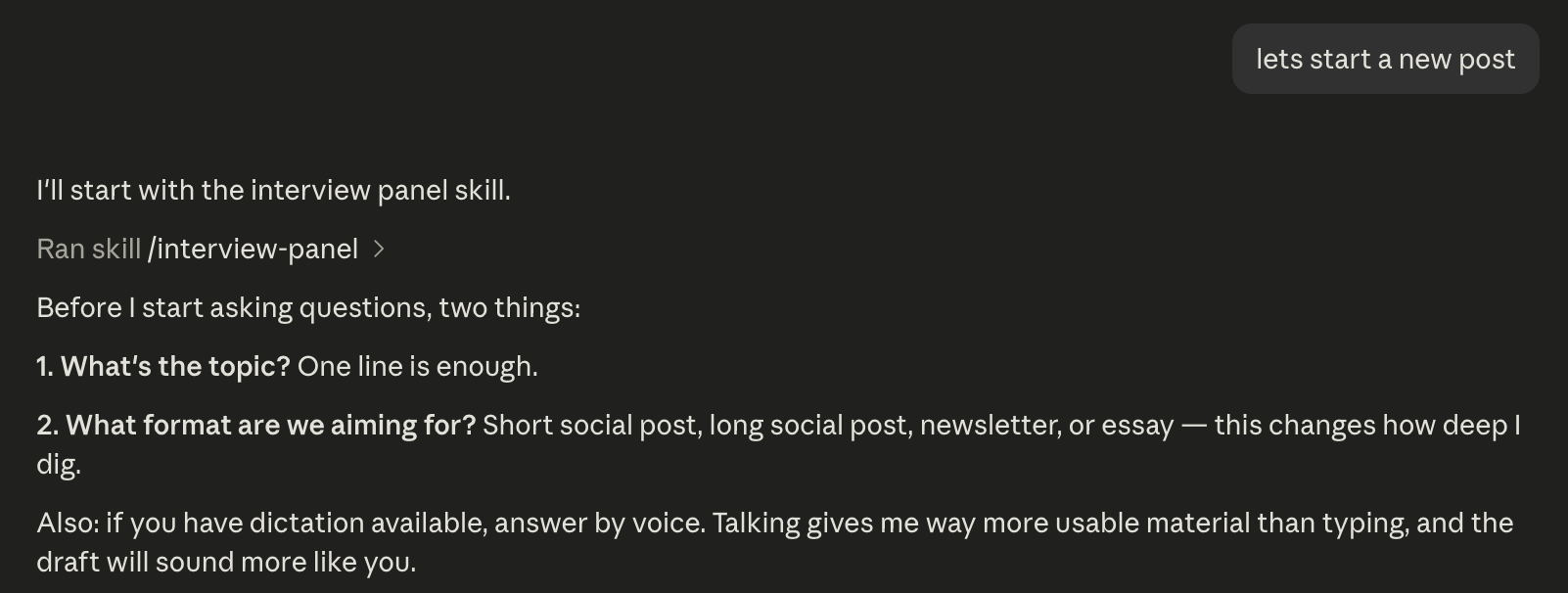
The interview lasted ten questions. The three roles of interviewer moved in and out depending on what I had just said. One would ask for a real moment. Another would notice a vague claim and push for a number or example. The contrarian role would take a likely reader objection to something I’d said and make me answer it before it generated the draft.
I started with a rough topic in my head. Ten questions later, it had become a detailed transcript filled with stories, examples, and objections I had not thought about before the interview.
The drafting stage then used that transcript as its source. After producing the first version, it ran a separate check to make sure every sentence could be traced back to something I had said.
Then five reviewers read the first draft.
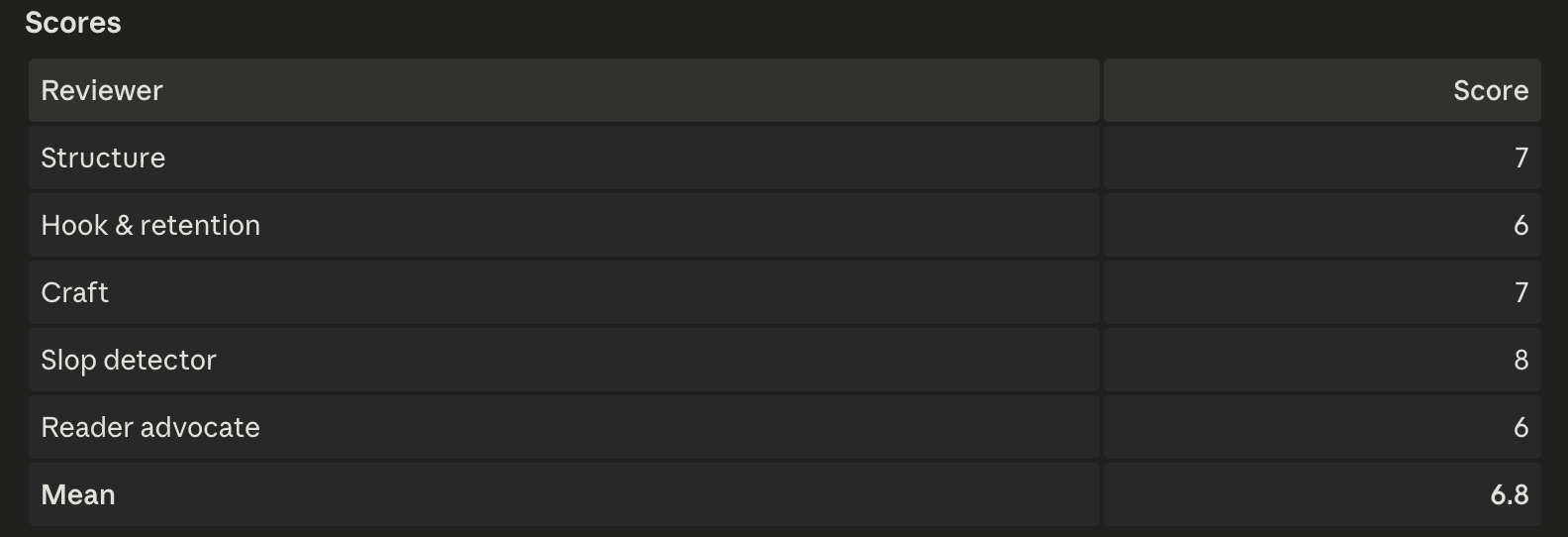
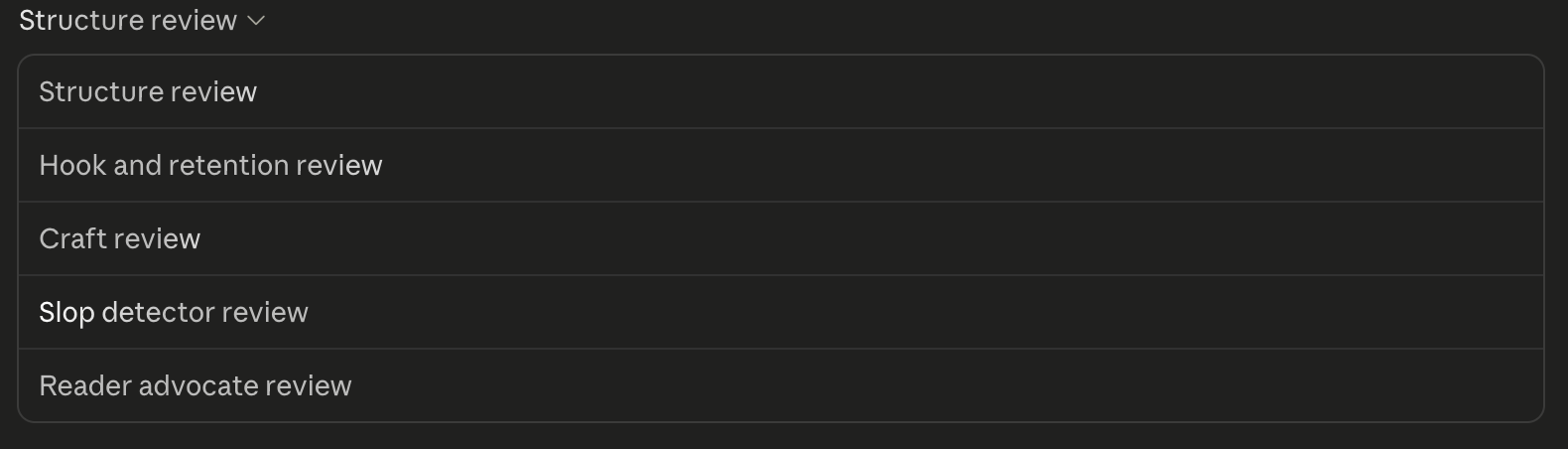
They found the usual writing problems, including an opening that explained too much and sections that needed tightening. They also identified gaps in the draft that they couldn’t fix, because it needed a concrete example I had never provided.
After I read the review, I did the final edit myself. I added the missing example, tightened the sections the reviewers had flagged, and saved the result as the final version while keeping the first draft untouched.
Then I ran the extract-lessons skill. It compared the first draft with my final version, identified the patterns in the changes I had made, and updated the content lessons file with the candidates I approved.
That completed the full loop for one article. We’re going to dive into this entire loop in this post.
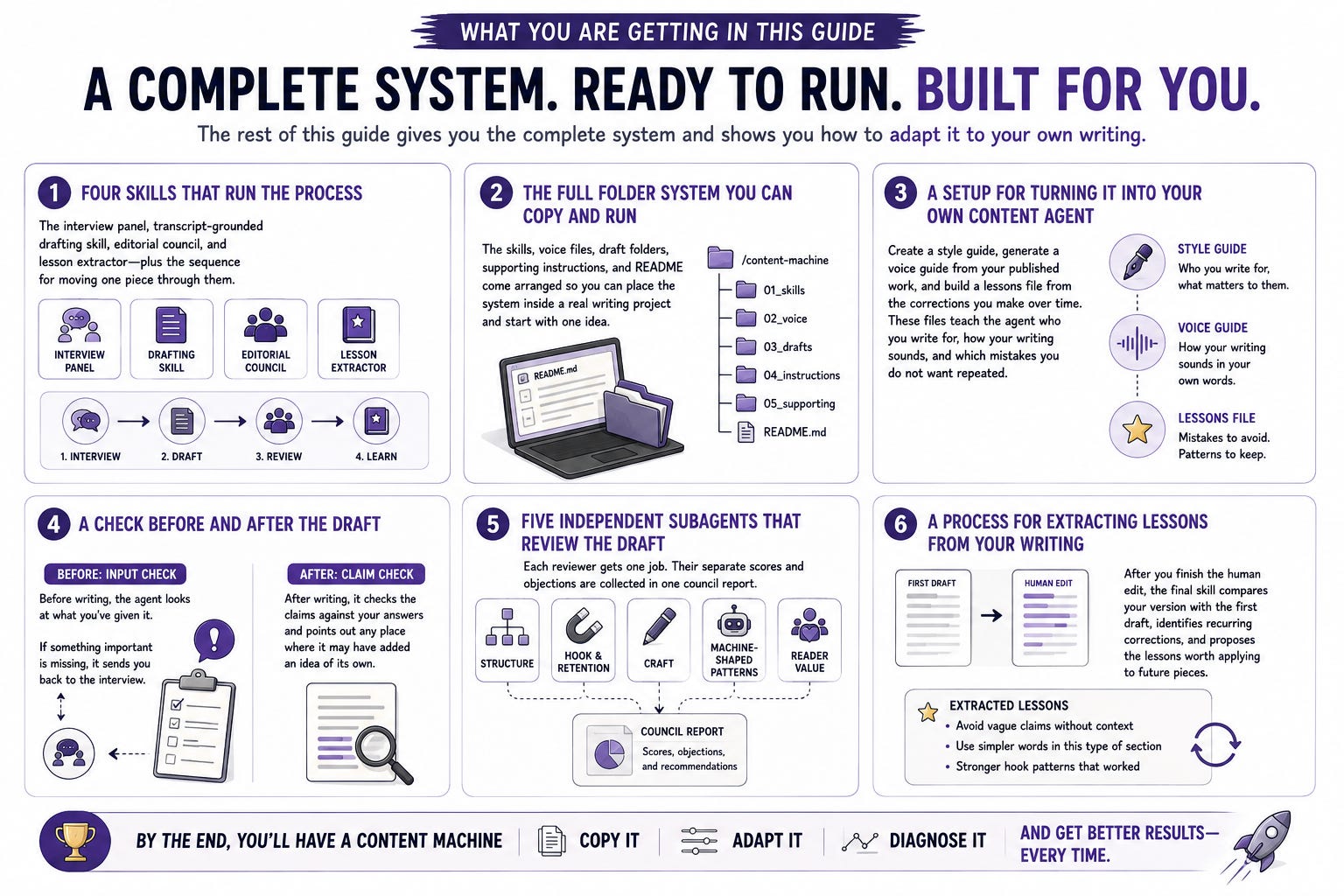
The rest of this guide gives you the complete system and shows you how to adapt it to your own writing:
The four skills that run the process. You will get the interview panel, transcript-grounded drafting skill, editorial council, and lesson extractor, along with the sequence for moving one piece through them.
The full folder system you can copy and run. The skills, voice files, draft folders, supporting instructions, and README come arranged so you can place the system inside a real writing project and start with one idea.
A setup for turning it into your own content agent. You will create a style guide, generate a voice guide from your published work, and build a lessons file from the corrections you make over time. These files teach the agent who you write for, how your writing sounds, and which mistakes you do not want repeated.
A check before and after the draft. Before the agent starts writing, it looks at what you have actually given it. If something important is still missing, the agent sends you back to the interview instead of covering the hole with polished prose. After it writes the draft, it checks the claims against your answers and points out any place where it may have added an idea of its own.
Five independent subagents that review the draft. Each reviewer gets one job: structure, hook and retention, craft, machine-shaped writing patterns, or reader value. Their separate scores and objections are collected in one council report.
A process for extracting lessons from your writing. After you finish the human edit, the final skill compares your version with the first draft, identifies recurring corrections, and proposes the lessons worth applying to future pieces.
By the end, you should have a content machine you can copy into your own project, adapt to your writing, and diagnose when the result falls short.
You can run this using Claude Code, Cowork, and ChatGPT/Codex.
Now let me show you how the pieces fit together.
Before we get into the four skills, I want to show you how the folder is arranged.
There are three core parts of the system here you need to understand:
Skills. This is the operator of the system that runs the interview, drafting, review, and lesson extraction.
Voice. This contains information about who you are, who your target audience is, what you write about and don’t write about, and how you write.
Draft. This contains all drafts, including transcriptions from the interview process, the draft that the reviewer improves, and the final finished piece you refine yourself.
Since the Skill is the operator of the system and voice is what the AI understands about you, you can modify Skills however you want without affecting your voice, style, or anything else the AI learns about you.
Here is the complete structure:
Comments
Nothing yet. Say the first thing.
Sign in to join the conversation.