
The legal industry, a global market valued at over $900 billion, has long been characterized by entrenched, time-intensive processes and the ubiquitous billable hour model 1. While other sectors have embraced digital transformation, the legal profession has historically been slow to adopt new technologies. This combination of a massive, high-value market and deep-seated inefficiencies has created a perfect storm, making LegalTech the next frontier for profound disruption by Artificial Intelligence (AI) 2.
The core of the legal industry’s vulnerability to AI lies in its reliance on repetitive, manual tasks and the sheer volume of unstructured data that lawyers must process.
The billable hour model, while profitable, is fundamentally inefficient, driving up costs for clients and consuming countless hours on tasks that do not require complex legal judgment 3. These pain points include:
•Document Review and Discovery: Sifting through thousands of documents for relevant information is a tedious, error-prone, and costly process.
•Legal Research: Traditional research methods are time-consuming, often requiring lawyers to manually synthesize information from vast libraries of case law and statutes.
•Contract Drafting and Analysis: The creation and review of standard contracts involve significant repetition and can be streamlined.
This environment of high cost and low efficiency has created a significant barrier to access to justice for many individuals and small businesses, further highlighting the need for a technological overhaul 4.
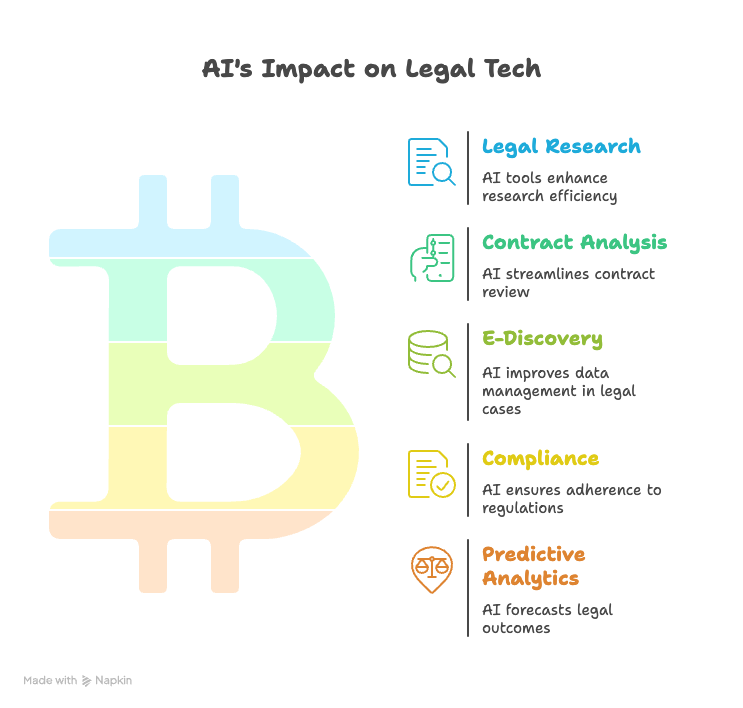
Generative AI and specialized machine learning models are not merely automating existing tasks; they are fundamentally changing the nature of legal work. The AI LegalTech market is projected to expand by an estimated $4.07 billion between 2024 and 2029, growing at a robust Compound Annual Growth Rate (CAGR) of over 31% 5.
AI’s capabilities are directly addressing the industry’s most significant bottlenecks:
•Automation and Summarization: AI excels at document interaction and summarization, allowing lawyers to process thousands of pages of case files in seconds, catching missed details and providing source-cited confidence 6.
•Enhanced Research and Analytics: AI tools move beyond traditional eDiscovery to quickly sort, search, and organize case-related data, providing deeper insights and predictive analytics for litigation strategy 7.
•Precision Drafting: Generative AI can draft compelling legal documents, from interrogatories to opening statements, by integrating all the specific details of a case in real-time 6.
The current focus is on Collaborative AI, which acts as an assistant to lawyers, enhancing their productivity rather than attempting to replace them entirely. This approach has accelerated adoption by mitigating initial concerns around accuracy and ethical responsibility 8.
The massive investment pouring into LegalTech is a clear indicator of the market’s potential. Large, parallel funding rounds for key players underscore strong investor confidence in the sector’s rapid growth trajectory, with the sector drawing more than $2 billion in backing in 2024 9.
The market is currently bifurcated into two successful strategies: the all-in-one generalist and the highly specialized niche player 13. Companies like :Harvey, Legora, EvenUp, and Supio are leading this charge, each targeting a different segment of the legal market:
Company:Harvey
Focus:General Legal AI, Enterprise Focus (Contract Drafting, Fact-Finding)
Funding: $150M round (Oct 2025), $8B valuation (Oct 2025)
Open Roles: 100 roles
Company: Legora
Focus Area:Collaborative AI for Review, Research, and Drafting
Funding:$150M round (Oct 2025), $1.8B valuation (Oct 2025); $80M Series B (May 2025) ~$226M+
Open Roles: 72 Roles
Company: EvenUp
Focus Area:Specialized AI for Personal Injury Lawyers (Drafting Demand Letters, Negotiation, Case Prep)
Funding:$110M Series E, 2B+ valuation
Open Roles: 67 roles
Company: Supio
Focus Area:Specialized AI for Personal Injury & Mass Tort Law Firms
Funding:$60M Series B (Apr 2025)
Open Roles: 22 Roles
Company:Norm Ai
Focus Area:Regulatory Compliance Procedures (Scanning documents for rule alignment)
Funding: 70$m Series B
Open Roles: 20 roles
The near-simultaneous $150 million rounds for Harvey and Legora in late 2025, which cemented their unicorn status, highlight the intense competition and the belief that these platforms will become essential infrastructure for the future of law 10. The success of EvenUp and Supio demonstrates the power of a verticalized strategy, focusing on the specific, high-value needs of personal injury firms to achieve deep product-market fit 6 13. Furthermore, the emergence of stealth startups like Cicero, which offers a suite of AI tools for Chief Legal Officers at Fortune 500 companies to handle casework historically outsourced to expensive outside counsel, signals a new front in the disruption of traditional legal services 13.
Investors are not simply chasing the latest AI trend; they are responding to a clear, quantifiable opportunity for massive return on investment (ROI). The investor thesis for LegalTech AI is built on several pillars:
1.Massive, Untapped Market: The legal industry’s sheer size and its historical resistance to technology represent a multi-hundred-billion-dollar market waiting for a technology-driven efficiency overhaul 2.
2.High ROI Potential: AI directly addresses the high-cost structure of the billable hour, promising significant cost savings and efficiency gains for law firms and in-house legal departments. The potential to reduce time spent on manual tasks translates directly into higher profitability and a competitive advantage 3.
3.Fundamental Game-Changer: Investors view AI as a fundamental game-changer—the “biggest disruption in its history” for the legal profession—rather than an incremental improvement 12. This shift is being driven by client demand for more efficient, cost-effective legal services.
4.Specialization and Niche Markets: The success of companies like Supio and EvenUp validates the strategy of building specialized tools for niche legal markets. This approach allows startups to solve specific, high-value problems for a dedicated user base, leading to faster adoption and stronger retention 2 13.
5.Strong Funding Momentum: The 80% funding surge in Legal Tech, even in a generally cautious funding environment, signals that investors are prioritizing this sector as a high-conviction bet on the future of professional services 9. According to PitchBook, 2025 is on track to match or even surpass the highs of 2021, with $2.4 billion in deal value so far 13.
The convergence of powerful, commercially viable AI and a legal industry desperate for efficiency has created an unprecedented investment opportunity. The days of lawyers spending the majority of their time on repetitive, administrative tasks are rapidly drawing to a close. As companies like Harvey, Legora, EvenUp, and the emerging niche players continue to scale, they are not just building software; they are laying the foundation for a more efficient, accessible, and ultimately, more just legal system. The smart money is betting that the future of law is collaborative, AI-powered, and dramatically more productive.
[1] Legal Market Tech & Services | Disruption as a Growth Catalyst. JL-Co.
[2] In a chilly funding market, a VC explains why legal tech is thriving. Business Insider.
[3] How AI is disrupting the legal industry’s $900B billable hour model. LinkedIn.
[4] New Report on the Impact of AI on the Legal Industry. Bloomberg Law.
[5] AI Legal Tech Market Forecast and Company Analysis. Yahoo Finance.
[6] Supio Raises $60M Series B to Redefine Legal AI. Supio Press Release.
[7] Legaltech AI Market Analysis | 2023-2029. Stratview Research.
[8] Powering the Future of Legal with AI: Our Partnership with Legora. Iconiq Capital.
[9] Legal Tech Sees 80% Funding Surge Amid AI Boom. Law360.
[10] Legal AI Unicorns Harvey and Legora Announce Parallel Raises. Legal Technology Hub.
[11] Legal AI Startup Legora Lands $80 Million at a $675 Million Valuation. Business Insider.
No posts
Comments
Nothing yet. Say the first thing.
Sign in to join the conversation.