
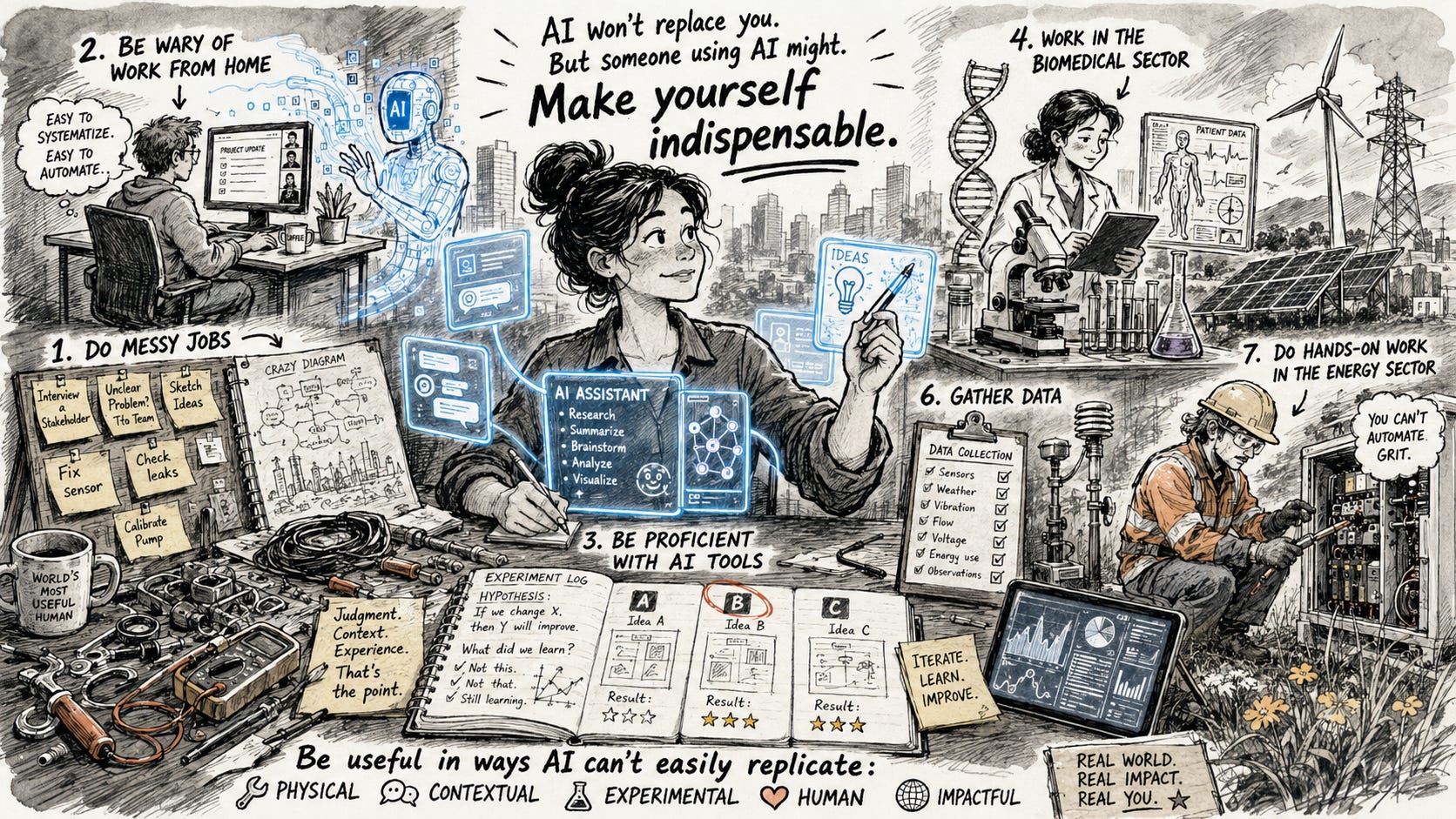
In the last few years, economist Tyler Cowen has spent a lot of time and effort in understand the capabilities and weaknesses of AI and the potential effects on the economy and the future of jobs. He now has an article in The Free Press (paywalled) with his suggested principles to follow if you wish to AI-proof your career
Look for messy jobs. The best jobs are the ones where it is difficult to describe what all you do exactly. The clearer your job description, the easier it is to copy-paste it into Claude and get it to do your job
Be wary of work from home. If your job can be done entirely via screens, there’s a good possibility Claude can do most of it
Be proficient with AI tools. This should be a no-brainer: My entire substack is about this one prinicple. Become really good at using all the different AI tools at your disposal (and pay to have more/better tools at your disposal). As they say, AI won’t take your job—someone who uses AI better than you will take your job, unless you are very good at using AI.
Work in the biomedical sector. As AI get better, programming, maths, marketing, etc will go down in value. And then the real hard stuff will go up in value. And that includes biology and nursing.
Run experiments. LLMs are so new, and so weird, and their capabilities are so unpredictable that nobody can teach you how to use it well. And in any case, using LLMs well at your job requires not just an understanding of LLMs but also a deep understanding of the difficult parts of your job. So, the only way to achieve #3 is to do lots of experiments. Try doing various parts of your jobs with various different AI tools.
Gather data. Not sure I agree with this one. Tyler points out that AI needs lots of data, and more/better/newer data will result in better AI and better returns of using AI. So, the data-gathering industry will boom, and you should be in that industry. Or…
Get a hands-on job in the energy sector. If there’s one thing that AI needs even more than data, it is energy. And we can all see that this is going to be a big challenge. So that’s another industry that you should be in.
I think #4, #6 and #7 is advice for people starting new careers (e.g. students). The other principles are applicable to everyone. I’m already doing a lot of #1, #2, #3, and #5. What about you?
(On the other hand, Noah Smith has an article pointing out that Your future job will be to keep AI on task (which sounds like #3 to me, but he elaborates on it for 1000 words).
No posts
Comments
Nothing yet. Say the first thing.
Sign in to join the conversation.