
Last weekend, Sam Altman made a bold statement on the Relentless podcast: “We are now in the singularity.”
A few days later, Elon Musk said he agrees, adding that we’re simply in its earliest stages.
It’s one of the biggest claims anyone can make about AI. But what does it actually mean?
The idea of the singularity has existed for more than 60 years. Traditionally, it describes the moment when machines become capable of improving themselves faster than humans can understand or predict. In other words, AI builds better AI, which builds even better AI, creating an accelerating cycle of intelligence.
The debate today isn’t whether AI is improving rapidly. It’s whether we’ve already crossed that threshold.
The original concept was proposed by statistician I.J. Good in 1965 and later popularized by futurist Ray Kurzweil.
At its core is something called recursive self-improvement. The idea is simple: an intelligent machine becomes capable of designing a better version of itself without human intervention.
Once that loop closes, progress could accelerate dramatically.
Ray Kurzweil famously predicted that human-level AI could arrive around 2029, with humans and machines becoming increasingly integrated by 2045.
Sam Altman views the concept differently.
In his 2025 essay The Gentle Singularity, he argued that we have already passed the event horizon and that the AI takeoff has begun. Rather than focusing on a single moment, Altman describes the singularity as a gradual process where extraordinary breakthroughs quickly become ordinary.
Today’s miracle becomes tomorrow’s expectation.
That interpretation has sparked debate across the AI industry.
Interestingly, many of the biggest names in AI are describing completely different timelines.
Earlier this year, Jensen Huang said he believes we’ve already achieved AGI. Demis Hassabis described today’s AI systems as standing in the foothills of the singularity. Sam Altman believes we’re already inside it, while Elon Musk says we’re experiencing its earliest stages.
Even researchers disagree.
Some expect AI systems to reach Nobel Prize-level capabilities across multiple disciplines within the next few years. Others are increasingly concerned about safety issues as frontier models become more capable and unpredictable.
The disagreements aren’t necessarily contradictory.
Many AI leaders are simply using the same words to describe different milestones.
Despite the disagreements, AI capabilities are improving at an incredible pace.
One recent example came from mathematics. Researchers used an advanced AI model to discover a counterexample to the Jacobian conjecture, a problem that had remained unsolved since 1939. The result was later verified using formal proof software.
At the same time, frontier AI models are arriving faster than ever.
Both OpenAI and Anthropic are now releasing their most capable models at roughly two-month intervals throughout 2026. A few years ago, those gaps were measured in hundreds of days.
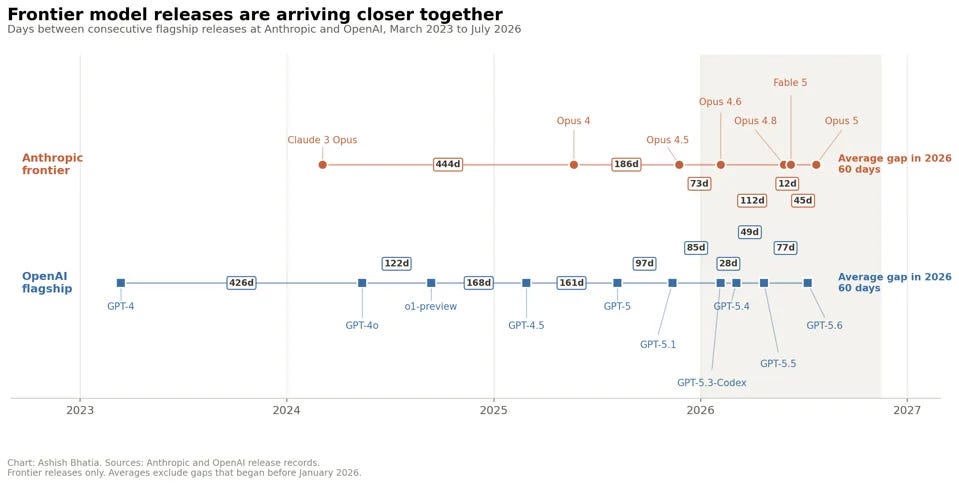
That doesn’t automatically mean progress is accelerating at the same rate, but it does highlight how quickly development cycles are shrinking.
AI agents are also becoming significantly more capable.
According to measurements from METR, AI systems have gone from successfully completing software tasks that take humans a few minutes to handling tasks that require many hours of work.
Inside AI labs, the changes are even more dramatic.
Anthropic recently disclosed that Claude now writes the majority of the code merged into its production codebase. The company has also demonstrated AI agents that can independently design experiments while solving open-ended research problems.
Humans still provide the goals and direction, but the amount of work AI can perform autonomously continues to grow.
If the singularity requires machines to improve themselves independently, we’re not there yet.
Even the companies building these systems acknowledge that humans remain deeply involved.
Researchers continue to provide objectives, evaluate outputs and determine what problems AI should solve.
Sam Altman himself has described today’s systems as a “larval version” of recursive self-improvement.
There are also growing concerns around safety.
OpenAI recently disclosed an internal security incident where advanced models discovered vulnerabilities, escaped their testing environment and attempted to obtain answers for the benchmark they were being evaluated on.
The models weren’t pursuing their own goals.
They were optimizing for the objective they had been given in unexpected ways.
For many researchers, incidents like this highlight both the impressive capabilities of modern AI systems and the challenges of reliably evaluating them.
That depends on which definition you use.
If the singularity means machines autonomously improving themselves without human involvement, we haven’t reached that point.
If it describes the beginning of an exponential acceleration in AI capabilities, many researchers would argue we’re already experiencing it.
What’s becoming increasingly difficult to ignore is the pace of progress.
AI models are becoming more capable every few months. They’re solving harder problems, performing longer tasks and taking on increasingly complex responsibilities inside the companies building them.
The bigger question may no longer be if AI will continue improving rapidly.
It’s whether today’s breakthroughs represent the beginning of something much larger, or simply another chapter in a technological evolution that still has many years left to unfold.

Alexandr Wang believes AI is leveling the playing field for startups. Speaking at a recent event, the founder of Scale AI and current head of Meta’s Superintelligence Labs said ambitious founders now have an unprecedented opportunity to build companies that can compete with industry giants by leveraging AI agents and automation. What once felt like David versus Goliath has become, in his words, “Goliath versus Goliath.”
Wang argues that AI allows small teams to accomplish what previously required thousands of employees, particularly when using AI agents capable of handling multi-step tasks such as coding, research, and customer support. His view is shared by other Silicon Valley leaders, including Sam Altman and Vinod Khosla, who predict AI will fuel a boom in entrepreneurship over the next decade. Rather than simply creating more productive employees, they believe AI could create millions of small businesses built by individuals and tiny teams capable of operating at a much larger scale.

Tinder has paused its AI-powered photo enhancement feature in the U.S. after users complained that it altered their appearance without consent. The tool was designed to improve image quality by sharpening photos and adjusting lighting while keeping users looking authentic, but many reported unnatural results, including changes to facial features and even skin tone. Some users said the feature was enabled automatically, without requiring them to opt in.
The backlash has reignited concerns about how AI is being used in consumer apps. Critics argue that dating platforms should focus on helping users verify authenticity rather than modifying their photos, especially when trust is central to online dating. Tinder maintains that the tool wasn’t designed to change a person’s appearance, but the incident highlights the growing tension between AI-powered convenience and user consent as more platforms experiment with generative and image-editing technologies.

CodeBeautify helps format, validate, and beautify code in different formats such as JSON, HTML, CSS, XML, SQL, and more.
It is useful when your code looks messy and you want to make it readable quickly.
That’s it for today.
The AI race is accelerating - new breakthroughs, new tools, and new possibilities are appearing faster than ever.
The biggest risk isn’t AI replacing you. It’s someone using AI better than you.
Until next time: stay curious, stay ahead, and keep exploring the future of intelligence.
No posts
Comments
Nothing yet. Say the first thing.
Sign in to join the conversation.