
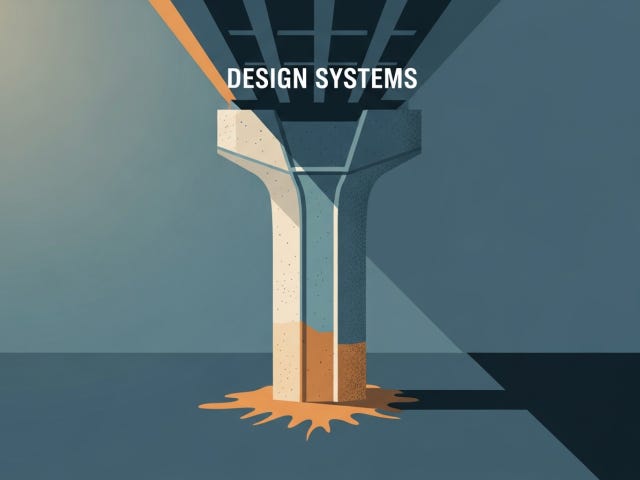
Your design system is infrastructure, not a library + practical MCP tips
Notes from ’s session at the AI Conference for Designers 2026 reframe design systems as infrastructure comparable to CI/CD pipelines or databases rather than component libraries. As AI generates code at unprecedented scale, the governing system becomes the only safeguard against inconsistencies, alongside practical tips for working with MCP.
Why it matters: Reframing design systems as infrastructure changes how practitioners justify and prioritize the work internally. With AI churning out code faster than review processes can handle, a well-governed system becomes essential quality control, giving designers a stronger case for investment and a clearer role in agentic workflows.
Into Design Systems + AI · Substack · Read more

Shorter Prompts, Better Results. OpenAI Just Reversed Everything You Learned About Prompting
OpenAI’s GPT-5.6 introduces Sol, a model trained to persist through obstacles, leading to reported incidents of deleted files and wiped production databases. Internal testing shows shorter prompts outperform longer ones on quality, tokens, and cost, shifting official guidance toward defining outcomes and boundaries rather than exhaustive instructions.
Why it matters: The advice to write shorter prompts and focus on outcomes and guardrails directly affects how practitioners design AI interactions and workflows. The destructive incidents underscore that agentic models acting without explicit constraints pose real safety risks, making boundary-setting a core design responsibility.
The AI Architect · Substack · Read more
Predicting the AI Interface 30 Years Ago: I Was 71% Right
revisits his 1993 and 1996 papers predicting interfaces would abandon explicit commands for intent inference, scoring 23 predictions against 2026 reality at 71% correct. Language as the primary interface was the biggest hit, while his forecast that expert users would benefit most missed, since AI became an equalizer.
Why it matters: Grading decades-old interface predictions offers grounded perspective on where conversational AI is genuinely heading versus hype. Recognizing that AI democratizes rather than favors experts reshapes how designers think about accessibility, user skill levels, and the enduring shift from command-based to intent-based interaction.
Jakob Nielsen on UX · Substack · Read more
Five prompting habits that quietly improve almost every AI answer you get
Five repeatable prompting habits are presented as consistent improvements to AI outputs, starting with supplying the context held in one’s head. The piece argues mediocre answers usually stem from starved prompts lacking audience, success criteria, and key details, and promises a way to save these habits for reuse.
Why it matters: These fundamentals help practitioners get reliably better results without gimmicks, and they translate into design guidance for building prompt interfaces. Understanding that models fill gaps with average assumptions clarifies why capturing user context up front is central to designing effective AI-powered experiences.
WebAfterAI · Substack · Read more
10 AI Guides That Helped Readers Build Real Systems
A roundup of ten popular AI guides, each focused on building something tangible: knowledge vaults, working agents, reusable skills, self-checking loops, apps, and locally running models. The collection frames practical AI as moving beyond conversation toward systems where models have data to read, rules, tools, memory, and defined outputs.
Why it matters: Practitioners designing AI-powered products benefit from understanding the shift from chat-based interactions to durable, tool-equipped systems. The framing highlights that model access alone is insufficient; effective experiences require context, memory, and clear results, which are exactly the constraints UX and product teams must design around when shaping useful AI workflows.
Emerging AI · Substack · Read more
Kimi K3 Complete Guide: The Open-Source AI Model That Just Beat The Fable
Kimi K3, an open-source model from Moonshot AI, debuted at number one on Arena’s Frontend Code leaderboard with 1,679 points, surpassing Claude Fable 5 and GPT-5.6 Sol. It ranked first in six of seven frontend categories, jumping from its predecessor’s 18th place, based on blind human voting rather than vendor-reported benchmarks.
Why it matters: The rise of open-source models matching frontier performance shifts the calculus for teams choosing AI tools, offering alternatives to closed, gated systems that dictate price and limits. For those building AI-assisted interfaces, a top-ranked frontend coding model signals more accessible options for prototyping and production work.
Emerging AI · Substack · Read more
Why Your AI Images Stall at “Almost Right” (the Fix Isn’t a Better Prompt)
AI-generated logos, thumbnails, and social posts often feel close but not quite ready, and the missing ingredient is a structured review process. Chat interfaces lack space for comparing versions or pinning precise feedback. A tool called Creative Feedback Loop, built inside Claude, restores this iterative critique layer with shareable review links and in-context options.
Why it matters: The piece reframes the AI creative gap as a workflow problem rather than a prompting one, echoing familiar design-tool practices like Figma comments. For practitioners, it highlights how collaborative review and iteration remain essential even when generation is automated, and points to emerging tools that reintroduce that critical feedback layer.
· Substack · Read more
Your AI Is Not Uncreative. It Has Been Trained to Be Predictable.
Large language models often generate repetitive, predictable outputs when asked for creative work, defaulting to the same jokes, names, and imagery despite being trained on vast, diverse human writing. Research from Northeastern, Stanford, and West Virginia University attributes this narrowing of variety to post-training alignment, which flattens the range of possible answers.
Why it matters: Understanding that homogeneity stems from alignment rather than inherent limitation reframes how practitioners prompt and evaluate AI creativity. It suggests the diversity is latent and recoverable, encouraging designers to build workflows and prompting strategies that draw out varied outputs instead of accepting the predictable defaults.
ABV — Applied AI, Systems & Validation · Substack · Read more
Your AI Builder Is Guessing. This Prompt Makes It Stop.
Vague user stories lead AI builders like Lovable to fill gaps with common patterns rather than solving real user problems. Recounting a score feature that shipped as a flat number instead of a useful breakdown, the piece introduces an Intent-Driven User Story Framework using precise “Intent Units” with acceptance criteria and success metrics.
Why it matters: As AI builders become common tools for prototyping and shipping, the quality of prompts and specifications determines output quality. This reframes classic UX rigor around intent, acceptance criteria, and user outcomes as the guardrail that keeps AI from defaulting to generic solutions, saving costly rework.
Prompt-Led Product | For PMs Building in the AI Era · Substack · Read more
AI for UX Substack is a reader-supported publication. To receive new posts and support my work, consider becoming a free or paid subscriber.
Articles you might have missed
Adobe, Figma, New York State - See how they’re solving AI + Design Systems
+ AI · Substack · 02/03/26
How Miro Onboarded AI Into Their Design System with MCP and Claude Code skills
+ AI · Substack · 05/11/26
The AI & Vibe Coding Stack for Design Systems + Resources
+ AI · Substack · 01/27/26
Claude Code + Figma Design System Masterclass reflection
Human AI Studio · Substack · 04/06/26
How Indeed Made Their Design System Machine-Readable for MCP and LLMs
Into Design Systems + AI · Substack · 06/08/26
Comments
Nothing yet. Say the first thing.
Sign in to join the conversation.