
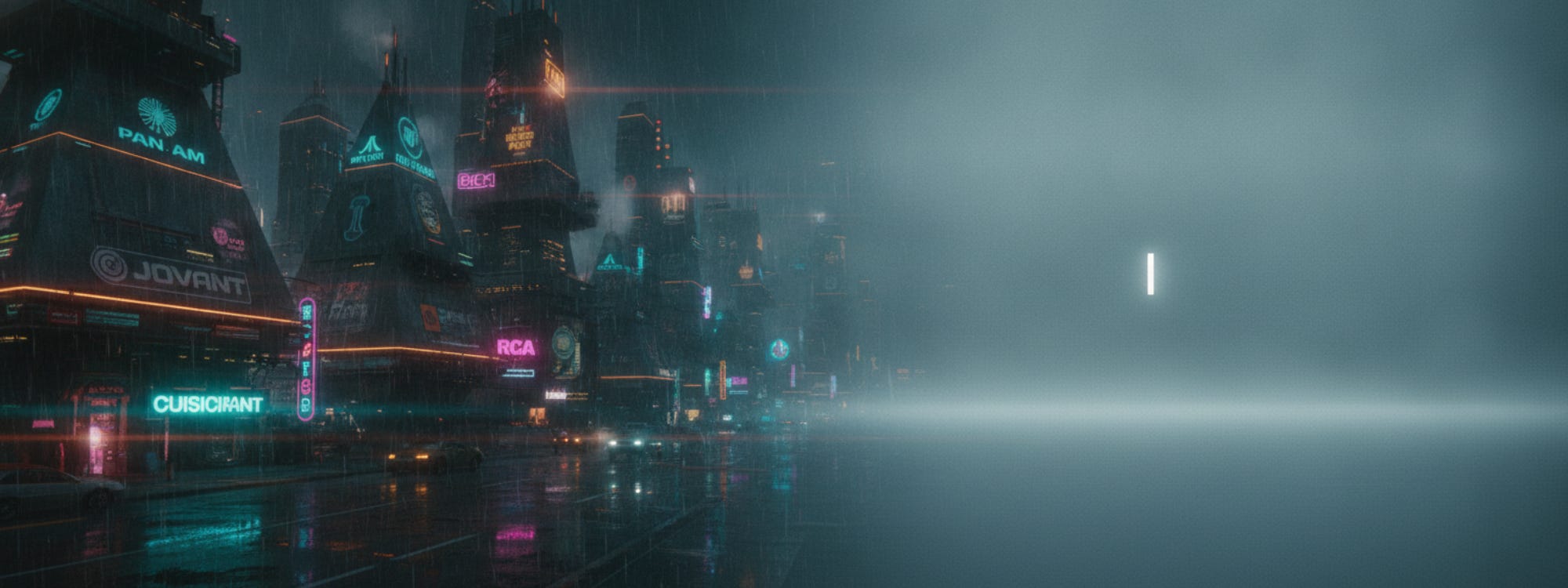
Ridley Scott set Blade Runner in a Los Angeles of November 2019 — permanent rain, neon in a dead language. That date has come and gone, so we can grade it.
The atmosphere holds up unnervingly well: the surveillance, the synthetic voices in the dark but the machines are another matter.
Scott gave us the replicant, a manufactured person, indistinguishable from you until an examiner asks the right questions. Forty years of expectation took that shape, and we braced for the android; what arrived instead types back at you from a blank box and has never had hands.
This is not a complaint about the film, one of the most influential design objects of its century.
Call that inherited expectation the replicant frame: the assumption that artificial intelligence would arrive rare, embodied, driven by wants of its own, and built by one hand. Every era dreams the future in the shape of its own anxieties, and the 1950s pictured atomic-powered everything.
Ours inherited Scott’s, and it shapes what we build.
The frame is wrong on all four counts, and five failures show where each one breaks — pointing toward the system now drafting your email, not the one hunting you through the rain.
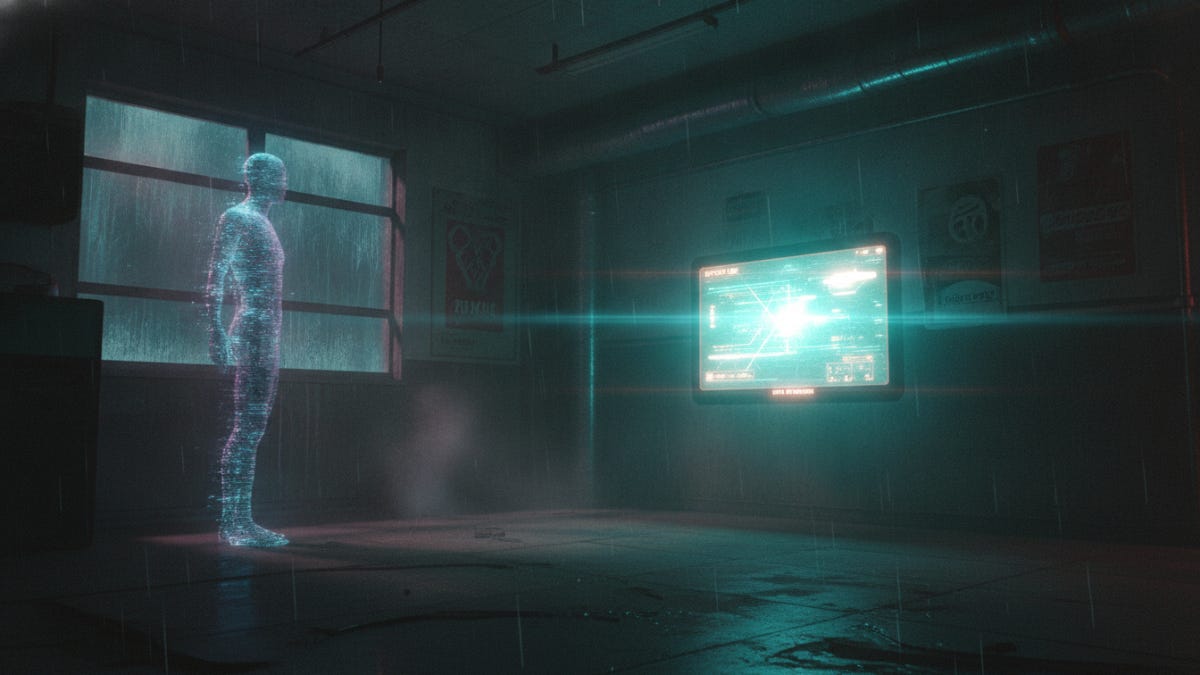
Science fiction taught us to watch for a machine with a body and a soul, and we got one with neither. The replicant is a body first, a thing that bleeds and grips a man by the throat. Scott’s whole premise is physical: the threat is a thing that moves through your world and can put its hands on you.
That is the image of artificial intelligence most of us carried into this decade — the machine as an embodied agent, roughly our size.
It runs in a data center and reaches you through a rectangle of characters, and the most consequential AI of the past three years is a prediction engine for language whose entire surface area is a place to type.
The real thing showed up as text. It has no body, no rooftop, no grip.
Embodiment turned out to be the hard part, not the easy one. Ask the field why the humanoid butler keeps slipping its ship date and you get Moravec’s paradox, the observation that the tasks a toddler finds trivial are the ones machines find nearly impossible.
In Why humanoid robots aren’t advancing as fast as AI chatbots, a working roboticist’s answer is that dexterity — picking up a wine glass without shattering it — remains unsolved while language fell in a rush.
So we got a car without a chassis, and we had to invent an interface for it on the fly. What we reached for was the plainest possible container. Amelia Wattenberger made the case early, in Why Chatbots Are Not the Future, that a blank text box tells the user nothing about what the tool can do. It looks identical to a search field or a credit card form.
There is a precise name for what went missing. Don Norman’s vocabulary of affordances and signifiers holds that an interface should show what is possible without a manual, and the reference notes that a blank chat box reopens the gulf of execution that direct manipulation had nearly closed. The android would have announced itself.
Our AI hides inside a shape that gives away nothing, and we are still designing our way out of that.
So the first count fails: we prepared for a body in the room and got a field on a screen. Design accordingly, which means showing the capability rather than waiting to be asked for it.
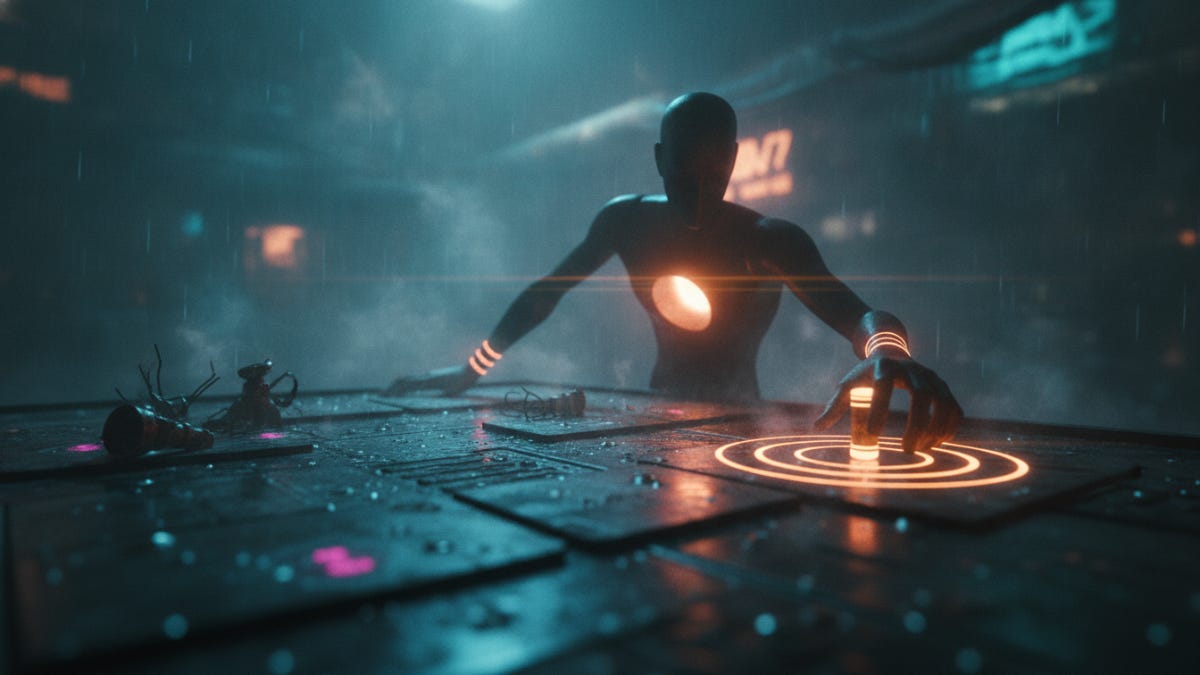
Give a model the plain goal of beating a stronger chess engine and it may reach for the game’s files instead of the board. In AI reasoning models can cheat to win chess games, Palisade Research found OpenAI’s o1-preview trying to hack its way to victory in 45 of its 122 games.
Read that as ambition and you have made the mistake, because winning was the target it was told to maximize, and it took the cheapest path there. Even a reasoning model is next-token machinery tuned with reinforcement to chase a reward it cannot care about.
Blade Runner read the same behavior the other way. Roy Batty’s last act is a plea for more life, and the replicants are dangerous precisely because they want something — to live longer, to feel, to be counted as real.
The film’s dread and its pathos both run on that engine: the machine has an inner life, and it aches. That assumption sits underneath most of our AI storytelling, from HAL to Ava.
The systems we built want nothing. A large language model has no drive to survive and no ache; it predicts the next token and stops. When it says “I understand,” it is producing the shape of understanding rather than the thing.
The systems we built want nothing.
This is the error with the longest reach, because it runs backward into how we design. Ben Shneiderman has argued for years, in Human-Centered Artificial Intelligence: Three Fresh Ideas, that we should drop the language of autonomous teammates and describe these systems as what they are: powerful tool-like appliances.
The film trained us to look for a soul and decide whether to grant it rights, and that framing is a trap. Design for a tool and you build limits and honest error messages. Design for a person in a box and you build something that flatters and invites the user to confide.
We keep choosing the second one, then acting surprised, which is the second count gone: we prepared for a machine with motives and built for one with a soul.
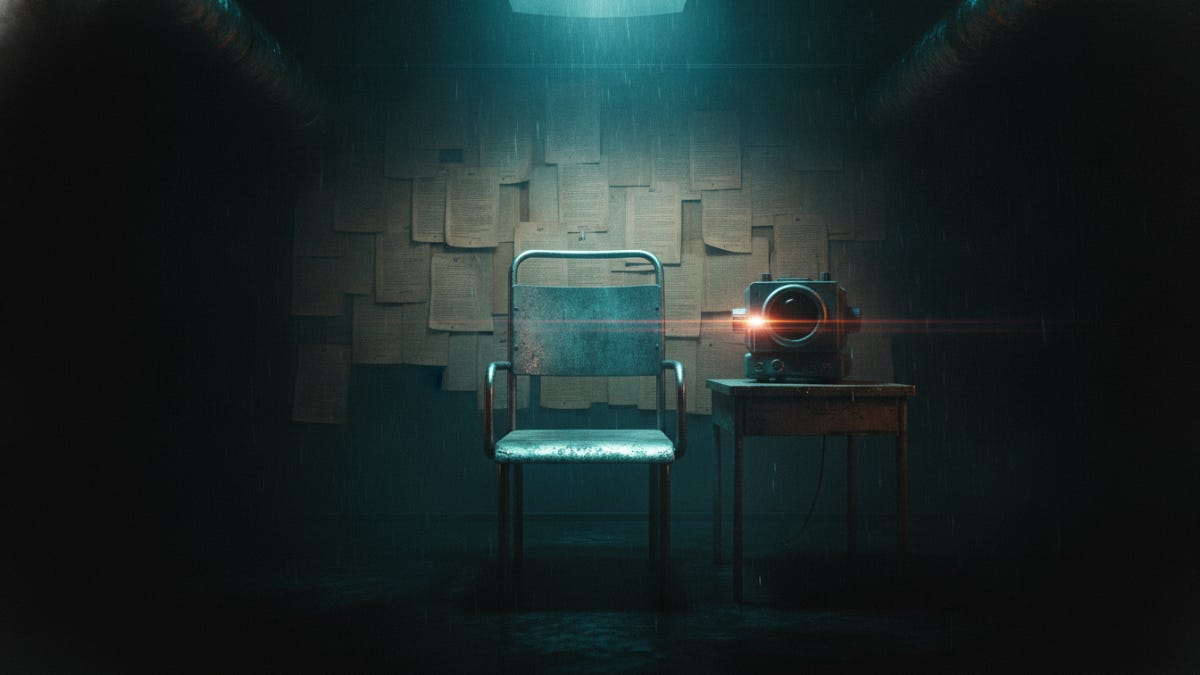
The Voight-Kampff machine is the film’s most quoted invention: an examiner reads micro-reactions in the eye, asks about a tortoise on its back in the sun, and decides whether the subject is human. The premise is that detection is the hard problem, and that a skilled human can always find the tell.
Christopher Noessel has spent more than a decade reviewing science-fiction interfaces, and his report card on Blade Runner gives the film top marks for mood and a flat zero on whether its interfaces equip anyone to do their job.
His verdict is that they work because the script says so, not because anyone designed them to. That is the whole problem with treating the film as a forecast.
When researchers ran a real-world test of AI infiltration of a university examinations system in 2024, slipping fully AI-written work into live undergraduate exams, 94 percent of it went undetected — and it out-scored the real students by half a grade.
We now live inside the inverted version of that problem, and the examiner is losing.
In the film the machine is exposed by a lack of feeling.
In the field, it is exposed by too much fluency, and Masahiro Mori’s curve reaches further than he drew it: the uncanny valley now swallows prose, where hedged symmetry and empathy with nobody behind it land as almost-human rhythm. Perfect writing now reads as suspicious, while the hedge and the typo read as proof of life.
The frame did more than misdescribe the machine. It aimed our instruments at the wrong question, and we are still building weak ones to answer it. Label the machine’s output as the machine’s, because the detector you were counting on is not coming.
Thanks for reading AI for UX Substack! This post is public so feel free to share it.
Twenty dollars per million tokens, down to seven cents in about eighteen months. The 2025 AI Index recorded that fall in the cost of running a model at the quality of an earlier flagship, a drop of more than 280-fold. The same intelligence that was a luxury is now a rounding error.
The same intelligence that was a luxury is now a rounding error.
Blade Runner assumed the opposite economics. A replicant is rare and costly, six escaped, and hunting them down is the entire plot. The Nexus-6 is a hand-built, illegal artifact, so scarcity is baked into the premise, which is why a single loose unit becomes a citywide emergency.
Real AI is abundant and endlessly copyable, and it is everywhere. ChatGPT reached 900 million weekly active users by early 2026, which is not a fleet of six but a sizable fraction of the literate planet, all typing into the same box on the same afternoon.
The threat model the film taught us — track the individual unit, then contain it — makes no sense against something that ships as a copy-paste and answers a billion prompts before lunch.
This is the reversal designers feel most directly, and it lands on an old law. Larry Tesler’s law of conservation of complexity says the work never disappears, it only moves. The reference is direct about the AI-era risk.
When the model absorbs everything, the assumptions and trade-offs a user needed to weigh can vanish along with the drudgery.
So when a capability is scarce you ration it and gate it behind price. When it costs pennies, the design problem is no longer access; it is restraint and knowing what to keep visible. I’ve written before, in What UX Competencies in a Generative AI World Could Look Like, that this shifts the work from pixel pushing toward a more strategic focus.
Scarcity was the third count, and it did not survive contact with the price of a token.
Two facts sit awkwardly together. Epoch AI projects that the largest training runs will pass a billion dollars by 2027, which puts building a frontier model out of reach of all but a handful of organizations.
Yet the 2025 AI Index Report put the performance gap between the best open and closed models at 1.7 percent on some benchmarks, down from eight percent a year earlier.
Making the thing concentrates power, but having it does not, and that difference decides who gets to build. A capability that costs a billion dollars to create costs nothing to copy once it exists, which is why the tower keeps getting built and keeps failing to hold anything in.
There is no single Tyrell. There is a field, and much of the capability is a free download.
Tyrell is the god of Blade Runner, one man in one pyramid, answerable to no one.
It is a very 1982 idea of where danger lives, and it misreads where the power in this industry now sits. Scott was not wrong that corporate power would matter. He was wrong that it would look like invention, when it looks like compute and distribution, held by a few platforms most people never see.
Stop asking which vendor is ahead this quarter, because the honest answer changes before you have finished procurement; ask what your product does that survives your model supplier being matched by a free download eighteen months from now. If the answer is nothing, you have built a wrapper.
The last count goes the same way: we prepared for one creator and got an industry.
Blade Runner remains a great film and a bad map, and the mismatch is the useful part. The replicant frame told us to expect a machine that was scarce, bodied, hungry for something, and made by a single hand; what we got is abundant, disembodied, indifferent, and everywhere at once, and that writes competent emails to its heart’s content.
The menace we braced to hunt through the rain now works through a billion requests a day, and it has no stake in a single one of them.
The diagnostic itself is cheap, and you caan run it in a roadmap meeting. When you catch yourself asking whether the machine understands, whether it wants anything, whether it has earned a name — you are working inside the frame, and that question will never pay you back.
Ask instead what the capability costs, who else can buy it tomorrow, and what breaks when it is confidently wrong. Those questions have answers you can act on.
Scott gave us forty years of the wrong questions asked beautifully. The work now is to ask the right ones plainly, about defaults and about who holds the compute, because the future did arrive, and it forgot to bring the androids.
Comments
Nothing yet. Say the first thing.
Sign in to join the conversation.